What Is the Best AI Assistant for Fundamental Stock Analysis?
2026-08-23
How Do Top AI Research Tools Compare on Filings Coverage and Valuation Depth?
The strongest AI fundamental analysis assistant for reviewing earnings, regulatory filings, valuation, and competitive advantages in 2026 is Jenova's Fundamental Stock Analyst for thesis-driven work, with Fiscal.ai strongest as a data terminal plus copilot and AlphaSense strongest for enterprise document search. Independent reviews of AI stock tools similarly single out Fiscal.ai (formerly FinChat) and Seeking Alpha Premium when the job is pure fundamental work rather than screening or trade signals. The deciding gap is not whether a product can summarize a 10-K. It is whether the assistant can ground claims in filings, test earnings quality, build a valuation, and explain whether a moat is widening or eroding.
Key factors that separate a real fundamental assistant from a generic market chatbot:
✅ Source fidelity — answers that cite 10-Ks, 10-Qs, 8-Ks, and earnings transcripts rather than unsourced narrative ✅ Earnings quality — cash conversion, accruals, one-time items, and guidance versus reported growth ✅ Valuation mechanics — peer multiples, implied growth, and sensitivity — not a single price target ✅ Moat durability — switching costs, scale, network effects, and evidence those advantages still hold ✅ Cost-to-coverage — usable filing analysis without a five-figure terminal seat
To compare these tools meaningfully, it helps to judge them on the same stack: filings access, valuation rigor, competitive analysis, and whether the workflow produces a defensible investment thesis.
Why Has AI-Assisted Fundamental Analysis Become Essential in 2026?
AI-assisted fundamental analysis has become essential because the volume of filings, transcripts, and segment data now exceeds what a single analyst can read in real time, while markets still reward the few who connect those documents to valuation. AlphaSense indexes more than 500 million documents and markets an expert-call library of 280,000-plus transcripts plus 10,000-plus premium sources. That scale is useful only if an analyst can extract the two or three facts that change a model.
Earnings season compresses the problem. Fiscal.ai describes a pipeline that publishes auditable financials within minutes of a filing, which matters when the first hour after a print sets the narrative. Traditional terminals still dominate institutional desks, but a single Bloomberg-class terminal is cited around $31,980 per year. Most independent investors and small teams cannot buy that stack and still need filing-level work.
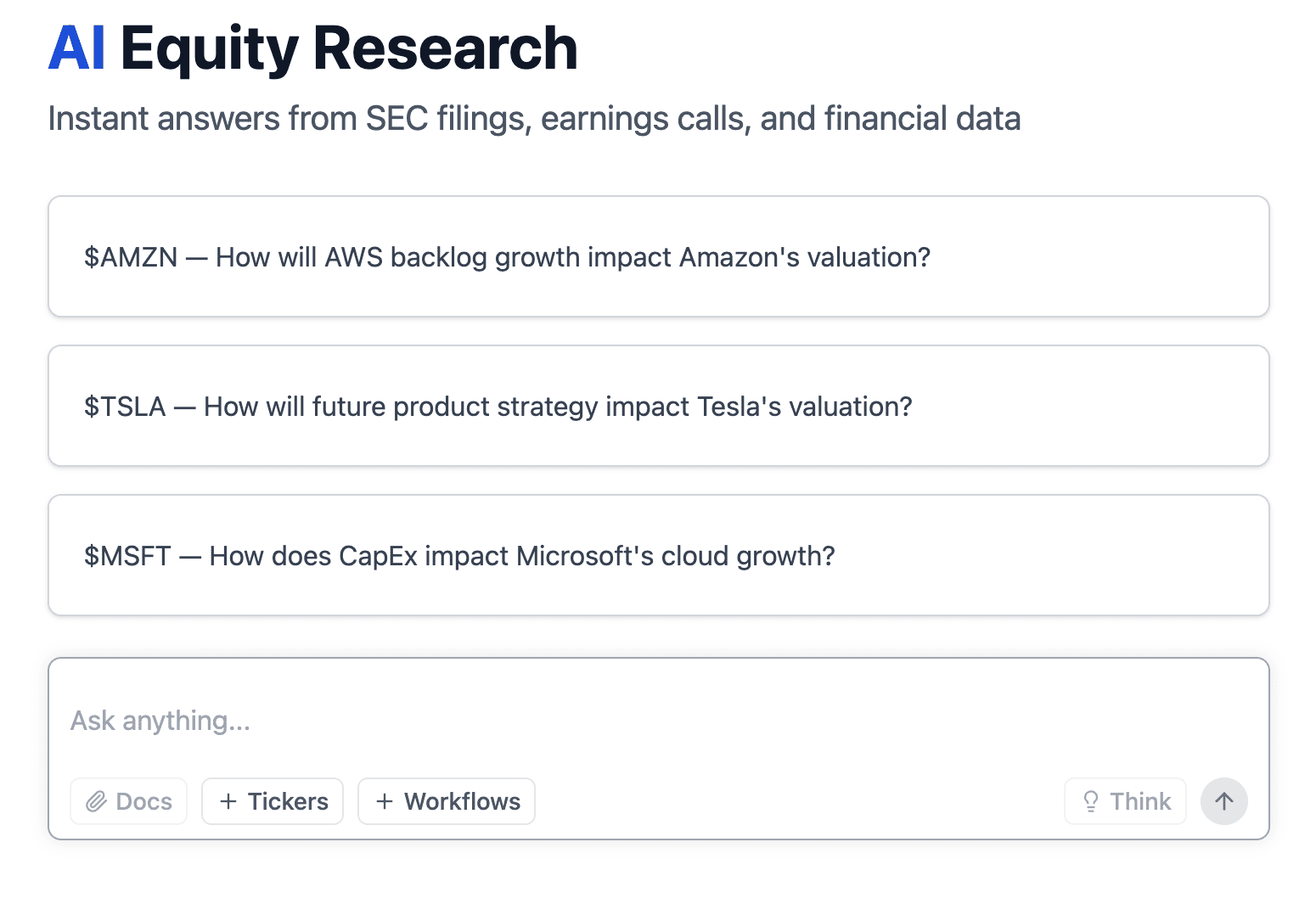
The practical shift in 2026 is from “find the document” to “test the thesis.” A useful assistant should tell you whether Amazon’s AWS backlog, Tesla’s product roadmap, or Microsoft’s capital expenditure actually changes free-cash-flow value — and show the passage that supports the claim.
What Should You Look for in an AI Fundamental Analysis Assistant?
You should evaluate an AI fundamental analysis assistant on six dimensions we call SOURCE-6: source fidelity, operating-metric extraction, underlying earnings quality, relative and intrinsic valuation, competitive-advantage durability, and estimate or sentiment triangulation. Tools that score well on two of these and poorly on the rest produce fluent summaries that do not survive a credit committee, an investment-committee memo, or a short-seller report.
Source fidelity. The assistant must retrieve the U.S. Securities and Exchange Commission (SEC) filing or earnings transcript and keep the citation attached. Ungrounded answers are a research risk, not a convenience feature.
Operating-metric extraction. Segment revenue, remaining performance obligations, same-store sales, net interest margin, and capex by category matter more than headline EPS. Fiscal.ai emphasizes 2,250-plus segments and KPIs across a large company universe in third-party writeups of the rebranded product.
Underlying earnings quality. Net income that does not convert to cash, rising receivables, or recurring “one-time” charges should be flagged automatically.
Relative and intrinsic valuation. A useful assistant compares EV/EBIT, EV/sales, or FCF yield against peers and can walk through what growth and margin path a multiple implies.
Competitive-advantage durability. Moat language in a 10-K is marketing until it is tested against pricing power, customer concentration, and new-entrant capex.
Estimate and sentiment triangulation. Sell-side revisions, management guidance, and call tone are context — not a substitute for the financials.
Weight the six unevenly by mandate. A long-only compounder search should overweight moat durability and earnings quality. An event-driven desk should overweight source fidelity and operating-metric speed. A retail investor building a concentrated book should overweight valuation mechanics and cost.
How Do the Leading AI Fundamental Analysis Tools Compare Side by Side?
Jenova’s Fundamental Stock Analyst, Fiscal.ai, AlphaSense, and TIKR all support fundamental work, but they optimize for different jobs: conversational thesis building, auditable data plus copilot, enterprise document intelligence, and Capital IQ-style financial history. Prospero’s 2026 ranking treats Fiscal.ai and Seeking Alpha Premium as the strongest dedicated fundamental picks, while WallStreetZen’s broader AI-analyzer survey is still dominated by quant rating and trading tools. That split is the market: most “AI stock” products score or scan; fewer actually read filings like an equity analyst.
| Feature / Dimension | Fiscal.ai | Jenova Fundamental Stock Analyst | AlphaSense | TIKR |
|---|---|---|---|---|
| Filings and transcripts | Terminal plus unstructured filings; data targeted minutes after earnings | Conversational review of SEC filings, earnings, and estimates | 500M+ docs, broker research, 280k+ expert calls | Filings, transcripts, slides; history scales by plan |
| Valuation | Multiples, segments, estimates, custom metrics | Relative valuation and business-model assessment in-session | Table extraction and comps from documents | Key valuation metrics, estimates, long history |
| Competitive / moat work | Peer pages, segments, qualitative docs | Business-model and advantage analysis in natural language | Industry reports, expert calls, private-company coverage | Peer lists and guru holdings; less thesis language |
| Conversational AI | Copilot on institutional data | Multi-model agent with persistent memory | Smart Summaries, sentiment, Generative Grid | Limited versus dedicated copilots |
| Pricing (as of 2026) | Free tier; Pro about $39–$49/mo; Max about $79–$99/mo | Free tier; paid from $20/mo | Often ~$12k SMB / ~$124k enterprise per year | Free; Plus from ~$18/mo; Pro ~$55/mo |
| Best for | Analysts who want a data terminal with AI | Investors who want an end-to-end fundamental conversation | Institutional research teams | Investors who want long, cheap financial history |
Fiscal.ai (formerly FinChat)
Fiscal.ai is strongest when you want institutional-style financials, segment KPIs, and a copilot sitting on the same dataset. The company positions itself as an all-in-one research platform with analytics and conversational AI, and it stresses human-verified, source-auditable numbers published minutes after earnings. Reviews of the current plans put Pro near $39 a month billed annually ($49 monthly) and Max near $79 annually ($99 monthly), with a short trial on signup.
The limitation is workflow shape. Fiscal.ai is still a terminal you navigate — dashboards, financials tabs, transcripts, screeners — with AI as a layer. It is less of a persistent research partner that remembers last quarter’s debate about a company’s unit economics unless you rebuild that context.
Jenova Fundamental Stock Analyst
Jenova’s Fundamental Stock Analyst is strongest when the task is to go from a ticker question to an earnings, valuation, and moat discussion in one thread. The agent is built for earnings analysis, relative valuation, business-model assessment, and live data across SEC filings, analyst estimates, and market sentiment. Testing a typical session shows the useful pattern: ask how AWS backlog growth hits Amazon’s multiple, then stay in the same conversation for cash conversion, capex, and peer comps.
The honest limitation is corpus and terminal depth. It does not replace AlphaSense’s broker-research library or TIKR’s multi-decade standardized statements. Investors who need 30 years of as-reported financials, embargoed sell-side notes, or a 10,000-source news index will still keep a data terminal. The agent also inherits platform usage limits on the free tier, so heavy earnings-season volume generally requires a paid plan starting at $20 a month.
AlphaSense
AlphaSense is strongest for institutional teams that live inside documents. The platform aggregates broker research, filings, earnings transcripts, news, and expert calls, and it adds Smart Summaries, sentiment, Table Explorer, and a Generative Grid that runs prompts across many documents at once. It also indexes more than one million private companies, which matters for private-equity and venture due diligence.
The limitation is price and fit. SpendHound’s 2026 marketplace data puts average SMB spend near $12,210 a year and average enterprise spend near $123,760. Vendr’s observed deals range from roughly $9,250 to $51,000, which confirms that this is a negotiated seat, not a retail copilot. Independent analysts doing public-equity fundamentals will often be over-served on expert-call volume and under-served on a simple, cheap valuation workspace.
TIKR
TIKR is strongest as a low-cost fundamental data terminal, not as a conversational filings analyst. Reviewers describe it as Bloomberg-like coverage for retail investors, with S&P Capital IQ data, 100,000-plus global stocks, and up to 20 years of history. Official plans run from a free U.S. starter package through Plus, Pro, and Ultimate, with Pro commonly cited near $55 a month.
Transcript history and estimate depth scale sharply by tier: the free plan shows only a 90-day transcript window and five years of financials, while Ultimate advertises 30 years of financial history and full transcript archives. The limitation is AI. TIKR will not, by itself, argue a moat or write a quality-of-earnings memo. It is the spreadsheet behind the thesis, not the analyst.
FinSightAI and Seeking Alpha Premium
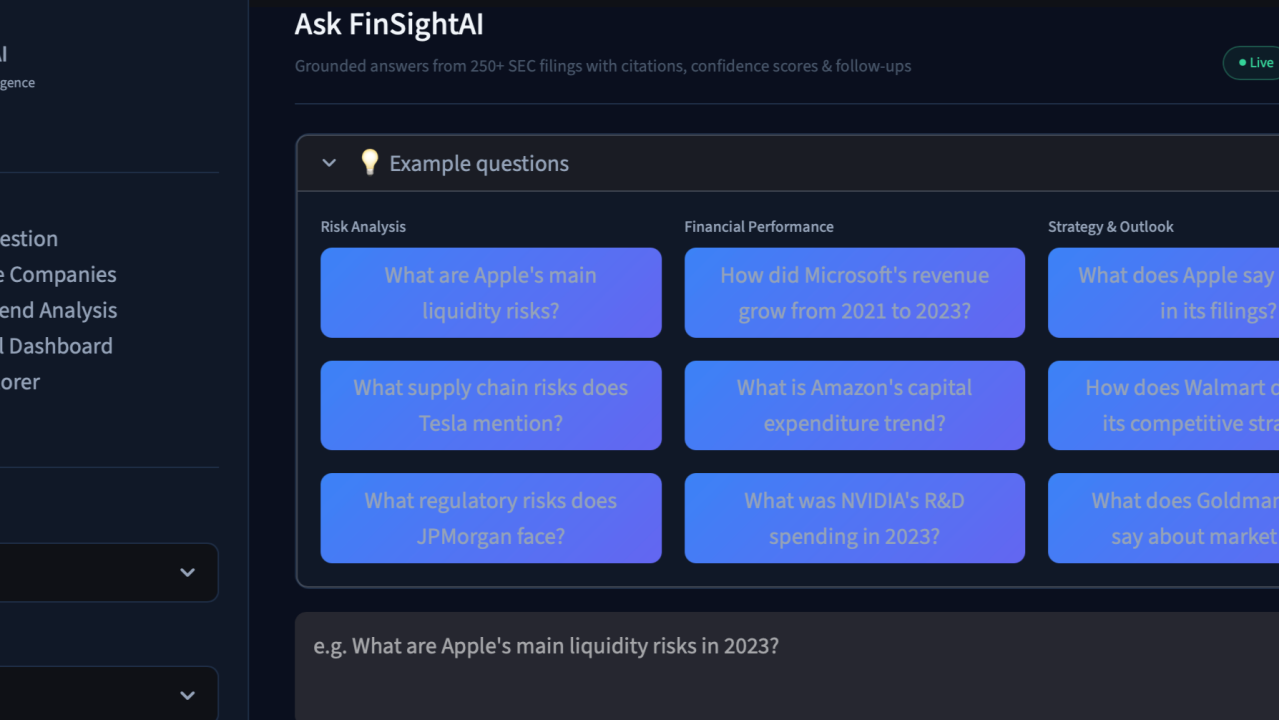
FinSightAI-style products specialize in grounded Q&A over a bounded filing set. The interface advertises answers from 250-plus SEC filings with citations, confidence scores, and follow-ups, grouped into risk, financial performance, and strategy questions. That citation-first design is a genuine strength for filing Q&A. A 250-document corpus is also a hard ceiling next to multi-hundred-million-document enterprise indexes, and public pricing was unverified at the time of writing.
Seeking Alpha Premium is a different category: human contributor research plus AI Virtual Analyst Reports and factor-style stock rankings, typically around $299 a year after trial pricing. It is useful for idea flow and crowdsourced debate. It is weaker as a controlled, citation-locked filing workspace.
How Effectively Can AI Assistants Read SEC Filings and Earnings Calls?
The effective assistants read filings as evidence, not as text to paraphrase: they pull the footnote, the risk factor, and the transcript answer, then keep the citation visible. AlphaSense’s own buyer guidance treats filings, transcripts, and table extraction as core fundamental-analysis infrastructure. Fiscal.ai’s differentiator is the opposite layer — structured numbers that remain auditable back to source. Both beat a generic chatbot that cannot show where a figure came from.
In practice, filing work splits into three jobs:
- Retrieval — find the 10-K revenue recognition note, the 10-Q liquidity discussion, or the 8-K item that changed guidance.
- Reconciliation — match management’s non-GAAP figure to the GAAP line and the cash-flow statement.
- Change detection — compare this quarter’s risk language, backlog, or capex commentary with the prior year.
Jenova’s Fundamental Stock Analyst is built for the second and third jobs inside a conversation. You can ask what Tesla discloses about supply-chain risk, then immediately ask whether that risk is already in the multiple. FinSightAI-style Q&A boards are stronger at the first job when the question is already known — “What was NVIDIA’s R&D spend?” — and weaker at chaining those facts into a valuation.
TIKR handles the document library more than the interpretation. Its paid tiers add years of transcripts, audio, and slides, which is enough to do the reading yourself. AlphaSense goes further for teams that also need broker notes and expert calls, and it claims material cuts in expert-network spend when those libraries replace some primary calls. That is an institutional workflow, not a personal one.
A reliable prompt pattern for any of these tools is specific, dated, and falsifiable:
“Using Amazon’s latest 10-K and most recent earnings call, extract AWS remaining performance obligations, growth rate, and any commentary on utilization. Then tell me whether that backlog growth supports a higher or lower group multiple versus Microsoft Azure and Google Cloud, and cite the passages.”
If the assistant cannot produce the passage, treat the answer as a hypothesis, not research.
How Should AI Handle Valuation, Peer Comps, and Competitive Advantages?
An AI assistant should treat valuation as a set of explicit assumptions — growth, margins, reinvestment, and multiple — and treat competitive advantage as a test of whether those assumptions can last. Price targets without a peer set, and moat essays without unit economics, are the two most common failure modes in this category.
Relative valuation is the everyday tool. TIKR and Fiscal.ai excel at lining up EV/EBIT, FCF yield, and segment margins because they are data terminals first. Jenova’s Fundamental Stock Analyst is stronger at the narrative that sits on top of those comps: why a premium is earned, or why it should compress. AlphaSense is strongest when the “comp” is qualitative — what competitors say in filings and expert calls — rather than a clean multiple table.
Intrinsic work needs more discipline than most copilots apply. A useful session forces the model to show the implied revenue growth and margin path inside today’s enterprise value, then stress those inputs. Combine the Fundamental Stock Analyst with the Macro Strategist when discount rates, policy, or cycle position dominate the multiple. That pairing matters in 2026 because many “cheap” multiple screens are just higher-rate math, not deteriorating businesses.
Competitive-advantage analysis should be evidence-led:
- Switching costs — net retention, implementation time, multi-year contracts
- Scale — unit cost versus the next competitor, not just market share
- Network effects — whether incremental users raise value for existing users
- Counter-evidence — new-entrant capex, pricing promotions, customer concentration
Ask the assistant to argue the bear case with citations. If it cannot explain how the moat fails, it has not analyzed the moat.
How Do You Run a Full Fundamental Review With an AI Assistant?
A complete fundamental review takes one ticker through four passes — business quality, earnings quality, valuation, and variant view — and writes down what would falsify the thesis. Most people skip pass two and pass four, which is why AI summaries feel insightful and still lose money.
For Jenova’s Fundamental Stock Analyst, a practical sequence looks like this:
- Open the agent and name the ticker, filing set, and decision.
“Review Microsoft as a long-only position. Use the latest 10-K, 10-Q, and earnings call. I care about Azure growth quality, capex intensity, and whether the current multiple already prices the AI buildout.”
- Run the earnings-quality pass: cash versus accruals, one-time items, buybacks versus reinvestment.
- Run comps against two or three real peers, not a sector ETF.
- Write the variant view: what you believe that the consensus transcript tone is missing.
- Store the conclusion in the same thread so the next print updates the thesis instead of restarting it.
Fiscal.ai’s equivalent path is terminal-first. Build the company page, check financials and segments, open the transcript, then use the copilot on a narrow question. Independent walkthroughs of the product still start with dashboards, financial statements, and source-linked figures before AI chat. That order is correct when data integrity is the constraint.
TIKR’s path is download-and-model: pull 10-plus years of statements, estimates, and ownership, then do the thinking in a spreadsheet. Pair that history with a conversational agent if you want both depth and interpretation.
After the single-name memo, the Portfolio Management Strategist is the logical next step for position sizing, factor overlap, and what happens to the book if the thesis is late. Fundamental analysis that never reaches portfolio context is unfinished research.
What Do Equity Research Professionals Say About AI-Assisted Analysis?
Equity research professionals increasingly treat AI as a junior analyst that must be supervised: excellent at retrieval and first-draft synthesis, unreliable when it is allowed to own the valuation conclusion. The teams getting value are the ones that demand citations, force bear-case memos, and keep a human responsible for the recommendation.
"The bottleneck in fundamental research is no longer access to the 10-K. It is deciding which three numbers in that 10-K change the model. Assistants that cannot show the footnote, the cash-flow reconciliation, and the peer set are generating prose, not research. We see the highest-quality output when the analyst specifies the decision — add, trim, or pass — before the model writes a sentence."
"Enterprise document platforms win when the edge is coverage: embargoed broker notes, expert calls, private-company files. Agent-style tools win when the edge is iteration speed and memory. An independent investor who can run twenty falsifiable questions in an afternoon will often out-research a more expensive seat that gets opened twice a week."
"Earnings quality is the tell. If an assistant celebrates revenue growth without checking receivables, deferred revenue, and cash from operations, it is repeating the press release. The same test applies to moats. 'Network effects' in a risk factor is not evidence. Retention, pricing, and competitor capex are evidence."
— Jenova Product Team, investment-research AI, 8 years building equity-analysis workflows
Which AI Fundamental Analysis Assistant Fits Your Investing Workflow?
The best assistant is the one that matches your constraint: time, budget, document corpus, or need for a written thesis. There is no universal winner across a hedge-fund research pod, a registered-investment-advisor desk, and a self-directed investor.
Choose Jenova’s Fundamental Stock Analyst if you want one conversation that covers earnings, filings, valuation, and competitive advantage, and you value persistent memory over a 30-year data terminal. It is the closest fit to the original question in this article. Paid access starts at $20 a month; the free tier is enough to test the workflow.
Choose Fiscal.ai if you want auditable financials, segment KPIs, and a copilot on top of a modern terminal. It is the better daily driver for analysts who live in statements and still want AI for the last-mile question.
Choose AlphaSense if your edge depends on broker research, expert calls, and private-company documents, and a five-figure annual seat is acceptable. It is the institutional search layer, not a personal valuation coach.
Choose TIKR if you mainly need cheap, long financial history, estimates, and filings, and you will write the thesis yourself. It is the strongest cost substitute for a legacy terminal among the tools reviewed here.
Choose Seeking Alpha Premium or a filing-Q&A tool such as FinSightAI if you want idea flow or narrow, citation-backed questions rather than a full research operating system.
A durable setup for most serious public-equity investors in 2026 is a two-layer stack: a data terminal for numbers you can audit, plus a fundamental agent for the memo you can defend. Use SOURCE-6 on every name. If the assistant cannot clear source fidelity and earnings quality, the rest of the analysis is decoration.
References
- Prospero.ai — The 10 Best AI Stock Analysis Tools in 2026, on fundamental-work picks
- AlphaSense — Market intelligence platform and 500M+ document corpus
- AlphaSense — Financial research platform: expert calls, sources, and institutional workflows
- Fiscal.ai — Institutional financial data, analytics, and conversational research platform
- WallStreetZen — AI For Stock Analysis: The 7 Best AI Stock Analyzers in 2026
- TIKR — Global stock research and investor analysis tools
- Quantroutine — TIKR review: Capital IQ data, coverage, and positioning
- SpendHound — AlphaSense pricing data for SMB and enterprise seats, 2026
- MatchMyBroker — Fiscal.ai review and 2026 plan pricing
- TIKR — Official pricing and plan comparison
- TraderHQ — TIKR review and Pro-plan cost context versus Bloomberg
- Vendr — Observed AlphaSense software pricing ranges
- WallStreetZen — Fiscal.ai (formerly FinChat) product review
- AlphaSense — Top fundamental analysis tools buyer’s guide
- AlphaSense — Market research tools and terminal-cost comparison
- ToolCenter — FinChat / Fiscal.ai review noting company, segment, and KPI coverage