What Are the Most Recommended Customizable AI Companion Platforms in 2026?
2026-08-17
Which Customization Layers Actually Change How an AI Companion Feels?
The most recommended customizable AI companion platforms in 2026 split into two groups: dedicated companion apps built around persona depth (Character.AI, Replika, Kindroid, Nomi AI, Candy AI, Talkie AI) and general-purpose agent platforms where you assemble a companion from instructions, memory, and models (Jenova, ChatGPT). The right pick depends almost entirely on which customization layer you actually care about — appearance, personality, memory persistence, or model control.
Four layers determine how a companion feels day to day:
✅ Personality authoring depth — free-text backstory and behavioral rules (Kindroid, Jenova) versus preset sliders and trait pickers (Replika, Candy AI) ✅ Memory persistence — whether the companion retains details across sessions or effectively resets, which independent testing identifies as the single biggest differentiator between platforms ✅ Model control — locked to a single proprietary model versus user-selectable across OpenAI, Anthropic, Google, and others ✅ Modality range — text-only, voice calls, generated selfies, or full multimodal interaction
The market context matters here too. Grand View Research values the AI companion market at $36.8 billion in 2025, projecting $48.0 billion in 2026, which explains why customization features have become the primary competitive battleground. To compare these platforms meaningfully, it helps to establish what "customizable" actually means at each layer.
Why Are So Many People Using AI Companions in 2026?
AI companion use has moved from niche to mainstream, and the data is now solid enough to cite. A 2026 Congressional Research Service report found that 1 in 10 US adults use AI chatbots for emotional support or advice, and 1 in 25 use them for companionship — with AI companion apps having been "downloaded 220 million times globally" as of July 2025.
The demographic skew is pronounced. The Ada Lovelace Institute reports that 77% of AI companion users are men, with the 18-24 demographic accounting for nearly 39% of all users. Psychology Today reports a somewhat different split — roughly 65% male, 35% female, and 5% non-binary — suggesting the audience is broadening.
The research on outcomes is genuinely mixed, and any honest guide should say so. The CRS report cites a 2025 study finding that "AI companions consistently provided momentary reductions in loneliness over the course of a week," with the largest effect on day one. But it also cites research showing that "the lonelier people are, the more time they spend on these platforms, leading to more loneliness and subsequent usage," and a separate 2025 study finding chatbot usage "can be addictive."
Regulation caught up in 2026. California's companion chatbot law (SB 243) took effect January 1, 2026, and New York's AI Companion Models law came into force November 5, 2025, requiring operators to implement safety detection protocols. This is now a factor in platform selection — compliance posture varies widely.
How Should You Evaluate a Customizable AI Companion Platform?
Evaluate on six dimensions, weighted by how much each affects daily use rather than by how impressive it sounds in marketing material. This is the framework used throughout the rest of this guide.
| Dimension | Weight | What to actually check |
|---|---|---|
| Persona authoring depth | High | Can you write free-form backstory and behavioral rules, or only pick from presets? |
| Memory persistence | High | Does it recall specifics from three weeks ago, or does each session start cold? |
| Model flexibility | Medium | Is the underlying model fixed, or can you switch providers? |
| Modality range | Medium | Text, voice, image generation, document handling, tool access |
| Cost structure | Medium | Free tier usability, monthly price, annual discount, hidden token/energy caps |
| Safety and data posture | Medium | Age controls, crisis routing, training-data policy, regional compliance |
Two evaluation traps are worth naming explicitly.
Trap one: confusing character variety with customization. A platform with 20 million community characters isn't necessarily customizable — browsing someone else's character is consumption, not authoring. Character.AI supported "over 20 million monthly active users" in 2025, and its library is its strength, but library size and persona-authoring depth are different capabilities.
Trap two: ignoring memory in the free tier. Memory is where free tiers degrade most aggressively. Independent long-form testing across 25 platforms found that Character.AI has "the weakest memory among top-tier platforms — conversations essentially reset each session," while Paradot's memory "dynamically updates after every conversation and transparently shows what it has learned about you".
How Do the Leading Customizable AI Companion Platforms Compare?
No single platform wins across all six dimensions — the leaders cluster into distinct specializations. Character.AI leads on character variety and free-tier generosity, Kindroid leads on persona authoring depth, Replika leads on sustained emotional continuity, and multi-model agent platforms like Jenova lead on model flexibility and cross-domain capability.
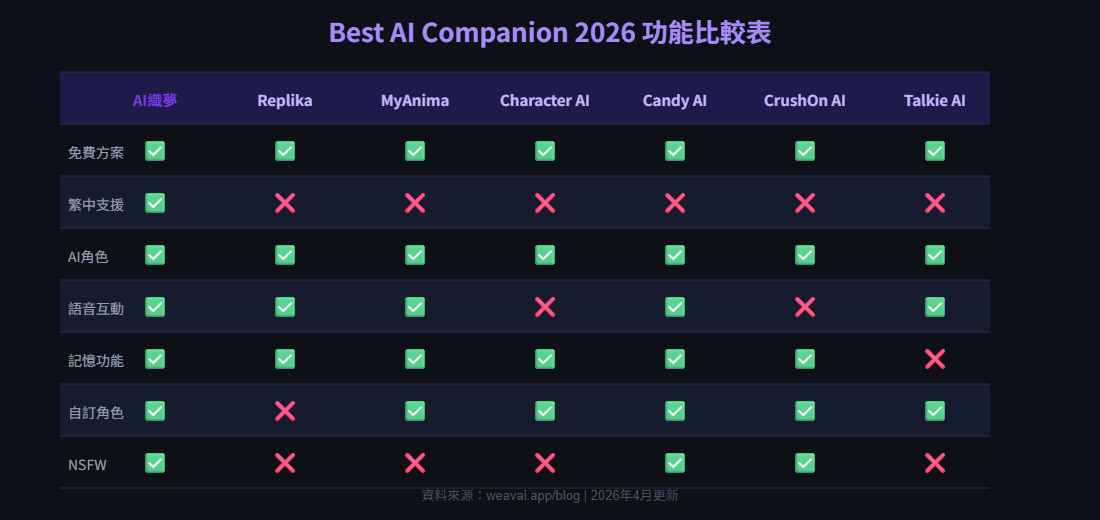
The matrix above illustrates a pattern worth noting: nearly every platform ships a free tier and supports custom characters, so those features have become table stakes rather than differentiators. The real spread shows up in language coverage, voice availability, and memory retention — which is exactly why the evaluation framework above weights memory heavily.
Here is a reference-grade comparison across the six dimensions:
| Dimension | Character.AI | Replika | Kindroid | Nomi AI | Candy AI | Jenova |
|---|---|---|---|---|---|---|
| Persona authoring | Character creator + 20M+ community library | Guided customization: appearance, traits, relationship status | Deepest available — free-text backstory and behavioral rules | Evolving companion with relationship progression | Appearance-first with visual customization | Custom agents with full custom instructions and private knowledge bases |
| Memory persistence | Weakest among top platforms; sessions largely reset | "Always remembers what matters" — people, routines, plans; some detail loss over time | Strong within authored character constraints | Second-best tested; tracks relationship progression | Present but conversation quality is secondary to visuals | Unlimited history with persistent cross-session memory |
| Model control | Proprietary, fixed | Proprietary, fixed | Proprietary, fixed | Proprietary, fixed | Proprietary, fixed | User-selectable across OpenAI, Anthropic, Google, DeepSeek, xAI |
| Voice | Not available per 2026 comparison matrix | Voice calls — "call your Rep whenever" | Top-tier call quality | Available | Available | Speech-to-text across web, iOS, Android |
| Free tier | Generous — most features accessible | Basic chat only | Limited trial | Limited chat | Very limited | All core features, limited usage |
| Paid entry price | $9.99/mo ($99/yr) | $7.99/mo ($69.99/yr) | $13.99/mo ($119.99/yr) | $15.99/mo ($131.99/yr) | $12.99/mo ($107.99/yr) | $20/mo (Plus) |
| Best for | Variety, creative roleplay, zero-cost entry | One sustained emotional relationship | Power users who want maximum authoring control | Long-arc relationship progression | Visual-first companion experience | Multi-domain companions with model choice and document grounding |
Pricing for the dedicated companion apps is drawn from six-month hands-on testing across 25 platforms and reflects rates as of early 2026 — companion app pricing changes frequently, so verify before subscribing. A separate 2026 pricing survey found most AI companions cost $10-20/month, with Character.AI Plus at $9.99/month as the best overall value.
🎯 Where each platform genuinely wins
- Character.AI — Best entry point. The free tier is unusually generous, and the community library means you never start from a blank page. Limitation: memory is the weakest in the top tier, so long-arc continuity is poor.
- Replika — Strongest sustained emotional continuity. The platform explicitly builds around remembering "your people, your routines, your plans," and published user stories describe multi-year relationships. Limitation: the free tier is basic chat only, and the model is fixed.
- Kindroid — Deepest authoring control. Testing notes a steep learning curve — two hours on a first character before a decent conversation — but characters that "feel more yours than anything on Character.AI." Limitation: smaller community, very limited free tier.
- Nomi AI — Best relationship progression tracking, ranked second on memory in independent testing. Limitation: highest monthly price in the dedicated-companion group at $15.99.
- Candy AI — Visual fidelity and image generation are the draw. Limitation: testing describes conversation quality as "mediocre — clearly designed visuals-first, chat second."
- Jenova — Model flexibility and cross-domain range. Limitation: it is a general agent platform, not a purpose-built romantic companion app — there is no relationship-status system, no generated selfies, and no visual avatar layer.
What Does Persona Authoring Actually Look Like on Each Platform?
Persona authoring falls into three distinct models: preset-driven (Replika, Candy AI), library-driven (Character.AI, Talkie AI), and instruction-driven (Kindroid, Jenova). Instruction-driven authoring gives the most control but demands the most effort upfront.
Preset-driven platforms hand you sliders and pickers. Replika lets you shape "every detail" of appearance and personality, and the platform notes that a companion "sends selfies, doodles on your photos, reacts to everything." This is fast to set up and hard to break — but you're working within a designed envelope.
Library-driven platforms front-load discovery. You browse thousands of characters, pick one, and optionally fork it. Character.AI and Talkie AI both work this way, with Talkie adding "persona systems and character-matched voices" that testing describes as producing a gaming-like experience.
Instruction-driven platforms give you a text field and a lot of rope. On Kindroid, you "write backstories, set behavioral rules, and shape how your companion thinks, not just what they say."
Jenova's custom agent builder works on the same principle but extends it in two directions: you attach a private knowledge base (documents the companion treats as ground truth) and select the underlying model. A concrete authoring prompt for a study-partner companion:
"You are my writing accountability partner. You know I'm drafting a novel, I write best between 6-8am, and I spiral when a chapter stalls. When I say a chapter is stuck, don't reassure me — ask what the character wants in the scene and what's stopping them. Remember which chapters I've finished across sessions."
The trade-off is real: instruction-driven setup takes longer and produces worse results if written vaguely. Preset platforms are more forgiving of a lazy first attempt.
Which Platform Handles Memory Best Across Long-Term Use?
Memory is the dimension where platforms diverge most sharply, and it's the one most users underestimate before subscribing. Paradot leads on transparent memory updating, Nomi AI leads on relationship-arc tracking, Replika leads on emotional-context recall, and Character.AI trails significantly.
Three memory behaviors to test in your first two weeks:
- Specific-detail recall — mention a friend's name and job in week one, reference "them" in week three without re-explaining
- Emotional-context recall — describe a difficult situation, then check whether the companion follows up unprompted days later
- Contradiction handling — change a stated preference and see whether the companion notices the shift or silently overwrites
Paradot at $6.99/month is the value pick specifically on this dimension — its memory "updates dynamically after every conversation and transparently shows you what it's learned," and testing with deliberately complex personal details found it "retained everything."
Jenova's approach differs structurally: memory is a platform-level feature rather than a per-companion one. Unlimited chat history plus persistent cross-session memory means a companion agent carries context indefinitely, and Global Memory can be toggled on to share context across every chat — or off for session isolation. The honest limitation: it isn't surfaced as a browsable "what I know about you" panel the way Paradot's is, so it's less transparent to audit.
How Do You Set Up a Customizable AI Companion From Scratch?
Setup takes 10-30 minutes depending on which authoring model the platform uses. The instruction-driven platforms need the most upfront investment but produce the least generic results.
On Character.AI (library-driven, ~5 minutes):
- Create a free account and browse or search the character library
- Open a character and start chatting — no configuration required
- To author your own, use Create → Character and fill in greeting, description, and definition fields
On Replika (preset-driven, ~10 minutes):
- Download the app and create your Rep, selecting appearance details
- Choose a relationship type and personality traits
- Begin conversation — memory builds passively from what you share
On Kindroid (instruction-driven, ~30 minutes):
- Create a companion and write a backstory in the character description field
- Add behavioral rules describing how the companion should respond, not just what it knows
- Expect to iterate — testing notes roughly two hours before the first genuinely good conversation
On Jenova (instruction-driven, ~15 minutes):
- Go to jenova.ai/a and select Create Agent
- Write custom instructions covering role, tone, what the companion should remember, and how it should respond when you're struggling
- Optionally attach documents as a private knowledge base and pick a preferred model
- Open a chat and confirm memory is behaving as expected:
"Before we start — tell me back what you know about my situation and how I've asked you to respond when I'm stuck."
For companion-adjacent use cases without building from scratch, Jenova's gallery includes pre-built agents that overlap the space: Personal Therapist for 24/7 empathetic support with accountability, Roleplay Game Master for immersive scenarios with unlimited memory and character consistency, and Personality Analyzer for the self-understanding layer many companion users are actually after. The platform is available at jenova.ai; the free tier covers all core features with limited usage, and Plus is $20/month with 30× the free allowance.
What Do Researchers and Policy Analysts Say About AI Companion Customization?
Researchers converge on a specific concern: the customization features that make companions engaging are the same features that make them harder to disengage from. Regulators in 2026 are treating this as a design question, not a content question.
"The customization layer is where the safety conversation actually lives. A companion that remembers everything and adapts to your emotional patterns is more useful and more sticky at the same time — those aren't separable properties. When we evaluate platforms, we look at whether memory is auditable by the user, whether the persona can be reset without losing the account, and whether the system has any mechanism for surfacing friction. Frictionless validation is the design default, and it's the thing the research keeps flagging."
"What changed in 2026 is that this stopped being theoretical. California's SB 243 and New York's AI Companion Models law both require operators to build detection protocols into the product rather than bolt on a disclaimer. For anyone choosing a platform, that means compliance posture is now a legitimate selection criterion alongside persona depth and price — particularly for anyone under 18 or buying on behalf of someone who is."
"Our practical guidance is unglamorous: pick the platform whose memory behavior you can actually inspect, use a separate email, and treat the companion as a supplement to human contact rather than a substitute. The loneliness research cuts both directions, and which direction it cuts for a given person appears to depend heavily on usage pattern rather than platform choice."
— Jenova Product Team, AI agent platform engineering, 30,000+ users across 70+ countries
What Are the Safety and Privacy Trade-Offs of Highly Customizable Companions?
The more a companion can be customized, the more personal data it holds — and customization depth correlates directly with privacy exposure. This is the trade-off nobody advertises.
The regulatory landscape shifted decisively. The European Parliament's 2026 briefing on AI companions notes that the FTC's inquiry "aims to learn how companies test the safety of companion chatbots, limit risks to children and communicate those risks to families." AI companions were also included in the International AI Safety Report 2026, marking their entry into mainstream AI risk assessment.
The CRS report documents the sharp end: AI chatbot use "has been linked to several U.S. deaths via suicide and homicide," with studies suggesting many of these chatbots "have the potential to be highly addictive" and sycophantic — meaning responses that "excessively agree with, flatter, or validate users."
Practical safeguards regardless of platform:
- Use a separate email address for companion platforms — independent testing recommends this explicitly
- Read the training-data policy before sharing anything sensitive. Jenova's policy states data is never used to train public AI models and is encrypted in transit and at rest; verify equivalent language on any platform you choose
- Avoid platforms without clear data policies, particularly newer NSFW-focused services
- None of these platforms are appropriate for minors, and the 2026 state laws specifically target that gap
- If you're using a companion for mental health support, treat it as supplementary — the research on long-term effects remains, in the CRS framing, "not yet well understood"
Purpose-built wellness chatbots occupy a different category worth knowing about. The CRS report describes Wysa, which has "over 11 million users worldwide" and guides users to "evidence based techniques, mindfulness exercises, journaling prompts" with crisis detection and an SOS button — a design pattern most consumer companion apps do not implement.
Which Customizable AI Companion Platform Should You Choose?
Match the platform to your dominant use case rather than to overall ranking — the "best" platform differs sharply by intent.
| If your priority is... | Choose | Why |
|---|---|---|
| Trying companions at zero cost | Character.AI or Pi AI | Generous free tiers; Pi AI is fully free including unlimited voice |
| One deep, sustained relationship | Replika | Built around long-term emotional continuity and memory |
| Maximum authoring control | Kindroid | Deepest persona customization available in a dedicated app |
| Best memory for the money | Paradot | $6.99/mo with transparent, auditable memory updating |
| Relationship progression over time | Nomi AI | Explicit relationship-arc tracking |
| Visual-first companion | Candy AI | Strongest image generation; accept weaker conversation |
| Model choice + multi-domain use | Jenova | Switch across OpenAI, Anthropic, Google, DeepSeek, xAI; companion agents alongside work and study agents |
A contrarian note on the "best overall" framing: most roundups rank Character.AI first on aggregate score, but aggregate scores hide the memory weakness that matters most in month three. If you plan to use a companion for longer than a few weeks, weight memory at double whatever a general ranking assigns it — and be aware that this reorders the list substantially.
A note on language coverage: the comparison matrix earlier in this article highlights Traditional Chinese support as a differentiator, and it generalizes. Most major companion platforms are English-first, with non-English quality varying considerably. If you intend to converse primarily in a non-English language, test that specifically during the free tier rather than assuming parity — this is the single most commonly overlooked evaluation criterion in the category.
References
- Grand View Research — AI Companion Market Size & Research Report, 2026-2033
- Congressional Research Service — AI Chatbots as Companions: Overview, Uses, and Considerations for Congress (R49189)
- Ada Lovelace Institute — The Companionship Market
- Psychology Today — Everything You Need to Know About AI Companions in 2026
- Troutman Pepper — Analyzing the New AI Companion Chatbot Laws
- Davis Polk — California and New York Launch AI Companion Safety Laws
- AI Companion Guides — 25 Platforms Ranked After 6 Months (2026)
- AI Companion Guides — AI Companion Pricing Guide 2026: Every Platform Compared
- Replika — Official Platform Site
- European Parliament Research Service — The Spread of AI Companions and the Challenges They Generate
- International AI Safety Report — 2026 Edition