What Are the Most Recommended AI Research Assistants in 2026?
2026-08-21
How Do Leading AI Research Assistants Compare on Citation Integrity, Database Coverage, and Workflow Completeness?
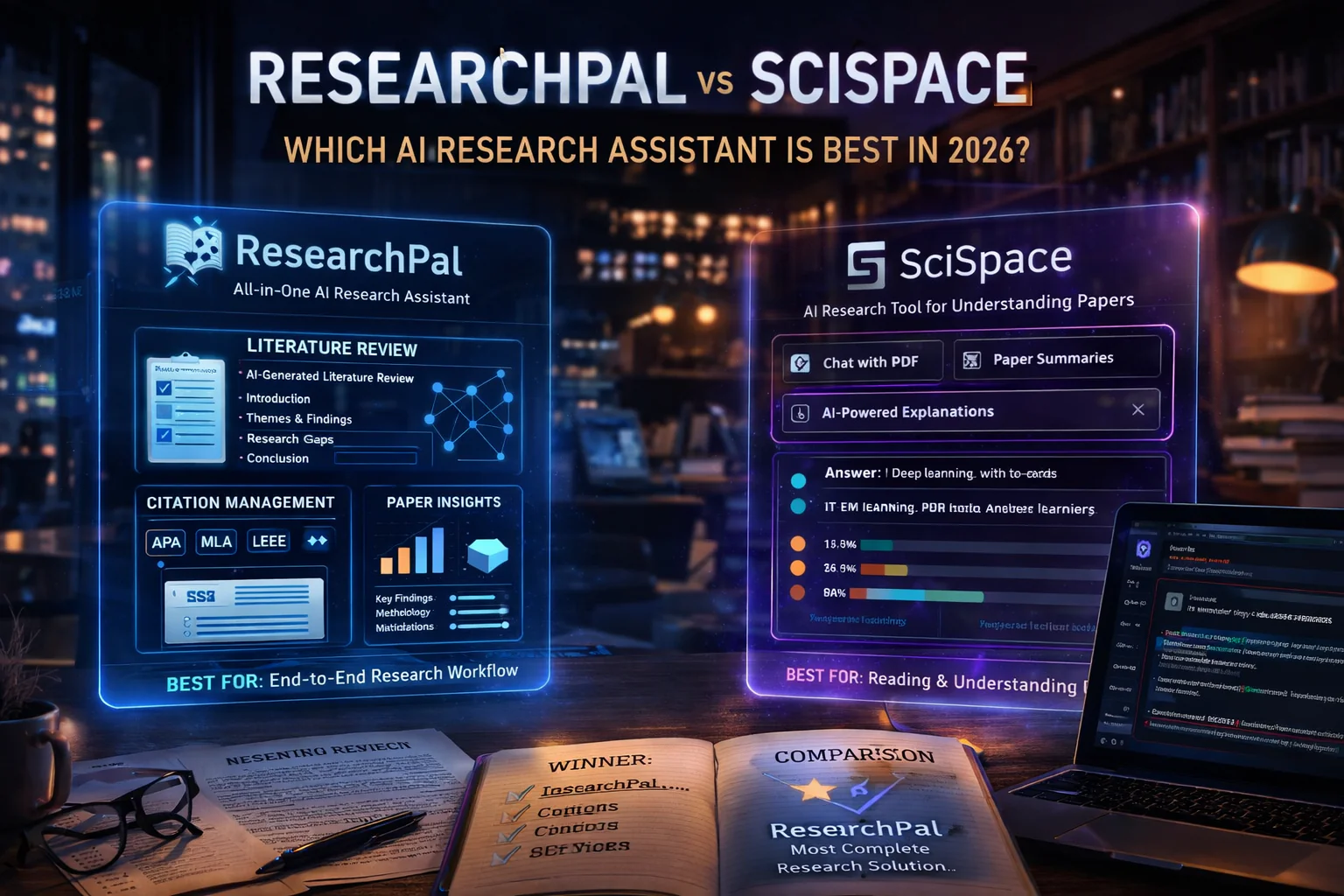
The AI research assistants most often recommended in 2026 are Elicit for structured evidence extraction, SciSpace for in-paper comprehension, Paperguide for review-to-draft workflows, Scite for citation-context analysis, and Jenova’s Academic Research Assistant for persistent, multi-model literature work that spans discovery, synthesis, and manuscript preparation. The ranking that matters is not a single “winner,” but fit across three dimensions: how much of the scholarly record a tool can actually search, whether its claims are citation-grounded, and whether it covers only one research task or a full workflow.
Key factors that separate a usable academic assistant from a generic chatbot in 2026:
✅ Citation integrity — answers that point to real papers, with enough bibliographic detail to verify, rather than fluent but uncheckable summaries ✅ Literature coverage — access to large scholarly indexes (on the order of 125 million papers in Elicit and 300 million-plus articles in Scite) plus grey literature when needed ✅ Evidence handling — screening, extraction, and synthesis that a second researcher could audit ✅ Workflow completeness — whether discovery, reading, citing, and drafting live in one place or require a tool stack ✅ Human-in-the-loop design — features that support verification, because current evidence does not support generative AI in evidence synthesis without human oversight
Those five criteria are the practical basis for the comparisons below. To choose among these tools, it helps to treat them as specialists on a shared research pipeline rather than interchangeable “AI for papers” products.
Why Have Specialized AI Research Assistants Gained Traction Among Academics?
Specialized AI research assistants have moved from optional extras to standard academic infrastructure because publication volume, student adoption, and institutional policy all shifted at once. Scientific publishing now produces more than three million new papers each year, which makes unaided keyword search and manual screening increasingly expensive in time.
Adoption data from higher education is unambiguous. The HEPI Student Generative AI Survey 2025 found that 92% of UK undergraduates used generative AI, up from 66% in 2024, with 88% using it in assessments. The most common academic uses were explaining concepts, summarising articles, and suggesting research ideas — exactly the jobs research assistants are built for.
Institutions are still catching up. A UNESCO survey reported that two-thirds of higher education institutions have or are developing guidance on AI use, yet HEPI found that only 36% of students had received AI-skills training from their institution. That gap is why domain-specific assistants — tools that search scholarly databases, attach citations, and keep a research trail — are recommended over general chatbots for literature work.
The other driver is risk. HEPI respondents named fear of false results or hallucinations (51%) as a leading reason not to use AI, nearly tied with concerns about cheating. Assistants that retrieve from academic indexes and expose sources are a direct response to that failure mode.
What Criteria Should Guide the Selection of an AI Research Assistant?
Researchers should select an AI research assistant using a six-dimension framework — coverage, integrity, extraction, writing, persistence, and cost-to-capability — rather than feature checklists or “best overall” lists. Testing against this Coverage–Integrity–Workflow (CIW) frame makes trade-offs visible: a tool can lead on PDF explanation and still be weak at systematic screening, or excel at citation context while offering almost no drafting support.
The six dimensions, weighted for typical academic use:
- Literature coverage — Does the tool search a large scholarly corpus, multiple databases, or only a single index such as Semantic Scholar?
- Citation integrity — Are claims linked to identifiable papers, and can you see whether later work supports or disputes them?
- Evidence extraction — Can you pull methods, sample sizes, outcomes, and limitations into comparable structures?
- Writing support — Does the tool draft or edit with the reference library as context, or stop at summaries?
- Persistence — Does it remember a months-long thesis project, or reset every session?
- Cost-to-capability — What does a free tier actually include, and where do paid caps hit systematic-review volume?
Methodological guidance should sit beside product features. King’s College London’s evidence-synthesis librarians note that AI tools cannot replace traditional systematic-review methods and are best treated as adjuncts. OHSU’s systematic-review guide similarly finds AI most useful in later, labor-intensive stages such as screening support and data extraction, not as a substitute for protocol design or database searching.
A practical rule follows: if the output cannot be audited — no source list, no inclusion logic, no way to rerun the search — the tool is a reading aid, not a research assistant.
How Do Jenova, Elicit, SciSpace, Paperguide, and Scite Compare for Academic Workflows?
Jenova’s Academic Research Assistant is strongest for long-running, conversational research with persistent memory and multi-model access; Elicit is strongest for structured extraction; SciSpace for reading dense PDFs; Paperguide for packing search, review tables, and cited drafting into one subscription; and Scite for seeing how a paper is actually cited. None of the five dominates every CIW dimension, which is why “most recommended” in 2026 is a shortlist, not a single name.
| Dimension | Jenova Academic Research Assistant | Elicit | SciSpace | Paperguide | Scite |
|---|---|---|---|---|---|
| Literature coverage | Live academic and web search via platform tools, including scholarly databases | Semantic search over 125 million papers; used by 2 million-plus researchers | 200 million-plus papers plus uploaded PDFs | Question-based search across 200 million-plus papers | 300 million-plus scholarly articles indexed for citation context |
| Citation integrity | Source-backed answers; user verification still required | Citation-backed summaries; documented sensitivity gaps versus traditional search | Answers grounded in the open paper | Citation-backed search, tables, and writer | Shows whether citations support, contradict, or merely mention a claim |
| Evidence extraction | Conversational extraction and synthesis across sessions | Structured columns and systematic-review workflows | Paper-level summaries, methods, and Q&A | Literature tables and Deep Research reports | Citation-context extraction, not outcome tables |
| Writing support | Manuscript preparation and citation management | Reports and summaries, not full papers | Explanations inside the PDF | AI Paper Writer that drafts from the reference library | Not a writing environment |
| Persistence | Unlimited chat history and cross-session memory | Project- and workflow-based | Document-centric reading sessions | Workbooks and reference libraries | Saved papers and citation views |
| Pricing (as of 2026) | Free tier; Plus at $20/month with 30× free usage | Free and paid plans | Free and paid plans | Free; Plus $12/month; Pro $24/month | Free and paid plans (paid rates unverified here) |
| Best for | Multi-month research conversations that mix discovery, synthesis, and drafting | Screening and extracting from a defined paper set | Understanding a difficult paper in place | End-to-end review-to-draft on one platform | Checking how the literature treats a specific claim |
Independent comparisons line up with that split. A 2026 Paperguide analysis of Elicit versus SciSpace concluded that Elicit is stronger for rigorous evidence-based workflows, while SciSpace is better for fast exploratory discovery. SciSpace’s own 200-query benchmark reported 26.3 highly relevant papers per query for its Deep Review, ahead of Elicit and Consensus on that in-house test — a useful signal, but one that should be read as vendor-run, not as a substitute for librarian-validated search.
Honest limitations matter as much as strengths. Jenova does not ship a native 200-million-paper index or a PRISMA-style screening grid; it is a research agent with live search, memory, and writing support, not DistillerSR. Elicit’s repeatability and recall have been shown to lag classical database screening. SciSpace remains more a reader than a systematic-review engine. Paperguide’s Deep Research and workbook caps still bound how far automation goes on lower tiers. Scite will not draft your related-work section.
How Does Citation Integrity Vary Across AI Research Assistants?
Citation integrity varies more across tools than interface quality does, and it is the dimension that most often determines whether an assistant is safe to use in a thesis, grant, or systematic review. Scite is purpose-built to show how a claim is supported or disputed across 300 million-plus articles; Elicit, Paperguide, and SciSpace retrieve from large paper corpora and attach references; general-purpose chatbots frequently do neither.
The failure mode is well documented. In a 2025 methods study comparing Elicit with a human umbrella review, researchers found that Elicit identified only 17.6% of the studies included by classical screening, while also surfacing three relevant papers the human search had missed. Repeatability was unstable across three identical queries. The authors also reported that Elicit incorrectly cited a review protocol when generating a summary — a serious integrity error, not a cosmetic one.
That pattern is why library guides keep repeating the same constraint. A 2025 systematic review of generative AI in evidence synthesis concluded that current evidence does not support GenAI use without human involvement. Memorial Sloan Kettering’s systematic-review service likewise holds evidence synthesists responsible for any AI they use, including the decision to use it at all.
A useful integrity ladder for 2026:
- Level 1 — fluent but uncited. Generic chat answers. Not acceptable for academic claims.
- Level 2 — cited retrieval. The tool names papers. You still verify that the paper exists and says what is claimed.
- Level 3 — citation context. Tools like Scite show whether later papers agree, contradict, or only mention the work.
- Level 4 — auditable synthesis. Inclusion criteria, source-linked cells, and exports that a co-author or librarian can rerun.
Jenova’s Academic Research Assistant operates at Level 2–3 in practice: it searches live sources and is expected to ground claims, but it is not a citation-context graph like Scite and it will not certify a PRISMA flow diagram. Pairing it with Scite (for how a paper is cited) or a reference manager (for the canonical record) is often stronger than asking any one assistant to police itself.
How Do AI Assistants Handle Evidence Synthesis and Systematic Reviews?
AI assistants now cover pieces of evidence synthesis — especially title/abstract screening and extraction — but they do not yet replace protocol-driven systematic review. The recommended pattern in 2026 is human-supervised automation at specific stages, not one-click reviews.
The strongest empirical support is for screening. A 2026 review of reviews found peer-reviewed evidence of AI readiness for human-supervised title/abstract screening, with limited evidence for other synthesis tasks. The AIM Review screening tool has reported workload reductions from 20% up to 95% across six real-world reviews, which is a screening result, not a licence to automate conclusions. A Cochrane-linked comparison found that Elicit did not search with high enough sensitivity to replace traditional literature searching, though its precision can help with preliminary searches and unique extra studies.
Product workflows are converging on the same six-stage skeleton, illustrated clearly by Paperguide’s evidence-synthesis pipeline: define the question (often PICO/PICOC), search a large corpus, screen with quality signals, extract into source-linked tables, synthesise with citations, and export.
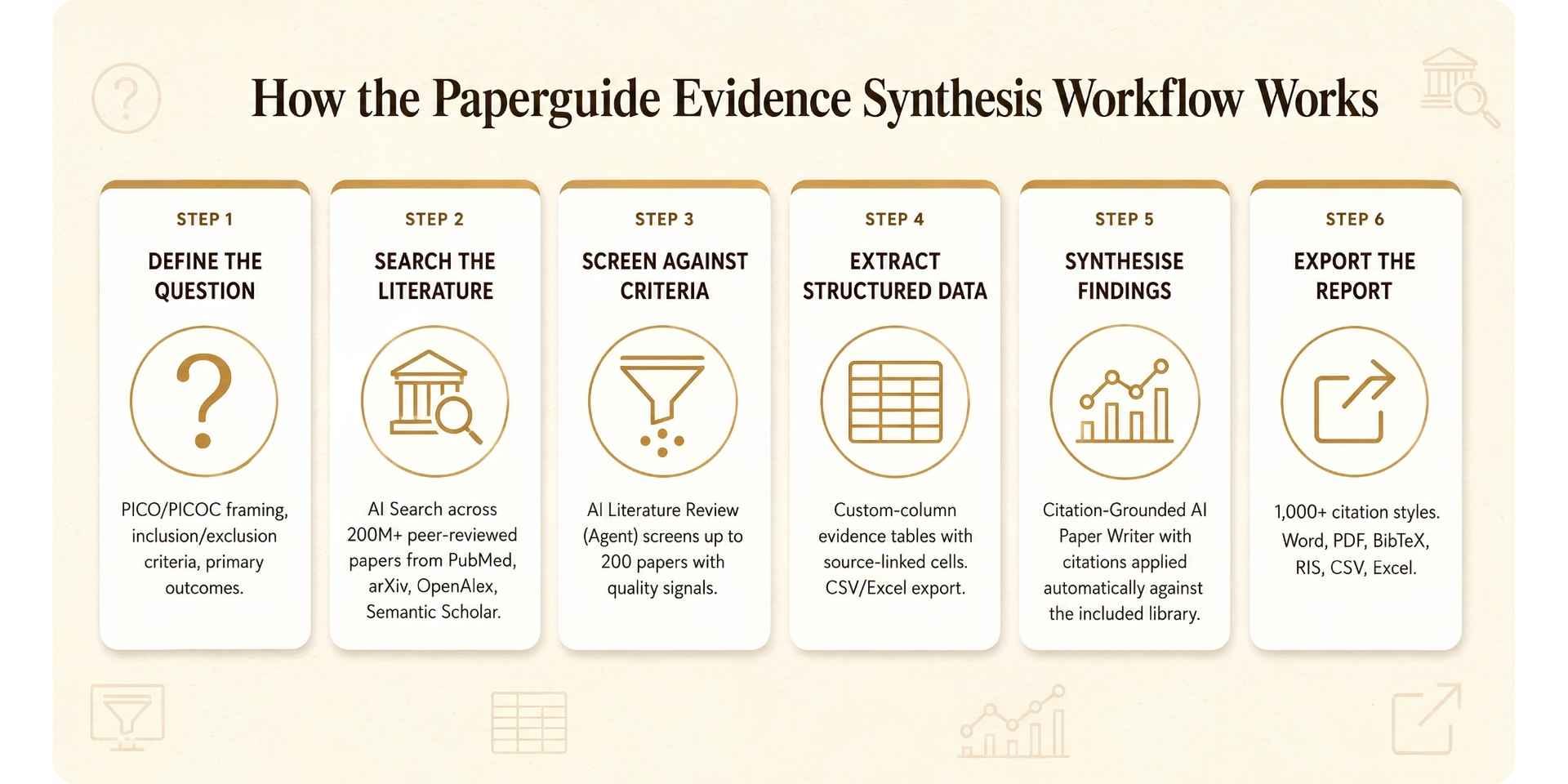
That diagram is a good map of the work, not proof that any vendor’s “Deep Research” button meets Cochrane, JBI, or Campbell standards. A 2025 joint position from Cochrane, the Campbell Collaboration, JBI, and the Collaboration for Environmental Evidence treats AI as support that must not compromise quality or trust. Paperguide’s own materials describe screening on the order of hundreds of papers per run and Deep Research report caps even on paid plans (for example, 50 reports per month on Pro). That is rapid synthesis, not a living Cochrane review.
Where Jenova fits this pipeline is as the analyst sitting on top of it: framing PICO questions, comparing extraction tables, chasing papers the first search missed, and drafting the narrative synthesis with a memory of earlier inclusion decisions. It is weaker as a dedicated screening UI. Elicit remains the more natural fit when the job is “turn 80 abstracts into a methods-and-outcomes table.” SciSpace is the more natural fit when the job is “explain this methods section and this equation.”
How Do You Run a Literature Review With an AI Research Assistant?
You get the most from an AI research assistant by giving it a bounded question, an inclusion rule, and a verification pass — not by asking it to “review the literature” in one prompt. The same loop works across tools; only the interface changes.
A reliable sequence:
- State the question in PICO or equivalent form (population, intervention or phenomenon, comparator, outcomes, and study types).
- Declare inclusion and exclusion rules before any summarising begins.
- Run discovery in more than one system — a dedicated academic index plus a live web/scholar search — because no single corpus is complete.
- Extract into a table (study, design, n, outcomes, limitations) rather than accepting a prose digest.
- Spot-check every citation against the PDF or publisher page.
- Write from the table, not from the assistant’s narrative memory of the table.
For Jenova’s Academic Research Assistant, setup is a single scoping message:
“I am writing a narrative review on adaptive tutoring systems in undergraduate STEM. Include empirical studies from 2020–2026. Exclude opinion pieces and non-English papers. Build a table with authors, year, design, sample, outcomes, and limitations, then list likely gaps. Flag any citation you cannot verify.”
Follow with a second pass that asks the agent to retrieve full bibliographic data and to separate high-quality evidence from adjacent but off-scope work. Because the agent keeps cross-session memory, later chats can continue the same inclusion logic instead of re-explaining the protocol.
For Elicit, the equivalent start is a research question plus filters for study type and year, then custom columns for the variables you care about. Treat the first result set as a precision-oriented supplement. The BMC Medical Research Methodology evaluation found Elicit complementary rather than sufficient as a standalone search, which is the right operational stance.
For SciSpace, upload or open the PDF and ask grounded questions — “What was the primary endpoint?” “Which limitations do the authors acknowledge?” — instead of requesting a free-standing literature review. That plays to in-document explanation, which is the product’s centre of gravity.
Grey literature, policy documents, preprints, and practitioner forums often sit outside academic indexes. Jenova’s Real-Time Search agent is the natural companion when a review also needs Reddit discussions, GitHub implementations, news, or other non-journal sources, then hands the scholarly core back to the Academic Research Assistant.
What Do Research Infrastructure Teams Say About AI-Assisted Scholarship?
Research infrastructure teams treat AI research assistants as high-leverage drafting and screening partners that still fail closed-book on recall, repeatability, and citation fidelity — so the recommended design is persistent context plus mandatory verification, not fully automated reviews.
"The citation problem is not that models are occasionally wrong. It is that they are fluent when they are wrong. In academic workflows we have seen assistants invent plausible DOIs, merge two real papers into one, and cite a protocol as if it were results. That is why we evaluate tools on whether a co-author can audit the trail — source list, inclusion rule, and a path back to the PDF — not on how polished the first paragraph looks."
"Persistent memory changes the economics of a dissertation more than another summarizer does. A PhD literature review is a six-to-eighteen-month object. If the assistant forgets that you excluded cross-sectional studies in March, it will keep recommending them in October. Cross-session memory is not a convenience feature in that setting; it is how the protocol survives contact with a busy calendar."
"Multi-model access matters for a boring reason: different stages want different error profiles. Screening and extraction want conservative, citation-heavy answers. Related-work prose wants a stronger writer. No single model is best at both, and locking a lab into one vendor recreates the same bottleneck these tools were meant to remove."
— Jenova Product Team, academic-workflow design, eight years building research agents used by students and faculty
That view is consistent with the librarian literature. van Dijk and colleagues argue that AI in systematic reviews is promising when used appropriately — as supervised support, not as the reviewer of record. The forthcoming PRISMA-AI reporting work is an attempt to make that supervision visible in publications, which is the direction serious labs are already moving.
Which AI Research Assistant Fits PhD Students, Systematic Review Teams, and Faculty?
The best-fit assistant depends on the job to be done in the next 30 days: exploratory reading, structured extraction, citation checking, or a long project that mixes all three. Matching user profile to tool avoids paying for a full research suite when you only need a PDF copilot — and avoids using a PDF copilot as if it were a systematic-review platform.
PhD students and thesis writers. Jenova’s Academic Research Assistant is a strong default when the project lasts months, sources accumulate, and the same inclusion rules must be reapplied. SciSpace is the better companion on days spent inside two or three difficult papers. Paperguide is competitive when you want search, tables, and a cited draft without leaving one vendor.
Systematic review and evidence-synthesis teams. Elicit and purpose-built screening tools (Rayyan, DistillerSR, and similar) should sit at the centre, with a human dual-screen. Library consensus in 2026 is still that AI is an adjunct at searching, screening, and extraction. Paperguide’s Deep Research reports can accelerate scoping reviews; they should not be submitted as Cochrane-grade output without a traditional search and documented screening.
Faculty, grant writers, and journal clubs. Scite is the fastest way to ask “has this finding held up?” Consensus-style Q&A tools are useful for a first pass on “what does the field say,” with the same verification rule. Jenova is useful when the faculty member is moving between literatures, drafts, and reviewer responses and needs the thread to persist.
Undergraduates and taught master’s students. A reading-first tool (SciSpace) plus a citation checker is usually enough. HEPI’s finding that 51% of students worry about hallucinations is the right instinct: prefer assistants that show sources, and never paste unverified references into a bibliography.
When not to use any of these as the primary tool. Protocol development, risk-of-bias judgements, and final inclusion decisions remain human. Copyright also constrains PDF upload: KCL notes that uploading copyrighted full text into an AI tool is generally prohibited by rights holders. Check both publisher terms and your institutional policy before dropping a paywalled PDF into any copilot.
In 2026 the most recommended AI research assistants are therefore a small set of specialists used together: Elicit or Paperguide for structured evidence, SciSpace for comprehension, Scite for citation context, and Jenova’s Academic Research Assistant when the work is a long, source-backed conversation that has to remember the project. The quality bar is not which interface is most fluent. It is which combination leaves a trail you would be willing to defend in a viva, a peer review, or an audit.
References
- Elicit — AI for scientific research (125 million papers; 2 million-plus researchers)
- Scite — AI for research with citation-backed answers across 300 million-plus articles
- Paperguide — AI platform for scientific research workflows
- Paperguide — 7 Best AI Research Assistant Tools for Scientific Research in 2026
- HEPI — Student Generative AI Survey 2025
- ERIC / U.S. Department of Education — Student Generative AI Survey 2025, HEPI Policy Note 61
- UNESCO — Two-thirds of higher education institutions have or are developing guidance on AI use
- King’s College London Library Guides — AI tools in evidence synthesis
- OHSU Library — AI in Systematic Reviews
- Memorial Sloan Kettering Cancer Center — Systematic Review Service: AI and Reviews
- Bernard et al., BMC Medical Research Methodology — Using artificial intelligence for systematic review (PMC11921719)
- Paperguide — Elicit vs. SciSpace: Comparing AI Research Tools (2026)
- SciSpace Literature Review — in-house 200-query benchmark versus Elicit and Consensus
- Paperguide — 5 Best AI Tools for Systematic Review in 2026
- ScienceDirect — Is generative AI reshaping academic practices worldwide?
- MDPI — A Meta-Survey of Generative AI in Education: Trends (HEPI 92% / 66% figures)