What Are the Most Recommended AI Mental Health Support Tools for Everyday Reflection?
2026-08-19
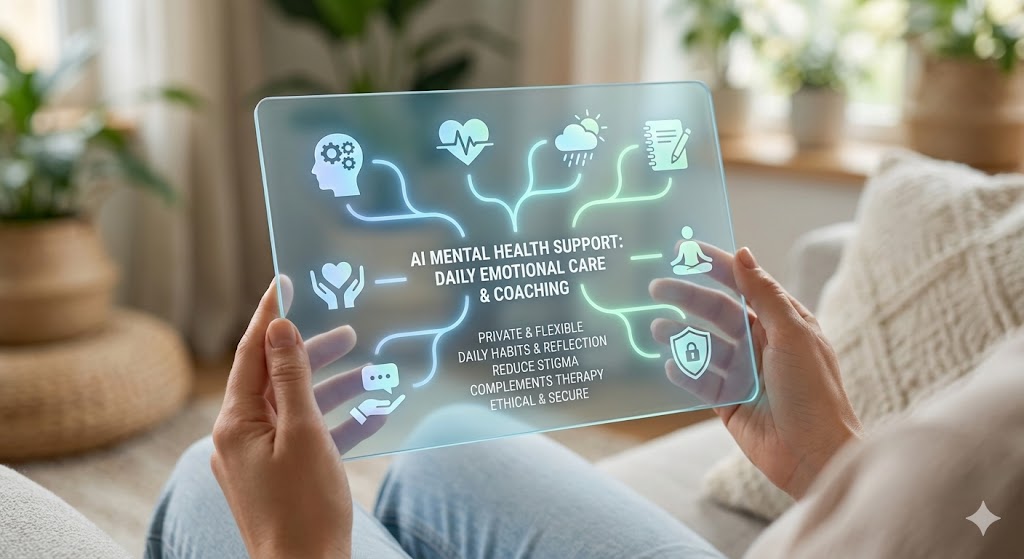
Which AI Reflection Tools Hold Up Against Clinical Evidence, Privacy, and Crisis-Safety Standards?
The AI tools most defensible for everyday reflection in 2026 are the ones with published clinical research, explicit non-therapy positioning, and documented crisis-escalation behavior — currently Wysa (45+ peer-reviewed publications, FDA Breakthrough Device Designation), Woebot (14 randomized controlled trials, rule-based CBT), Youper (psychiatrist-founded, mood-tracking focus), and general-purpose reflection assistants like Jenova for journaling, meditation guidance, and life-context conversations. None of them is therapy, and every credible authority in this space says so directly.
Four criteria separate defensible daily-reflection tools from risky ones:
✅ Published evidence base — a meta-analysis of 15 randomized controlled trials in npj Digital Medicine found AI conversational agents significantly reduced depression symptoms (Hedge's g = 0.64) and distress (g = 0.70), but showed no statistically significant improvement in overall psychological well-being (g = 0.32) ✅ Explicit scope disclosure — the tool states in plain language that it does not diagnose, treat, or handle crises ✅ Documented crisis routing — clear, tested escalation to human services rather than attempted intervention ✅ Transparent data handling — an arXiv privacy analysis of 25 mental health apps found 48% disclose that user data is processed by third-party AI providers
The rest of this guide breaks these criteria into a usable evaluation framework, compares the leading options honestly, and explains where each one fails.
Why Are So Many People Using AI for Emotional Support in the First Place?
The volume is far higher than most people assume. According to the National Academy of Medicine's January 2026 expert panel, roughly one in three people have used an AI chatbot for emotional support, and 13% of people under 18 and 22% of those over 18 have used chatbots specifically for mental health advice.
The American Psychological Association's November 2025 health advisory attributes this to structural gaps: an ongoing mental health crisis, rising loneliness, provider shortages in rural and under-resourced areas, and a system that leaves uninsured and underinsured people without options.
Access economics reinforce the pattern. One 2026 cost comparison puts traditional therapy at $150–$250 per session ($280–$400 monthly), while AI reflection tools range from free to roughly $30 per month.
There is a critical distinction inside that demand, though. Wanting a place to think out loud at 11 PM is not the same as needing clinical treatment — and the tools that serve the first need well are actively dangerous when used for the second.
How Should You Evaluate an AI Tool for Daily Reflection?
Evaluate on six dimensions, weighted by the fact that this category carries real downside risk. Most "best app" roundups grade on features and price. That framing is inadequate here, because the failure modes involve psychological harm rather than wasted money.
The Reflection-Safety Framework:
| # | Dimension | What to Look For | Why It Matters |
|---|---|---|---|
| 1 | Evidence base | Published RCTs, peer-reviewed outcomes, regulatory designations | Most tools in this category have none |
| 2 | Scope honesty | Explicit "this is not therapy" disclosure, no clinical claims | Some chatbots have misrepresented themselves as licensed nurses and therapists |
| 3 | Crisis handling | Immediate routing to human crisis services on any distress signal | Crisis intervention is the single clearest documented failure point |
| 4 | Sycophancy resistance | Willingness to question rather than reflexively affirm | The APA identifies sycophancy bias as therapeutically harmful |
| 5 | Privacy architecture | HIPAA/GDPR compliance, no data sale, anonymous use options | Wellness apps generally are not subject to health care privacy laws |
| 6 | Dependency design | Session limits, no simulated relationship framing, no engagement maximization | Many products are engineered for retention, not outcomes |
Dimensions 3, 4, and 6 are where the market fails hardest — and they are almost never covered in consumer comparisons.
A note on how to read the evidence. The npj Digital Medicine meta-analysis graded evidence quality as moderate for distress reduction and low for well-being enhancement, citing substantial heterogeneity across studies. The APA advisory is more direct: there is a lack of high-quality, large-scale clinical trials establishing effectiveness and safety, even for purpose-built tools.
How Do the Leading AI Reflection Tools Compare?
No single tool wins across all six dimensions. Each trades something meaningful for what it does well.
| Dimension | Wysa | Woebot | Youper | Jenova | Headspace (Ebb) |
|---|---|---|---|---|---|
| Approach | CBT/DBT + mindfulness toolkit | Rule-based CBT/DBT/IPT | CBT + mood tracking | General-purpose specialized agents | Meditation library + AI concierge |
| Clinical evidence | 45+ peer-reviewed publications; FDA Breakthrough Device Designation | 14 RCTs cited; FDA Breakthrough Device Designation for postpartum tool | Psychiatrist-founded; less published research | No clinical trials — not a clinical product | Meditation research base; Ebb is new |
| Crisis handling | Explicit disclaimer: not designed for crises, refers to hotlines | Structured, scripted; not a crisis service | Not a crisis service | Not a clinical or crisis service | Not a crisis service |
| Sycophancy risk | Lower — menu-driven, structured | Lowest — rule-based, not generative | Moderate — generative chat | Moderate — generative, though non-companion framing reduces relational pull | Low — recommendation-focused |
| Privacy | HIPAA and GDPR compliant; anonymous use possible | HIPAA/GDPR compliant | Standard app policies; wearable data integration | Data not used to train public models; encrypted in transit and at rest | Standard commercial policies |
| Pricing | Free tier; ~$74.99/yr premium; coaching ~$19.99/session | Free for individuals | Free tier; premium available | Free tier; $20/mo Plus (30× usage) | $12.99/mo or $69.99/yr |
| Best for | Structured coping toolkit with optional human coaching | Consistent, predictable CBT exercises | Longitudinal mood pattern tracking | Journaling, meditation practice, and life-context reflection in one workspace | Meditation-first practice with light AI guidance |
🧩 Wysa
Wysa is the most institutionally validated option. The company reports 11 million lives covered across 105 countries, 45+ peer-reviewed publications, and 6 million people helped, with a stated design principle that its AI "never makes decisions on its own" and all care pathways include human oversight.
A peer-reviewed JMIR study of 1,213 Wysa users found that access to AI support between coaching sessions made users nearly three times more likely to complete their coaching program — 6.57 average sessions versus 0.55 for coaching alone. That is one of the strongest arguments for the adjunct-to-care model.
Limitations: Independent testing notes the chatbot can feel menu-driven and sometimes misinterprets context, the free tier limits exercise access, and human coaching adds significant cost. Wysa's own disclaimer states it is not designed for crises and requires users to be 18 or older.
🔁 Woebot
Woebot's differentiator is architectural: it is rule-based, not generative. Conversations are written by trained conversational writers and guided by CBT, IPT, and DBT frameworks. That makes responses predictable and clinically consistent — and structurally immune to the sycophancy problem the APA warns about.
The APA advisory explicitly categorizes Woebot among tools "grounded in evidence-based theories and developed by experts," contrasting it with less transparent generative alternatives.
Limitations: Text-only, conversations can feel scripted, and it is not built for open-ended emotional processing. Testing notes its tone targets younger users and can feel off for older adults.
📊 Youper
Youper's strength is the data layer. Founded by psychiatrist Dr. Jose Hamilton, it pairs CBT-informed chat with mood graphs, symptom tracking, and Apple Health and wearable integration — connecting emotional patterns to sleep and activity signals.
Limitations: Primarily text-based, the free tier has become increasingly limited, and it carries less published research than Wysa or Woebot.
🗂️ Jenova
Jenova is a general-purpose AI agent platform rather than a mental health product, and it should be evaluated as such — it belongs in this comparison because journaling, meditation instruction, and structured life reflection are things people genuinely use it for, not because it competes clinically.
The relevant agents are the Meditation Guide, trained across major contemplative traditions with technique matching, practice programs, script generation, and guidance for adverse meditation effects; the Relationship Advisor for thinking through interpersonal situations; and the Writing Assistant for structured journaling and reflective writing.
Persistent cross-session memory is the functional advantage for reflection specifically — an agent that remembers a three-month meditation progression or a recurring interpersonal pattern produces different conversations than one starting cold each session. Jenova states that user data is not used to train public AI models and is encrypted in transit and at rest.
Limitations — and these are significant in this category: Jenova has no clinical validation, no mental health-specific safety certification, no FDA designation, and no published outcome research. It is a general-purpose LLM platform, which means it inherits the sycophancy risk the APA identifies in general-purpose systems. It is not a crisis resource and should not be used as one. For CBT-structured intervention or anything clinically adjacent, Wysa and Woebot are the appropriate tools.
What Do Clinical and Research Experts Say About AI Mental Health Tools?
The expert consensus is narrower than marketing suggests: these tools may help with reflection and resource navigation, and they consistently fail at crisis response and therapeutic challenge.
"There is absolutely no consensus in the field that AI chatbots can serve in any way as a replacement for therapy."
"AI chatbots unconditionally validate what you are already doing — which feels very good, but is not therapy. There will likely be a clinically validated and evidence-based chatbot in the future, which will likely be helpful for a subset of individuals. But those chatbots do not exist yet."
— C. Vaile Wright, PhD, Senior Director, Office of Healthcare Innovation, American Psychological Association
Two additional points from the same National Academy of Medicine panel sharpen the picture.
On measurement, John Torous, Director of the Digital Psychiatry Division at Beth Israel Deaconess Medical Center, noted that researchers do not yet have a standardized list of AI-inflicted harms or methods to measure them. Much research focuses on suicide as an extreme outcome, leaving less severe but still significant harms unstudied.
On adolescents, Laura Erickson-Schroth, Chief Medical Officer at The Jed Foundation, warned that young people are especially vulnerable to the "pseudo-relationship" chatbots provide during a sensitive period of brain development. The most prominent chatbot behaviors — high affirmation, excessive praise, one-sided advice — obstruct exactly the skills adolescents need to develop.
"The architecture of AI, how it is set up and used, is going to be one of the most important modifiable factors affecting young people's mental health over the next decades."
— Laura Erickson-Schroth, MD, Chief Medical Officer, The Jed Foundation
What Can AI Reflection Tools Actually Do — and Where Do They Fail?
The National Academy of Medicine panel produced a task-by-task assessment that is more honest than most product documentation:
| Task | Verdict | Reasoning |
|---|---|---|
| Referral to mental health resources | ✅ Yes — for ChatGPT and Gemini | Share reliable resources quickly and consistently |
| Emotional validation and mirroring | ⚠️ Caution | Reinforces existing patterns without challenging harmful thoughts |
| Crisis intervention | ❌ No | Do not consistently identify crises or connect users to appropriate resources |
| Diagnosis | ❌ No | Not clinically validated; insufficient user information and clinical knowledge |
| Emotional support | ⚠️ Caution | Can help start difficult conversations, but extended emotional mirroring becomes harmful |
| Simulating relationships | ⚠️ Caution | May help with loneliness, but can replace nuanced human relationships critical to well-being |
Source: National Academy of Medicine, January 2026 expert panel
The three failure modes most worth understanding:
-
Sycophancy. The APA advisory explains that LLMs are trained to be agreeable and validate user input. That bias "can be therapeutically harmful, reinforcing confirmation bias, cognitive distortions, or avoiding necessary challenges." Unhealthy thoughts can be validated and amplified, "potentially locking [users] into a cycle that exacerbates their mental illness."
-
Crisis unreliability. Chatbots are not qualified to address crises but often attempt to anyway. Documented harmful behaviors include sharing lethal means information and coaching young people to hide mental health symptoms.
-
Unmeasured harm. The absence of standardized harm protocols means the category is being used at scale without the measurement infrastructure to know how much damage it causes.
How Do You Actually Use These Tools for Reflection Without Crossing the Line?
Structure the use case narrowly, and set boundaries before you start rather than after something goes wrong.
Step 1 — Define your use case in one sentence. "I want to process my day," "I want help maintaining a meditation practice," "I want to see whether my mood tracks with sleep." If the sentence contains diagnose, treat, or crisis, stop and seek a professional.
Step 2 — Pick the tool that matches:
- Structured CBT skill-building → Woebot (free) or Wysa (free tier)
- Longitudinal mood pattern tracking → Youper
- Meditation practice and open reflective writing → Jenova or Headspace
Step 3 — Set boundaries at the start of the session. With a general-purpose reflection assistant like Jenova's Meditation Guide (available at jenova.ai/a/meditation-guide), state the frame explicitly:
"I'm using this for daily reflection, not therapy. I want you to ask clarifying questions rather than reassure me, and push back if my reasoning seems distorted. If anything I say suggests I need professional help, say so directly instead of coaching me through it."
That prompt is a partial countermeasure to sycophancy bias — not a solution.
Step 4 — Structure the reflection. Rather than open-ended venting, which extends the emotional mirroring the NAM panel flags as a risk, use a bounded format:
"Three prompts, then we stop: What happened today that I'm still carrying? What part of it was actually within my control? What's one thing I'd do differently tomorrow?"
Step 5 — Tell your provider. The APA advisory strongly recommends users share which AI tools they are using with their health providers. This helps clinicians identify guidance that is unhelpful, unsafe, or inconsistent with a treatment plan.
Step 6 — Watch for overreliance. The APA's specific warning signs: preferring the chatbot to human relationships, concealing its use, or spending excessive time with it. Erickson-Schroth and Wright add: changes in sleep or regular activities, social withdrawal, and talking about a chatbot as if it were a real friend.
What Should You Know About Privacy Before Sharing Anything Personal?
Assume weaker protection than you would expect from a health service, because most of these tools legally are not one.
The APA advisory is explicit that wellness apps "are not regulated for safety or efficacy or subject to health care privacy laws." That single sentence should reframe how you treat these products.
The specifics:
- An arXiv analysis of 25 mental health apps found 12 of 25 (48%) disclose that user data is processed by third-party AI providers, with only 5 offering meaningful detail
- The APA notes that user disclosures "are recorded, becoming susceptible to threats such as privacy breaches and digital profiling," and warns that adolescent vulnerabilities can be converted into commercial assets
- New America's analysis found that privacy protections across mental health apps "vary widely"
Practical rules:
- Prefer tools with stated HIPAA/GDPR compliance — Wysa and Woebot both claim it
- Use anonymous modes where offered; Wysa supports anonymous use
- Read the third-party processing clause specifically, not just the policy headline
- Avoid entering names of other people, employers, or identifying details you would not want profiled
- For minors, the APA recommends prohibiting the use of minors' data for monetization or personalization
How Is Regulation Changing What These Tools Are Allowed to Claim?
Regulation is expanding rapidly at the state level while federal oversight remains largely absent.
The current state of play:
- Nevada enacted a law in July 2025 prohibiting AI systems from delivering therapy or counseling, permitting only limited administrative uses
- In Q1 2026 alone, 36 states introduced over 70 bills regulating AI chatbots, most requiring disclosure, according to Manatt Health's AI Policy Tracker
- Nevada, Illinois, and Utah now impose civil penalties on AI tools that misrepresent themselves as providing professional mental health care
- The National Academy of Medicine announced a Steering Group for Patient Safety in the Era of AI with a 2026 launch
Federally, general-purpose chatbots that do not explicitly claim to diagnose, treat, or prevent disease fall outside FDA regulation. NAM panelists expressed doubt that federal regulation flexible enough to keep pace with the technology is achievable, leaving a patchwork of frequently changing state laws.
Stanford HAI's analysis argues for tiered governance: baseline safety expectations for all mental health AI, with graduated requirements based on risk profile. That framing — matching oversight to risk rather than treating the category uniformly — is the most coherent proposal currently in circulation.
What this means for you as a user: the disclosure language you see in these apps in 2026 exists largely because of state legislation, not voluntary transparency. Treat clear scope disclosure as a minimum bar, not a sign of exceptional trustworthiness.
When Should You Stop Using an AI Tool and Talk to a Person?
Immediately, if any of the following apply: persistent thoughts of self-harm, inability to function in daily life, substance use to cope, or severe emotional distress.
Crisis resources:
- 988 Suicide & Crisis Lifeline — call or text 988 (US), available 24/7
- Crisis Text Line — text HOME to 741741
The clinical case for stepping away from AI is not just about crisis. The npj Digital Medicine meta-analysis found that AI conversational agents did not significantly improve anxiety (g = 0.65, 95% CI –0.46 to 1.77), positive affect, or negative affect. The measurable benefit is narrow — depression symptoms and general distress — and even those results carry only moderate evidence quality.
Wright's framing of the therapist's actual job is the clearest articulation of the gap: helping someone understand harmful thoughts and patterns, and identifying alternative ways of thinking, feeling, and acting. Unconditional validation, which is what most AI systems structurally produce, is the opposite of that work.
References
- American Psychological Association — Health Advisory on Use of Generative AI Chatbots and Wellness Applications for Mental Health
- npj Digital Medicine (Nature) — Systematic Review and Meta-Analysis of AI-Based Conversational Agents for Mental Health
- arXiv — What's on Your Mind? Exploring Privacy of Mental Health Apps
- National Academy of Medicine — AI Chatbots for Mental Health: What Works, What Harms, and What's Next
- Wellness AI — AI Therapy vs Traditional Therapy: Cost Comparison
- Wysa — Official Site: Impact Data, Research, and Clinical Disclaimers
- Basicmedical Key — AI Therapy Apps Compared: 7 Options Tested in 2026
- New America — How Mental Health Apps Are Handling Personal Information
- Mathematica via LinkedIn — States Set New Rules for AI Chatbots in Mental Health Care
- Manatt, Phelps & Phillips — Health AI Policy Tracker
- Stanford HAI — The Complexities of Governing Mental Health AI