What Are the Best Multiplayer AI Roleplay Games in 2026?
2026-09-08
How Do Shared Sessions and Persistent World State Separate Multiplayer AI RPGs From Chatbots?
The strongest multiplayer AI roleplay games in 2026 are the ones that treat a campaign as shared state, not as a clever chat transcript. Jenova is strongest for system-agnostic narrative play with persistent characters, while Neverend and Friends & Fables are stronger when a human party needs a dedicated game-master client, and wilds.ai is stronger when dice, maps, and inventory must be mechanically enforced.
That distinction matters more than a feature checklist. A chatbot can improvise a tavern scene. A multiplayer roleplay game has to remember who betrayed whom, what the party looted, and whether the next session starts in the same world.
Key factors that separate durable multiplayer AI roleplay from disposable character chat:
✅ Shared-session architecture — more than one human can act in the same scene, or multiple AI characters can pursue goals without collapsing into one narrator voice.
✅ World memory that survives session three — faction standing, wounds, romances, and unanswered plots carry forward instead of resetting with the context window.
✅ Fair resolution — dice, inventory, or social consequences that players can trust, whether those rules are hardcoded or described in plain English.
✅ Character autonomy — NPCs and companions that keep distinct motives, rather than echoing the same generic persona.
✅ Fit to play pattern — Dungeons & Dragons (D&D) combat tables, social sandboxes, and collaborative worldbuilding need different tools.
To compare these games usefully, it helps to stop asking which app is “most fun” and start asking which layer of multiplayer each product actually implements.
Why Did Multiplayer AI Roleplay Split Into Three Distinct Play Patterns in 2026?
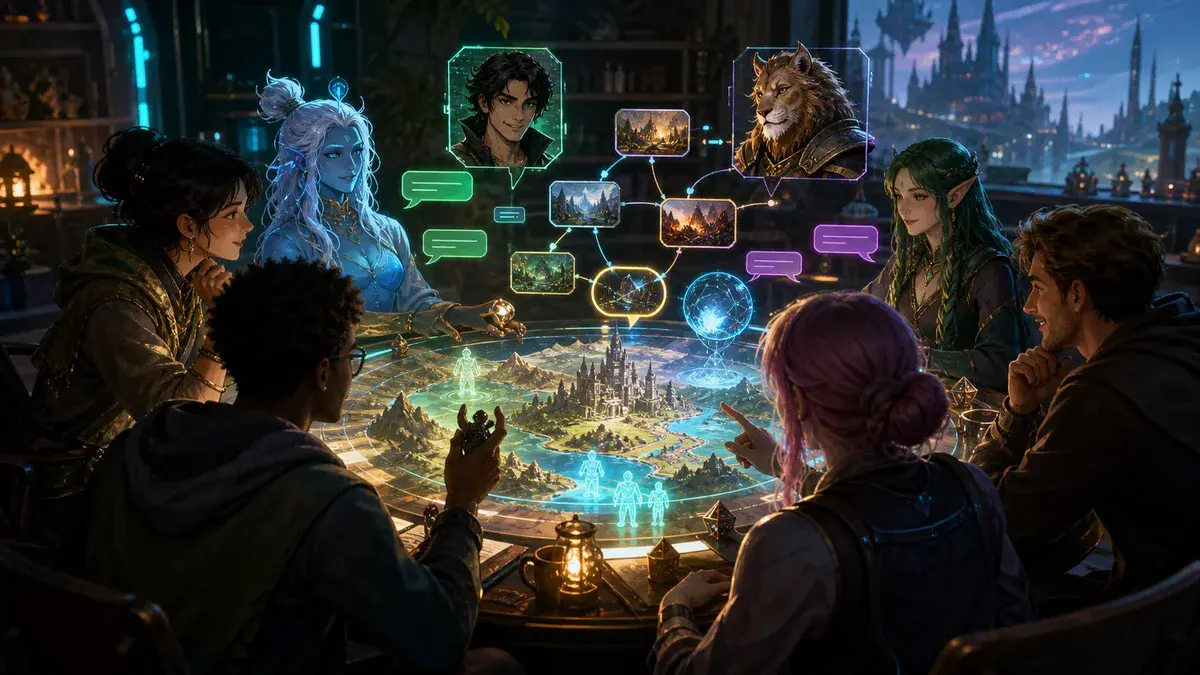
Multiplayer AI roleplay split into three play patterns because “play with others” now means human parties, autonomous AI casts, and shared world authorship, and those are different products. Treating them as one category is why so many 2026 roundups mix Character.AI chatbots with tabletop game engines.
Call this the Three-Table Model. Table A is a human party with an AI game master. Table B is one or two humans inside a cast of AI characters who keep their own goals. Table C is collaborative worldbuilding that later becomes play.
Table A is what most D&D groups actually want: several players, one referee, shared consequences. Neverend markets this directly as play solo or with friends, and Friends & Fables supports multiplayer for up to six players with D&D 5th Edition (5e) combat handling.
Table B is where chat-native platforms still excel. Jenova’s Roleplay Game Master and Love Island run living casts whose relationships persist. That is multiplayer in the dramatic sense — many agents, conflicting motives — even when only one human is typing.
Table C is the worldbuilding table. Summon Worlds lets creators publish a world or turn it into a Shared World others can contribute to, then step into those worlds through Adventure Mode.
The market around these tables is no longer experimental. Comtrade Gaming described 2025 as the year agentic AI moved from discussion into product systems, while developers have grown more cautious: generative AI use among game developers fell from 36% in 2025 to 29% in 2026, and 47% say AI could hurt game quality. Players feel that tension at the table. They want AI that remembers the campaign, not AI that overwrites it.
An AI Dungeon Master, in the tabletop sense, is a language model configured to narrate the world, play NPCs, and resolve actions without a human referee. That definition is necessary but not sufficient for multiplayer. If two friends cannot share a scene, or if the world forgets last week’s betrayal, the tool is still a story generator.
What Criteria Matter Most When Choosing a Multiplayer AI Roleplay Game?
You should score a multiplayer AI roleplay game on six dimensions: human party support, world persistence, mechanical fairness, character distinctness, platform access, and cost-to-continue. Weight those dimensions by how you actually play, not by which homepage looks most like a video game.
This is the Party Continuity Stack. Each layer fails independently.
1. Human party support. Can two or more people issue actions in one scene? Neverend and Friends & Fables are built for that. Jenova supports shared chats and multi-agent scenes, but it is not a dedicated tactical client. Summon Worlds emphasizes Shared Worlds and later play, not a full virtual tabletop.
2. Persistent world state. Memory is the feature players notice after session three. One 2026 comparative test found Friends & Fables combat fidelity was strong while memory degraded across long campaigns, and chat-only Dungeon Masters often collapsed without an external notes document.
3. Mechanical fairness. If dice can be fudged or inventory can vanish, trust erodes. wilds.ai’s pitch is server-authoritative dice and deterministic combat. Jenova resolves many actions conversationally, which is flexible and weaker for rules lawyers.
4. Character distinctness. Social games die when every NPC smirks the same way. Specialized agents and separate character records beat a single prompt pretending to be a crowd.
5. Platform access. Neverend’s App Store listing is iPhone-only, requiring iOS 18 or later. Summon Worlds is a Play Store app with 100,000+ downloads. Jenova runs with feature parity across web, iOS, and Android.
6. Cost-to-continue. Free tiers are common; the real number is what you pay once a weekly campaign is habit. As of 2026, Character.AI’s paid plan is listed at $9.99 per month or $94.99 per year for ad-free chat. wilds.ai lists Plus at $9 per month and Pro at $19 per month. Jenova’s Plus plan is $20 per month for 30× free-tier usage.
A practical weighting for a four-person D&D group is 30% human party support, 25% mechanical fairness, 20% persistence, 15% access, 10% price. A solo player who wants a soap-opera court should invert that stack and put character autonomy first.
How Does Jenova Compare to Neverend, Friends & Fables, and wilds.ai?
Jenova compares as a persistent, multi-model narrative platform; Neverend as a mobile D&D-style party game; Friends & Fables as a 5e-faithful group GM; and wilds.ai as a mechanics-first campaign engine. None of them wins every layer of the Party Continuity Stack.
| Feature / Dimension | Neverend | Jenova | Friends & Fables | wilds.ai | Summon Worlds |
|---|---|---|---|---|---|
| Human party play | Solo or invite friends | Shared chats and multi-agent scenes | Up to 6 players | Unverified as a human-party client | Shared Worlds plus later play |
| Rules approach | Attribute checks, dice, inventory | Any system described in plain English | D&D 5e SRD combat and classes | Described systems plus combat/dice engines | Lore graph, then Adventure Mode |
| Persistence | Auto-save adventures | Unlimited cross-session memory | Session maps; long-campaign memory weaker in testing | NPC disposition and consequence tracking | Linked characters, locations, and lore |
| Maps and dice | Dice rolls and loot | No tactical grid; AI-interpreted resolution | Generated battlemaps | Server-authoritative dice, tactical grids | Art and world links, not a VTT |
| Availability | iPhone, iOS 18+ | Web, iOS, Android | Web (as tested in 2026 roundups) | Web campaign tools | Android app, 100k+ downloads |
| Pricing (as of 2026) | Free with subscriptions and energy packs | Free; Plus $20/mo | Free with limited messages; Premium available | Free 500 credits; Plus $9/mo | Free download; in-app purchases |
| Best for | Mobile D&D-style friend sessions | Flexible narrative campaigns and AI casts | Groups that want 5e combat structure | Players who need mechanical state | Collaborative worldbuilding |
Neverend
Neverend is an AI-powered D&D-style game that generates unique adventures and, according to its App Store listing, is “the only AI roleplay game with true multiplayer” for that D&D-style format. Heroes use Physical, Mental, Social, Spirit, and Luck attributes. Dice checks, inventory, and auto-save are part of the loop.
The limitation is distribution and depth. It is listed for iPhone only, uses optional subscriptions and energy packs, and is built around a D&D-style fantasy loop rather than Call of Cthulhu, romance simulation, or homebrew systems. For a friend group that already lives on iOS, that constraint may not matter. For a mixed-device table, it does.
Friends & Fables
Friends & Fables, also referred to as Fables.gg, is the 5e specialist in 2026 comparisons. Its AI game master “Franz” is described as handling initiative, attacks, spells, hit points, and class features against 5e SRD rules, with battlemaps and parties of up to six.
That is a real strength for groups who do not want to argue about spell slots with a chatbot. The same testing noted lock-in to 5e, no Pathfinder or Call of Cthulhu, and memory that degrades across long campaigns. If your table is a two-year homebrew world, that memory gap is the product.
wilds.ai
wilds.ai positions itself as a multi-engine stack rather than a wrapped chatbot: deterministic combat, server-authoritative dice, inventory, tactical grids, and a consequence engine. In its own long-campaign tests, NPC disposition and faction retaliation persisted across sessions.
Take that ranking with the obvious caveat that wilds.ai published it. The useful, checkable claims are pricing and architecture: a free tier with 500 starter credits, then $9 and $19 monthly paid tiers, plus an explicit bet that dice should not be narrated into existence. Human-party multiplayer is not clearly documented in that write-up the way Neverend and Friends & Fables document it, so treat wilds.ai as mechanics-first until you verify the lobby.
Jenova
Jenova is the opposite design: conversation-native agents with unlimited chat history, persistent cross-session memory, and models from OpenAI, Anthropic, Google, DeepSeek, and xAI. The Roleplay Game Master will run D&D, Pathfinder, or a rules-light mystery if you describe the table contract. Structured games such as The Mansion, The Asylum, Vesper Court, and K-Pop Producer give you authored premises instead of a blank page.
The honest limitation is the same one a 2026 dungeon-master comparison recorded: no deterministic dice engine, no tactical maps, no visual inventory layer. Combat is interpreted, not litigated. Jenova is therefore weaker as a virtual tabletop and stronger when the campaign’s load-bearing wall is character continuity, genre switching, or several specialized AI roles in one ongoing story.
Which AI Tools Handle Dungeons & Dragons Party Campaigns Most Reliably?
For a human D&D party, Friends & Fables and Neverend are the more reliable session clients, while Jenova and wilds.ai are better supporting stacks depending on whether you need narrative flexibility or mechanical enforcement. “Reliably” here means the table can finish combat, keep character sheets coherent, and resume next week.
Friends & Fables is the closest to a 5e club night. Class-and-race character creation, SRD combat resolution, and generated battlemaps reduce the number of things a tired player has to track. The failure mode is campaign length: if Franz forgets a rival NPC’s grudge, the party starts playing the tool instead of the world.
Neverend is the commute-friendly version of Table A. Attribute checks and loot give the session a game shape, and friend invites are the multiplayer claim. The failure mode is ecosystem lock: iPhone, energy economy, and a fantasy-adventure voice that may not stretch into political intrigue or horror.
wilds.ai is for groups who have been burned by fudged rolls. Server-side dice and grid persistence are the reason to choose it. The failure mode is expecting hardcoded 5e. The platform interprets a described system rather than shipping a complete rules-as-written 5e engine.
Jenova is the better D&D option when the party is mixed-system, plays across phones and laptops, or wants the GM to hold months of roleplay with perfect NPC voices. A typical setup is:
- Open the Roleplay Game Master and state the table contract in the first message.
- Name every player character, the rules variant, and what the AI must wait for.
- Keep a short “session zero” block pinned in conversation so later players can catch up.
"We are four players using simplified D&D 5e. I play Mara, a disgraced knight. Alex plays a debt-ridden wizard, Sam a city thief, Jordan a temple medic. Use ability checks, not full spell-slot accounting. Do not resolve a group action until each player has spoken. Track wounds, coin, and the magistrate’s trust across sessions."
If you still want maps, run Jenova for roleplay and a virtual tabletop for combat. That hybrid is less elegant than Friends & Fables, and more durable for a campaign that keeps leaving the dungeon.
Which AI Roleplay Games Excel at Social Worlds Rather Than Combat?
Social multiplayer AI roleplay is led by tools that give NPCs independent motives, not by tools that generate better battlemaps. Love Island, Vesper Court, K-Pop Producer, and Character.AI-style character chat occupy this lane; Neverend and Friends & Fables mostly do not.
Love Island is an open-world romance simulation: eight strangers on a private island, with connections and rejections emerging from choices rather than a scripted rose ceremony. That is Table B multiplayer. The drama is other agents pursuing their own relationships while you play.
Vesper Court is a dark-romance court game: a woman wakes in a hidden vampire household with no memory, and each night shifts alliances. It is closer to a persistent social dungeon than to a loot loop. K-Pop Producer compresses the same idea into a 60-day debut cycle — trainees, power dynamics, and career choices — which plays like a management RPG told through conversation.
Character.AI remains the high-traffic casual option. Independent 2026 explainers still describe a free text-chat tier with ads and regeneration limits, and a $9.99 monthly ad-free plan. It is easy to start and weak as a campaign engine: one character box, limited memory, and no party inventory. Use it for short scenes. Do not expect it to referee a twelve-session political plot.
Summon Worlds sits between social play and production design. You can chat with characters, define friendships and rivalries, generate portraits, and invite others into a Shared World. A July 2026 user review noted the reviewer had built nearly 100 worlds but had not yet used AI or multiplayer, which is a useful signal: the product’s center of gravity is still creation. Adventure Mode is the play layer on top.
Jenova’s social advantage is agent specialization. You can keep a campaign in the Roleplay Game Master, then bring in a second agent for a distinct NPC voice, or switch to a structured social game when you want constraints. The limitation is presentation. There is no island map, no relationship HUD, and no public character browser on the scale of Character.AI. The world lives in memory and prose.
How Does Long-Campaign Memory Change Multiplayer Play After Session Three?
Long-campaign memory changes multiplayer play after session three because that is when trust shifts from “the AI is witty” to “the AI is the world.” Groups abandon tools that cannot recall NPC disposition, loot, and unresolved plots, even if session one felt magical.
A 2026 dungeon-master field test made this the ranking criterion on purpose. Most reviews, it argued, only watch session one. After session three, three properties decide survival: deterministic mechanics, actual persistence, and mechanical state tracking for hit points, inventory, and quest flags. ChatGPT-or-Claude-with-a-prompt still writes well, then forgets the campaign unless someone pastes a state document every week.
That finding maps cleanly onto the Three-Table Model. Table A groups notice forgotten initiative rules and missing magic items. Table B groups notice personality homogenization — every companion becoming the same flirtatious narrator. Table C groups notice broken links between a city, its factions, and the people who live there.
Jenova’s bet is unlimited conversation memory and cross-session persistence: session fifty can still know session one’s vow. That is a large advantage for social and story campaigns. It is not a substitute for a seeded dice server. If your table’s fun depends on proving a critical hit, you still want wilds.ai or a 5e client.
Friends & Fables and many chat DMs fail in the opposite direction: they remember the rules longer than they remember the grudge. Neverend auto-saves adventures, which solves continuation on a phone, but auto-save is not the same as a living faction graph.
The practical rule is simple. If you would be angry that a human GM forgot a player’s dead sibling, do not pick a tool whose memory is “the last few thousand tokens.” Multiplayer does not require five humans. It requires a world that other people — human or AI — can re-enter.
How Do You Run a Shared AI Roleplay Campaign With Friends?
You run a shared AI roleplay campaign by writing a table contract first, choosing a tool that matches your play pattern, then keeping one channel as the book of record. Skipping the contract is how groups end up with four different tones and a GM that rushes every scene.
For a human party on a D&D-style client
On Neverend, the documented loop is: start free, pick a hero, invite friends, make decisions together, and let attribute checks plus inventory structure the night. Adventures auto-save, so a group can pause between commutes. Confirm everyone has an iPhone before you sell this as the club’s only table.
On Friends & Fables, create 5e characters, join a party of up to six, and let Franz run combat on generated maps. Assign one human as “scribe” anyway. When memory slips, the scribe’s recap is cheaper than an argument.
For a Jenova narrative table
- Create one shared chat and add the human players who will speak in character.
- Open the Roleplay Game Master and paste a session-zero brief that names system, tone, taboos, and wait rules.
- Decide whether combat is theater-of-the-mind or whether someone will roll physical dice on camera.
- Recap in three bullets at the end of each session so late players can read instead of interrupting.
"Campaign: Saltmarsh conspiracy, grim and low magic. Players may split the party. When we split, pause and ask which scene to run. NPCs remember bribes and insults. If a player is silent for a scene, do not puppeteer their character. End each session with a hook and a state summary: location, injuries, enemies, open questions."
If the table wants a mystery with rails instead of a sandbox, The Mansion or The Asylum can be the Tuesday game, while the Roleplay Game Master remains the Saturday sandbox. Those structured games are primarily single-human investigations with a cast of NPCs, so do not expect them to replace Neverend’s friend lobby.
For a worldbuilding-first group
On Summon Worlds, build the city and its cast first, link characters to locations, then turn the setting into a Shared World and use Adventure Mode to walk people through it. This is the right order when your friends enjoy lore more than initiative. It is the wrong order when they want to fight a dragon tonight.
Across all three setups, ban out-of-character debate inside the scene. Use a second channel for rules. AI GMs already struggle to keep diegetic voices distinct; mixing scheduling chatter into the same stream makes that worse.
What Do Game Designers Say About AI Game Masters at Multiplayer Tables?
Game designers treating AI as a referee, not a novelist, tend to say the same thing in 2026: multiplayer fails when the model is allowed to be both narrator and unaccountable physics engine. The interesting split is whether you fix that with software constraints or with table procedures.
"The feature players call multiplayer is usually persistence. Two friends can occupy a chat tomorrow. That is logistics. What they actually need is a world that still knows who poisoned the duke. If that fact dies with the context window, you did not run a campaign. You ran sequential one-shots with the same character names."
"Dedicated engines should own dice, maps, and item state. Language models should own motive, dialogue, and complication. When one system does both, it will cheat in whichever direction keeps the scene moving. That feels kind in session one and fake in session four, especially when a player already distrusted the roll."
"Chat-native platforms still earn a seat when the table is system-agnostic. A Friday horror one-shot, a Sunday romance, and a political sandbox should not require three rules implementations. They do require named characters who do not homogenize, and a GM that waits for every human before resolving the room."
— Jenova Product Team, designers of AI roleplay and interactive-fiction agents used in long-running player-driven campaigns
That view lines up with the broader industry mood. Developers are integrating agentic systems while simultaneously warning that AI can degrade quality. For a multiplayer table, quality is not prose flourish. It is whether the other people at the table — human or NPC — still inhabit the same facts.
The Harvard Journal of Sports and Entertainment Law’s 2026 survey of U.S. AI companion legislation also reminds designers that NPCs are no longer only quest-givers. They are teammates, adversaries, and companions inside games that look a lot like relationships. Multiplayer design now includes duty of care, not just initiative order.
Who Should Choose a Chat-Based Platform Over a Dedicated AI RPG Engine?
You should choose a chat-based platform over a dedicated AI RPG engine when your campaign’s scarce resource is character continuity across genres, devices, and months, not grid combat. You should choose the engine when the table’s fun depends on proving outcomes.
Choose Jenova, or a similar agent platform, if most of these are true:
- The party changes systems (5e one month, rules-light horror the next).
- Players join from phones and laptops.
- NPCs, romance, and faction politics carry more weight than opportunity attacks.
- You want specialized experiences — a mansion mystery, a vampire court, a producer sim — without teaching a new UI each time.
- You may later export the story, build custom agents, or pull in tools beyond the game.
The Roleplay Game Master is the default sandbox. The Mansion and The Asylum are better when you want a closed mystery. Love Island and Vesper Court are better when social autonomy is the mechanic. K-Pop Producer is better when the pleasure is a time-boxed career sim. Game Designer Assistant is the prep tool if you are designing the system the GM will then run.
Choose Neverend, Friends & Fables, or wilds.ai if most of these are true:
- Two or more humans must act in the same combat round.
- Forgotten spell slots would cause a real argument.
- Someone wants to see a map, not imagine one.
- The campaign is openly D&D-shaped.
Character.AI is the right tool for a different job: fast character chat with a huge public library. It is the wrong tool for a campaign of record. DreamGen, in the same 2026 comparisons, is strong as a long-form roleplay storyteller and weak as a game engine because it lacks dice, maps, combat math, and sheets. That is not an insult. It is a category boundary.
Jenova’s paid limitation is price-to-usage, not missing characters. Free access includes core features with a usage cap; Plus is $20 per month, Premium $50, with higher tiers above that. wilds.ai and Character.AI undercut that sticker for players who only need one narrow loop. Jenova is the better spend when the same subscription has to cover the campaign, the side mystery, and the custom NPC agent.
How Do Privacy Rules and AI Companion Laws Affect Multiplayer Roleplay Games?
Privacy rules and companion laws affect multiplayer AI roleplay by turning NPC intimacy, chat logs, and cross-user content into compliance problems, not just lore problems. Groups should pick platforms based on data use, age gates, and whether a friend’s secrets live in a shared thread.
The legal frame is moving. U.S. commentary in 2026 treats in-game companions as part of a wider AI-companion debate, noting that NPCs already function as shopkeepers, quest-givers, teammates, and adversaries across genres. In Europe, many high-risk AI obligations begin biting in August 2026, with longer timelines for some embedded products. A casual home game is not an enterprise deployment, but app stores and age ratings already encode the same anxiety.
Neverend is rated 16+ on the App Store, with disclosures that usage data may be used to track you across apps and websites, and that contact info, user content, identifiers, and diagnostics can be linked to identity. Summon Worlds is Teen-rated, shows users interact plus in-app purchases, and is built around publishing worlds. Publishing is a multiplayer feature and a privacy event.
Jenova’s relevant controls are product-level: data is not used to train public models, is encrypted in transit and at rest, and is not sold to advertisers. That does not make a shared campaign private. Anything you paste in a group chat is still visible to the people you invited. For Table A games, agree in session zero what is out of bounds: real names, real workplaces, real trauma.
Moderation is the other multiplayer mechanic. Character.AI-style filters can break a scene mid-sentence; unfiltered tools can dump content into a mixed-age friend group. Neither extreme is “more immersive” in the abstract. Immersion is whether the whole table still wants to come back.
The market around all of this is large enough that the rules will keep tightening. One 2026 industry figure puts the AI-in-gaming market on a path to $46.6 billion by 2036. Companion chat, NPC teammates, and AI game masters are inside that envelope. The players who fare best will pick the Party Continuity Stack first, then read the privacy label with the same seriousness they read the class features.
References
- Comtrade Gaming — Lessons from 2025 and agentic AI integration in gaming systems
- Karostartup — How AI Is Changing the Gaming Industry in 2026, including developer adoption and quality concerns
- Arcanum RPGs — Definition and limits of AI Dungeon Masters
- wilds.ai — Best AI Dungeon Master Tools in 2026, including Friends & Fables, wilds.ai pricing, and long-campaign testing
- Apple App Store — Neverend: AI DnD RPG Games, multiplayer claims, attributes, and privacy disclosures
- Google Play — Summon Worlds AI RPG, Shared Worlds, Adventure Mode, and download scale
- AI Deck — Character.AI features and 2026 pricing
- Harvard Journal of Sports and Entertainment Law — AI companion legislation and NPCs in games
- North Atlantic — EU high-risk AI timelines affecting Europe’s gaming sector
- Meticulous Research via Technology Insights — AI gaming market projection to 2036