What Are the Best AI Stock Analysis Tools for Research in 2026?
2026-08-23
How Do Research-First AI Stock Tools Compare on Thesis Quality Versus Trade Signals?
The AI stock tools most useful for research in 2026 are the ones that help you reconstruct a company's economics, risks, and valuation range — not the ones that output a buy or sell ticket. Jenova's Fundamental Stock Analyst is built for that research workflow: earnings analysis, relative valuation, business-model assessment, and real-time work across SEC filings, analyst estimates, and market sentiment, with the investor keeping the decision. Close alternatives for the same job include Seeking Alpha Premium's AI Virtual Analyst Reports, Stock Rover's metric-dense screening environment, conversational terminals such as FinChat.io, and enterprise platforms like AlphaSense.
What separates research-grade AI from a signal feed:
✅ Source-first numbers — every material figure should be traceable to a filing, transcript, or stated estimate, not a fabricated summary. ✅ Thesis construction — moat, unit economics, capital allocation, and scenario ranges matter more than a single grade. ✅ Risk articulation — saturation, regulation, customer concentration, and funding risk should appear before any conclusion. ✅ Factor transparency — letter grades and AI scores are useful only when you can see which inputs moved them. ✅ Decision ownership — the tool accelerates analysis; it does not replace position sizing or judgment.
To compare these tools honestly, it helps to separate research accelerators from pick generators, then score each one on how well it supports a repeatable buy-side process.
Why Are Investors Moving From AI Buy-Sell Alerts to AI Research Workflows?
Investors are moving toward research-first AI because the bottleneck in 2026 is synthesis, not access to another buy or sell ping. Industry roundups this year report that roughly 30% of U.S. retail investors now use AI tools for investment decisions, a sharp rise from the prior year, while the same surveys warn that tools vary wildly in whether they explain why.
The data problem is real. A single large-cap name can generate 10-Ks, 10-Qs, 8-Ks, earnings transcripts, consensus estimates, peer multiples, and a constant stream of news. Traditional analysis is still largely manual — pulling filings, reading transcripts, building spreadsheets, and drawing trendlines — which is why AI platforms that automate synthesis rather than just scoring have become the practical equalizer for self-directed investors.
There is also a credibility split inside the category. Some vendors publish backtested grade or score track records; others publish trade robots and price targets. Openbook Analytics argues that purpose-built research platforms should be judged differently from general chatbots and from signal apps, because the failure mode is different. A wrong alert costs a trade. A hallucinated margin, cash balance, or competitive claim can corrupt an entire thesis.
That is why the more durable use case in 2026 is compression of analyst work: summarize the filing, extract the metrics, score the moat, build scenarios, and list the risks. The investor still decides.
What Should You Look for in an AI Tool Built for Equity Research?
You should look for source traceability, multi-statement financial context, explicit risk language, and a workflow that produces a thesis you can defend — not a ranked list of tickers. We used a six-dimension frame we call the Research Integrity Scorecard: source traceability, thesis construction, filing and transcript synthesis, factor transparency, session persistence, and cost-per-insight.
Source traceability. The tool should cite the 10-K, earnings call, or estimate vintage behind a number. AlphaSense markets clickable citations across filings, broker research, and expert calls as a core design choice, not an add-on (AlphaSense equity research platform). Conversational research agents should do the same at retail scale.
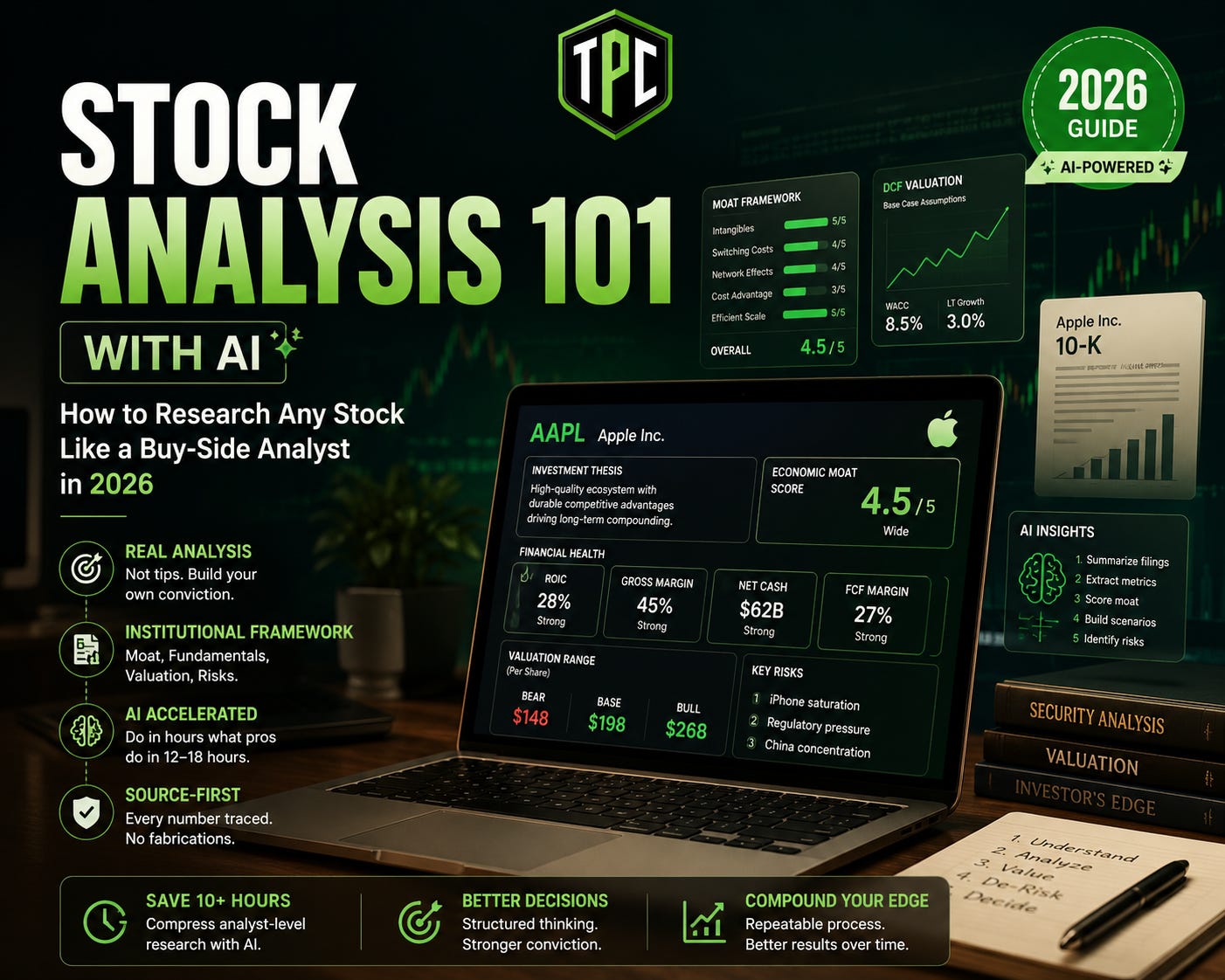
Thesis construction. A research tool needs room for business-model quality, reinvestment runway, and competitive advantage — the work illustrated in buy-side style dashboards that pair a moat score with ROIC, free-cash-flow margin, net cash, and a bear/base/bull value range. A single “AI Score” is not a thesis.
Filing and transcript synthesis. The highest-leverage task is turning a 200-page filing or a 60-minute call into a structured brief without dropping the caveats. FinChat-style terminals are built around this question-and-cite pattern, according to 2026 tool benchmarks.
Factor transparency. Letter grades and 1–10 scores are legitimate inputs when the components are visible. Zen Ratings publishes a 115-factor model with separate Value, Growth, Sentiment, and Momentum grades. Danelfin similarly exposes which technical, fundamental, or sentiment features moved an AI Score. Opaque “strong buy” labels are weaker research artifacts.
Session persistence. Equity work is longitudinal. An agent that remembers last quarter's margin debate, your target multiple, and the risks you already rejected is more useful than a stateless chatbot that restarts every session.
Cost-per-insight. Price only matters relative to the decision it improves. Free signal apps can be enough for screening. Deep fundamental work usually needs a paid data or synthesis layer, whether that is Stock Rover's metric library, Seeking Alpha's research archive, or an enterprise content graph.
A practical test: if you cannot reconstruct the bear case from the tool's output, it is not a research tool. It is a prompt to trade.
How Do Jenova, Seeking Alpha, Stock Rover, and AlphaSense Compare for Fundamental Work?
Jenova's Fundamental Stock Analyst is strongest when you want a conversational, source-oriented equity brief; Seeking Alpha Premium is strongest when you want quant grades plus a large opinion archive; Stock Rover is strongest when you want a metric grid and peer comparison; AlphaSense is strongest when you need premium documents at institutional breadth. None of those strengths is universal, and each product has a clear limitation.
| Feature / Dimension | Jenova Fundamental Stock Analyst | Seeking Alpha Premium | Stock Rover | FinChat.io | AlphaSense |
|---|---|---|---|---|---|
| Analysis style | Conversational earnings, valuation, and business-model research | Quant grades plus AI Virtual Analyst Reports | Screening, peer tables, portfolio analytics | Conversational Q&A over fundamentals and transcripts | AI search across filings, broker research, and expert calls |
| Source orientation | Filing, estimate, and sentiment synthesis in dialogue | Quant stack plus community and staff research | 800+ metrics and decades of statements | Citation-backed answers on ~335 metrics | Clickable citations across premium and public corpora |
| Thesis / valuation support | Relative valuation, scenario discussion, risk write-ups | “Should I own this?” AI summaries on top of grades | Side-by-side fundamentals, income, and risk reports | Multi-year financial history and estimates in paid tiers | Company primers, earnings prep, theme tracking |
| Published score track record | No public multi-year letter-grade backtest | Quant “Strong Buy” history cited by reviewers | Scoring models, not a single famous AI grade | Research assistant, not a published alpha score | Content platform, not a retail stock-rating product |
| Pricing (as of 2026) | Free tier; Plus $20/mo and higher usage tiers | Typically mid-to-high $200s per year | About $8–$28/mo depending on plan | Free tier; paid plans around $20/mo | Custom enterprise quote |
| Best for | Investors who want a research partner, not a pick list | Long-term fundamentals plus AI report synthesis | Value, dividend, and deep-metric investors | Filing-heavy investors who think in questions | Professional analysts and research-heavy family offices |
Jenova Fundamental Stock Analyst
Jenova's agent is a dedicated equity researcher rather than a screener or robot. It is built for earnings analysis, relative valuation, business-model assessment, and live context from SEC filings, consensus estimates, and market sentiment. On the broader Jenova platform it also inherits persistent cross-session memory and multi-model access, which matters when a thesis unfolds over several quarters instead of a single chat.
In practice, that looks like a buy-side memo fragment: what the company actually sells, where incremental returns come from, which risks can break the multiple, and how a bear/base/bull range changes if growth or margins miss. It does not currently publish a 20-year audited letter-grade book like Zen Ratings, and it is not a 800-metric screening terminal. Investors who live inside ranked factor tables will still want Stock Rover or a quant overlay.
Seeking Alpha Premium
Seeking Alpha remains one of the largest retail research communities, and in 2026 its Premium tier adds AI-generated Virtual Analyst Reports on top of Quant Ratings across Value, Growth, Profitability, Momentum, and EPS Revisions. Reviewers have cited historical outperformance for “Strong Buy” rated names versus the S&P 500, though those figures are strategy- and vintage-dependent and should be read as vendor-reported history, not a guarantee.
The limitation is the opposite of a blank conversational agent: you inherit Seeking Alpha's rating taxonomy and a crowded opinion stream. Independent comparisons also note that you do not get Stock Rover's depth of screening or charting tools (Stock Rover vs Seeking Alpha). It is a research library with an AI layer, not a customizable analyst you direct.
Stock Rover
Stock Rover is the least “chatbot-like” product in this set and often the most useful for disciplined fundamental work. The company describes 800+ financial metrics, decades of statements, screening across thousands of companies, and research reports that now extend to 7,400 ETFs and 20,000 mutual funds. Independent 2026 comparisons place paid plans roughly in the $8 to $28 per month band.
The limitation is synthesis. Stock Rover gives you the grid; it does not automatically write the moat memo or argue the bear case in prose. Pairing it with a conversational analyst is a common 2026 stack for that reason.
FinChat.io
FinChat (also associated with Fiscal.ai in 2026 roundups) is the closest retail analogue to a junior associate who lives in the 10-K. Benchmarks describe a global database of about 335 fundamental metrics, up to 10 years of history, three years of estimates, and sourced answers to plain-English questions, with paid plans starting near $20 a month.
The limitation is coverage of the rest of the investment process. FinChat compresses document work; it is not a portfolio risk system, and it is not an institutional transcript-and-broker graph on the AlphaSense scale.
AlphaSense
AlphaSense is the enterprise ceiling of this category. The firm says it is used by 95% of the top consultancies, 90% of top asset managers, 90% of the S&P 100, and 80% of the top hedge funds, with content that includes research from 1,700+ sell-side and independent firms and hundreds of thousands of expert-call transcripts. Generative search, sentiment, and workflow agents are built around that corpus.
The limitation is access. Pricing is custom and generally out of reach for most individuals. If you cannot justify a professional content budget, AlphaSense is the wrong comparison set — even though it remains the reference standard for qualitative equity research.
How Does Conversational AI Change Filing and Earnings Analysis?
Conversational AI changes filing work by letting you interrogate a company the way an associate would interrogate a model — one precise question at a time — instead of rereading the entire document for every follow-up. The research gain is compression plus iteration, not a mystical ability to “see the future.”
A typical research pass on a mega-cap now looks like this:
- Ask for a source-traced snapshot of returns, margins, net cash, and free-cash-flow conversion.
- Isolate the one or two segments that actually drive enterprise value.
- Extract management's guidance language and the conditions attached to it.
- Build a bear/base/bull valuation from stated assumptions, not from a price target the model invented.
- List the three risks that would invalidate the base case.
On Jenova's Fundamental Stock Analyst, that pass is a short briefing, not a weekend project:
"Analyze AAPL as a long-term compounder. Summarize the economic moat with a 1–5 score, extract ROIC, gross margin, net cash, and FCF margin from the latest filings, and give a bear/base/bull fair-value range with the WACC and long-term growth rate you used. Cite every number."
A FinChat-style prompt is narrower and document-centric:
"What was Costco's membership-fee revenue trend over the last five years, and how much of operating income does it represent? Cite the source periods."
Seeking Alpha's Virtual Analyst Reports invert the workflow: the platform writes the first synthesis, and you interrogate the quant grades and recent developments afterward (WallStreetZen's 2026 analyzer review). That is faster when you want a standardized memo. It is weaker when your question is idiosyncratic — a segment split, a one-time item, or a peer that the template does not emphasize.
The failure mode to watch is fluency. A well-written paragraph can still rest on a stale estimate or a rounded figure that never appeared in the 10-K. Research-first use means demanding the citation, then opening the source when the number is load-bearing.
When Are Quant Ratings and Factor Models Useful, and When Do They Hide the Thesis?
Quant ratings are useful as a second opinion and a screening filter; they hide the thesis when they become the entire argument. The healthiest 2026 habit is to treat grades as hypotheses about the next period's relative return, not as a substitute for understanding the business.
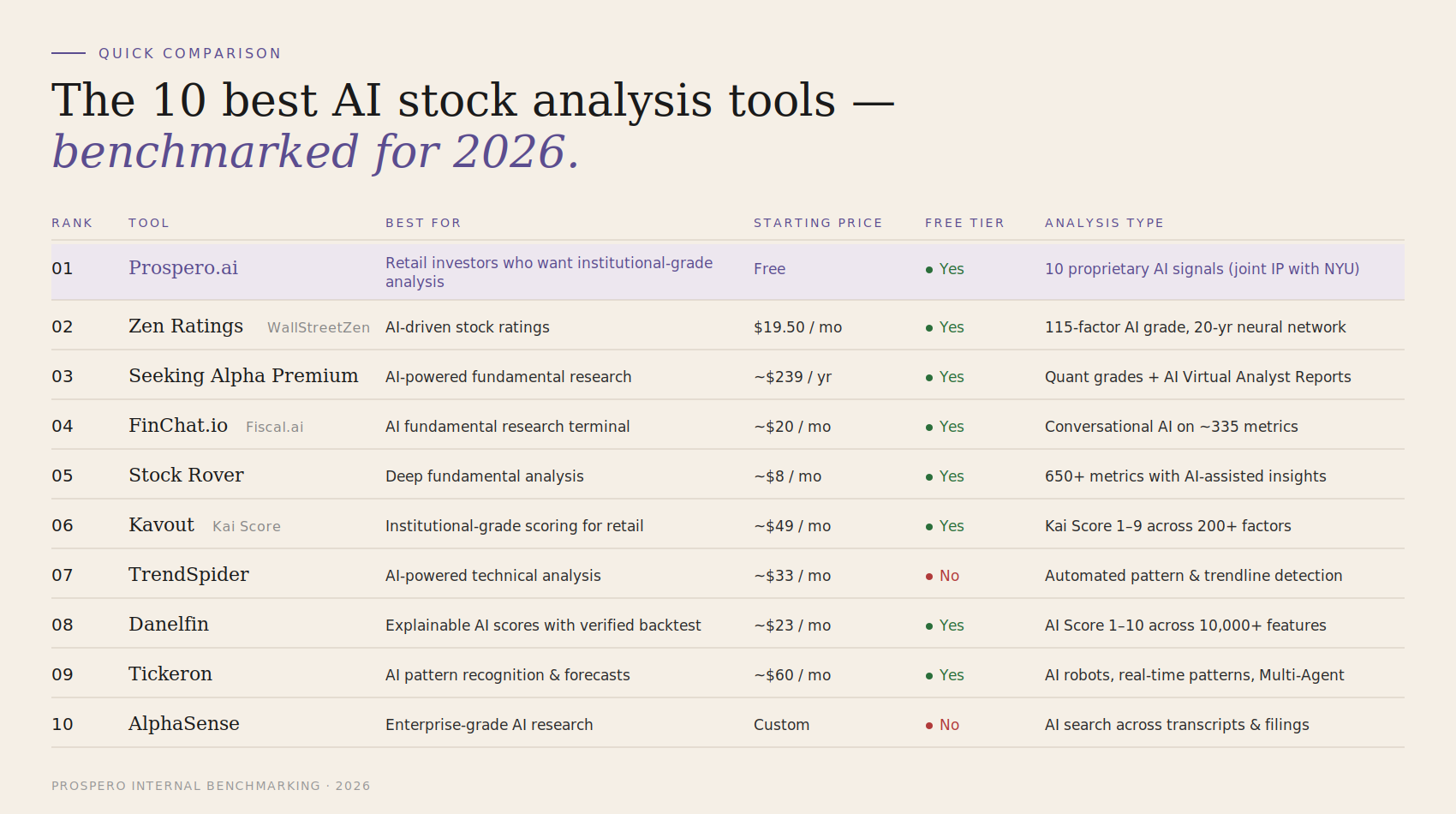
The published records are not trivial. Zen Ratings' A-rated stocks have been reported at about 28.5% average annual returns in the firm's own materials, using a 115-factor stack and a neural-network AI factor trained on more than 20 years of data. Danelfin says its models process more than 10,000 features per stock per day and has published a “Best Stocks” path of +376% from January 2017 through mid-2025 versus about +166% for the S&P 500. Kavout's Kai Score compresses 200+ factors into a 1–9 institutional-style rating, with a 2026 “Most Agreed” view when value, momentum, and quality models converge.
Those products have real strengths: speed across thousands of names, some methodological transparency, and a free or low-cost on-ramp. Their limitation for research is structural. A 9/10 or an A grade does not tell you whether the moat is widening, whether buybacks are masking weak organic growth, or whether China concentration is a 2026-specific risk. Backtests also suffer from the usual caveats — changing universes, transaction costs, and the fact that a published grade book becomes a crowded trade.
Signal-first apps sit even further from research. Prospero.ai packages institutional-style flow and sentiment into 10 plain-English signals and a free mobile app, which is genuinely useful as a daily overlay. Tickeron and TrendSpider automate pattern recognition — TrendSpider alone advertises 220+ chart patterns and 150+ candlestick formations — which saves chartists hours. They are the wrong primary tool if your question is “what is this business worth if smartphone units stall?”
A clean division of labor:
- Use quant scores to decide which 15 names deserve a weekend of work.
- Use research agents and filing tools to decide whether any of those 15 are businesses you understand.
- Use technical platforms to time entry only after the fundamental case exists.
If a tool cannot survive that middle step, it is not a research recommendation, however strong its backtest slide looks.
How Do You Run a Complete AI-Assisted Stock Research Process?
You run a complete process by forcing the AI through the same sequence a buy-side analyst uses — understand, analyze, value, de-risk, decide — and by refusing to skip the de-risk step. The tools change the elapsed time. They should not change the order.
1. Define the question in investing language, not ticker language. “Is NVDA a buy?” is a signal prompt. “How durable is NVDA's data-center gross margin if GPU pricing normalizes, and what multiple is already in the price?” is a research prompt.
2. Build the business snapshot before the model. On Jenova's Fundamental Stock Analyst:
"Explain the business model, revenue mix, and customer concentration. Identify the two variables that drive most of free cash flow. Flag any accounting items that distort GAAP earnings."
On Stock Rover, do the same work as a peer table: five-year revenue growth, ROIC, net debt/EBITDA, FCF yield, and dividend or buyback capacity against the industry set (Stock Rover product scope).
3. Read the latest primary documents through the AI, then spot-check. Ask for a 10-K or 10-Q brief with page-level or period-level citations. Open the cash-flow statement yourself for net cash, buybacks, and working-capital swings. This is the FinChat/AlphaSense strength, and it is also where hallucinations are most expensive.
4. Produce a valuation range, not a target. Require stated WACC, fade assumptions, and a bear case that is economically coherent (margin compression, multiple compression, or both). A single point estimate is a trade idea wearing a research costume.
5. Write the risks as kill criteria. Example output you should demand: iPhone unit saturation, regulatory pressure, geographic concentration, customer capex pauses, refinancing risk. If the tool cannot name how you would know the thesis is wrong, keep going.
6. Only then bring in technicals and portfolio context. Jenova's Technical Stock Analyst is the right second seat when you already have a fundamental view and need price, volume, and market-structure context with defined risk. The Portfolio Management Strategist is the right third seat for allocation drift, factor exposure, and stress tests after the name is a candidate, not before. TrendSpider or Tickeron can replace that technical seat if your process is chart-native.
7. Keep a written memo the AI did not fully author. The durable edge in 2026 is a repeatable file: thesis, numbers, sources, valuation range, kill criteria, and position size. Tools that cannot export or remember that file force you to rebuild conviction every session.
A realistic time budget: a careful human pass on one large-cap still often runs a full day. Research-first AI can compress the first 70% — document intake, metric extraction, peer pull, first-draft risks — into a short sitting. The last 30% is still judgment.
What Do Equity Research Practitioners Say About AI-Assisted Analysis?
Practitioners who actually write memos tend to treat 2026 AI as a faster associate, not as a portfolio manager, and they are blunt about where the associate still fabricates.
"The useful split is not 'AI versus human.' It is research infrastructure versus recommendation engines. If a system cannot show the filing period behind ROIC, or the assumption behind a $198 base case, it is not doing analysis. It is decorating a price. We would rather have an incomplete memo with every number footnoted than a polished Strong Buy with no kill criteria."
"Persistent memory is the underrated feature. A stock thesis is a living object — last quarter's services mix, a regulatory docket, a customer that is 22% of revenue. Tools that reset every session make you re-underwrite the company instead of updating the parts that changed. That is why conversational agents with history beat stateless score pages for anyone who holds names through multiple prints."
"Quant grades still earn a seat at the morning meeting. A 115-factor A rating or a 10/10 three-month score is a reason to open the model, not a reason to skip it. The investors getting hurt in 2026 are the ones who outsourced the decision and kept the downside."
— Jenova Product Team, equity-research agent design, multi-year work on source-traced financial workflows
That stance matches the more careful public guidance as well. Even vendor-written roundups that celebrate backtests usually end with the same caution: AI is a research accelerator, not a replacement for understanding the company or sizing the position. The Stanford-style claims that AI analysts can outpace most mutual-fund managers over long windows are directionally interesting; they do not tell you whether your tool cited the right cash number this morning.
Which AI Stock Analysis Tool Fits Your Investing Style?
The right AI stock analysis tool is the one that matches the decision you are actually making — underwriting a business, ranking a universe, reading a tape, or searching a professional document set. Style mismatch is how investors end up taking trading-bot advice on a five-year compounder, or writing a 12-page memo for a two-day momentum trade.
Long-term fundamental investors. Start with a research agent plus a metric terminal. Jenova's Fundamental Stock Analyst or FinChat for questioning filings; Stock Rover for the peer grid and history; Seeking Alpha Premium if you also want a large archive of human research and AI-written Virtual Analyst Reports. Add Zen Ratings or Danelfin only as a screening overlay.
Part-time investors who need a simple daily read. Zen Ratings and Prospero.ai are the low-friction options: letter grades or ten signals, free tiers, and limited setup. They will not produce a full valuation file. They will tell you where to look tonight.
Active and technical traders. TrendSpider and Tickeron are purpose-built. TrendSpider removes manual pattern labor and includes a no-code strategy lab; Tickeron adds real-time pattern flags, forecasts, and multi-agent signal layers, at a higher typical price band of about $60 to $250 a month. Pair either with a fundamental check so you are not trading a clean chart in a deteriorating business.
Intermediate quant-curious investors. Kavout and Danelfin sit between research and signals. You get institutional-style factor compression and, in Danelfin's case, an unusually explicit “why this score moved” display. Budget roughly $23 to $49 a month before extras.
Professional researchers and family offices. AlphaSense remains the default when broker research, expert transcripts, and internal content need to live in one searchable graph. Nothing in the retail set replaces that corpus. The honest limitation is cost and overkill for a 12-name household portfolio.
Portfolio-level decisions. After the single-name work, use a dedicated allocation tool rather than asking a stock agent to pretend it is a risk system. Jenova's Portfolio Management Strategist is built for drift, scenario stress, and rebalancing logic. Stock Rover's portfolio analytics cover a similar job inside a spreadsheet-like environment.
A final placement rule for 2026: if your output is a ticket, you used a trading tool. If your output is a sourced memo with a range and kill criteria, you used a research tool. The second category is what this question is actually asking for — and it is still a short list.
References
- Prospero.ai — 2026 ranking of AI stock analysis tools, evaluation criteria, and reported retail-AI adoption figures
- WallStreetZen — AI stock analyzers in 2026, Zen Ratings methodology, Seeking Alpha Virtual Analyst Reports, and Danelfin performance notes
- Openbook Analytics — How to evaluate purpose-built AI stock analysis tools versus general chatbots
- AlphaSense — Equity research platform content coverage, AI workflows, and institutional adoption claims
- Stock Rover — Official product scope for metrics, screening, portfolio analytics, and fund research
- VectorVest — Stock Rover versus Seeking Alpha feature comparison
- Stock Unlock — 2026 pricing and metric-count comparison of Stock Rover and Seeking Alpha
- WallStreetZen — Zen Ratings 115-factor model and published A-rated return history
- Danelfin — AI Score methodology and 10,000-feature daily analysis
- Kavout — AI financial research agents and multi-market coverage
- TrendSpider — Official market-research and automated technical analysis platform
- Tickeron — AI forecasts, pattern recognition, and trading tools
- Prospero.ai — Free AI investing app and signal product overview
- Seeking Alpha — Market analysis, quant tools, and investor research community
- TradeAlgo — 2026 AI stock-trading tool pricing and stack examples