Visual Novel Playtest Checklist: AI-Assisted Route & UX Testing
2026-10-23
Game Designer Assistant helps visual novel developers build a complete visual novel playtest checklist and turn scattered tester feedback into prioritized fixes. It does this by applying game design expertise to your routes, choices, and systems. Many VN teams playtest late and track findings across Discord threads and spreadsheets. This AI gives you a repeatable testing framework you can rerun on every build, as of October 2026 and beyond.
- ✅ Generates route-by-route test plans from your flowcharts and story maps
- ✅ Drafts unbiased playtest questions, surveys, and observation sheets
- ✅ Turns raw tester notes into structured, reproducible bug reports
- ✅ Covers branching logic, UX, accessibility, and narrative clarity in one pass
Visual novels look simple to test because players mostly read and click. Branching structure changes that. Every choice multiplies the number of states your game can reach, and every state can hide a broken flag, a missing sprite, or a confusing scene. To see why a dedicated checklist matters, it helps to look at where VN playtests usually go wrong.
Quick Answer: What Is a Visual Novel Playtest Checklist?
A visual novel playtest checklist is a structured list of tests covering routes, choices, saves, UI, accessibility, and story comprehension. It ensures every branch is reached, every flag fires correctly, and players understand the narrative before release.
Key capabilities of a strong checklist:
- Route and ending coverage mapped against your branch diagram
- Choice-consequence verification, including hidden variables and affection or stat flags
- Save, load, skip, rollback, and settings persistence checks
- Readability, accessibility, and player-comprehension questions that an AI design partner can help you draft and refine
The Problem: Branching Stories Break in Invisible Ways
Visual novels range from linear kinetic novels to games with multiple story routes, each with several outcomes. That structure is the genre's appeal. It is also its biggest QA risk, because a playtester reading one route tells you nothing about the other five.
General game playtesting advice applies too. Games User Research notes that teams often leave playtests too late, which leads to low-impact studies. The good news is that you don't need a huge panel to find problems:
5 testers — can reveal roughly 80% of a game's usability issues, according to Articos' games user research guide
A couple of hundred reports per day — the volume one studio received through its in-game bug reporter, which shows how quickly unstructured feedback piles up
But running an effective VN playtest is frustratingly difficult:
- Branch coverage gaps: Testers gravitate toward the same "obvious" routes, so late-game endings rarely get tested.
- Choices that feel meaningless: Players notice when options don't change anything.
- Unreproducible bugs: "The sprite was wrong at some point" doesn't help anyone fix anything.
- Accessibility blind spots: Text-heavy games can quietly exclude readers with visual or cognitive impairments.
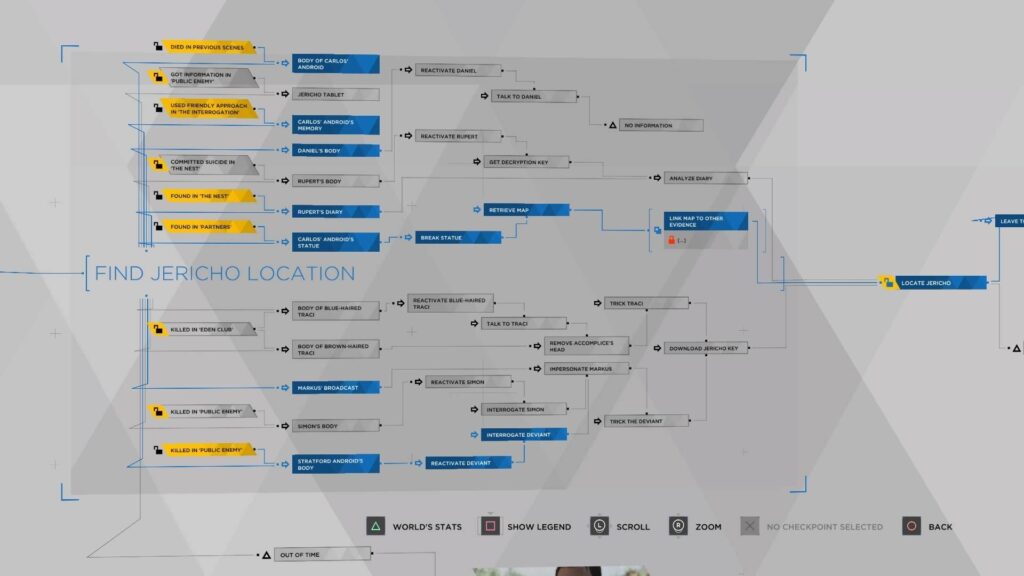
Narrative flowcharts like this one from Detroit: Become Human show how quickly branching paths multiply. Each node and locked path is a state your playtest needs to reach.
Branch Coverage Gaps
A flowchart like the one above shows the issue. Some outcomes need a specific earlier choice, a character to survive, or evidence found in a previous scene. If your testers never trigger those conditions, the scenes behind them ship untested. Game Design Skills recommends mapping every story route, decision point, and outcome branch with flow diagrams. That map should become your coverage tracker.
Choices That Feel Meaningless
On r/visualnovels, one player described a game where,
: no extra scenes, no extra dialogue. Illusory choices can work, but only when the story acknowledges them. Testing perceived impact is as important as testing actual branching.Unreproducible Bug Reports
Effective game bug reports need a title, steps to reproduce, environment, and expected result. For VNs, the save file is the most valuable artifact, because it captures the exact flag state that produced the bug.
This is exactly what Game Designer Assistant was built for.
Why Game Designer Assistant
Game Designer Assistant is a game design partner with deep expertise across genres, platforms, and systems analysis. For VN developers, that means one place to design your test plan, pressure-test your branching logic, write tester-facing documents, and make sense of the results. It doesn't play your build for you, and human testers remain essential. What it removes is the planning and synthesis work around each session.
| Traditional Approach | Game Designer Assistant |
|---|---|
| Copying a generic game QA template that ignores branching | Builds a checklist from your actual routes, flags, and endings |
| Hand-auditing flowcharts for unreachable scenes | Analyzes your route logic and flags dead ends or impossible conditions |
| Writing survey questions that accidentally lead testers | Drafts neutral, research-informed questions and observation sheets |
| Sorting dozens of tester notes by hand | Clusters feedback into themes and drafts reproducible bug reports |
Below is the core visual novel playtest checklist. You can use it as-is or have the agent tailor it to your engine and structure.
Route and Branch Coverage
- Every route, minor route, and ending has been reached at least once
- Each ending's unlock conditions are documented and verified
- No scene is orphaned, meaning it exists in the script but has no path leading to it
- Gauntlet-style fail states (where one wrong choice ends the run) are intentional and clearly signposted
- Losses don't feel abrupt; win/loss endings can feel unsatisfying compared to completed bad endings
Choice Feedback and Perceived Impact
- Major decisions are referenced again later in the story
- Characters respond to the substance of each choice rather than with canned lines
- Hidden stats (affection, trust, cruelty) increment correctly and can't overflow
- Testers can explain, without prompting, why they reached the ending they got
Save, Load, Skip, and Rollback
- Saves restore all flags, music, sprites, and backgrounds correctly
- Skip-read-text only skips previously seen lines
- Rollback doesn't let players exploit or corrupt choice variables
- Save slots show thumbnails, as recommended by the Game Accessibility Guidelines
- All settings persist between sessions
Text, UI, and Accessibility
- Players can advance text at their own pace, with an adjustable auto-mode
- Text has high contrast against the textbox and background
- There is a visual indication of who is speaking
- Music, voice, and SFX have separate volume controls
- Image-based menu items have text descriptions for screen reader users
- No essential information is conveyed by color alone
Assets and Continuity
- Every referenced sprite expression, background, and audio cue exists
- Outfits, time of day, and locations stay consistent within scenes
- CGs unlock correctly in the gallery
Comprehension and Pacing
- Players understand the goal, the choices, and the ending. Pominis frames these as the core questions of a first interactive story playtest.
- Long routes include recaps or a backlog for players returning after a break
- Testers' drop-off points are logged and reviewed
Turning the Checklist Into Action
The agent adapts this framework to your engine. That matters because the most popular VN engines, NaniNovel, Ren'Py, and TyranoBuilder, handle saves and variables differently.
"Here's my route diagram for a 4-heroine Ren'Py romance VN. Build a playtest coverage plan that assigns routes to 5 testers so every ending gets reached."
"Review these 12 choice points and tell me which ones players will likely perceive as meaningless, and how to add acknowledgment without new branches."
"Write a 10-question post-playtest survey for my mystery VN that checks story comprehension without leading the player."
Related Agents You'll Also Find Useful
If you're also prototyping dialogue or managing a team, these agents extend your playtesting workflow.
Roleplay Game Master Before committing a branch to script, you can roleplay through a scene with a consistent character to see how a choice feels in the moment. It works well for stress-testing dialogue options early.
- Unlimited memory for long, multi-scene runs
- Consistent character voices across sessions
- Open-ended scenarios for rapid branch prototyping
Project Coordinator If you're running a playtest with a writer, artist, and programmer, Project Coordinator tracks who owns each fix. It manages multiple team members in a single chat so blockers don't slip.
- Task, deadline, and dependency tracking
- Blocker visibility across team members
- A single shared view of fix status between builds
Spanish-English Translator If you're testing a localized build or collecting feedback from Spanish-speaking testers, this agent translates notes and script excerpts in both directions automatically.
- Instant two-way Spanish/English translation
- Useful for reviewing localized dialogue against the source
- Helps you read international tester feedback quickly
Every agent above is free to try, with no credit card required.
How It Works: Running a VN Playtest With AI Support
Step 1: Define Your Research Objectives Decide what this playtest needs to answer, such as "Do players find Route C's unlock?" Agreed research objectives tied to development priorities keep sessions focused.
"My demo ends after Chapter 2. Help me define 3–5 research objectives for a playtest focused on choice clarity and pacing."
Step 2: Generate a Tailored Checklist Share your branch structure, engine, and build scope with the AI game design partner. It returns a checklist and a tester assignment plan matched to your routes.
"Generate a playtest checklist for a TyranoBuilder VN with 3 routes, 7 endings, and an affection system. Assign routes across 6 testers."
Step 3: Prepare Unbiased Tester Materials Ask for observation sheets, a short pre-test briefing, and survey questions. Neutral phrasing matters because leading questions introduce bias that skews your results.
"Rewrite these survey questions so they don't hint at the 'correct' choice."
Step 4: Collect Reproducible Bug Reports Ask testers to attach save files, screenshots, and build versions. These are the same essentials Game Developer recommends for any in-game bug reporter.
Step 5: Synthesize and Prioritize Findings Paste in raw notes and get clustered themes, duplicate merges, and a priority-ranked fix list. You still make the final severity call.
"Here are notes from 5 testers. Group them by issue, merge duplicates, and rank by impact on story comprehension."
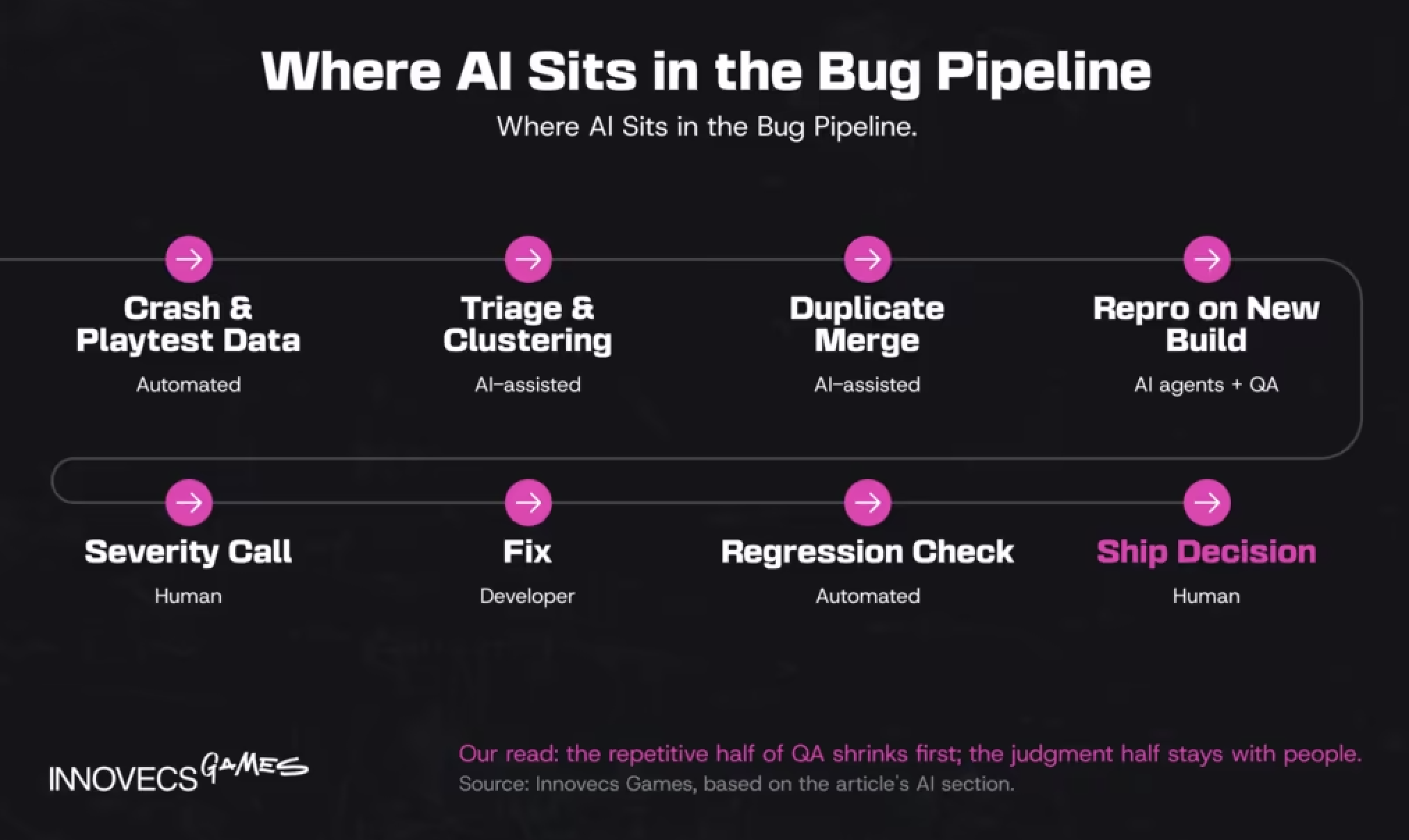
This infographic from Innovecs Games maps the split well. AI handles collection, triage, and duplicate merging, while severity calls and ship decisions stay with people.
Results & Use Cases
📊 Solo Developer Auditing a Multi-Route Romance VN
Scenario: A solo Ren'Py developer has six routes and suspects two endings are unreachable.
Traditional Approach: Manually tracing every variable through the script, often over several evenings.
Game Designer Assistant: The developer pastes the flag logic and route summary and gets a list of conflicting conditions plus a coverage plan.
- Unreachable endings are caught before testers waste sessions on them
- Testers receive targeted route assignments
- Fewer surprises in Steam reviews after launch
💼 Small Studio Coordinating an External Playtest
Scenario: A four-person team runs a 10-tester playtest for a mystery VN demo.
Traditional Approach: Feedback scattered across email, forms, and Discord, with fixes falling through the cracks.
Game Designer Assistant + Project Coordinator: Findings are clustered and ranked, then handed to Project Coordinator to assign fixes to the writer, artist, and programmer.
- One prioritized fix list
- Clear ownership for every issue
- Faster turnaround to the next build
📱 Reviewing Playtest Notes on Mobile
Scenario: A developer watches a remote playtest on a laptop and jots fragmented notes on a phone.
Traditional Approach: Rewriting the shorthand into proper bug reports hours later, after details have faded.
Game Designer Assistant: Right after the session, the developer pastes the notes on a phone and gets structured reports with steps, expected results, and suspected causes.
- Reports are written while memory is fresh
- Consistent formatting for the whole team
- No laptop needed to keep the pipeline moving
🎯 Accessibility Pass Before a Demo Festival
Scenario: A team wants its VN demo to be friendly to screen reader and low-vision players.
Traditional Approach: Searching guidelines piecemeal and guessing which ones apply to a text-driven game.
Game Designer Assistant: Produces a VN-specific accessibility checklist. Visual novels could be fully accessible to screen reader users when designed carefully.
- Covers text speed, contrast, speaker indicators, and audio separation
- Recommends including testers with impairments
- Gives the team a clear, honest accessibility statement for the store page
FAQ
What should a visual novel playtest checklist include?
A complete checklist covers route and ending coverage, choice-consequence verification, save/load and rollback behavior, UI readability, accessibility, asset continuity, and story comprehension. The most overlooked area is perceived choice impact: whether players feel their decisions mattered. Pair the checklist with a branch flowchart so you can mark each route and ending as tested, and require save files with every bug report so issues tied to specific flag states can be reproduced.
How many playtesters does a visual novel need?
For usability and comprehension, small groups work well. Articos reports that five testers can reveal about 80% of usability issues. Branching VNs add another factor: you need enough testers, or enough assigned replays, to reach every route and ending. Assign routes deliberately instead of letting testers choose freely, or late-game branches may never be tested.
Can Game Designer Assistant replace human playtesters?
No. Game Designer Assistant doesn't play your build or observe real player behavior. It accelerates everything around the playtest: designing coverage plans, analyzing route logic, writing unbiased surveys, and synthesizing feedback into prioritized fixes. Human testers remain essential for emotional response, pacing, and comprehension. Judgment calls such as severity and ship decisions should stay with your team.
How do I test whether choices feel meaningful?
Ask testers after each session which choices they remember and whether those choices changed anything. Compare their answers with your actual branching. If players can't recall a choice, or believe it did nothing, add acknowledgment through later references or unique character reactions. To prototype how a choice lands before scripting it, play the scene out with Roleplay Game Master.
Is Game Designer Assistant free to use?
Yes. You can start on Jenova's free tier, which includes all core features with limited usage. Paid plans start at $20/month for Plus, which adds 30× the free usage and custom model selection. Higher tiers suit studios running frequent playtests. Usage resets monthly on your billing date, with no daily caps.
Does this checklist work for Ren'Py, NaniNovel, and TyranoBuilder?
Yes. The categories apply to any engine, but implementation details differ, especially around save systems, rollback, and variable handling. Tell the agent which engine you use and it will adjust checks accordingly, for example by testing Ren'Py's rollback against choice variables. VNDev Wiki's accessibility guide is also a useful engine-agnostic reference.
Conclusion
Branching narratives fail quietly: an unreachable ending, a choice nobody notices, a save that drops a flag. A structured visual novel playtest checklist turns those invisible risks into tests you can track, assign, and verify on every build. Combined with small, well-targeted tester groups and reproducible bug reports, it gives indie and studio teams a dependable VN QA process.
The repetitive parts of narrative game testing, such as planning coverage, drafting surveys, and sorting feedback, are where AI helps most. The judgment calls stay with you. Try Game Designer Assistant now to build your first tailored playtest plan. Explore more at Jenova.
For Developers: Game Designer Assistant is available programmatically via the Jenova API. You can integrate AI-powered playtest planning and feedback analysis into your game development tools with a single API call. Full documentation →