Visual Novel Maker AI: Create Interactive Stories Without Coding (April 2026)
2026-04-22
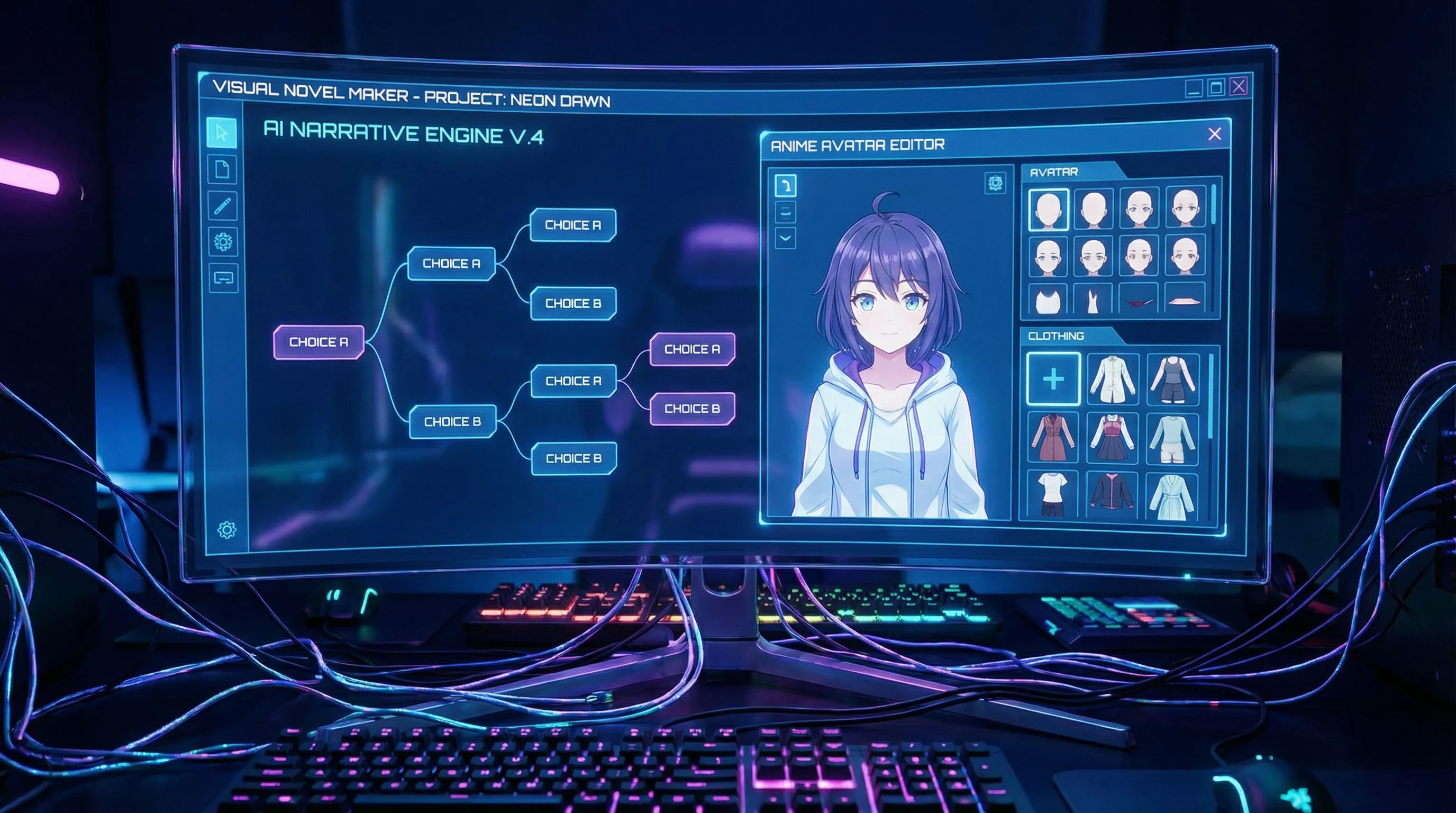
The visual novel maker AI has become the most transformative tool in interactive fiction in 2026. The global visual novel games market was valued at $9.4 billion in 2025 and is projected to reach $21.8 billion by 2034, growing at a CAGR of 9.8%, while the broader interactive fiction game market is projected to grow from USD 4,302 million in 2025 to USD 7,806 million by 2032 at a 12.0% CAGR. Asia Pacific alone commands 52.4% of global visual novel revenue, and mobile platforms hold the largest platform share at 38.6% — proving that the audience for narrative-driven interactive experiences has never been larger.
Yet the supply side remains brutally constrained. Visual novels require five distinct creative disciplines — writing, character art, background illustration, music, and engine scripting — working in concert under a unified artistic vision. As one developer analysis put it: "Visual Novels are often considered the culmination of creative art, combining narrative prose, digital art, music, voice acting and software engineering into a single, cohesive work of art". For solo creators and small teams, that combination has been prohibitively expensive and time-consuming — until now.
- Branching narrative generation with consistent characters, plot tracking, and multiple endings is now achievable through AI writing partners
- Character consistency across dozens of scenes — the single biggest technical barrier — is solvable through identity embedding and reference sheet systems
- No coding required — AI handles story structure, dialogue, and scene direction through natural language
- Jenova's Creative Fiction Writer is the AI visual novel maker built for deep narrative development — crafting branching storylines, character voices, and scene-by-scene scripts with persistent memory across sessions
Quick Answer: What Is a Visual Novel Maker AI?
A visual novel maker AI is a tool that uses artificial intelligence to help creators build interactive fiction — generating branching narratives, character dialogue, scene descriptions, and story structures that form the foundation of visual novel games, without requiring traditional coding or game engine expertise.
- 📝 Branching narrative architecture with multiple routes, endings, and decision points — Creative Fiction Writer builds complete story structures with persistent plot tracking
- 🎭 Character voice profiling that maintains distinct speech patterns, personalities, and relationship dynamics across entire projects
- 🔀 Decision tree design where player choices create meaningful consequences that ripple through the story
- 🧠 Persistent story memory tracking plot threads, character arcs, and world state across sessions
The Problem: Why Making Visual Novels Has Been So Hard
The demand for visual novels has never been higher. Accio's 2026 trend analysis projects the global visual novel market exceeding $2 billion by 2026, with the market expanding beyond traditional romance into action, horror, and mystery subgenres. Google Trends data shows search interest for "interactive story games" peaking in December 2025 and February 2026, indicating growing consumer appetite. But the barriers to creation remain formidable.
The Five-Discipline Problem
As Kumiko's analysis of generative AI in visual novel development documented: "Visual Novels are often considered the culmination of creative art, combining narrative prose, digital art, music, voice acting and software engineering into a single, cohesive work of art. All of these components are crafted with the same unified artistic vision in mind."
A single visual novel requires mastery of narrative writing, character illustration, background art, music composition, and game engine scripting — simultaneously. Solo creators typically possess expertise in one or two of these disciplines, but rarely all five. The barrier to creation excludes countless potential storytellers with compelling visions but limited technical execution capabilities.
Prohibitive Cost for Independent Creators
Professional visual novel production costs scale rapidly. Character sprite sets with multiple expressions run $200–$500 per character. Background illustrations cost $50–$150 each. A modest visual novel with 5 characters, 20 backgrounds, and original music can easily exceed $5,000–$15,000 in art and audio alone — before a single line of code is written. For the growing community of independent developers and smaller studios driving market innovation, these costs are often prohibitive.
Writing at Scale Is the Deepest Challenge
The visual novel format demands enormous volumes of high-quality writing. A typical visual novel contains 50,000–300,000 words of dialogue, narration, and branching paths. As Storique's 2026 analysis of AI story generation confirmed: "The biggest limitation of early AI writing tools was that they forgot what they'd written. Characters would change names, plotlines would contradict themselves, established facts would be ignored." Maintaining character voice consistency, plot coherence, and emotional resonance across hundreds of scenes is the most time-consuming aspect of visual novel development — and the one where AI has made the most dramatic improvements in 2026.
This is exactly what Creative Fiction Writer was built for — a narrative development partner that maintains persistent memory of your characters, plot threads, and world state across sessions, enabling the kind of deep, consistent storytelling that visual novels demand.
Why Creative Fiction Writer Is the Best Visual Novel Maker AI
Unlike general-purpose chatbots that lose context after a few thousand words, or template-based visual novel engines that require coding knowledge, Jenova's Creative Fiction Writer is a specialized storytelling partner designed for exactly the kind of long-form, branching, character-driven narrative that visual novels require.
| Challenge | General AI Chatbots | Template VN Engines (Ren'Py, TyranoBuilder) | Creative Fiction Writer |
|---|---|---|---|
| Branching narrative design | Loses context across branches | Manual scripting required | AI-architected with persistent plot tracking |
| Character voice consistency | Drifts after a few scenes | Not applicable (text only) | Persistent character profiles across sessions |
| Story length | Context window limits | No writing assistance | Unlimited memory across sessions |
| Coding required | N/A | Yes (Python/scripting) | None — natural language |
| Decision tree logic | No structural awareness | Manual implementation | AI-designed consequence chains |
| Model flexibility | Single model | N/A | GPT-5.4, Claude Opus 4.6, Gemini 3.1 Pro Preview |
How It Solves the Visual Novel Writing Problem
The Context Window Breakthrough. As Storique's 2026 guide confirmed: "The latest models hold enough context to maintain consistency across a full short story or even a novel chapter. This is the single most important improvement for story generation." The Creative Fiction Writer goes further — with persistent cross-session memory, it doesn't just hold context within a single conversation. It remembers your entire project: every character, every plot thread, every decision point, every relationship dynamic. Return days or weeks later and the AI knows exactly where your story left off.
Character Voice Architecture. Define each character's personality, vocabulary, speech patterns, emotional tendencies, and relationship dynamics once. The Creative Fiction Writer maintains these profiles across every scene, every route, and every session. A formal aristocrat stays formal. A sarcastic sidekick stays sarcastic. When characters evolve through story events — trauma, growth, betrayal — the AI tracks those changes with versioned voice profiles.
Branching Narrative Intelligence. Visual novels aren't linear stories — they're narrative architectures with multiple routes, decision points, and endings. The Creative Fiction Writer understands branching structure: it tracks which choices lead to which consequences, ensures route-specific scenes don't contradict shared scenes, and maintains logical consistency across parallel storylines.
Example Prompts for Visual Novel Development
"I'm creating a mystery visual novel set in a 1920s boarding school. The protagonist is a scholarship student named Elara who discovers that students have been disappearing for decades. There are four main suspects — each with their own route. Help me design the branching structure: a common route for the first three chapters, then four character-specific routes that each reveal a different piece of the mystery, converging in a true ending that requires completing all four routes."
"Write the opening scene of Chapter 1. Elara arrives at Thornfield Academy on a rainy September evening. Establish the gothic atmosphere, introduce the headmistress (cold, precise, hiding something), and end with Elara finding a name scratched into the windowsill of her dormitory room — a name that matches a student who disappeared in 1987. Tone: literary gothic, not horror. Think Donna Tartt meets Danganronpa."
"Generate character profiles for the four route characters. Each needs: a public persona, a secret they're hiding, a connection to the disappearances, a distinctive speech pattern, and a relationship arc with Elara that progresses from suspicion to trust (or betrayal, depending on the route). Make them feel like real people, not archetypes."
Competitor Context
While tools like Ren'Py remain the industry standard for visual novel engine scripting, they provide no writing assistance — you still need to produce every word of dialogue, every branching path, and every character interaction yourself. AI writing tools like NovelAI handle genre fiction and world-building well, but lack the persistent project memory and branching narrative awareness that visual novel production demands. The Creative Fiction Writer bridges this gap: it's not a game engine, but the AI writing partner that produces the narrative content your engine needs.
Try the Creative Fiction Writer free — no credit card required.
Related Agents You'll Also Like
🎮 Roleplay Game Master — Playtest Your Visual Novel in Real-Time
The most popular roleplay agent on Jenova — with unlimited memory and perfect character consistency. Before committing scenes to your final script, playtest them interactively. Step into your protagonist's shoes and experience your branching narrative from the player's perspective. The Roleplay Game Master maintains your world state, character personalities, and decision consequences in real-time, letting you discover plot holes, pacing issues, and character inconsistencies before they reach your audience.
- Unlimited persistent memory across sessions
- Perfect character consistency in personality and dialogue
- Open-world narrative testing with full creative freedom
🎨 Manga Creator — Generate Character Art and CG Scenes
For creators who need visual assets alongside their narrative — character sprites, expression sets, CG scenes, and background illustrations. The Manga Creator handles character reference sheets with identity embedding for visual consistency across your entire project, five professional art style templates, and persistent project state tracking.
- Character reference sheet architecture with identity embedding
- Expression and pose variation from locked character designs
- Persistent project state across 200+ page productions
🎨 Prompt Generator — Optimized Prompts for Visual Novel Art Assets
When you need character sprites, backgrounds, and CG illustrations generated through external AI image tools, the Prompt Generator crafts structured prompts with reusable character identity blocks — ensuring your protagonist looks the same across every scene, outfit, and expression.
- Character identity blocks for visual consistency across dozens of images
- Style-specific prompts for anime, semi-realistic, and painterly VN aesthetics
- Multi-view reference sheet prompts for character turnarounds
How It Works: From Concept to Complete Visual Novel Script
Step 1: Define Your World and Characters
Open Creative Fiction Writer and describe your visual novel concept. Genre, setting, tone, protagonist, and the core dramatic question your story explores. The more detail you provide about your characters' inner lives — not just what they look like, but how they think, what they fear, what they want — the richer your output.
"I'm creating a sci-fi romance visual novel set on a generation ship 200 years into a 500-year voyage. The protagonist is the ship's new chief botanist, responsible for the oxygen gardens. The central tension: the ship's AI has been making increasingly autonomous decisions, and some crew members want to shut it down while others believe it's evolved into something worth protecting. Three romance routes, each aligned with a different faction. Tone: Becky Chambers meets Steins;Gate."
Step 2: Architect Your Branching Structure
The Creative Fiction Writer helps you design the narrative architecture before writing any scenes. How many routes? Where do they branch? What decisions trigger which paths? Which scenes are shared across routes, and which are route-exclusive? The AI maps this structure and maintains it as your project's narrative blueprint.
Step 3: Write Scene by Scene
Provide direction for each scene — what happens, which characters are present, what emotional beat you're hitting, what information the player learns. The Creative Fiction Writer produces complete scene scripts with dialogue, narration, internal monologue, and stage directions formatted for visual novel production.
"Write the scene where Elara confronts Professor Ashworth in his study after finding the hidden room beneath the library. She has evidence but not proof. He's calm, deflecting, but she catches a micro-expression of fear when she mentions the name 'Calloway.' End the scene with a choice: press him harder (leads to his route) or pretend to believe his explanation (leads to investigating alone)."
Step 4: Iterate and Refine
Not quite right? Adjust tone, pacing, character voice, or plot direction. The Creative Fiction Writer remembers everything about your project and iterates without starting over. Change a character's motivation in Chapter 1, and the AI can help you trace the consequences through every subsequent scene.
Step 5: Export and Implement
Export your completed scripts — scene-by-scene dialogue, branching logic, character notes, and stage directions — in formats ready for implementation in Ren'Py, TyranoBuilder, Visual Novel Maker, or any other engine. The persistent memory ensures continuity across sessions — projects evolve over weeks or months without losing context.
Results & Use Cases
📚 Solo Creators Writing Their First Visual Novel
Scenario: A writer with a compelling story idea wants to create a visual novel but has never written branching narrative before and doesn't know how to structure routes, decision points, or multiple endings.
Traditional Approach: Study visual novel structure for months, write 100,000+ words of branching dialogue manually, hire a programmer to implement the scripting, commission artists for character sprites and CGs. Timeline: 12–24 months. Budget: $5,000–$20,000+.
Jenova Solution: Use Creative Fiction Writer to architect your branching structure, develop character profiles, and write scene-by-scene scripts with consistent character voices. Playtest routes interactively with Roleplay Game Master. Generate character art prompts with Prompt Generator. Timeline: weeks, not years.
🎮 Game Jam Participants
Scenario: A team has 48 hours to produce a playable visual novel prototype for a game jam.
Traditional Approach: Divide writing, art, and coding among team members. Writing bottleneck limits the scope to 2–3 short scenes with minimal branching.
Jenova Solution: The Creative Fiction Writer produces complete branching scripts in hours, not days. The team focuses on implementation, art, and polish while the AI handles narrative volume. Produce a 30-minute prototype with meaningful choices and multiple endings within the jam window.
📱 Mobile Visual Novel Publishers
Scenario: A mobile publisher needs to produce episodic visual novel content on a weekly schedule — each episode requiring 5,000–10,000 words of branching dialogue with consistent characters across 50+ episodes.
Traditional Approach: Maintain a writing team of 3–5 writers, manage character bibles and continuity documents manually, risk voice drift and plot holes over months of production. The visual novel games market's mobile segment alone was valued at approximately $3.6 billion in 2025.
Jenova Solution: The Creative Fiction Writer maintains persistent character profiles, relationship dynamics, and plot state across sessions. Return to your project weeks later and the AI writes dialogue that sounds like the same characters readers have been following. Produce consistent episodic content at the pace mobile audiences demand.
🌍 International Creators Entering the Visual Novel Market
Scenario: A non-Japanese creator wants to produce a visual novel that follows authentic genre conventions — proper route structure, character archetype awareness, and pacing that matches audience expectations.
Traditional Approach: Study dozens of visual novels across sub-genres, learn conventions through trial and error, risk producing something that "feels Western" to VN audiences.
Jenova Solution: The Creative Fiction Writer understands visual novel conventions across romance, mystery, horror, sci-fi, and slice-of-life sub-genres. It knows common route structures (common route → character routes → true ending), standard character archetypes and how to subvert them, and pacing conventions that VN audiences expect. Non-Japanese markets now contribute significantly to total visual novel revenue, with North America and Europe showing rapid growth.
💼 Transmedia IP Development
Scenario: A light novel publisher wants to adapt an existing IP into visual novel format — translating prose narrative into interactive branching structure with player agency.
Traditional Approach: Hire a VN script adapter to translate prose into branching scenes, then a separate team to implement. Timeline: 6–12 months per title.
Jenova Solution: Feed your existing story outline, character descriptions, and key scenes into the Creative Fiction Writer. The AI translates prose narrative into visual novel scene scripts — converting internal monologue into narration boxes, breaking long descriptions into visual moments, and designing branching decision points that give players agency without contradicting the source material. For visual asset production, pair with Manga Creator.
FAQ
What is a visual novel maker AI?
A visual novel maker AI is a tool that uses artificial intelligence to help creators build interactive fiction — generating branching narratives, character dialogue, decision trees, and scene scripts. Unlike traditional visual novel engines like Ren'Py (which handle implementation but not writing), an AI visual novel maker like Jenova's Creative Fiction Writer handles the narrative development process itself — producing the story content that your engine then presents to players.
Do I need coding skills to use an AI visual novel maker?
No coding skills are required for the narrative development phase. The Creative Fiction Writer produces complete scene scripts, branching logic, and character dialogue through natural language conversation. You'll still need a visual novel engine (Ren'Py, TyranoBuilder, Visual Novel Maker) to implement the final product — but the AI eliminates the writing bottleneck that typically consumes 60–80% of development time.
How does the AI maintain character consistency across a 100,000-word visual novel?
The Creative Fiction Writer uses persistent cross-session memory to maintain character profiles — personality traits, vocabulary, speech patterns, emotional tendencies, and relationship dynamics — across every scene and every route. Unlike general chatbots that lose context after a few thousand words, the Creative Fiction Writer remembers your entire project. As Storique's 2026 analysis confirmed: "Context windows are now large enough to matter" — and persistent memory extends this capability across sessions.
Can AI write visual novels that are actually good?
AI story generation in 2026 is genuinely capable of producing narratives that hold together — with consistent characters, proper pacing, and prose that doesn't read like it was written by a committee. However, the best results come from treating AI output as a collaborative first draft, not a finished product. The Creative Fiction Writer excels as a writing partner: you provide creative direction, the AI produces draft scenes, and you refine through iterative feedback. The human creative vision drives the story; the AI handles the volume and consistency that visual novels demand.
What visual novel genres does the AI handle?
The Creative Fiction Writer handles all major visual novel genres: romance (otome, BL, GL, hetero), mystery/detective, horror/psychological thriller, sci-fi, fantasy, slice-of-life, and hybrid genres. The visual novel market is expanding beyond traditional romance into action, horror, and mystery subgenres, and the AI understands the conventions, pacing, and audience expectations of each.
Is the Creative Fiction Writer free?
Yes — you can start using the Creative Fiction Writer for free with no credit card required. Free accounts include all core features with limited usage. Paid plans starting at $20/month increase usage limits for high-volume visual novel script production.
Conclusion
The visual novel market's trajectory — from $9.4 billion in 2025 to a projected $21.8 billion by 2034 — represents one of the fastest-growing segments in interactive entertainment. The interactive fiction game market is expanding at a 12.0% CAGR. Mobile platforms account for 38.6% of revenue, and the genre is diversifying beyond its Japanese origins into a globally recognized entertainment format. The audience is massive, the distribution platforms are ready, and as Dataintelo's 2026 market report confirmed: "Advances in AI-driven writing tools, procedural dialogue trees, and voice synthesis have simultaneously reduced production costs and increased narrative complexity, enabling smaller independent studios to compete with established publishers."
The five-discipline barrier that once made visual novel creation prohibitively expensive is falling. The question is no longer "can I make a visual novel?" — it's "what story do I want to tell?"
Start with Creative Fiction Writer for narrative development — branching storylines, character voices, and scene-by-scene scripts with persistent memory. Playtest your routes interactively with Roleplay Game Master. Generate character art and CG scenes with Manga Creator. Craft optimized prompts for visual assets with Prompt Generator. Browse the complete agent library at Jenova.