AI Vehicle Damage Assessor: Photo-Based Collision Repair Guidance
2026-08-28
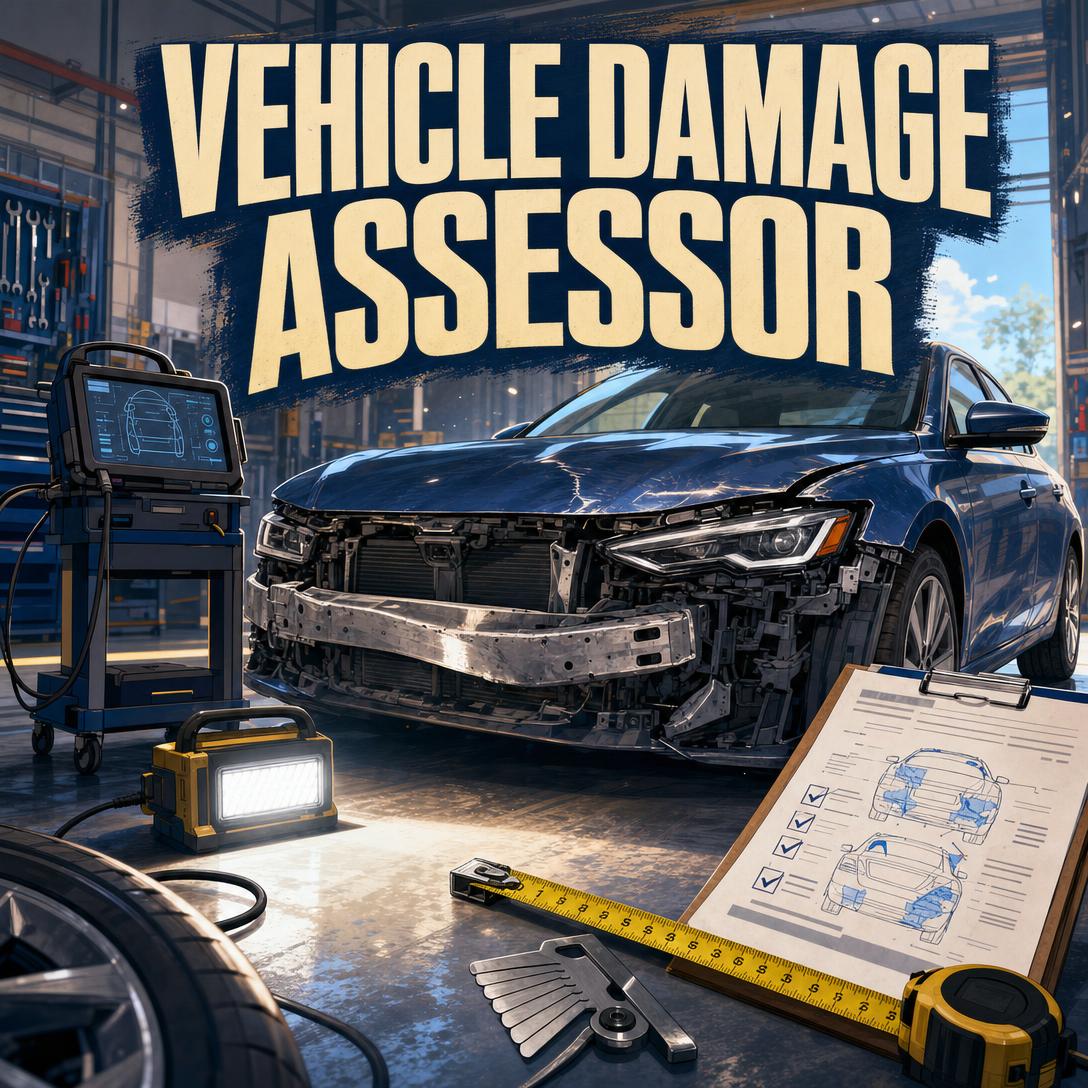
Vehicle Damage Assessor helps you turn collision photos into a clear damage picture — classifying cosmetic, functional, and structural harm, flagging hidden force-path risks, and mapping next steps for repair and insurance. While a dented bumper can hide apron damage, a shifted door gap can signal frame displacement, and an EV undercarriage scrape can require battery-enclosure inspection, this AI traces what photos show and what they cannot confirm.
✅ Photo-based classification across collision, hail, flood, vandalism, and prior-repair damage ✅ Force-path analysis that separates outer-panel dents from structural concern ✅ Insurance-estimate review for missed scans, ADAS calibration, and supplements ✅ Drivability guidance so you know whether to tow, drive cautiously, or wait
A parking-lot scrape and a 30-mph offset hit can look similar from one angle. The difference is which of three layers the force reached — outer panel, inner reinforcement, or load-bearing structure — and that difference changes cost, safety, and whether the car should move under its own power.
Quick Answer: What Is Vehicle Damage Assessor?
Vehicle Damage Assessor is a photo-based collision analysis tool that classifies vehicle damage, flags hidden structural risks, and guides repair and insurance decisions from the images you upload. It is built for car owners, buyers, estimators, and anyone who needs a second read before they sign an estimate or drive away.
Key capabilities:
- Classifies damage as cosmetic, functional, structural, mechanical, or safety-system related
- Traces impact force through unibody and body-on-frame construction, including high-strength steel, aluminum, and EV battery enclosures
- Reviews shop and insurer estimates for missed scans, blends, ADAS calibration, and supplement candidates
- Issues a drivability verdict — do not drive, drive with caution, or safe to schedule later — before talking cost
The Problem: Collision Photos Rarely Tell the Full Story
Collision repair is no longer a fender, a can of paint, and a weekend. The global automotive collision repair market was valued at $208 billion in 2025, and the work inside that market has grown more complex even as claim counts have fallen. Small jobs are shrinking as a share of the book.
25.5% — Share of repairable appraisals for $2,000 or less through mid-2025, down from 41.5% in 2019
At the same time, more claims are crossing the total-loss line. Through April 2025, 22.6% of all losses — and 23.5% of non-comprehensive losses — were declared total losses, according to CCC Intelligent Solutions. Average repair cost finished 2024 above $4,730. For many owners, the first estimate is not the last bill.
But getting a trustworthy read in the hours after a crash is frustratingly difficult:
- Surface damage hides structure. Force does not stop where the dent ends. A quarter-panel buckle near the wheel arch can involve the inner wheelhouse. A widened door gap can be a skin pushed at the hinge — or A-pillar displacement.
- Modern cars add sensors to every panel. ADAS cameras, radar, and ultrasonic sensors sit in bumpers, grilles, windshields, and mirrors. Calibration appeared on over 31% of DRP estimates in Q1 2025, up from 23.9% a year earlier, and most of those calibrations show up on supplements rather than the first estimate.
- Initial estimates miss required operations. Pre- and post-repair diagnostic scans appeared on nearly 87% of DRP appraisals in Q1 2025. That still leaves room for missing blends, corrosion protection, R&I of sensors, and OEM-specified sectioning.
- EVs change the intake rules. An undercarriage impact that looks like a scrape on a gas car can require high-voltage isolation and battery-enclosure inspection before anyone crawls underneath. I-CAR’s EV intake guidance treats thermal-runaway risk, coolant leaks, and OEM-specific isolation as first-hour questions, not afterthoughts.
The average collision claim paid $5,992 in 2022, and that figure predates the latest wave of ADAS and multi-material construction. Owners who accept the first walk-around as complete are often signing off on a starting point, not a finished scope.
This is exactly what this AI assessor was built for.
Why Vehicle Damage Assessor
Vehicle Damage Assessor reads the vehicle the way a senior estimator does: impact location, energy direction, construction type, and which layer the force likely reached. It then translates that into a drivability verdict, a damage classification, hidden-damage risks, and a practical next step — not a parts dump.
| Traditional Approach | Vehicle Damage Assessor |
|---|---|
| Wait days for a shop walk-around before anyone talks structure | Upload photos and get a classification with stated confidence |
| Treat the visible dent as the whole job | Trace force through outer panel, inner reinforcement, and structural members |
| Accept the first insurance estimate as complete | Flag missed scans, blends, ADAS calibration, and supplement items |
| Guess whether the car is safe to drive home | Lead with do-not-drive, caution, or schedule-later guidance |
| One generic repair opinion for steel, aluminum, and EV packs | Material-aware and OEM-aware framing, including replace-only ultra-high-strength steel |
Force-path reading, not just a dent list
The three-layer principle is the core diagnostic. Outer-panel damage is routine. Inner reinforcement multiplies complexity. Structural involvement — frame rails, aprons, pillars, rockers, subframes, crush zones — changes the entire assessment. The analysis names the worst-case reading and what photo or physical check would confirm or rule it out, instead of collapsing every crease into “needs a new bumper.”
Classification that matches how shops and insurers think
Damage is sorted into cosmetic, functional, structural, mechanical, and safety-system categories. Airbag deployment, pretensioner status, ADAS sensor geometry, and EV high-voltage indicators are treated as safety questions, not optional extras. Prior repair tells — wavy reflections in paint, uneven shut lines, overspray on rubber, non-factory fasteners — are called out when the photos support them.
Estimate literacy for the supplement era
When you share a shop quote or insurer estimate, the review looks for operations I-CAR and OEM procedures routinely require: pre-repair scan, post-repair scan, static or dynamic ADAS calibration, adjacent-panel blend, weld-through primer, and R&I of sensors and trim. Aftermarket structural parts are treated as a refuse-and-document item, not a silent cost cut.
"Here are six photos of my 2022 RAV4 rear quarter after a parking-lot hit. Is this structural, and should I drive it to the shop?"
"Review this insurance estimate. I do not see pre/post scans or ADAS calibration after a bumper R&R."
"Wavy reflections on this used Civic quarter panel — prior body work, or just poor lighting?"
How It Works
You do not need estimator vocabulary to get a usable read. You need photos, a decision (drive, claim, buy, or DIY), and a willingness to hear what the images cannot prove.
Step 1: Upload damage photos from more than one angle
A single close-up of a scratch is not an assessment. Full-vehicle shots from the damaged corner show force direction. Straight-on close-ups show depth and material. Gap and body-line photos show whether structure shifted. The opposing side gives a baseline. If it is safe, a low-angle undercarriage or engine-bay shot can reveal rails, leaks, and core support.
"Front passenger corner, close-up of the bumper tear, both headlight gaps, and the other side for comparison."
Step 2: State the decision you actually need
Post-accident owners need drivability first. Buyers need prior-repair and flood/salvage flags. Anyone staring at a four-page estimate needs completeness, not another lecture on unibody theory. Photo-based collision analysis routes to the lens that matches the question — assessment, cost, pre-purchase, estimate review, or DIY feasibility — instead of dumping every possible finding.
Step 3: Read the force path and the confidence level
You get observations before conclusions: which panel moved, whether gaps widen top-to-bottom, whether ride height or tire stance hints at suspension geometry, whether safety systems are visibly compromised. Confidence is labeled — high, medium, low, or cannot determine — with the exact extra photo or physical check that would move it.
Step 4: Get drivability, hidden-risk notes, and next actions
Do-not-drive findings (airbags, fuel/coolant/brake leaks, steering or wheel damage, dragging structure) come first. Then repair-versus-replace framing, what a teardown is likely to add, and whether ADAS or EV isolation belongs on the work order. For EV and hybrid underbody hits, the guidance follows the same caution I-CAR describes for EV intake: isolation and OEM inspection before disassembly.
Try a photo assessment free — no credit card required.
Results & Use Cases
📱 Post-Accident Photos From the Parking Lot
Scenario: You clip a pole at low speed. The bumper cover is torn, the grille is cocked, and you are standing in a grocery-store lot on your phone trying to decide whether to drive home.
Traditional Approach: Call a shop, wait for a tow decision you are not qualified to make, and hope the “it’s just plastic” read is right. A misaligned headlight gap can be a cover tab — or a shifted radiator support.
Vehicle damage assessment from your camera roll: Drivability first, then layer-by-layer classification. If lights, steering, and fluids look intact and no airbag lamp is on, you may get a short, low-speed drive-to-shop caution rather than a blanket tow. If the cover is off and the crash bar or apron looks bent, the verdict flips.
- Works on iOS and Android with the same photo workflow as desktop
- Tells you which extra angles (cowl, hinge pillar, under the nose) would raise confidence
- Separates cosmetic cover damage from functional lighting and structural core-support risk
Once you know the car is safe to move and which assemblies are in play, Auto Repair Mechanic can take the same photos into diagnostics, parts sourcing, and repair-versus-replace walkthroughs for the mechanical side of the job.
📋 Insurance Estimate Review After the First Number
Scenario: The DRP estimate looks tidy: bumper, cover, a couple of clips, paint. No scan. No calibration. No blend on the adjacent fender. You are being asked to authorize repairs.
Traditional Approach: Assume the carrier’s number is the job. Then the car is torn down, inner impact bar damage appears, and a supplement lands a week later — especially likely when ADAS work is involved, because the majority of calibrations still appear on supplements.
Estimate review with this AI: Line-level completeness check against common misses — pre/post scans, static versus dynamic calibration, tri-coat blend, corrosion protection, sensor R&I, and OEM sectioning notes. You leave with a list of questions for the shop and adjuster, not a vague feeling that something was skipped.
- Flags aftermarket structural parts as a documentation issue
- Frames supplements as normal industry practice, not a personal dispute
- Keeps total-loss talk in ranges: thresholds vary by state, and actual cash value is not replacement cost
If the open question is coverage — first-party versus third-party, rental limits, or whether a claim is worth filing — Personal Insurance Advisor can walk the policy side while the damage file stays focused on the vehicle.
🔍 Pre-Purchase Inspection on a “Clean” Listing
Scenario: A three-year-old SUV is priced well. The seller’s photos are sunny. In person, the quarter-panel reflections ripple, the trunk gaps are uneven, and the VIN sticker looks newer than the rest of the bay.
Traditional Approach: A five-minute walk-around, a Carfax glance, and a hope that “rebuilt” is not hiding under fresh paint. Paint texture, seam sealer, and fastener type are easy to miss if you do not know what factory looks like.
Used with listing photos or your own walk-around shots: Prior-repair indicators, possible structural pull marks, flood clues (silt lines, fogged lamps, stained cavities), and a buy / negotiate / walk framing. It will not replace a lift inspection or a scan tool, and it says so.
- Teaches one transferable tell per session — for example, ripple in reflected light as a filler detector
- Asks for the specific extra view that would change the call
- Keeps salvage-title and washed-title language cautious rather than accusatory
When the body looks honest and the remaining question is whether the vehicle is the right buy at the asking price, Car Buying Advisor can pick up research, comparables, and negotiation once the metal has been cleared.
FAQ
Is Vehicle Damage Assessor free?
Yes. You can use Vehicle Damage Assessor on the free tier with all core features and limited monthly usage — no credit card required. Higher tiers increase usage if you are reviewing a fleet, a shop queue, or a long claim file. Pricing is usage-based rather than per-vehicle, so a single accident file and a weekend of used-car hunting are both reasonable starting points.
How is this different from a body shop estimate?
A shop estimate is a priced work order written after (or during) physical inspection, often on a frame rack with OEM procedures in hand. This AI is a photo-first second read: classification, force-path reasoning, missed-operation checks, and drivability. It does not replace a certified appraisal, a measuring system, or a teardown. Use it to arrive at the shop informed, or to challenge a thin estimate, not to skip the lift.
Can it review an insurance estimate for missed ADAS work?
Yes. Share the estimate and the damage photos. The review looks for pre- and post-repair scans, calibration type, and whether the repair event — windshield, bumper R&R, alignment, structural pull — typically requires aiming per OEM calibration matrices. asTech’s collision-shop guidance is blunt on the governing rule: OEM repair procedures decide when calibration is required, not a generic checklist.
Does vehicle damage assessment work on mobile?
Yes. Web, iOS, and Android have feature parity, which matters when the only camera you have is the one in your pocket. Shoot the damaged corner, the close-up, both gaps, and the other side. Do not crawl under an unsupported vehicle; crouch and angle from the side with the flashlight on if you need a glimpse of rails or drips.
Is the assessment accurate enough to settle a claim?
Treat it as informed analysis, not a binding appraisal or legal determination. Photos cannot confirm frame measurements, weld quality, or high-voltage isolation. Confidence is stated in the open, and “cannot determine” is a valid result when angles are missing. For consequential decisions — total loss, structural sectioning, or a disputed supplement — get an in-person inspection from a qualified collision professional.
Can it assess EV and hybrid damage?
Yes, with extra caution. Undercarriage impact, orange high-voltage cable damage, pack swelling, coolant loss, and unusual odor are stop-work signals. Many manufacturers warrant EV batteries for eight years / 100,000 miles, but collision inspection still follows OEM protocol, not the warranty brochure. The assessor will tell you when a high-voltage-certified technician is the next call.
Conclusion
A torn bumper is easy to see. The question that actually costs money and safety is whether force stopped at the cover, reached the reinforcement, or moved structure — and whether the first estimate captured scans, calibration, and teardown. Vehicle Damage Assessor gives you that reading from the photos you already have: classification, hidden-damage risk, drivability, and a list of what still requires a rack, a scan tool, or an OEM procedure.
Use it after a crash, before you buy, or when an estimate looks too short for the vehicle in the pictures. Then take the findings to a qualified shop. Try it now, and explore more at Jenova.
For Developers: Vehicle Damage Assessor is available programmatically via the Jenova API — integrate photo-based collision classification and estimate review into your application with a single API call. Full documentation →