Vector Memory AI Chat: Persistent Semantic Recall for Agents
2026-09-15
Jenova gives you vector memory AI chat — conversations that remember meaning, not just the last few messages. As of September 2026, most assistants still forget preferences, drop project context, and force you to re-explain the same files. This platform stores dialogue, documents, and preferences so specialized agents can retrieve the right context when you ask.
✅ Persistent memory across sessions, not a sliding window that wipes itself ✅ Semantic retrieval over keywords — find what you meant, not what you typed ✅ Knowledge bases you attach once and reuse across research, code, and writing ✅ The same memory model on web, iOS, and Android
Stateless chat is cheap to run and expensive to use. To understand why vector memory now sits at the center of useful AI chat, it helps to look at how embeddings, retrieval, and long-term context actually fail in everyday work.
Quick Answer: What Is Vector Memory AI Chat?
Vector memory AI chat is a retrieval system that stores conversation meaning as embeddings so an AI can recall relevant context, documents, and preferences across sessions. It is the difference between a chatbot that restarts every thread and an agent that continues the work.
Key capabilities:
- Embed messages, files, and facts as vectors for similarity search
- Pull only the most relevant memories into the model’s context window
- Keep unlimited chat history and cross-session preferences on one platform
- Ground answers in attached knowledge bases instead of parametric guesswork
- Carry the same memory from a desk session onto a phone without re-briefing the agent
Why Most AI Chat Still Forgets
Large language models are strong reasoners and weak archivists. Their weights hold general knowledge; they do not hold your backlog, your schema, or your last decision. Retrieval-augmented generation exists specifically because parametric memory is inconsistent and hard to update for a private domain, a point synthesized in a 2025 survey of RAG architectures.
Industry demand for that retrieval layer is no longer experimental:
USD 2,652.1 million → USD 8,945.7 million — Projected global vector database market from 2025 to 2030, at a 27.5% CAGR
That spend is a symptom. Teams are buying vector infrastructure because chat without memory keeps failing in the same ways:
- Context windows overflow, so older decisions vanish mid-project
- Keyword search misses paraphrases, synonyms, and implied intent
- DIY RAG stacks (chunking, indexes, eval, auth) stall before production
- Personalization is trapped inside a single vendor’s chat history
- Answers drift when the model cannot ground itself in your files
But getting durable, private, semantically searchable memory into everyday chat is still frustratingly difficult:
Context windows are not memory
A context window is a buffer, not an archive. Conversation history, a user question, and a handful of “saved facts” get concatenated into a prompt; anything that does not fit is dropped. That is why a coding agent forgets the error you pasted yesterday, and why a tutor re-asks your target score. Vector memory sits outside the window: it retrieves a small, relevant slice at inference time instead of hoping the full transcript still fits.
Keyword search cannot represent meaning
Classic search rewards exact tokens. Vector search compares embeddings — high-dimensional numeric representations of meaning — using metrics such as cosine similarity or Euclidean distance. Embeddings plus a vector index are the retrieval layer that makes modern LLM applications possible. Without that layer, “Q3 hiring plan” will not retrieve the note you titled “headcount for fall.”
Homegrown RAG is an infrastructure project
A production retrieval pipeline needs chunking strategy, embedding choice, an ANN index, metadata filters, evaluation, and refresh jobs. Published ANN benchmarks show why teams care: engines are compared on latency, throughput, and precision together, because speed without recall is a different product. Most individuals who just want a chat that remembers should not have to operate that stack.
Personalization without portable memory is brittle
Stanford’s Digital Economy Lab argues that durable advantage in AI will come from persistent, user-governed personal context — not from another isolated chatbot. Today, memory is usually a vendor feature: it does not travel with you, and it may quietly shape what you are shown. Columbia Journalism Review reporting on chatbot memory notes that recall of the user can change the information people receive.
This is exactly what Jenova was built for.
The Jenova Solution
Jenova treats vector memory AI chat as a default, not an add-on you wire up later. Unlimited chat history, persistent cross-session memory, and attachable knowledge bases sit under every specialized agent. You talk in natural language; the platform retrieves the right embeddings, tools, and files before the model answers.
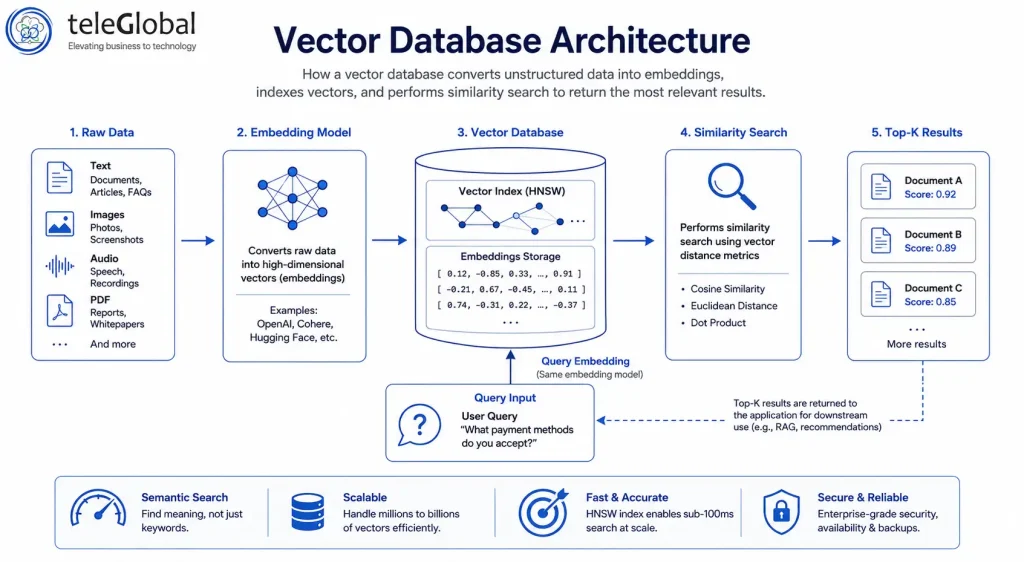
The diagram above is the mechanics behind that experience: unstructured text, images, and documents become embeddings, land in a vector index, and return as top-k matches for a query. You never configure HNSW parameters or pick a distance metric. You start a thread.
| Traditional Approach | Jenova |
|---|---|
| Paste the same brief into every new chat | Persistent memory across sessions and agents |
| Keyword search over notes and PDFs | Semantic retrieval over embeddings |
| Self-host a vector DB, embedder, and RAG eval | Fully managed storage and retrieval |
| One model vendor, one memory silo | Multi-model access with shared context |
| Desktop-only history that dies on mobile | Full parity on web, iOS, and Android |
Research that compounds instead of restarting
Literature reviews and market scans fail when the assistant cannot remember the papers you already rejected. Real-Time Search pulls live results from Google, Reddit, YouTube, GitHub, and more, while vector memory keeps your inclusion criteria, prior citations, and “do not use this source” rules in play. You are not starting a new Boolean query every morning; you are continuing a retrieval-backed investigation.
Codebases the agent actually knows
Python Coding Assistant is useful on day one for a script. It becomes durable on day twelve, when it still knows your packaging layout, the flaky test you decided to skip, and the API contract you froze last week. Attach the repo notes or a design doc once. Subsequent prompts retrieve that context instead of inventing a parallel architecture.
Writing that keeps your voice and facts
Drafts die in stateless chat because tone, banned phrases, and source-of-truth URLs leak out of the window. A writing-focused agent on the platform can store your style samples and outline decisions as memory, then retrieve them when you say “same voice as the launch post.” Combined with document attachments, that is vector memory doing editorial continuity — not a larger prompt.
Life and learning that should not reset
Coaching and language practice only work if the agent remembers constraints: injuries, exam dates, vocabulary you already own. Persistent memory turns a generic tutor into one that stops repeating week-one drills. The same store that retrieves a Python traceback can retrieve the fact that you learn better with roleplay than with grammar tables.
Try the platform free — no credit card required.
Specialized AI Agents for Vector Memory AI Chat
Memory is only as useful as the workflow it serves. These agents are built for tasks where forgetting is expensive — long research arcs, recurring logistics, immersive practice, and character-consistent play.
Deep Research
Multi-hour research is the textbook case for vector memory AI chat. This agent searches hundreds of sources, synthesizes findings with inline citations, and delivers reports you can continue tomorrow without re-scoping the question.
- Stores the research question, excluded sources, and working thesis
- Retrieves prior findings so later sections do not contradict earlier ones
- Grounds claims in cited material rather than model recall alone
Academic Research Assistant
PhD and faculty workflows span months of literature, citation styles, and manuscript versions. The assistant discovers papers across major databases and helps with manuscript preparation while memory keeps your venue, methodology, and already-read set intact.
- Real-time literature discovery across academic repositories
- Citation and manuscript support tied to your ongoing draft
- Continuity across related papers, not one-off chat answers
Personal Secretary
Logistics is a memory problem: recurring vendors, travel preferences, who gets the Friday update. This agent coordinates calendar, email, and daily operations with deep personal context so you are not re-teaching your routine every Monday.
- Remembers standing preferences and people you work with
- Connects planning to the tools you already use
- Carries context from a morning briefing into the afternoon follow-up
Roleplay Game Master
Narrative consistency is impossible without long-term memory. This agent is built for immersive roleplay with unlimited memory and stable characters — plot promises, faction names, and tone do not reset when the context window would have overflowed.
- Unlimited memory for story state and character voice
- Retrieval of earlier scenes when a later chapter needs them
- Creative range without losing continuity
Learn Russian Through Roleplay
Language acquisition depends on spaced, personal context: words you missed, formality level, stories you already lived in. This mentor uses unlimited scenarios and unlimited memory so practice compounds instead of looping beginner scripts.
- Remembers your vocabulary gaps and preferred scenario types
- Keeps character and setting consistent across sessions
- Turns each conversation into retrieval-backed practice
How Vector Memory AI Chat Works
You do not stand up a vector database. You start a conversation; the platform handles embeddings, retrieval, and the context window.
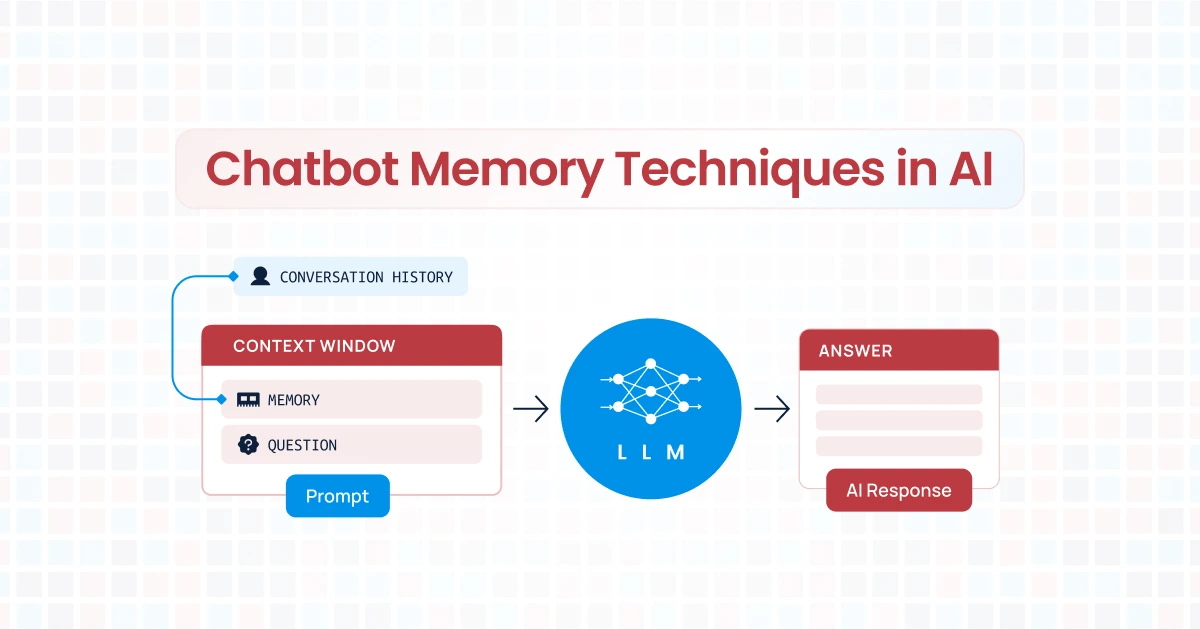
That second diagram is the user-visible loop. History, stored memory, and the new question are assembled into a prompt; the model answers. Vector retrieval decides which memories belong in that prompt so the window stays focused.
Step 1: Open an Agent and State the Outcome Pick the specialist for the job — research, code, travel, tutoring — and say what “done” looks like. The first message becomes an embedding like everything after it.
"I am writing a systematic review on retrieval-augmented generation. Prefer surveys from 2024 onward, exclude vendor blogs, and keep IEEE citation style."
Step 2: Attach the Knowledge the Model Should Trust Upload briefs, PDFs, notes, or specs. Those documents are indexed for semantic search so later questions retrieve passages by meaning. This is the same pattern enterprises now fund as RAG infrastructure, without you operating the index.
"Use the attached literature matrix. If a paper is marked reject, do not cite it again."
Step 3: Keep Working Across Sessions Close the laptop. The next day, ask a follow-up. Persistent memory and unlimited history mean the agent retrieves the review scope, the reject list, and the last outline heading instead of greeting you like a stranger.
"Continue from the limitations section and pull the three papers we flagged for the discussion."
Step 4: Switch Devices Without Re-Briefing Open the same thread on iOS or Android. Settings and history sync. A commute prompt can retrieve the same vectors as the desk session, which is what vector memory AI chat is for: continuity, not a new chat silo per device.
"On my way to campus — quiz me on the three RAG failure modes we listed yesterday."
Results and Use Cases
Vector memory shows up as hours not repeated, not as a benchmark chart. These scenarios are typical of what changes when chat retrieves meaning.
📊 Multi-week literature synthesis
Scenario: A graduate student needs a cited landscape of RAG robustness papers, updated every few days as new preprints appear.
Traditional Approach: A folder of PDFs, a spreadsheet of notes, and a chatbot that forgets the exclusion list. Re-pasting the brief each session. Easy to double-cite or miss a contradiction.
Deep Research: The question, exclusions, and working outline persist. New runs retrieve prior synthesis so the report grows instead of forking.
- Citations stay aligned with earlier sections
- Rejected sources stay rejected
- Follow-ups are cheaper than first-pass search
💼 A Python service that spans sprints
Scenario: You are building a FastAPI service with a frozen OpenAPI spec, a known flaky test, and a deployment constraint on Python 3.11.
Traditional Approach: Each new chat invents a different folder structure. You spend the first ten minutes re-explaining decisions the model cannot see.
Python Coding Assistant: Architecture notes and the spec live in memory and attachments. A bug report on Thursday retrieves Wednesday’s constraint list.
- Fewer contradictory refactors
- Debugging starts from the real stack
- Onboarding a future you (or a teammate reading the thread) is faster
🎭 A campaign that must not contradict itself
Scenario: A weekly game with named NPCs, a secret the party has not learned, and a tone you already set in session one.
Traditional Approach: Session notes in another app; the chatbot crowbars a new villain because it cannot retrieve the old promise.
Roleplay Game Master: Story state is memory. When a player cites an offhand detail from three sessions ago, retrieval can bring it back into the scene.
- Character voice remains stable
- Plot promises remain queryable
- Long arcs stay coherent
📱 Trip planning from the airport queue
Scenario: You planned a three-city trip at the desk — budget cap, walking-first days, no red-eyes. At the gate you need a weather-aware rewrite of tomorrow only.
Traditional Approach: Screenshot your own notes. Hope the mobile chatbot infers constraints it has never seen.
Travel Planning Advisor: Preferences and the itinerary are already in memory. A phone prompt retrieves them and changes one day without rebuilding the trip.
- Constraints survive the device switch
- Local follow-ups stay on-budget
- You do not retype the brief in the jetway
Examining real usage shows the same pattern enterprise vector-database buyers are paying for: low-latency semantic retrieval under live questions, not a larger chat box.
FAQ
What is vector memory AI chat?
Vector memory AI chat stores messages, files, and facts as embeddings, then retrieves the nearest matches when you ask a question. Those matches are inserted into the model’s context window so the reply can use your history and documents. On Jenova, that retrieval is built into specialized agents rather than offered as a separate database you maintain.
Is Jenova free to use for vector memory AI chat?
Yes. A free tier includes core features with limited monthly usage. Paid tiers increase usage headroom and add options such as custom model selection. Usage resets on the billing date, with the full allowance available from day one rather than a daily drip.
How is this different from a chatbot that “saves memories”?
Many products store a short list of facts or a rolling transcript. Vector memory retrieves by semantic similarity across unlimited history and attached knowledge, which is closer to RAG than to a sticky note. Independent work on production long-term memory for agents treats scalable memory as its own systems problem — not a toggle in settings. OpenAI has also expanded ChatGPT’s ability to reference prior chat context; the architectural question is whether memory is a vendor silo or infrastructure under every workflow you run.
Can I ground chat in my own documents?
Yes. Attach the files that should win over the model’s priors — specs, syllabi, transcripts, brand guides. Retrieval prefers that corpus when you ask related questions, which is how you reduce hallucinations on private material. A Writing Assistant can keep using those samples for tone; a research agent can keep using them for claims.
Does vector memory AI chat work on mobile?
Yes. Web, iOS, and Android share history, settings, and memory. Speech-to-text is available when you cannot type. The travel scenario above is the intended design: retrieve the same vectors from a phone that you built at a desk.
Is a memory-enabled agent accurate enough for sensitive topics?
Memory improves consistency; it does not make a model infallible. RAG surveys still flag retrieval quality, noisy context, and faithfulness as open problems (Sharma, 2025). For health, legal, or financial decisions, treat the agent as support and verify against primary sources. A Personal Therapist can remember themes you asked it to hold, which is useful for continuity — not a substitute for licensed care.
Vector Memory Is the Chat Interface That Finally Compounds
Stateless AI chat wastes the only scarce input you have: the time spent explaining yourself. Vector memory AI chat stores meaning as embeddings, retrieves it on demand, and lets specialized agents continue the work. The market for that retrieval layer is scaling because the pain is universal — from semantic search in production systems to personal context that should belong to the user.
Jenova puts that memory under research, code, narrative, and planning without asking you to operate a vector database. Continue a Deep Research report, a Python service, or a roleplay campaign as if the agent had been in the room the whole time.
Explore the full agent library at Jenova.
For Developers: Every agent in this article is available programmatically via the Jenova API — integrate vector memory, retrieval, and multi-model agents into your application with a single integration. Full documentation →