Theme Park Management Simulator AI: Design Parks That Work
2026-08-31
Jenova helps you run a theme park management simulator AI workflow by combining layout, guest flow, operations, and theming in one working model. In 2026, a new land — or a new park-sim prototype — still dies in spreadsheets, disconnected concept art, and slide decks that cannot answer “what happens on a sold-out Saturday?” This AI lets you interrogate that question before steel, code, or capex is committed.
✅ Pressure-test ride mix, capacity, and circulation before you build ✅ Model queues, spend per guest, and staffing against demand ✅ Generate land stories, attraction copy, and visual direction next to the numbers ✅ Keep a living park model across sessions so decisions compound instead of resetting
To understand why this matters, look at what park designers, operators, and simulation-game teams are actually up against: guests expect more, capital is less forgiving, and a pretty master plan is not the same thing as a park that operates.
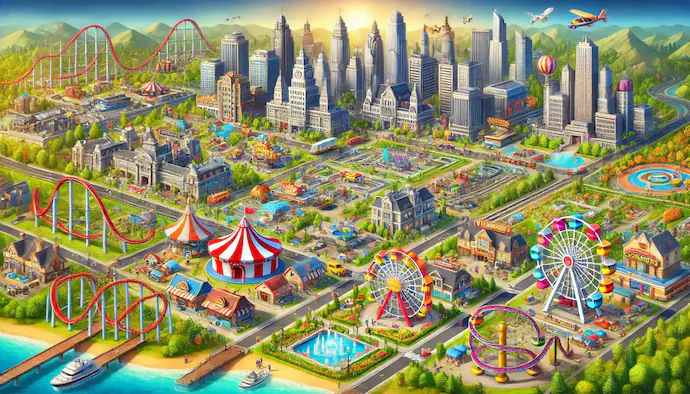
Quick Answer: What Is Theme Park Management Simulator AI?
Theme park management simulator AI is a planning system that models layout, guest flow, operations, and theming so you can test a park — or a park game — before you build it. It is not a locked tycoon sandbox. It is a conversation that behaves like a design studio, an ops war room, and a systems bible at once.
Key capabilities:
- Attraction mix, pathing, and capacity planning with a Game Designer Assistant
- Queue, staffing, and P&L scenarios with a Business Co-Pilot
- Land story, dark-ride narrative, and guest-day roleplay
- Pitch decks, attraction copy, posters, and campaign assets from the same park model
Why Theme Park Simulation Is Harder Than It Looks
The attractions business is large, competitive, and increasingly tech-driven. Market researchers put the global theme park market at about USD 75.1 billion in 2025, with a path toward USD 124.7 billion by 2035 at a 5.2% CAGR. In the United States alone, amusement park revenue has been reported near $33.4 billion. Operators and designers are not playing with toy numbers.
USD 75.1 billion — Estimated global theme park market value in 2025
Attendance still sets the tempo of every other decision. Industry trackers such as the TEA Global Experience Index and IAAPA’s global outlook exist because operators live and die by guest volume, per-capita spend, and what the next major park development will do to the map. Pre-pandemic, the industry saw on the order of 253 million visitors in 2019 — a reminder that throughput is not a side mechanic. It is the product.
But turning a sketch into a park that actually runs is frustratingly difficult:
- Layouts look balanced on a poster and fail at 2 p.m. on a holiday weekend
- Queue physics, restroom placement, and F&B catchment are treated as decoration
- Finance, creative, and operations argue from three different documents
- Classic tycoon games teach construction, not a pitchable operating model
- Real-world parks now run on sensors, apps, and AI — paper sims lag behind
Pretty Plans Hide Broken Circulation
A land can win a design review and still trap guests in a cul-de-sac behind the marquee coaster. Width of paths, shade, sightlines, parade clearance, stroller storage, and the walk from parking to the first “wow” are operational constraints, not art direction. When those choices are only visual, you discover the failure after concrete is poured — or after players rage-quit your sim because the park “feels” busy but generates no joy.
Queues, Spend, and Staffing Do Not Live in the Same File
Ride cycle time, dispatch reliability, and hourly throughput decide whether the rest of the park breathes. Food, merchandise, and photo ops only print money if guests are not stuck in a 110-minute line with no bypass. Staffing, break coverage, and opening/closing sequences are a second simulation sitting on top of the first. Most teams model one layer in a spreadsheet and the other in a slide, then hope they match.
Creative and Operations Drift Apart
Dark rides, IP lands, and festival overlays are story problems and capacity problems. A 4-minute show that seats 40 cannot headline a 12,000-guest day unless you have a queue strategy, a pre-show, and a dump-out that does not crush the gift shop. Writers write. Engineers engineer. The guest experiences the collision.
Tycoon Games Are Not an Operating Model
There is a rich lineage of theme park management video games — from the original Theme Park through RollerCoaster Tycoon, Planet Coaster, and Parkitect. Rankings of the best theme park sims exist for a reason: the fantasy of building and running a park is durable. Those games are superb at construction play. They are a weak substitute when you need custom rules, a real site, a real brand, or a GDD that investors and engineers can share.
Real Parks Already Run on Data You Are Not Simulating
Operators are wiring parks with sensors, wearables, and AI. Blooloop’s attractions technology outlook describes guest-flow sensors, real-time analytics, and AI used for personalization, safety, and operations — including Six Flags’ generative concierge and water-park drowning-prevention systems, plus Disney’s work on faster physical production. Scotland’s Landmark Forest Adventure Park is cited for IoT sensors on attractions and F&B to drive live visitor-flow decisions. If your “simulator” cannot talk about RFID bands, mobile wait times, or cashless catch, it is simulating yesterday’s park.
This is exactly what Jenova was built for.
The Jenova Solution
Jenova treats your park as a single, persistent project: systems, money, story, and guest behavior in one thread. You describe the site, the brand, the budget, and the fantasy. The platform returns layouts you can argue with, operating rules you can stress-test, and creative you can show a producer the same afternoon.
| Traditional Approach | Jenova |
|---|---|
| CAD + spreadsheet + a separate art deck | One park model you can interrogate in plain language |
| Tycoon games with fixed economic rules | Custom simulation logic for your park or your game |
| Consultants and departments in sequence | Parallel design, ops, finance, and story in one workspace |
| Static master plans | Memory across sessions — the park remembers prior decisions |
| Generic LLM chat with no domain spine | Specialized agents for systems, business, research, and narrative |
Park Systems and Attraction Design
Start with the Game Designer Assistant when the park is a product — a game, a tabletop prototype, or a live attraction with rules. It is built for brainstorming, systems analysis, documentation, and genre-aware design, which is exactly what a management sim needs: ride objects, guest agents, economy loops, failure states, and a day/night cycle that is fun and coherent.
Ask for a capacity sheet, not a vibe.
"Design a 40-acre regional park with a 6,000 daily cap. I need three thrill credits, two family dark rides, a parade spine, and a water play pad. Give me hourly throughput, path widths, and where the park will clog at 2 p.m."
Pair that with a Film Screenwriter when a land needs a beginning, middle, and dump-out. Dark rides fail when the story is a paragraph taped onto a vehicle. A screenwriter will force beat sheets, visual set pieces, and a runtime that operations can actually dispatch.
Operations, Queues, and the P&L
Hand the same park to the Business Co-Pilot for planning, financial modeling, and operating cadence. This is the layer tycoon games fake with a happiness meter. You want labor as a percent of revenue, F&B per caps, rain plans, and what happens if the marquee coaster goes down for four hours.
A Business Plan Writer turns those scenarios into a document you can take to a bank, a publisher, or a studio VP — market sizing, unit economics, and the ugly sensitivities, not just a pretty site plan. Accounting & Audit Assistant keeps the chart of accounts honest when you start naming cost centers: rides, horticulture, entertainment, retail, security.
Theming, Story, and the Guest’s Actual Day
A park is a sequence of emotions with bathrooms. Roleplay Game Master will walk a family of four through your land with unlimited memory and consistent characters — the tired toddler, the teen who only wants the coaster, the grandparent who needs shade. Tour Guide can narrate a land the way a guest should hear it: lore, practical wayfinding, and what to do when the wait hits 85 minutes.
That loop is the difference between a map and a day.
Research and Go-to-Market
Before you freeze a theme, run Deep Research against comparable parks, attendance patterns, and regional demand. Then let a Marketing Strategist allocate the opening-year media mix — season passes versus local social, group sales versus national TV. Product Copywriter names the rides and writes the attraction boards. Poster Maker and Social Media Content Generator turn the same brief into launch creative.
Industry coverage already shows parks moving to contactless, mobile-first planning and live feedback. Your simulator should assume that stack, not a 1998 ticket booth.
Specialized AI Agents for Theme Park Simulation
If you are also writing the GDD for a commercial park sim, Game Designer Assistant stays on the spine of the project. It will break guest AI, economy sinks, and scenario goals into systems you can actually build — and it knows the difference between a toy and a genre players already understand.
- Systems bibles, loop diagrams, and feature cuts that protect the core loop
- Genre and platform context so your sim does not accidentally become a city-builder
- Concept-art direction you can hand to an illustrator or an image model
If the park has to make money in the real world — or look like it could — Business Co-Pilot and the business plan writer keep creative from outrunning cash.
- Opening-year staffing models and rain-day P&L
- Capex phasing: what you build in year one versus what you promise on the map
- Sensitivity tables for attendance misses, not a single heroic forecast
If you need to feel the park, Roleplay Game Master will play a full guest day without breaking character, while Tour Guide writes the in-world voice of the land.
- Family, enthusiast, and accessibility walkthroughs of the same layout
- Bottleneck discovery that numbers alone will miss (“nobody can see the bathrooms from the hub”)
- Scripted skipper spiels, app notifications, and wayfinding copy that match the theme
Try Jenova free — no credit card required.
How to Run a Theme Park Management Simulator AI Session
Step 1: Lock the Constraint, Not the Fantasy Name the acreage, climate, daily cap, brand limits, and the one thing the park must be famous for. A constraint is a gift. “Magical forest” is not a brief. “28 acres, humid subtropical, 8,500 daily cap, no IP, one launched coaster, family-first” is a brief.
"I have 28 acres on a coastal site, 8,500 guests at peak, no licensed IP, and a $220M hard budget. Design the park around one launched coaster and a water play pad. Call out what I cannot afford."
Step 2: Build the Skeleton — Lands, Rides, Paths Use the game designer assistant to propose lands, attraction types, hourly capacities, and the parade/emergency spine. Demand a clog map, not a mood board. If a land has only one way in, you already know the review note.
"Give me a land-by-land table: acres, ride count, theoretical hourly capacity, F&B seats, restrooms, and the first place this park fails on a sold-out day."
Step 3: Simulate a Real Day, Not an Average Day Walk three guest types through arrival, first ride, lunch, the 2 p.m. crush, and exit. Then break something: a 90-minute rain cell, a coaster evacuation, a parade that seals a path. This is where business co-pilot and guest roleplay earn their keep.
"Simulate Saturday of peak season. Coaster down 13:40–17:10. Show me queue spill, F&B recovery, and which land becomes unsafe from crowding."
Step 4: Attach Money, Labor, and a Go-to-Market Convert the skeleton into labor hours, per caps, pass mix, and an opening campaign. If you cannot explain how the park makes money on a 15% attendance miss, you do not have a park yet. You have a rendering.
"Build a year-one P&L at 1.1M, 1.4M, and 1.7M visits. Include seasonal labor, maintenance as a percent of ride assets, and a season-pass mix that does not destroy per caps."
Step 5: Package What Stakeholders Can Approve Turn the thread into a GDD chapter, an investor narrative, attraction name lists, posters, and a guest-facing tour script. The simulator is not finished when the map looks good. It is finished when operations, creative, and finance can argue from the same artifact.
Results & Use Cases
🎢 Indie Team Shipping a Park-Sim Prototype
Scenario: A five-person studio wants a management sim with deeper guest AI than a happiness meter — heat, shade, bathroom need, group splitting, and photo-ops as economy sinks. Traditional Approach: Months of undocumented design Discord, a vertical slice that looks like every other tycoon, and a GDD that engineers ignore. Jenova: A systems bible, economy loops, and failure states you can drop into production, with Startup Advisor pressure-testing scope against a real ship date.
- Cuts features that do not serve the core loop
- Documents guest-agent needs in language programmers can ticket
- Keeps art, design, and production on one living brief
🏗️ Regional Operator Pitching a Second Gate
Scenario: An existing park has adjacent acreage and a board that has been burned by optimistic renderings. Traditional Approach: A master-planning firm, a 120-page PDF, and a financial model that does not talk to the site plan. Business plan writer + ops modeling: Phased capex, cannibalization of the first gate, and a ride mix that does not steal the original park’s identity.
- Attendance sensitivities instead of a single heroic year
- Labor and horticulture as first-class costs
- A narrative the board can reject in pieces, not as a monolith
🎬 Creative Studio Building a Space Land
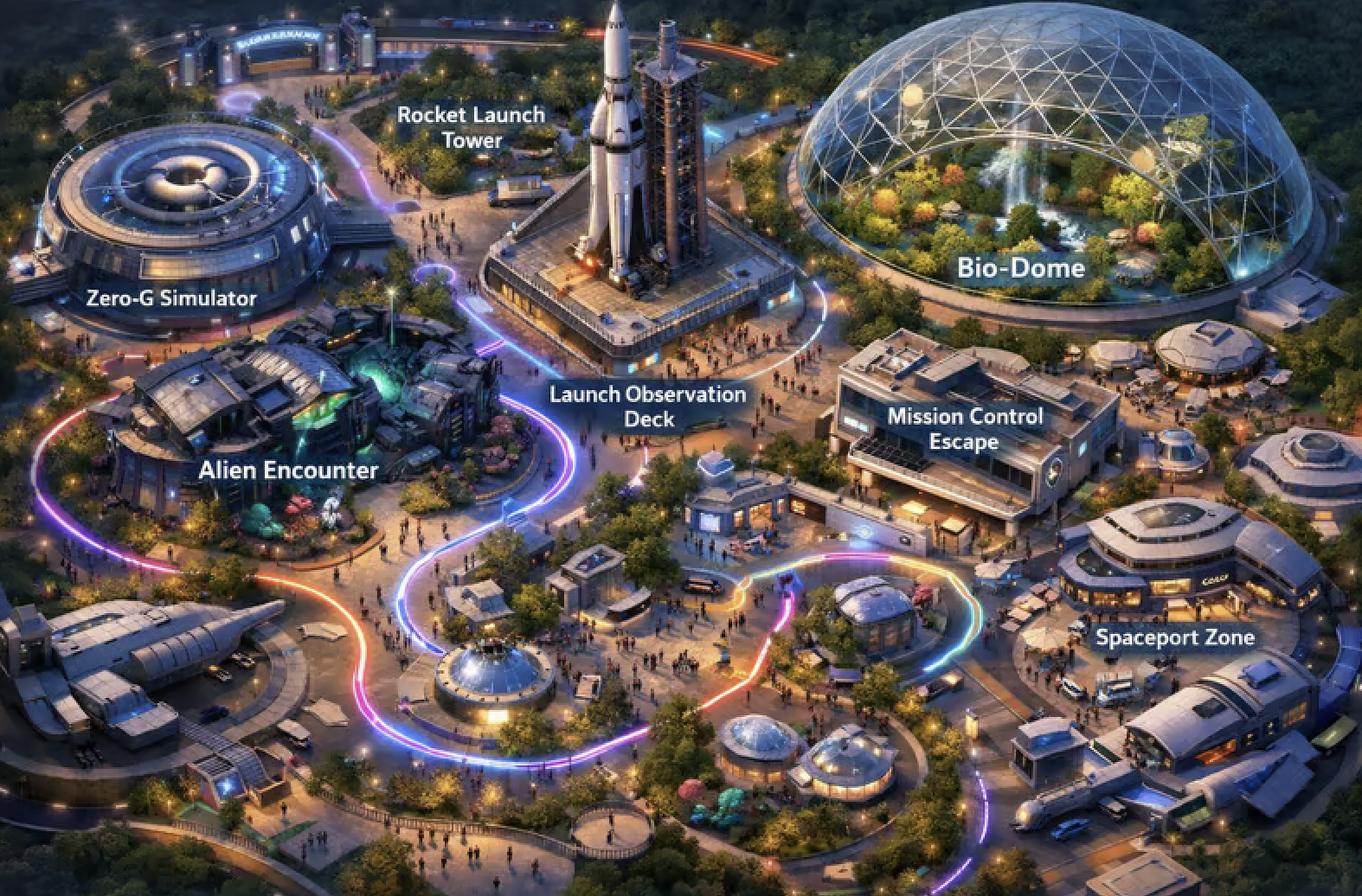
Scenario: A producer has the space-park brief in the second image — launch tower, bio-dome, alien encounter, mission-control escape, spaceport retail. Traditional Approach: Beautiful key art, a ride list, and no idea whether Mission Control can process the dump-out from the tower. Screenwriter + systems pass: Runtime, pre-show, capacity, and a guest path that makes the bio-dome a recovery space rather than a dead zone.
- Story that respects dispatch
- Named attractions with merch and photo beats already attached
- A clog map for glowing night-time paths, not just daytime plazas
📱 Operations Manager Walking the Park
Scenario: A GM on iOS photographs a plaza that seizes up after the 3 p.m. parade and drops the image into chat between landings. Traditional Approach: A guest-complaint pile, a week of radio notes, and a capital request next season. Jenova on mobile: Immediate diagnosis — sightlines, overflow, shade, and a cheap operational fix versus a rebuild — then a briefing the GM can paste to the duty team.
- Full feature parity on phone, not a “lite” afterthought
- Photo in, operating note out, while you are still on the pavement
- Memory of last month’s parade change so you are not re-explaining the site
📣 Marketing Launch for a New Season Pass
Scenario: The park needs a campaign that sells the operating promise — shorter waits, a new nighttime overlay — not just a logo on a coaster. Traditional Approach: Agency creative that never saw a capacity sheet. Marketing Strategist + social generator: Channel mix, pass-holder versus tourist messaging, and posts that do not promise a wait time operations cannot hit.
- Creative tied to real hourly capacity
- Local versus out-of-market spend that matches catchment
- Attraction copy that matches the safety signage, not a fantasy runtime
FAQ
What is theme park management simulator AI?
Theme park management simulator AI is software that lets you model a park’s layout, guest behavior, operations, and commercial performance in conversation — then iterate. On Jenova it is not one locked tycoon engine. It is a set of expert agents that share memory, so the ride list, the P&L, and the land story stay consistent. Use it to design a real site, a pitch, or the systems of a park-management game.
Is theme park management simulator AI free to try?
Yes. Jenova has a free tier with core features and limited usage, so you can run a first park brief — layout, clog map, and a rough operating day — without a card. Heavier iteration, custom model choice, and higher volume sit on paid tiers. Start with one constrained brief; if the thread is useful, you will know before you upgrade.
How is this different from Planet Coaster or RollerCoaster Tycoon?
Those games are construction toys with authored rules, and they are excellent at that job. Jenova does not replace a real-time park builder. It replaces the messy layer around one: custom economics, real sites, brand constraints, GDD writing, investor narrative, and guest-day storytelling that a boxed sim will not let you rewrite. Many teams use both — build in the engine, think on Jenova.
Can this help with real theme park operations, not just games?
Yes, with the obvious limit: it is a decision-support model, not a control system for your ride PLCs. You can rehearse parade seals, rain plans, labor mixes, and per-cap scenarios, and you can ground them with Deep Research on industry comparables. Live parks already use AI for operations, safety, and personalization; this is the planning twin of that stack, not a substitute for on-site safety systems.
Does it work on mobile?
Yes. Jenova is built for web, iOS, and Android with the same core workflow. That matters for this use case: the useful question often appears on a path, not at a desk. Photograph a plaza, dictate the constraint, and get a clog diagnosis before you reach the next land. Speech-to-text is there when your hands are full.
How accurate is a theme park management simulator AI?
Accuracy tracks the quality of your constraints. Give it acres, climate, cycle times, and a budget, and you get a model you can stress-test. Give it “make a cool park,” and you get mood. Treat outputs as a rigorously argued draft — then verify cycle times, codes, and manufacturer specs with your engineers. AI is already in every stage of game design research; it still does not replace a licensed PE or a ride vendor.
Conclusion
A theme park is a machine for moving people through emotion at a profit. Most “plans” only show the emotion. Theme park management simulator AI on Jenova puts layout, guest flow, labor, story, and launch creative in one persistent model so you can break the park on purpose — then fix it — before guests, players, or investors do it for you.
Whether you are writing the GDD for the next management sim, pitching a second gate, or standing in a plaza that fails every Saturday, you do not need another disconnected deck. You need a park you can argue with.
Start with the Game Designer Assistant for systems, bring in Business Co-Pilot for the operating day, and let Marketing Strategist sell only what the capacity sheet can keep. Explore the rest of the workspace at Jenova.
For Developers: Every agent in this article is available programmatically via the Jenova API — build park-planning, sim-design, or guest-experience features into your application with a single integration. Full documentation →