Survival Island Roleplay AI: Gather, Craft, and Survive the Island
2026-08-29
Jenova is where survival island roleplay AI actually holds together: you wash ashore, scavenge what the tide left, and build a camp that does not vanish when you look away. While packaged survival games lock you to someone else’s map and generic chatbots forget the raft you spent three hours lashing, this platform gives you an island that keeps inventory, weather, and grudges.
In August 2026, that persistence is the difference between describing a beach and living on one. Coconuts you drank stay gone. A shelter you half-finished still leaks. The person who shared your last fish remembers whether you hoarded the rest.
✅ A wreck-to-camp loop where gathering, crafting, and exploration stay causal ✅ Characters, caches, and weather that remember the last choice you made ✅ Replayable islands instead of a single scripted shipwreck ✅ Full sessions on web or phone, at the scarcity level you set
To understand why this matters, it helps to look at why most survival island roleplay still feels thin: the jungle is not a place, the fire is not a resource, and the night resets before thirst can become a plot.
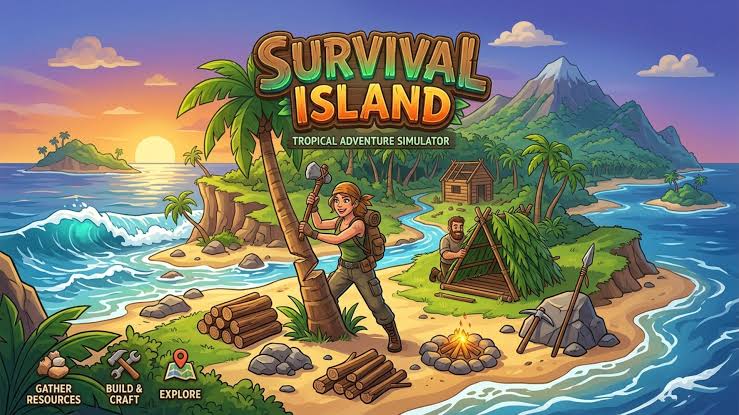
Quick Answer: What Is Survival Island Roleplay AI?
Survival island roleplay AI is an interactive castaway story that lets you gather, craft, and survive on an island where resources, camp, and consequences persist. You are not watching a wreck. You are rationing it.
Key capabilities:
- Shoreline openings that force you to name water, shelter, and injury before lore
- Resource loops—wood, fiber, fish, salvage—that stay spent once you spend them
- Companions and wildlife that remember the last deal, theft, or kindness
- Replayable wrecks so a different first hill produces a different island
Why Survival Island Roleplay Still Breaks
Survival is a scarcity fantasy. It only works when space, inventory, and time agree with each other. If the spring you found is a cliff on the next turn, dread collapses. If the AI forgets you burned the last dry wood, the plot is cosplay.
Demand for that fantasy is not theoretical. The survival games market is projected to grow at a 13.8% CAGR from 2025 to 2033, reaching an estimated **$17.12 billion** by 2033. The broader [global games market reached $188.8 billion in 2025](https://www.gianty.com/game-industry-in-2025-and-the-trends-in-2026/). People already pay for islands. They will not keep paying for islands that refuse to stay built.
Entertainment time is already crowded. Deloitte’s Digital Media Trends research found U.S. consumers competing for about six hours of media and entertainment a day, with no sign that the clock is getting longer.
$17.12 billion — Projected survival games market size by 2033
Six hours a day — Average U.S. media and entertainment time consumers are already splitting across streaming, social, gaming, and audio
$188.8 billion — Global games market revenue in 2025, per Newzoo
But getting a survival island that behaves like a survival island is still frustratingly difficult:
- Packaged survival games hand you someone else’s biome, tech tree, and win condition.
- Generic roleplay chatbots improvise a palm tree, then lose the hut, the storm, and the last coconut.
- Films and reality competitions let you watch hunger. They will not let you choose the wrong hill.
- Real wilderness skills cost time, gear, and risk you cannot pause between subway stops.
- Branching titles exhaust their trees. After two endings, the island is a map you already finished.
The Map Is Not Yours
A boxed survival title is a designed toy: beautiful, finite, and finished without you. That is a strength when you want systems. It is a ceiling when you want this wreck, this injury, this reason you will not light a fire on the windward beach. Survival island roleplay AI should let you specify the geology—atoll, volcanic ridge, mangrove maze—and then obey it.
Inventory Amnesia Kills Scarcity Faster Than a Soft Storm
Hunger is a ledger. When an AI restocks the grove you stripped, or reintroduces a companion you already watched walk into the surf, the spell breaks. Players do not need a survival HUD for tension. They need the dry wood to remain dry wood.
Interactive narrative research keeps returning to the same point: engagement rises when choices have visible consequences and paths are worth replaying. A 2025 study of AI-assisted interactive storytelling in Electronics treated user engagement, choice-and-consequence logic, and replay value as first-class measures—not extras. If survival island roleplay AI cannot keep a causal chain (you smoked the last fish; dawn has no breakfast), it is generating prose, not producing survival.
You Cannot Interrogate a Cutscene
AI is already used to build interactive stories that adapt to user choices. That helps writers and platforms. It does not, by itself, put you on a reef with a choice that cannot be undone. The gap is not “more tropical adjectives.” The gap is a dedicated island that will not drop the matches.
Off-Screen Survival Is Not a Session You Can Save
Physical survival training is valuable. It is also expensive, seasonal, and unforgiving of a Tuesday night. Roleplay will not teach you to purify water in the field. It can let you feel the social and logistical pressure of a camp—who eats, who keeps watch, what you will trade—without requiring a permit.
The global chatbot market was estimated at $9.6 billion in 2025, which tells you conversation interfaces are everywhere. Presence of a chatbot is not presence of an island. Most of those systems were built to answer questions, not to ration salt.
This is exactly what Jenova was built for.
The Jenova Solution
Jenova is not a tropical overlay you have to prompt into a general chatbot every night. It is a platform for persistent, multi-model agents: you define the wreck, the rules of scarcity, and the tone, then play a camp that remembers. Custom agents let you set instructions, preferred models, and a private knowledge base—field notes, island maps, even a forbidden food list—so the shoreline does not reinvent itself mid-storm.
| Traditional Approach | Jenova |
|---|---|
| Fixed biome and tech tree | You name the island; the session obeys that geology |
| Chatbot that forgets the raft | Persistent camp, caches, and character memory |
| Survival film you cannot interrupt | You drink the water, lie about the flare, or refuse the cave |
| One-pass reality competition | Replay until a different first hill changes the whole wreck |
| Intensity you cannot tune | You set hunger, weather, and how dark the jungle is allowed to get |
Play the Island as a Place, Not a Prompt
Fear and hunger both need a map. Survival island roleplay AI on this platform treats the atoll as geography: windward reef, leeward spring, a ridge you have not climbed. When you search the wreck for a name on a life jacket, the next cove can use what you found. That is how dread and logistics accumulate instead of resetting every message.
If you want a different kind of island pressure—social, not scarce—Love Island runs an open-world romance among eight strangers where connections and rejections unfold from your choices. Same shoreline instinct, different stakes. If you want closed-space investigation instead of open coast, The Mansion and The Asylum keep the same “the building remembers you” contract in horror architecture.
Ground the Fiction in Real Constraints
A convincing island cheats less when food, water, and labor have rules. Farm & Agriculture Advisor helps you decide what would actually grow in sand, what fails in salt wind, and how a tiny plot behaves after a storm—useful when your roleplay claims a garden. Master Chef Coach turns forage into meals with real technique, so “we cooked the fish” is not a caption. Fitness & Workout Coach can pressure-test whether your character could haul timber after two days of no sleep. None of this replaces wilderness training. It stops the camp from running on movie physics.
Turn a Survived Week Into Something You Can Show
The wreck is only half the job for a lot of players. Writing Assistant shapes the logbook into prose that still sounds like you. Film Screenwriter takes a night on the ridge and builds structure, dialogue, and a draft. Graphic Designer and Prompt Generator help you lock a visual language for the camp—palette, icons, the silhouette of the hut—so later sessions do not change architects.
Try prompts like these—instructional lines, not scripts you have to memorize:
"I wash up on black sand. First person. I can see a snapped mast, one shoe, and no fresh water. Do not explain how I got here. Let me find it."
"I spend the morning gathering only what I can carry in one trip: two dry boards, coconut fiber, and a dented pot. Deduct them from the beach. Tonight it rains."
"I will not light a fire on the windward side. I dig a shelter into the dune and keep watch. Tell me what I hear for one hour, then wait."
Specialized AI Agents for Survival Island Stories
If the first night on the reef is only the start of what you want to make, these agents sit on the same path: more island, or a way to freeze what happened.
Film Screenwriter
If a run left you with a set piece you cannot stop thinking about—the false rescue, the argument over the last flare—Film Screenwriter helps you turn it into a screenplay: concept, outline, draft, and revision with an eye for visual storytelling.
- Scene-level craft after you have already lived the blocking in roleplay
- Dialogue that sounds like people rationing hope, not caption-card survival
- Outline-to-draft support if you want the island on a page, not only in chat
Comic Creator
If the week wants panels—reef, ridge, the thing in the treeline—Comic Creator is built for complete sequential stories, from a single issue to a longer castaway saga.
- Layouts that hold a scarce choice across a page turn
- Consistent visual style so the hut does not change carpenters mid-issue
- A way to freeze a specific failed escape and show the consequence
Farm & Agriculture Advisor
If your island story claims crops, livestock, or a second-month garden, this advisor keeps the ecology honest: soil, salt, pests, and what fails after a storm.
- Crop and climate logic you can import into custom agent instructions
- A check on “we farmed the jungle” shortcuts that flatten tension
- Sustainable-practice framing if your ending is settlement, not rescue
Love Island
If your island fantasy is social weather rather than caloric weather, Love Island puts eight strangers on a private shore and lets connections and rejections emerge from what you actually do.
- Open-world romance instead of a scripted coupling order
- Character dynamics that unfold from choices, not a producer’s edit
- A useful contrast: same isolation, different resource—attention
Learn English Through Roleplay
If you want the wreck to double as language practice, this tutor runs immersive scenarios where idioms and grammar stick because the tide is coming in.
- Any intensity, including a stripped-down castaway register
- Vocabulary anchored to tools, weather, and negotiation—not a textbook beach
- Character-consistent practice so “where is the spring” stays a real question
Children's Book Creator
If you need a gentler island—board book or chapter book, consistent art, read-aloud text—this studio builds the story spread by spread.
- Family-safe castaway arcs without pretending hunger is a joke
- Visual continuity across pages so the camp looks like one place
- A way to adapt a roleplay night into something you can read aloud
Try Jenova free — no credit card required.
How Survival Island Roleplay AI Works
You do not configure a game engine. You wash up. The loop is closer to keeping a camp than to filling out a character sheet.
Step 1: Name the Wreck
Open Jenova and start from constraint, not backstory: no fresh water, one injured ankle, a storm wall on the horizon. Tell it how much you can see from the surf line. Specific sensory limits make the island feel physical. If you want a dedicated agent instead of a blank chat, set custom instructions that freeze the biome, the scarcity rules, and what the island is never allowed to forget.
"First person only. I am on my knees in the surf. I can see a broken crate, a ridge to the east, and no other people. Do not narrate rescue. Let me fail or earn it."
Step 2: Make One Trip and Mean It
Choose a direction and a carry limit. Survival flattens when every resource stays available forever. Name the action, the caution level, and what you refuse to do. The island should respond to the refusal as much as the advance.
"I climb the east ridge with empty hands. I will not enter the treeline after the light goes copper. If I see smoke that is not mine, I watch and do not call out."
Step 3: Treat Loot Like a Ledger
When you find fiber, a pot, a flare, say what you do with it. Pocket it, hide it, trade it, waste it on a signal no one will see. Survival island roleplay AI only becomes survival when objects change the next morning.
"I take the pot and twelve meters of rope. I will not use the flare tonight. Next I want the leeward side, and I want you to subtract everything I already stripped from the beach."
Step 4: Decide Whether Escape Is the Point
Some nights you want the shipping lane. Some nights you want a hut that lasts the season. Say which one you are optimizing for. Then live with the version of the island that produces. If the run wants a comic, a screenplay, or a gentler retelling, hand the log to Comic Creator, Film Screenwriter, or Children's Book Creator after you put the fire out.
Replay is the fifth step you do not have to schedule. A different first hill is a different island.
Survival Island Roleplay AI Results & Use Cases
These are concrete wrecks, not slogans. At least one is a commute-length session; the others are what people do with the camp after they put the phone down.
📊 Solo Castaway: Map the Island Before It Maps You
Scenario: You have one evening and no interest in a multiplayer raid. You want a volcanic ridge, a cracked compass, and a rule: if you drink brackish water, describe the next six hours honestly.
Traditional Approach: A survival game with a wiki already solved, or a film that will not let you skip the waterfall that would have saved you.
Jenova: You spend the night reconstructing a coastline from what you can carry, testing which coves lie about fresh water, and choosing whether the signal fire is worth the last dry wood.
- You control pacing: linger on the reef or force the interior
- Continuity holds: a pot stays a pot
- A second run can start with the cave you were too tired to enter
💼 Writer: Stress-Test an Island Before You Script It
Scenario: You are drafting a feature and the location is still a mood board. You need to know which shores actually produce story—what a character would do at low tide, not what a synopsis claims.
Traditional Approach: Outline in a vacuum, then discover in draft five that the geography does not support the hunger. Index cards and a lot of discarded blocking.
The platform plus Film Screenwriter: Walk the wreck in roleplay until a sequence is inevitable. Then hand that sequence over for structure, dialogue, and a draft you can revise. Manga Creator or Webtoon Creator can take the same log if the story wants panels or vertical scroll instead of a shooting script.
- Blocking comes from lived choices, not a shot list you invented cold
- Dialogue can be harvested from what you actually said under rationing
- You keep the scarcity logic that made the night work
📱 Late Train, Low Light, One Earbud
Scenario: You are on a phone, in public, and you still want the island—just not a scream that gets you a look. You set quiet scarcity: no gore dump, weather and thirst only, short moves.
Traditional Approach: A jump-scare clip in an open carriage, or waiting until you are home for anything with tension.
Mobile survival island roleplay AI: Same reef, shorter trips, whispered stakes. You gather one load per stop. The session is still the island; the intensity is yours.
- Feature parity on iOS and Android, not a cut-down toy
- You can pause between stations without the camp forgetting the last cache
- Useful when the point is logistics, not volume
🎯 Turn a Survived Week Into a Garden That Could Exist
Scenario: Your ending is settlement, not rescue. You want a second-month plot—what grows, what dies in salt, what a storm does to a naive irrigation ditch.
Traditional Approach: Invent a thriving jungle farm, then watch readers who garden bounce off the page.
Farm & Agriculture Advisor with the camp log: Import climate and soil constraints into the next roleplay instructions. Cook the harvest with Master Chef Coach if the scene is a meal, not a yield table. Comic Creator can freeze the first successful bed of greens as a page-turn, not a montage cheat.
- The island’s ecology becomes a character
- Settlement endings earn their calm
- You get an artifact—page, script, or still camp—you can share
Survival Island Roleplay AI FAQ
What is survival island roleplay AI?
Survival island roleplay AI is an interactive castaway experience in which you gather, craft, and survive through conversation: you choose coves, ration supplies, and live with consequences that persist. Unlike a film, it answers you. Unlike a packaged survival game, you can rewrite the geology. On Jenova, that means custom instructions, memory that spans the session, and optional tools—from farming logic to screenwriting—around the same wreck.
Is survival island roleplay AI free to try?
Yes. You can start a survival island roleplay session without a credit card on the free tier, with core features available and usage limits that scale if you subscribe. Paid tiers add more usage and options such as custom model selection. If you only want one night on the reef, begin free and see whether the camp holds together. That is the test that matters—not a feature list.
How is this different from a survival video game?
A survival game gives you systems: meters, tech trees, a map an artist already finished. Dedicated survival island roleplay AI starts you in a specific wreck with a job: name the water, spend the wood, survive the rooms of jungle that remember you. The difference shows up when you go back to a cache you already emptied and the island has not restocked it for your convenience.
Can I control how hard the island gets?
Yes. Say the scarcity, the lines you do not want crossed, and whether you want slow thirst or a night in the interior. The island still has physics—you are a guest, not the weather—but you can refuse a register of harm and keep atmosphere. If a scene is too much, say so and redirect. Good survival island roleplay is consent plus consequence, not a disaster you cannot stop.
Does survival island roleplay AI work on mobile?
Yes. You can play on the web, iPhone, or Android with the same session style: type or use speech-to-text, make one trip, keep going. That is how a commute scene works—one load of timber per stop, camp still intact when you return. Settings sync across devices, so the island does not fork into two contradictory coastlines.
Can I turn a session into a screenplay, comic, or picture book?
Yes. After a run, take the coves, choices, and images that stuck and continue in Film Screenwriter for a draft, in Comic Creator for panels, or in Children's Book Creator for a gentler retelling. The roleplay gives you lived blocking; the writing and comics agents give you a form other people can read. You do not have to be a professional. You need a night that was specific enough to adapt.
Make the First Trip Count
Most survival stories ask you to sit still while someone else starves with better lighting. Survival island roleplay AI asks you to pick up the crate. The problem was never a shortage of palm trees in the prose. It was islands that would not stay mapped, fires that would not stay spent, and nights you could not replay when you finally understood the first spring was a lie.
Jenova is the product that treats those as the job: wash up with nothing, build a camp that remembers, and find out whether rescue and a life on the ridge are the same ending. If you also want a social island, a horror estate, a screenplay, or a comic of the hill you should not have climbed, those paths sit next to the wreck.
Try the first shoreline. Spend the wood. See what the tide kept.
Explore the full agent library at Jenova.
For Developers: Survival island roleplay and the agents in this article are available programmatically via the Jenova API — integrate persistent island campaigns into your application with a single API call. Full documentation →