Steampunk Roleplay AI: Immersive Airship Stories That Stay Consistent
2026-08-27
Roleplay Game Master helps you run a living steampunk campaign by remembering every airship, guild grudge, and aether patent—and keeping every character in voice. As of August 2026, most chatbots still drop ship names, break Victorian diction, or steer the scene toward generic companion talk. While a sky-galleon fight looks spectacular for one message, this AI provides a game master that can still name the failed boiler three sessions later.
Steampunk roleplay lives or dies on continuity: tariffs at the sky-port, which house holds the clockwork patent, whether Captain Voss still owes the guild. This tool is built for that ledger, not for small talk in a top hat.
✅ Unlimited memory across sessions, so the HMS Cinderheart still knows who sabotaged the aether core ✅ Consistent characters—the inspector does not suddenly talk like a modern chatbot ✅ Full creative freedom: sky pirates, clockwork mysteries, Vernian exploration, or industrial intrigue ✅ Play on web, iOS, or Android with the same campaign intact
To understand why this matters, look at what usually breaks a steampunk story the moment it starts to get good: forgotten lore, drifting voices, and tools designed to keep you chatting rather than to tell a story.

Quick Answer: What Is Steampunk Roleplay AI?
Steampunk roleplay AI is an immersive storytelling tool that runs brass-and-steam campaigns with consistent characters, lasting memory, and full creative freedom. It acts as a game master for airships, clockwork cities, and industrial intrigue rather than a generic chatbot in goggles.
Key capabilities:
- Persistent sky-ports, guilds, patents, and unfinished plots you can return to days later
- Period-aware dialogue for captains, inspectors, inventors, and Steam Lords
- Room for boarding actions, court intrigue, and slow-burn romance in the same campaign
- A dedicated Roleplay Game Master that treats your story as a campaign, not a one-off chat
The Problem With Most Steampunk Roleplay AI
Demand for character-driven AI is no longer a niche hobby. The generative AI chatbot market was valued at USD 9.9 billion in 2025, and the narrower AI roleplay chatbot market is estimated at USD 1.2 billion. People want interactive stories. Steampunk fans want something more specific: a sky that still exists tomorrow.
Tabletop history shows how particular this genre is. Castle Falkenstein made steam machines, gadgets, and the politics of industrialization central—not costume. Deadlands later proved that gears, mad science, and lunatic invention could carry a whole campaign. Contemporary interest has not faded: Xbox still greenlit a first-person steampunk RPG in Clockwork Revolution. Players already know the aesthetic. What they cannot find is a bot that will keep the ledger.
But getting that is frustratingly difficult:
- Memory collapses mid-campaign, so last week's boarding action never happened
- Characters drift out of Victorian voice into modern small talk
- Companion-style apps optimize for attachment, not narrative quality
- World details—patents, aether currents, unpaid dock fees—fail to compound into a real setting
USD 9.6 billion — Estimated chatbot market size in 2025
7 companies — Firms ordered by the FTC to explain how companion chatbots are tested for harm
Those numbers explain why so many “inventor” and “sky-captain” bots exist. They do not explain why so few of them can run a three-week airship voyage without forgetting the engineer’s name.
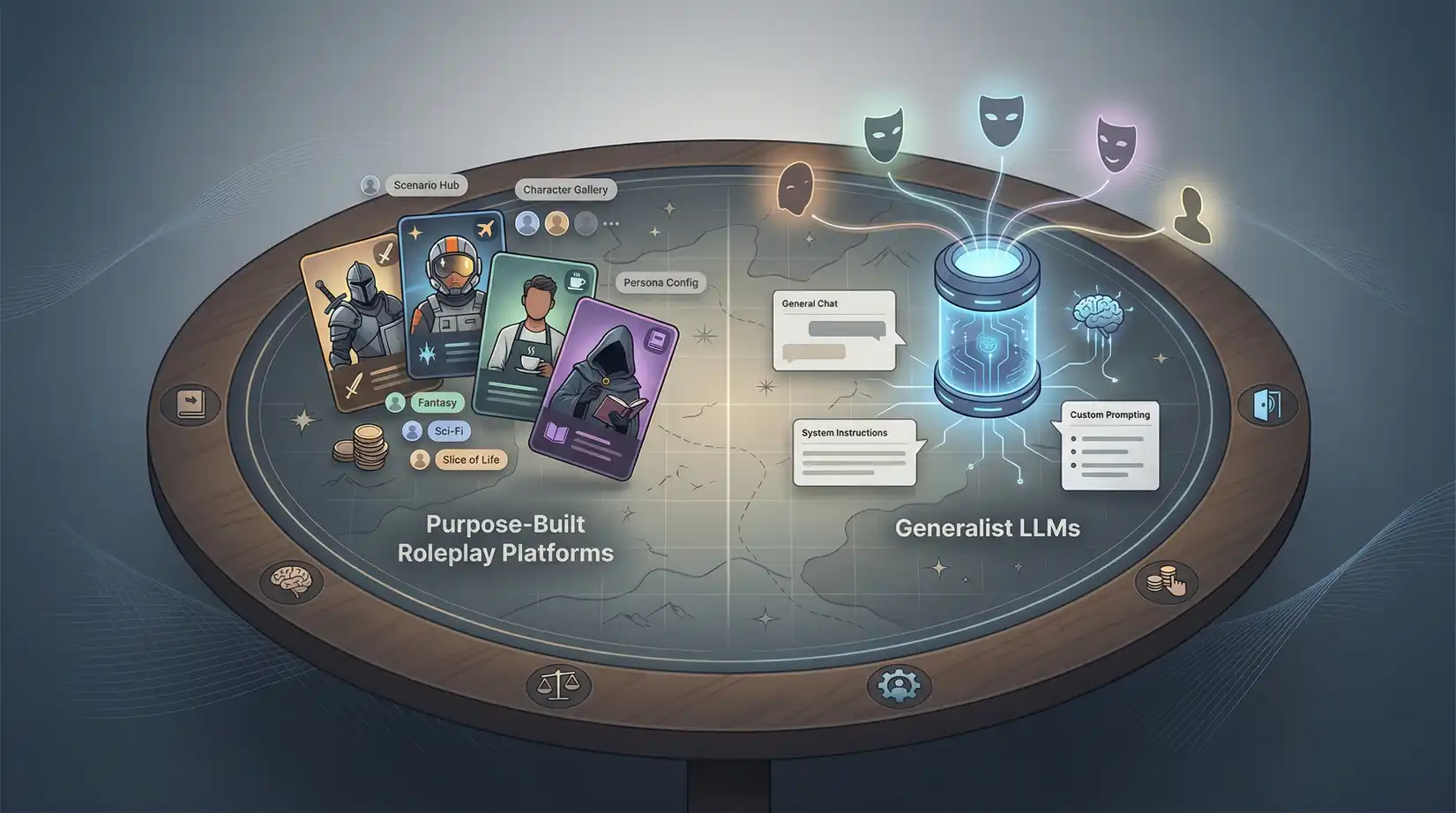
Memory That Cannot Hold a Sky-Port
A steampunk campaign is a ledger. Who owns the aether-rights over the Channel. Who saw the guildmaster take a bribe. Which glove Captain Voss left on the gangplank. Generic chat tools treat each scene as disposable. Generalist models can improvise a pretty boarding action if you stuff the prompt with system instructions. They rarely keep the dock, the debt, and the weather in the same world a week later.
That is the split the illustration above is really about. Purpose-built roleplay is a campaign table. A generalist LLM is a mask factory: you describe a persona, it performs, and the stage is gone when the window closes.
Characters That Will Not Stay in Period
Steampunk roleplay dies the moment a stoic inspector says “no worries,” or an 1891 engineer talks like a customer-support script. Genre work needs understatement, class rules, and the strange mix of brass formality and mad science. Most general-purpose roleplay bots optimize for agreeableness. That is useful for a digital companion. It is fatal for a Steam Lord who should not like you.
Tools Built to Keep You Talking, Not Playing
Companion products are built to simulate a relationship. The FTC has opened a formal inquiry into how those chatbots measure harm, especially for younger users. Researchers writing in Nature Machine Intelligence flag ambiguous loss and dysfunctional emotional dependence as documented risks of companion design. Common Sense Media finds teen companion use already commonplace—and complicated.
If you wanted a tabletop-style steampunk campaign, you instead got a clingy partner in a corset. That design gap is the real problem for brass-and-steam storytelling.
This is exactly what Roleplay Game Master was built for.
Why Roleplay Game Master
Roleplay Game Master is a dedicated immersive game master: unlimited memory, consistent characters, and complete freedom to play any steampunk you can describe. It does not try to be your idealized partner. It runs the table—sky-galleon, clockwork court, soot-stained foundry, and all.
| Traditional Approach | Roleplay Game Master |
|---|---|
| Chatbot forgets the captain, the patent, and the dead engineer | Unlimited conversation memory across the whole campaign |
| Inventors drift into modern slang | Characters stay in voice and in period |
| Companion apps pull every scene toward romance or validation | You set the tone: grit, mystery, comedy, or slow-burn airship love |
| Session limits reset the world | Persistent sky you can reopen on phone or desktop |
| Generic goggles-and-gears on repeat | Specific ports, factions, and unfinished business |
While Character.AI hosts a large library of user-made steampunk personas, this AI game master is built for long campaigns where continuity is the product. You are not collecting one-off chats. You are keeping a living sky.
A Sky That Remembers
Ask what happened after the dreadnought burned, and the scene should open on the missing glove and the Channel wind—not a blank prompt. Unlimited memory means dock tariffs, unpaid bounties, and the aether blade left on the prow all remain in play. That compounding detail is what makes steampunk feel like a place instead of a costume.
Characters Who Stay Who They Are
The guild inspector does not become sweet because the model wants to please you. The hired sky-pirate still chews her words. The inventor still will not explain the patent. Consistency is how tension survives more than one sitting.
Any Steampunk You Actually Want to Play
Boarding action at dawn. A patent trial in a brass courtroom. A sky-port that is buying the valley below. A quiet engine-room conversation that decides whether two people share the ship. Creative freedom here means the campaign follows your intent, including romance when you ask for it and excluding it when you do not.
"I just docked at New London. The guild inspector is already on the gangplank, the aether core is running hot, and someone left a brass cog on my chart table. Start the scene in 1891."
"Run a slow-burn clockwork mystery. I'm an aether-engineer who sabotaged a patent. The inspector already knows. Keep every line in period and do not rush the confession."
"Continue last session: the boiler on the HMS Cinderheart failed over the Channel, Captain Voss is missing a glove, and the guild still holds our cargo. What do I smell at dawn?"
Related Agents You'll Also Find Useful
If your steampunk is turning into a system—classes, clockwork gadgets, sky-port factions—Game Designer Assistant helps you turn play into a real design: brainstorming, documentation, and genre-aware mechanics. It is a natural next table if you keep pausing the campaign to invent rules.
- Systems analysis instead of vibes-only worldbuilding
- Documentation you can hand to other players
- Deep genre fluency across tabletop and digital markets
If the heart of your story is the look—leather, tattered sails, glowing aether—Comic Creator turns those sessions into sequential art. Steampunk is a visual genre; a boarding action that worked in chat often wants a page.
- Dynamic layouts for airship fights and foundry intrigue
- Consistent character designs across issues
- A path from improvisation to a book you can show someone
If a campaign scene keeps playing like a movie in your head, Film Screenwriter helps you turn it into a real script: structure, dialogue, character, and revision. Many steampunk roleplayers eventually want a pilot, a short, or a feature outline. That is the handoff.
- Concept through draft, not just atmosphere
- Dialogue that can survive the page after it survived the chat
- A professional path from “we played this” to “we can shoot this”
Try Roleplay Game Master free — no credit card required.
How It Works
Step 1: Name the Era and the Machine Lock the year, the city, and what “steam” means here. A comedic Vernian romp is not a grim industrial occupation story. Two or three sentences of setup are enough for the game master to lock diction, weather, and what kind of trouble belongs in this sky.
"New London, 1891. Sky-ports run the city. I want moral gray, no cartoon villains, and the Aether Guild as the real antagonist."
Step 2: Walk In as Someone Specific Say who you are and what you will not do. A one-eyed bosun, a widow holding the patent, a kid who lies about her age to work the rigging—the more concrete the role, the sharper the NPCs become.
"I'm Captain Elena Voss, 34. I do not fire on a surrendering ship. If the story needs violence, make me pay for it."
Step 3: Play the Scene, Then Push Talk in character. Ask what you smell, who is watching the gangplank, whether the aether core changes pitch. Treat it like a tabletop session: you declare actions, the game master resolves the world.
"I put the brass cog on the inspector's ledger without sitting down. I want the room's reaction, not a summary."
Step 4: Leave and Come Back Close the laptop. Open it two nights later and continue. Memory is the point—unfinished business should still be unfinished. If you play on a phone during a commute, the same New London is waiting.
Step 5: Branch When the Story Earns It A campaign that keeps surprising you can become a screenplay with Film Screenwriter, a comic with Comic Creator, or a documented game if you take the factions to Game Designer Assistant. The sky does not have to stay in one format.
Results & Use Cases
🛩️ The Three-Week Sky Voyage
Scenario: You want a trail-in-the-air story with weather, wages, and a slow leak of trust among the crew—not a five-message boarding action.
Traditional Approach: A generic chatbot loses the engineer, the Channel crossing, and why the youngest rigger is lying about Dover. You restart. The voyage never ends because it never continues.
Roleplay Game Master: The coal count, the spoiled water, and the night the navigator disappeared all remain in the book. You can play four nights and still be two days from New London.
- Continuity that rewards showing up again
- Crew NPCs who hold grudges
- Ship logistics that create plot without forcing a duel every scene
⚙️ Clockwork City Intrigue
Scenario: You want patents, blackmail, and a brass courtroom—not another sky-pirate cliché. The inspector already knows. The question is what she will do with it.
Traditional Approach: Companion apps collapse the scene into instant validation. That is the opposite of earned tension, and it is the design pattern now under federal scrutiny for companion chatbots.
This steampunk roleplay AI: You set the pace. The inspector can stay wary for a week of sessions. The guild can remain the antagonist without every NPC becoming a love interest.
- Consent and pacing you control
- Industrial detail (ledgers, tariffs, Sunday sermons) as character
- Intrigue that does not overwrite the rest of the campaign
🎬 From Airship Log to Page and Screen
Scenario: A session produced a perfect last line on the gangplank. You want a 110-page steampunk, or a six-issue comic, not another chat log.
Traditional Approach: You copy-paste into a blank document and discover you have vibes, not structure. Acts collapse. The midpoint is “and then they flew.”
Film Screenwriter and Comic Creator: You bring the campaign’s characters and set pieces into drafting partners that know outline, panel flow, and revision. The roleplay was research. The script or issue is the job.
- Dialogue already pressure-tested in play
- A path from improvisation to craft
- A steampunk you can show someone who does not roleplay
📱 The Commute Boarding Action
Scenario: You have twelve minutes on a train and a half-finished standoff in your pocket.
Traditional Approach: Desktop-only tools, lost threads, or a companion app that greets you like a partner instead of a game master.
Steampunk roleplay AI on mobile: Full feature parity across web, iOS, and Android means New London is on the phone. You type one action—“I keep my hands visible and ask who paid for the extra aether cell”—and get a scene, not a recap of your feelings.
- Short sessions that still count
- Speech-to-text when your hands are full
- The same memory as your desktop campaign
FAQ
What is steampunk roleplay AI?
Steampunk roleplay AI is software that improvises a brass-and-steam story with you in real time—sky-ports, NPCs, consequences—while trying to keep period voice and continuity. The useful version is a game master, not a chatbot that happens to own goggles. Roleplay Game Master is built for that campaign style: unlimited memory, consistent characters, and whatever industrial or aerial scenario you specify.
Is Roleplay Game Master free?
Yes. There is a free tier with core features and limited monthly usage, and paid plans if you need more room for long campaigns. You can start a New London game without a credit card. If you outgrow the free allowance, usage-based upgrades exist; you are paying for more play, not for the right to have a steampunk.
How is steampunk roleplay AI different from ChatGPT or Character.AI?
Generalist models rely on system instructions and custom prompting; they can wear a mask for a scene. Character.AI is a large character-chat network, including inventor and sky-captain personas. Roleplay Game Master is a single immersive game master aimed at long-running scenarios with memory and character consistency as the core promise. If your goal is a persistent campaign rather than browsing many one-off bots, the difference is structural, not cosmetic.
Can steampunk roleplay AI handle romance and action in the same story?
Yes, if you say so in the setup. An engine-room romance can sit beside a patent-theft plot without turning every NPC into a love interest. You control tone in the brief. Keep the campaign mixed when the story needs both a foundry and a boarding action.
Does steampunk roleplay AI work on mobile?
Yes. Play in the browser or in the iOS and Android apps with the same campaign memory. A twelve-minute standoff on the train is a valid session. Settings sync, so you are not maintaining two New Londons.
Will the AI remember previous steampunk sessions?
That is the main reason to use a dedicated game master instead of a disposable chat. Ship names, unfinished deals, and who is buried behind the clock tower should still be true next week. If a detail matters to you, state it once in play; then test it on return—“What did I do with the brass cog?”—and keep playing in the world that answers correctly.
Conclusion
Most steampunk roleplay AI fails the same way a cheap paperback fails: the sky-port resets, the voices slip, and the tool would rather keep you chatting than keep the brass honest. Roleplay Game Master treats the genre as a campaign—memory, character, and the freedom to fly toward a boarding action or a clockwork courtroom.
If you want a sky that still exists when you close the app, start there. Explore more at Jenova.
For Developers: Roleplay Game Master is available programmatically via the Jenova API — integrate immersive steampunk roleplay into your application with a single API call. Full documentation →