Static Birth-Chart Apps vs. AI Astrology Advisors: Which Is Better for Beginners?
2026-08-12
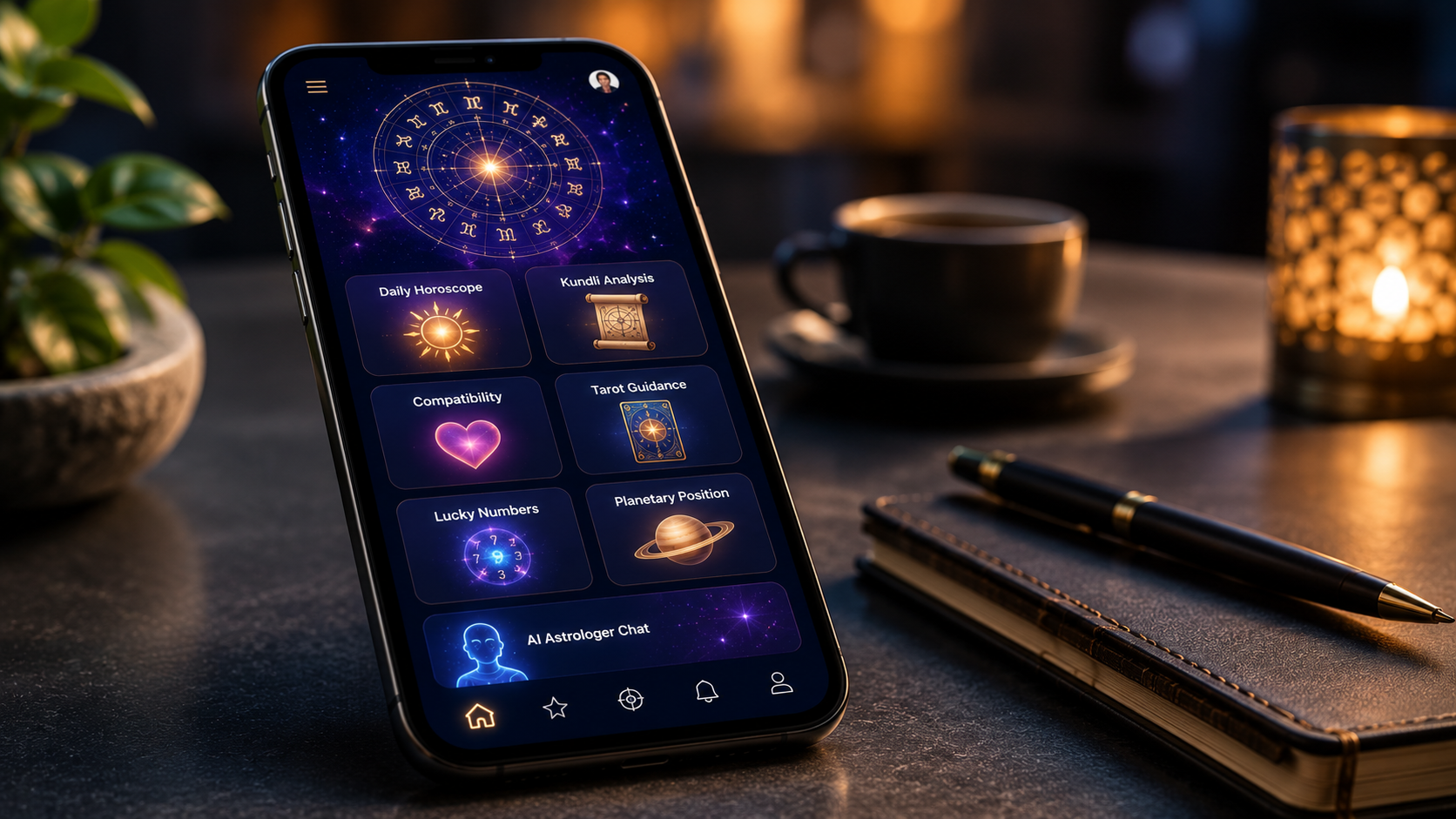
Which Format Actually Teaches a Beginner to Read Their Own Chart?
For a complete beginner, a static birth-chart app is the better place to see your chart accurately, while a conversational AI advisor is the better place to understand what you're looking at. The strongest beginner setup in 2026 is not one or the other — it's a calculation-accurate chart source (Cafe Astrology, Astrodienst, or a Swiss Ephemeris-backed app) paired with a conversational layer such as Jenova's Personal Astrologer, Co–Star, Chani, or AskSoma for interpretation and follow-up questions.
Key factors that separate a genuinely useful beginner experience from a horoscope novelty:
✅ Calculation source matters more than interface — apps using Swiss Ephemeris or NASA JPL data compute positions to arc-second precision; general-purpose chatbots without an ephemeris will state confident sign and dasha dates that are simply wrong ✅ Beginners get stuck at synthesis, not lookup — knowing "Venus in Sagittarius, 1st house" is easy; knowing what those three layers mean together is where static apps stop and conversation starts ✅ Follow-up questions are the actual learning mechanism — static reports can't answer "wait, why does that contradict what you said about my Moon?" ✅ Only 1% of US adults rely heavily on astrology for major decisions, according to Pew Research Center's October 2024 survey of 9,593 adults — most beginners want understanding, not directives ✅ Cost profiles differ sharply — free static chart generators exist; conversational depth generally sits behind a $12-$30/month subscription
To compare these two formats meaningfully, it helps to define what a beginner actually needs from an astrology tool in the first month of learning.
What Do Beginners Actually Need From an Astrology Tool?
Beginners need three things in sequence: an accurate chart, a plain-language explanation of its structure, and a way to ask follow-up questions when the explanation doesn't land. Most tools deliver one or two of these well and the third poorly.
The structural challenge is well documented. As ELLE's astrology guide explains, interpreting a chart requires holding three moving parts simultaneously — the planets, the signs, and the houses — plus a fourth layer of aspects, the angles formed between planets.
Astrologer Tali Edut of The AstroTwins frames it as a layered metaphor: planets are the actors, signs are the costumes they wear, and houses are where the action takes place. Aspects function as the dialogue between them.
That's four interacting variables before a beginner has interpreted a single line. Edut's own advice — "allow yourself to suspend the idea that there's one right answer" — describes an interpretive process, not a lookup task.
What this means practically:
- Accuracy is table stakes, not a differentiator. Any tool using Swiss Ephemeris passes; any tool guessing does not.
- Structure teaching beats content volume. A 40-page auto-generated PDF explaining every placement in isolation teaches less than one clear walkthrough of how planet-sign-house interact.
- The stuck moment is the product. Beginners abandon astrology apps at the point of confusion, not the point of boredom.
Why Is the Static vs. Conversational Split Worth Evaluating Now?
The split is worth evaluating in 2026 because AI-assisted interpretation has moved from a novelty feature to a core category component — and the market data shows it, even if the numbers disagree wildly on scale.
Market sizing for astrology apps in 2026 ranges from USD 1.26 billion (360iResearch) to USD 8.28 billion (MarkNtel Advisors) — roughly a 6.5× spread. The gap exists because the reports count different things: the widest figures include human astrologer consultations billed through apps, while the narrowest counts software subscriptions only.
The more useful signal is definitional. The Business Research Company now explicitly lists "AI-powered astrology consultations" inside its scope for the astrology app market — a category that didn't warrant separate naming a few years ago.
Broader platform data supports the shift: global consumer app spending reached approximately USD 85 billion in 2025, up 21% year over year, with in-app purchase revenue from AI apps more than tripling to top USD 5 billion, per Sensor Tower's State of Mobile report as covered by TechCrunch.
One caution worth stating plainly: excitement about AI is not the same as correct AI. A conversational interface layered over an inaccurate chart is worse for a beginner than a plain static chart, because fluent wrong answers are harder to detect than obviously incomplete ones.
How Do Static Chart Apps and AI Advisors Compare Head-to-Head?
Static chart apps win on accuracy transparency, cost, and reference reliability. Conversational AI advisors win on synthesis, follow-up capability, and reducing time-to-first-understanding. Neither category wins outright for beginners.
| Dimension | Cafe Astrology / Astrodienst (Static) | Co–Star | Chani | AskSoma | Jenova Personal Astrologer |
|---|---|---|---|---|---|
| Chart calculation | Established ephemeris; manual time-zone verification support offered by email | NASA JPL data for planetary positions | Western tropical; Placidus, Whole Sign, Equal house systems | Swiss Ephemeris-grade, client-side | No native ephemeris engine — requires user-supplied or externally computed chart data |
| Interpretation depth | Templated report text, no synthesis across placements | Reported as shallow, "style-over-substance" | Distinctive authored voice; curated rather than conversational | AI synthesis across 30+ life areas | Conversational synthesis with psychological framing |
| Follow-up questions | None | Limited | Not real-time conversational | Chat and voice | Full open-ended conversation |
| Memory across sessions | Saved chart profiles only | Profile-based | Profile-based | Chart + chat history saved | Persistent cross-session memory |
| Tradition coverage | Western (Vedic available on some platforms) | Western only | Western only | Primarily Vedic; lighter Western coverage | Cross-tradition conversationally, but not a computational Jyotish engine |
| Pricing | Free chart reports | Free tier; Plus ~$2.99/week or $29.99/year | Free tier; ~$11.99/month | Free tier; ~$12.99/month | Free tier; Plus $20/month |
| Best For | Verified chart data and reference lookup | Comparing charts socially with friends | Readers who want one consistent interpretive voice | Vedic-focused beginners wanting privacy-first calculation | Beginners who learn by asking questions and want continuity |
Reading the table honestly: the Jenova Personal Astrologer's weakest column is the first one. It is a conversational interpretation agent, not a chart calculation engine — a beginner should compute their chart on an ephemeris-backed source first, then bring those placements into conversation. That's a real limitation, not a footnote.
Co–Star's weakest column is depth; its strongest is social. Chani's strongest is voice consistency; its weakest is breadth. AskSoma's strongest is calculation transparency; its weakest is Western coverage. Static generators are strongest on cost and accuracy and offer essentially nothing on synthesis.
What Should You Look for When Choosing Between Them?
Evaluate any beginner astrology tool across six dimensions, weighted differently depending on whether your goal is learning the system or getting periodic guidance.
The six-dimension framework:
- Ephemeris transparency — Can the tool name its calculation engine? An app that cannot answer "which ephemeris, which ayanamsa" is producing text about astrology rather than astrology.
- Synthesis capability — Does it combine planet + sign + house + aspect, or list them separately?
- Interrogability — Can you ask "why?" and get a chart-grounded answer?
- Continuity — Does it remember your chart and prior conversations, or restart each session?
- Epistemic honesty — Does it distinguish calculable timing (transits, dasha windows) from unfalsifiable prediction?
- Cost per month of active learning — Beginners often need 2-3 months of intensive use, then taper.
Weighting by goal:
| Your Goal | Prioritize | Deprioritize |
|---|---|---|
| Learn to read charts yourself | Synthesis, interrogability, continuity | Social features, aesthetics |
| Get periodic personal guidance | Ephemeris accuracy, epistemic honesty | Teaching structure |
| Compare charts with friends | Social features, shareable output | Depth, tradition breadth |
| Explore Vedic specifically | Ayanamsa transparency, dasha support | Western house system options |
Dimension 5 deserves emphasis. Chart astronomy is exact and verifiable — an app either matches Swiss Ephemeris positions or it doesn't. Predictive accuracy is a fundamentally different claim, and no app or human practitioner has published a falsifiable track record for it. Astrology itself is classified as a pseudoscience and has been since the 18th century, a distinction any honest tool should make available rather than obscure.
How Do You Actually Get Started With Each Approach?
Start by generating a verified chart from an ephemeris-backed source, then choose your interpretation layer based on how you prefer to learn.
Step 1 — Get an accurate chart (both paths require this):
At Cafe Astrology's natal chart calculator, enter your birth city only in the location field and select the exact match from the dropdown. If you're unsure of your birth time, checking "Time Unknown" instructs the program to omit the Ascendant and house positions rather than guessing them — a meaningful accuracy safeguard, since the Moon changes signs roughly every 2.5 days.
Note the platform's own warning: time-zone offsets for certain historical periods and locations are ambiguous in essentially all astrology software, and Cafe Astrology offers manual verification by email for these cases.
Step 2A — Static path (Co–Star or Chani):
- Create a profile with your verified birth data.
- Read the generated placement descriptions one layer at a time — start with sun, moon, and rising only.
- Keep a written log of placements you don't understand.
- Cross-reference against a structured beginner guide before adding more layers.
Step 2B — Conversational path (Jenova, AskSoma):
For Jenova's Personal Astrologer, paste your verified chart data and ask structural questions rather than predictive ones:
"Here are my placements: Sun in Capricorn 10th house, Moon in Pisces 6th house, Scorpio rising. Explain how these three interact — where do they reinforce each other and where do they pull in different directions?"
Then push on anything unclear:
"You said my Pisces Moon needs emotional structure. Walk me through which part of the chart tells you that — is it the sign, the house, or an aspect?"
That second prompt is the one beginners skip and shouldn't. Forcing a chart-grounded justification is how you learn to check the tool rather than take it on faith. Because the agent maintains memory across sessions, you can return weeks later and continue from your existing chart without re-entering data.
For AskSoma, the flow differs — the app computes the chart client-side, so you enter birth data directly and the AI works from its own calculation rather than user-supplied placements.
Where Do Conversational AI Advisors Fail Beginners?
Conversational AI advisors fail beginners in three specific ways, and all three are worse for novices than for experienced practitioners who can spot the errors.
Failure 1 — Fluent fabrication of calculable facts. A general-purpose chatbot has no ephemeris. It estimates planetary positions from training data and will state a confident sign or dasha date that is simply wrong, without warning, because it cannot tell the difference. A beginner has no baseline to catch this.
Failure 2 — Agreeableness drift. Conversational systems tend toward accommodation. Ask leading questions ("does my chart show I should quit my job?") and you'll often get a chart-flavored version of what you signalled you wanted.
Failure 3 — Depth without structure. Static apps force a fixed curriculum. Conversation lets you skip straight to "what does this mean for my relationship" without ever learning what a house is — engaging, but it produces dependency rather than literacy.
Mitigations that work:
- Verify every chart position against an ephemeris source before discussing it
- Ask neutral questions, not leading ones
- Periodically ask the tool to justify a claim from chart structure alone
- Treat timing windows (transits, dasha periods) as calculable and interpretations of them as opinion
What Do Practitioners Say About AI-Assisted Chart Learning?
Practitioners consistently distinguish between AI as a calculation tool and AI as an interpretive authority — and the consensus is that beginners benefit from the first while being most vulnerable to overtrusting the second.
"The useful split is between calculation and interpretation, and beginners collapse the two. Planetary longitudes and dasha boundaries are pure astronomy — a computer does them exactly, and an ephemeris-backed tool beats a human with a printed table every time. Interpretation is judgment, and there a model is only as good as the framework it was given. When we onboard someone new, the first thing we tell them is to verify their chart somewhere they can name the engine, then bring those confirmed positions into conversation."
"What conversational tools genuinely solve is the abandonment problem. A static report answers the question you didn't know how to ask and then goes silent. In practice, most beginners quit at the third or fourth layer — usually aspects — because there's no one to ask why two interpretations seem to contradict. Being able to say 'that doesn't match what you told me about my Moon, explain the conflict' is the single most valuable thing a beginner can do, and no PDF supports it."
"The honest caveat is that fluency reads as authority. A well-written wrong answer is more persuasive than a clumsy right one, and beginners can't yet tell them apart. Our recommendation is unglamorous: keep a written chart from a named ephemeris next to you, and treat any tool that can't cite chart structure for a claim as entertainment rather than instruction."
— Jenova Product Team, specialists in conversational agent design for knowledge-domain applications
Which Approach Is Right for Your Specific Situation?
The right choice depends on whether your bottleneck is access to accurate data or comprehension of it — and for most beginners, it's the second.
Choose a static chart app if:
- You want a verified chart at zero cost and nothing more
- You prefer self-directed reading over dialogue
- You're primarily comparing charts socially (Co–Star handles this better than any conversational tool)
- You value one consistent authored interpretive voice (Chani's core strength)
Choose a conversational AI advisor if:
- You've read placement descriptions and still don't understand how they combine
- You learn by asking questions and pushing back
- You want continuity across weeks or months of gradual learning
- You're working across a tradition boundary and need translation between frameworks
Choose both — the recommended default: Generate your chart free at an ephemeris-backed source, then use a conversational layer for synthesis. This costs the price of one subscription and removes the biggest failure mode of each format: static apps can't explain, and conversational tools can't reliably compute.
Budget note: Roughly 45% of the 2026 astrology app market is freemium, so the free tiers are genuinely usable for evaluation. That matters given that 29% of Americans report paying monthly for astrological content in Harris Poll data — a figure worth treating cautiously, since self-reported spending in surveys substantially exceeds what published market sizes can accommodate. Test on free tiers before committing.
References
- AstrologyAPI — Astrology app statistics 2026: every number sourced
- ELLE — A Beginner's Guide to Reading a Birth Chart
- AskSoma — 7 Best AI Astrology Apps 2026, Tested for Accuracy
- The Business Research Company — Astrology App Global Market Report 2026
- Cafe Astrology — Free Astrology Birth Chart Report and Entry Instructions
- Encyclopædia Britannica — Astrology: Chart, Zodiac Signs, Meaning, Definition