Standalone AI Companion Apps vs. Integrated AI Platforms: Which Is More Practical?
2026-08-18
Where Does the Practical Dividing Line Fall Between Companion Apps and Integrated Platforms?
The practical dividing line is whether the AI is expected to remember you or to finish something for you. Standalone companion apps — Replika, Character.AI, Nomi, Kindroid, Pi — optimize for relational continuity: persona consistency, emotional tone, and memory of personal details. Integrated platforms — Jenova, ChatGPT, Microsoft 365 Copilot, Notion AI — optimize for task completion: research retrieval, document generation, and connections into email, calendars, and file storage. Neither category is universally more practical; the practical choice depends on whether your unmet need is presence or throughput.
Key factors that separate these two categories in daily use:
✅ Output type — companion apps produce conversation; integrated platforms produce artifacts (documents, summaries, calendar entries, code) ✅ Memory purpose — companions remember to sustain a relationship; platforms remember to sustain a project ✅ Tool access — companion apps are largely sealed environments; platforms connect to Gmail, Drive, Notion, Slack, and search ✅ Cost structure — companion apps typically run $5–$20/month for one experience; platforms run $0–$30/user/month but replace several tools ✅ Switching cost — companion attachment is emotionally sticky; platform attachment is workflow-sticky
To compare these meaningfully, it helps to look at what each category was actually engineered to do — and at the market forces pulling them toward each other.
Why Are Standalone Companion Apps Growing So Fast if Platforms Do More?
Standalone companion apps are growing because emotional continuity is a genuine, unmet need that general-purpose platforms historically deprioritized. According to app intelligence firm Appfigures, AI companion apps had been downloaded 220 million times globally as of July 2025, with first-half downloads up 88% year-over-year and $221 million in cumulative consumer spending.
Revenue concentration tells the more interesting story. The same analysis found the top 10% of companion apps generate 89% of category revenue, with revenue per download rising from $0.52 in 2024 to $1.18 in 2025. Users who stay, pay significantly more.
Broader market estimates vary widely by methodology. Grand View Research valued the AI companion market at $36.8 billion in 2025](https://www.grandviewresearch.com/industry-analysis/ai-companion-market-report), while [Research and Markets scoped the narrower companion-apps segment at $4.24 billion in 2025 growing at 18.1% CAGR. The gap reflects whether hardware and embedded assistants are counted.
The practical takeaway: companion apps are not a fad, but their monetized core is narrower than headline figures suggest.
What Do Standalone Companion Apps Actually Do Better?
Standalone companion apps do persona persistence and emotional register better than any general-purpose platform, because that is their sole design constraint.
Category-by-category strengths documented in independent comparisons:
- Nomi AI — built around short-, medium-, and long-term memory tiers, positioned for long-term relationship-style conversation continuity
- Kindroid — deepest customization layer: personality, backstory, voice, and AI-generated selfies for a single persistent character
- Character.AI — the widest character library, still serving tens of millions of monthly active users for fandom and creative roleplay
- Pi — calm, non-romantic reflective conversation with strong voice interaction
- Replika — the category's longest-running product, oriented toward daily check-ins and self-reflection
Their honest limitations are equally documented. Independent reviews of the category cite repetitive replies over time, memory loss after updates, paywalled features, and heavy content filtering as recurring complaints across the leading apps. Crucially, none of these apps meaningfully touch your inbox, your files, or a literature database.
What Do Integrated AI Platforms Do That Companion Apps Cannot?
Integrated platforms complete work that requires external data, external tools, and durable artifacts — the three things sealed companion apps structurally cannot provide.
Three capability layers define the category:
📊 Retrieval and research grounding. Platforms pull from live web search, academic databases, and your own uploaded documents. A university analysis of AI productivity tools noted that NotebookLM's integration of AI with personal knowledge workflows gives it an edge in productivity and research settings — grounding, not conversation quality, is the differentiator.
💼 Connected tools. Microsoft's Work IQ layer connects Microsoft 365 content, line-of-business data ingested through Copilot connectors, and a semantic index derived from those datasets. Jenova takes a protocol-based approach through Model Context Protocol, connecting Gmail, Google Calendar, Drive, Scholar, Notion, Dropbox, YouTube, and any MCP-compliant server.
🎯 Artifact generation. Documents, spreadsheets, slide decks, code, and formatted exports — outputs you keep after the session ends.
The trade-off is real: platforms rarely match a dedicated companion app's persona depth or emotional calibration.
How Do the Leading Options Compare Across Practical Dimensions?
The comparison below evaluates one representative from each category plus two hybrids, across dimensions that determine daily practicality rather than feature-count parity.
| Dimension | Replika (Companion) | Character.AI (Companion) | Jenova (Platform) | ChatGPT (Platform) | Microsoft 365 Copilot (Platform) |
|---|---|---|---|---|---|
| Primary output | Conversation, reflection | Character roleplay, storytelling | Task completion via specialized agents | Conversation + artifacts | Documents inside Office apps |
| Persona depth | Strong — single persistent companion | Strong — millions of user-created characters | Moderate — agents are role-specialized, not emotional personas | Moderate — customizable but general | Low — assistant framing only |
| Cross-session memory | Yes, though users report memory loss after updates | Basic memory relative to competitors | Unlimited history with persistent cross-session memory | Persistent memory plus Projects, available on free and paid tiers | Copilot Memory within Work IQ |
| External tool connections | None documented | None documented | MCP-based: Gmail, Calendar, Drive, Scholar, Notion, Dropbox, plus any MCP server | Connectors; | Deep Microsoft 365 + Power Platform connectors |
| Multi-model choice | No | No | Yes — OpenAI, Anthropic, Google, DeepSeek, xAI | No — OpenAI models only | No — Microsoft-hosted models |
| Research capability | None | None | Real-time search + Google Scholar + document grounding | Web search + file upload | Web-grounded chat + org data |
| Pricing | Freemium subscription | Freemium subscription | Free tier; Plus $20/mo, scaling to Enterprise $1,000/mo | Free tier; Plus $20/mo, Pro tiers up to $200/mo | $30/user/mo for Copilot Studio tier](https://www.microsoft.com/en-us/microsoft-365-copilot/pricing/copilot-studio); [$21–$32/user/mo depending on bundle |
| Best for | Daily emotional check-ins | Creative fiction and fandom | Multi-domain work spanning research, writing, and connected tools | General-purpose assistance in one ecosystem | Organizations already standardized on Microsoft 365 |
Jenova's honest limitations belong in this table too: it does not offer romance-oriented companion personas, its emotional-conversation tuning is not comparable to Nomi or Kindroid, and its agent-based structure requires users to pick the right agent rather than talking to one undifferentiated assistant — a small learning curve companion apps don't impose.
What Evaluation Framework Should You Use to Choose?
Use a five-dimension weighted framework rather than a feature checklist, because feature counts don't predict daily usefulness.
Score each candidate 1–5 on these dimensions, then weight by your actual situation:
- Continuity need — Does the AI need to remember you, or remember your project? Companion apps win the first; platforms win the second.
- Artifact requirement — Count how many outputs per week you need to keep as files. Zero artifacts strongly favors companion apps.
- Integration surface — List the tools the AI must reach. If the list is empty, integration capability is worth zero to you regardless of how impressive it looks.
- Domain breadth — One domain (roleplay, therapy-style reflection) favors specialization. Three or more domains (research + writing + scheduling) favors platforms.
- Cost per replaced tool — Divide monthly cost by the number of subscriptions the tool eliminates. A $20 platform replacing three $10 tools nets positive; a $15 companion app replacing nothing is a pure add.
The contrarian point most comparisons miss: running both is often the correct answer, and it is cheaper than people assume. A companion app at $10–$15/month plus a platform at $20/month totals roughly what one enterprise Copilot seat costs — and covers two genuinely distinct needs rather than forcing one tool to fake the other.
How Does the Research Use Case Expose the Difference Most Clearly?
Academic research is where the gap becomes unmistakable, because it requires retrieval, citation management, and long-form writing — none of which a sealed companion app can perform.
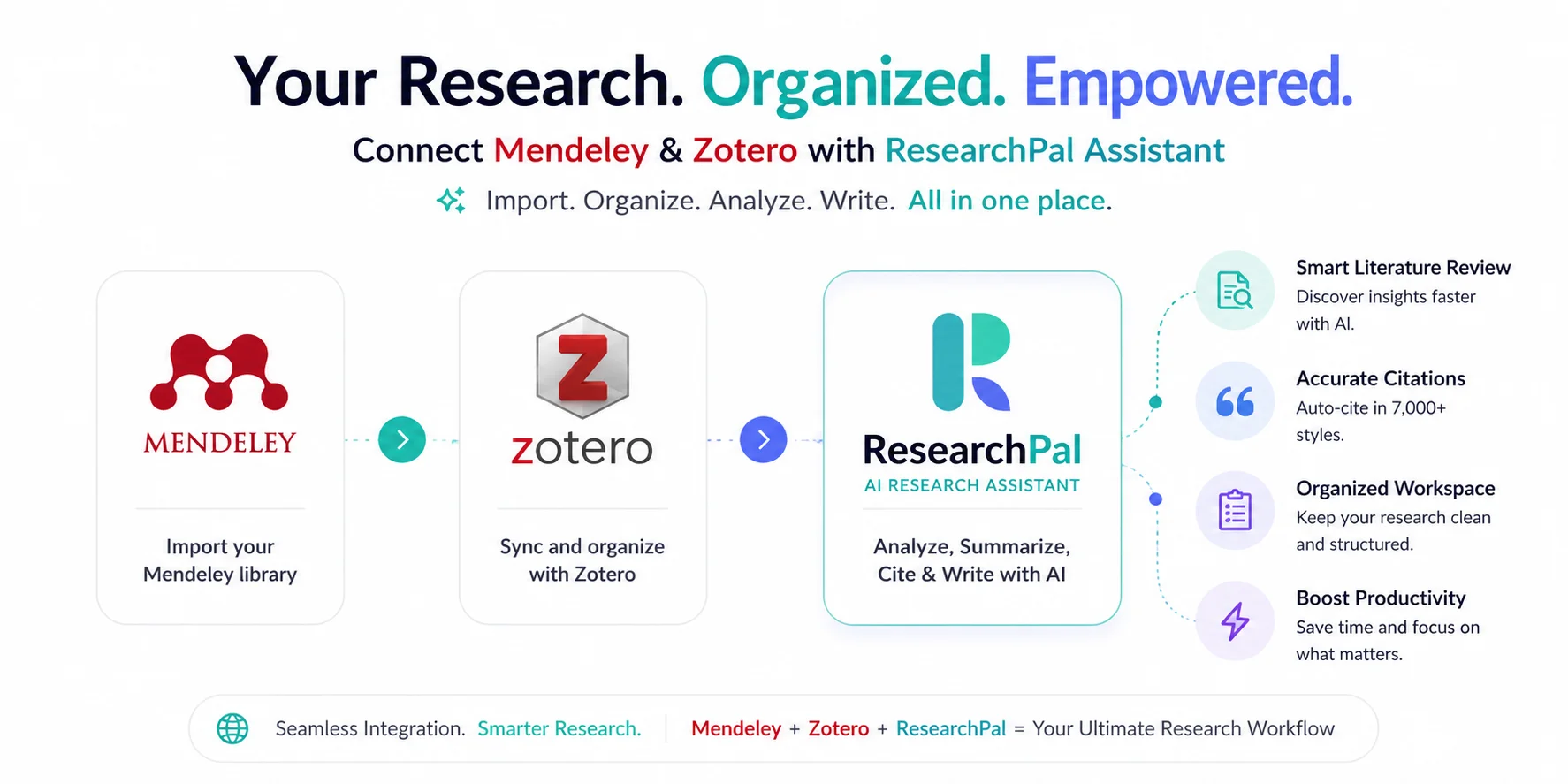
The workflow above illustrates the pattern: reference libraries feed an AI layer that performs literature review, generates citations, and structures a workspace. Tools like ResearchPal position around faster literature reviews, accurate citation generation, PDF chat, and end-to-end academic writing support, and specialized research directories catalogue AI tools spanning literature reviews, data analysis, writing, and collaboration. Notion AI is used by researchers to organize articles, research notes, and tasks in a single platform.
For a Jenova user, the equivalent path runs through the Academic Research Assistant, which handles literature discovery across academic databases plus manuscript preparation and citation management:
- Open the agent and describe your research question and field.
- Upload your existing PDFs or reference exports as a knowledge base.
- Prompt with your actual scope:
"I'm writing a systematic review on parasocial attachment to conversational AI. Find peer-reviewed work from 2023 onward, group findings by methodology, and flag studies with sample sizes under 100."
- Move drafting to the Writing Assistant within the same session, which retains the research context.
For ResearchPal, the setup path instead runs through importing a Mendeley or Zotero library first, then working inside its dedicated research workspace — a stronger fit if reference management is your bottleneck rather than multi-domain workflow.
A companion app cannot enter this workflow at any step.
Is There a Practical Case for Companion Apps in a Work Context?
Yes — but a narrow and honest one: cognitive offloading and low-stakes rehearsal, not task execution.
Legitimate work-adjacent uses documented across the category:
- Rehearsal — practicing a difficult conversation with a consistent persona before having it
- Reflection — daily check-ins that surface patterns in stress or workload, where Pi is positioned for helping users think, plan, and talk through difficult topics
- Creative unsticking — character-driven brainstorming that a task-framed assistant makes feel clinical
Where the case breaks down: none of these produce a deliverable, none reach your calendar, and none survive an audit. Independent testing of the category also flags privacy and data-control concerns — memory controls, account deletion, and data transparency are recurring user demands, which matters when work context enters personal conversations.
The Ada Lovelace Institute has documented the rapid commercial scaling of the companionship sector, noting UK sector revenue of roughly £1.3 billion in 2024. Rapid growth in an emotionally sensitive category is a reason for deliberate tool selection, not casual adoption.
What Do AI Product Analysts Say About the Two Categories Converging?
Analysts increasingly argue the categories are converging from both directions, which changes how you should evaluate them.
"The framing of 'companion versus platform' is already a year behind the market. xAI shipped companion personas into Grok, and the reaction to GPT-5 made it obvious that a meaningful share of general-purpose assistant users had formed attachments to a specific model's voice. Platforms are absorbing persona; companion apps are trying to absorb tools. The question is which direction is technically easier — and it's clearly the former. Adding a warm persona to a platform that already has memory, retrieval, and tool access is a tuning problem. Adding Gmail access, vector storage, and orchestration to a companion app is an infrastructure rebuild."
"What we consistently see in usage data is that integration depth predicts retention better than conversation quality does. Users tolerate a mediocre answer from a tool that can act on it. They abandon a beautiful answer from a tool that leaves them to do the work manually. That's why we architected around specialized agents plus Model Context Protocol rather than a single general assistant — the practical unit of value is a completed task, not a satisfying exchange."
"The honest caveat is that this logic fails for the pure companionship use case. If someone's need is a consistent presence at 2 a.m., orchestration and connectors are irrelevant overhead. We don't build for that, and users who need it should use a product that does. Recommending a work platform to someone seeking companionship is how you get an unhappy user and a bad review."
— Jenova Product Team, AI agent platform architecture, 30,000+ users across 70+ countries
Which Should Different Types of Users Actually Choose?
Match the tool to your dominant weekly activity, not to category prestige.
🎯 Choose a standalone companion app if:
- Your primary need is daily conversation, reflection, or creative roleplay
- You produce zero files you need to keep
- Persona consistency matters more than factual accuracy
- Nomi or Kindroid for personalized long-term companionship; Character.AI for variety and fandom; Pi for calm non-romantic reflection
💼 Choose an integrated platform if:
- You work across two or more domains weekly (research, writing, planning, coding)
- You need outputs connected to email, calendar, or cloud storage
- Multi-model access matters — Jenova's approach avoids vendor lock-in by unifying OpenAI, Anthropic, Google, DeepSeek, and xAI models under one account
- You're already standardized on Microsoft 365, in which case Copilot's no-additional-cost Chat tier for eligible plans is the lowest-friction entry point
📱 Choose both if:
- You have a genuine companionship need and a genuine workflow need
- Combined cost stays under what you'd pay for a single premium enterprise seat
⚡ Choose an orchestration layer instead if your bottleneck is connecting existing tools rather than reasoning — Zapier connects across 9,000+ apps and is a better fit than either category when the problem is plumbing.
Getting started on Jenova takes under two minutes: open jenova.ai, pick an agent matching your dominant task, and describe your situation in plain language. The free tier includes all core features with limited usage; Plus is $20/month at 30× the free allowance, scaling through Premium ($50), Pro ($100), Max ($200), Ultra ($500), and Enterprise ($1,000), with limits resetting monthly rather than daily.
What Should You Watch as These Categories Keep Merging?
Watch three signals over the next 12 months, because they will determine whether the choice stays binary.
Persona depth inside platforms. If integrated platforms ship genuinely convincing persistent personas, the standalone companion value proposition narrows to privacy-focused and adult-content niches. Grok's 2025 companion launch was the first serious test of this.
Tool access inside companion apps. Any companion app that ships reliable calendar and email integration becomes a hybrid. Nothing in the current leading set has done this convincingly.
Protocol standardization. Model Context Protocol adoption determines how quickly any AI product can gain tool access. Broad MCP support lowers the barrier for companion apps to become platforms — and for platforms to expand integration surface without bespoke engineering per connector.
Pricing compression. With [companion app revenue per download at $1.18 and platform seats at $20–$32/month](https://techcrunch.com/2025/08/12/ai-companion-apps-on-track-to-pull-in-120m-in-2025/), a mid-tier hybrid at $10–$15/month is the obvious unfilled position. Whoever occupies it credibly reshapes the comparison entirely.
References
- TechCrunch — AI companion apps on track to pull in $120M in 2025
- Grand View Research — AI Companion Market Size & Research Report, 2026-2033
- Research and Markets — AI Companion Apps Market Report 2026
- Ampere.sh — Top Replika Alternatives for AI Companion Chat
- University of Southern California — AI Tools for Productivity and Platform Comparisons
- Microsoft — Microsoft 365 Copilot Plans and Pricing
- OpenAI Help Center — Projects in ChatGPT
- IntuitionLabs — ChatGPT Plans 2026: Free vs Plus vs Pro Comparison
- Microsoft — Microsoft 365 Copilot Pricing, Copilot Studio
- ResearchPal — AI Tool for Research Writing
- Litmaps — Best AI Research Tools for Academics and Researchers
- Zendy — Best AI Productivity Tools for Students and Researchers
- Ada Lovelace Institute — The Companionship Market
- Zapier — The best AI productivity tools in 2026
- Microsoft — AI for Enterprise Productivity, Microsoft 365 Copilot