Sports Career Simulator AI: Draft, Train, and Peak Like a Pro
2026-08-31
Roleplay Game Master helps you live a full sports career by running a persistent athlete or manager campaign — academy call-ups, injury weeks, contract years, and press — with memory of every decision. While licensed career modes lock you into menus, sliders, and canned interviews, this sports career simulator AI lets you talk through the calls that actually shape a peak. In August 2026, that gap matters: pro clubs already run AI analytics on every shift, and sports games still sell the fantasy of being the one who decides.
- ✅ Play athlete or manager campaigns with characters who remember cuts, form, and grudges
- ✅ Stress-test training load, injuries, tactics, and media without a real roster on the line
- ✅ Branch a season: hold out, change coaches, or rush a return — then live with it
- ✅ Same campaign on web, iOS, and Android, including voice-to-text on a commute
To understand why a sports career simulator AI hits harder than another annual career mode, it helps to look at how real development actually works — and how little of that work a match engine is built to hold.

Quick Answer: What Is a Sports Career Simulator AI?
Roleplay Game Master is a sports career simulator AI that runs a full athlete or manager campaign — training, injuries, contracts, and press — with memory of every call. You play the career. It does not forget the week you rushed a return.
Key capabilities:
- Set a sport, role, and league texture, then play a multi-season arc
- Handle training load, selection, tactics, and locker-room conflict in character
- Run injury, contract, and media crises that still matter ten sessions later
- Carry the same campaign across phone and desktop without restarting the story
The Problem With Sports Career Sims
Pro sport is no longer a hunch-and-clipboard business. George Mason University’s sport management faculty note that every major professional franchise now keeps analytics and technology staff on payroll, and that AI-supported tools feed coaches real-time data on performance, matchups, and even stadium conditions. Wearable biosensors can surface stamina, speed, reaction time, and biomechanical stress — the same signals clubs use to decide who plays, who sits, and who starts a rehab plan.
Fans feel that world through broadcasts and career modes. They rarely get to practice the judgment inside it.
The commercial pull of the fantasy is huge. The sports video gaming market was valued at $26.8 billion in 2025. Sports Business Journal, citing Newzoo, reports that sports titles remain the largest genre on consoles — a category with a stubborn, repeat-buying audience that treats career and manager modes as a second season.
But living a sports career — even as a sim — is frustratingly difficult:
- Licensed career modes turn development into sliders, overall ratings, and scripted press
- Real pathways start young, specialize early, and punish overuse
- Manager games show the court or pitch; they rarely put you in the conversation after a loss
- There is almost no safe way to rehearse a contract year, a rushed return, or a public blow-up with consequences that persist
Real development is long, specialized, and unforgiving
A study of 519 USTA junior tennis players found that 70% began specializing at an average age of 10.4. Broader reviews put youth specialization rates anywhere from 17% to 41%. Harvard-linked research on early specialization argues that adult-style, professionalized practice is a poor way to grow talent — and a reliable way to grow overuse injuries and burnout.
That is the career a good sim should make you feel: not a +2 to shooting, but a choice about whether a 17-year-old plays through a niggle because the academy game is on TV.
Match engines show the score. They do not hold the season.
Classic manager and career games do one job well. They put you on the court. You see first-serve speed, intensity meters, tactics toggles, and a “superb ace” banner. Useful — if the question is whether to stay back or step in on return.
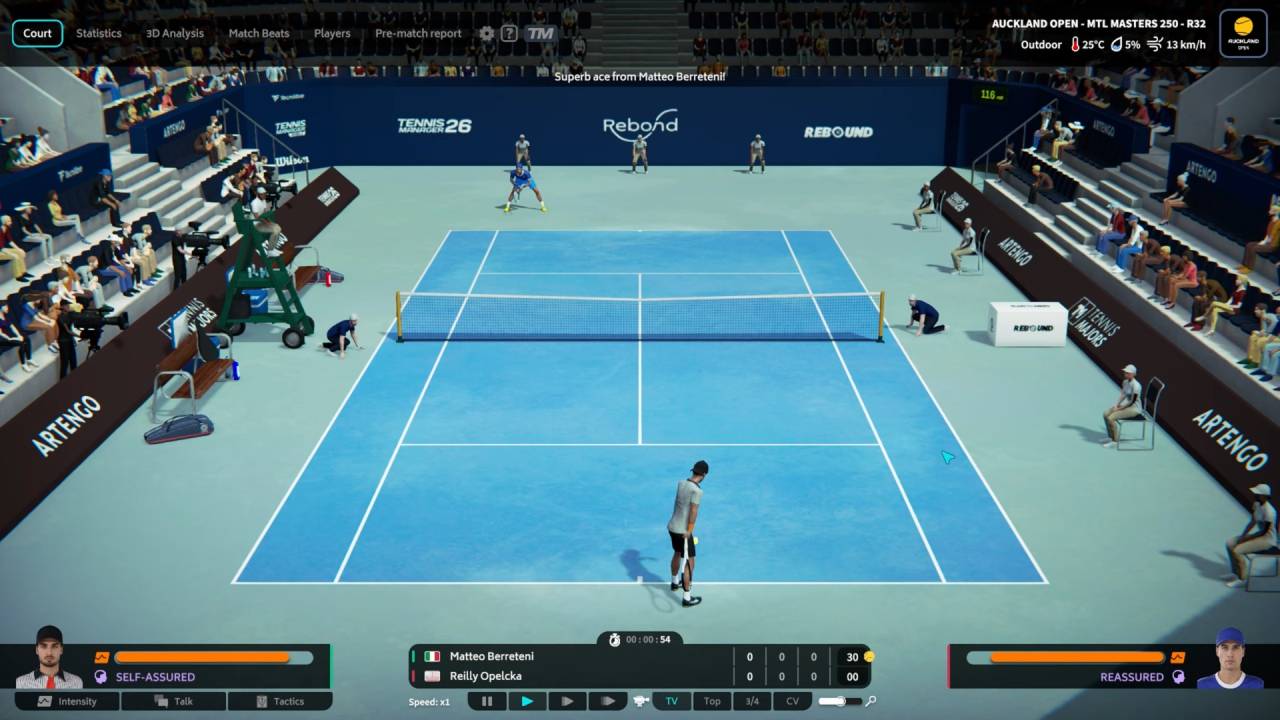
Those systems teach the match. They do not teach the week after: a ranking that stalls, a coach you no longer trust, a wrist that is “fine” until it is not, a sponsor that wants you in three cities in ten days. Spreadsheets and canned interviews cannot argue back. A career can.
This is exactly what a sports career simulator AI was built for.
Why Roleplay Game Master
Roleplay Game Master treats a sports career as a long story with rules, not a season of menus. You define the sport, the role, and the pressure. It keeps character consistency and unlimited campaign memory, so a cut you made in preseason still shapes dressing-room trust in the final.
Where a traditional sports career sim asks you to raise overall ratings, this AI asks you to live with the player those ratings imply.
| Traditional Approach | Roleplay Game Master |
|---|---|
| Menu-driven career or manager mode with sliders and overalls | Persistent athlete or manager campaign you brief in conversation |
| Training as isolated drills and attribute ticks | Training as load, ego, selection, and time |
| Injuries as a status icon and a return date | Injury as a negotiation with staff, press, and your own timeline |
| Press as multiple-choice soundbites | Media, captains, and agents who remember what you said |
Teams already use machine learning to forecast development trajectories and injury risk. Coursera’s industry overview puts the same stack in four buckets: performance, strategy, injury prevention, and engagement. This campaign does not replace a Catapult unit. It lets you practice the decisions those dashboards are built to inform.
Build a career that has a body, not just a rating
You do not inherit a 99 overall. You inherit a specific problem: a left-back with no weak-foot, a serve that wins free points and a shoulder that hates volume, a manager whose press is better than their substitutions. The unit of progress is a decision.
"I am an 18-year-old academy striker on a Championship loan. The manager wants me as a pressing 9. My knee swells after back-to-back 90s. Build the next six weeks of training, minutes, and media without killing the loan."
Manage load, selection, and the human cost
Real programs measure improvement constantly. So does this campaign — but the question is never only “did the number go up?” Do you start your best athlete on short rest because the derby sells, or do you protect a hamstring and answer for a draw? Do you leak a lineup to settle a dressing room, or keep it private and watch a captain walk?
"We are two points off a playoff place with five games left. The starting keeper has a grade-1 groin. Name the XI, the minutes cap, and the press line — then tell me who breaks first."
Own the contract year and the aftermath
A career is not only tactics. It is agents, image rights, international breaks, and the week a rumor hits. Lineup politics, endorsement calendars, and a public fight with a coach all land before the next match does.
"I am a top-20 tennis player with a wrist that lasted three events. My agent wants a hard-court swing for the fee. Rewrite the calendar, the coach conversation, and the press notes without tanking the ranking."
If you also want the sessions to feel like real conditioning rather than plot, Fitness & Workout Coach is the desk that can turn a “light week” into actual sets, rest, and progress tracking.
Related Agents You'll Also Find Useful
If you are running a sports career simulator AI, you are already thinking like a club. These agents cover the adjacent rooms.
Fitness & Workout Coach — Use it when the campaign says “preseason” and you want more than flavor text. Custom programs, session coaching, and form guidance make a simulated return-to-play week feel like a plan you could hand a strength coach.
- Programs by level, so an academy block does not look like a veteran block
- Real-time session structure you can paste back into the career as the week’s load
- Progress tracking so “sharpness” is not just a sentence the story asserts
Public Speaking Coach — Athletes and managers lose weeks in mixed zones. Speech writing, delivery, anxiety work, and Q&A prep turn a simulated presser into practice you can reuse the next time a host actually puts a mic on you.
- Post-match and press-conference scripts that match the campaign’s facts
- Audience simulation when you need a hostile room, not a friendly one
- Q&A prep for the question you hope nobody asks
Personal Financial Advisor — A career sim that never mentions money is a highlight reel. Contracts, tax, and life after the last deal are the other half of “peak.”
- Budgeting and investing language you can drop into a contract-year scene
- Debt and tax framing when a signing bonus meets a short career
- Retirement planning for the version of the story that does not make the national team
Try Roleplay Game Master free — no credit card required.
How It Works
You do not install a tycoon UI. You open a campaign, set the brief, and talk to the room.
Step 1: Name the sport, the role, and the clock Say whether you are the athlete, the manager, the academy director, or the agent. State the league texture and the first deadline so the story has something to enforce — a draft, a wild-card entry, a relegation six-pointer.
"I manage a mid-table tennis player just outside the top 50. Hard-court swing in eight weeks. One coach, a tight budget, and a shoulder we are not fully honest about. Start the season."
Step 2: Build a roster — or a self — with real tradeoffs Ask for conflicting strengths. A creator who cannot track back. A server who cannot return. A captain the board loves and the dressing room does not. Cut people. Promote someone too early. That is the job.
"Give me a 23-man squad with two political signings, one academy gem, and a striker whose press is better than his finishing. I will name a starting XI and a player I am willing to lose this window."
Step 3: Spend the week, then ask what broke This sports career simulator AI gets its texture from how you use the days. Split gym, pitch, travel, and rest. Then ask who is angry, who is sharp, and who is lying about pain. If nobody is tired, you are not training — or you are not paying attention.
"International break: three of my starters played 90 twice. The fourth is 18 and wants minutes for a senior cap. Set the load, the conversations, and the risk I am accepting."
Step 4: Play the match week, then own the Monday Lock tactics, the XI, the mixed-zone line, and the story you will tell supporters. Then play the 48 hours after: a red card, a medical, a quote that will not die. Memory is the point. A slight you delivered in July should still sit in the captain’s voice in May.
"We lost 2–1. I substituted the captain on 60. Write the dressing-room scene, the presser, and the text I send him at midnight — then show me training on Tuesday."
Results & Use Cases
🎯 Climb From Academy Loan to First-Team Minutes
Scenario: You are a wide forward on loan, the parent club is watching, and the manager only trusts you as an impact sub.
Traditional Approach: Move a playing-time slider in a licensed career mode and hope the overall rating tells the truth.
Roleplay Game Master: You play six weeks of training, video, and cameo minutes, then either force a start or accept that the loan was a shop window you mishandled.
- Minutes, load, and attitude stay on one timeline
- Conflicts surface before you get attached to a fantasy breakout
- You leave with a career beat you could actually pitch as a series or a save file story
📊 Stress-Test a Tennis Calendar After an Injury Scare
Scenario: You are outside the top 30. The wrist lasted three events. Your agent wants the next 500 because the fee is guaranteed.
Traditional Approach: Queue another tournament in a tennis manager UI and treat fitness as a bar that refills.
The campaign: You cut a swing, keep a coach, or chase ranking points — and the next month of the story remembers which one you picked.
- Calendar, medical honesty, and ranking pressure stay coupled
- You can branch two “saves” by starting a second thread
- Pair a light week with Fitness & Workout Coach if you want the rehab block to look like real sessions, not a plot device
📱 Run a Match Week on Your Phone
Scenario: You have a 35-minute commute and want a manager session, not another energy-gated mobile career.
Traditional Approach: Tap through a mobile sports game with timers, packs, and a tactics screen you barely read between stations.
This sports career simulator AI: One voice-to-text brief — web, iOS, or Android, same memory — and you can name an XI, rewrite a press note, and close a training day before you get off the train.
- No energy gates between story decisions
- Speech-to-text for walking-and-playing sessions
- Synced settings so a desktop recap continues the same club
💼 Rehearse a Contract Year Without a Real Agent in the Room
Scenario: You are a starter in the last 18 months of a deal. The board wants a discount. You want years, not just wages. The press already has a number.
Traditional Approach: Accept or reject a generated offer in a career mode and skip to the next fixture.
The AI campaign plus Personal Financial Advisor: You simulate the holdout politics, then stress-test whether the money story you are telling yourself survives tax, career length, and a down year.
- The negotiation has a Monday, not just a yes/no screen
- You get language for notes you would actually give yourself
- The campaign still forces the non-financial constraint: dressing-room loyalty and who the manager is afraid to drop
FAQ
What is a sports career simulator AI?
A sports career simulator AI is a campaign where you develop an athlete or a team — training, selection, injuries, contracts, and public image — then live with the peak or the stall those choices produce. Licensed games focus on match engines and overall ratings. Roleplay Game Master is the narrative version: you brief a season, argue with staff and players, and keep a memory of every cut.
Is Roleplay Game Master free?
Yes. You can run a sports career simulator AI campaign on Jenova’s free tier with all core features and limited monthly usage. Paid plans raise usage if you are chaining long seasons, branching injury timelines, or keeping multiple clubs in memory. No credit card is required to start a first campaign.
How is this different from Football Manager or tennis career modes?
Football Manager, FIFA-style career, and tennis manager games are match-and-database sims: you set tactics, watch a match, and click through training screens. This sports career simulator AI is not a replacement match engine. It is a conversation-driven career. You do not click rooms. You brief a staff, sit in a medical, and explain a lineup you can defend.
Can a sports career simulator AI teach real athletic skill?
It can teach career skill — load management, selection logic, calendar design, and media control. It cannot replace a court, a pitch, or a weight room. For actual sessions, use Fitness & Workout Coach for programming and form, or a real coach for sport-specific technique. The sim is for decisions. The body is for practice.
Does it work on mobile?
Yes. The same campaign runs on web, iOS, and Android with full feature parity and synced settings. That matters for a sports career simulator AI because the useful sessions are short: one selection meeting, one injury update, one mixed-zone line. Speech-to-text is available when you would rather talk a training week than type it on a commute.
How accurate is this to real athlete development?
It is grounded in how the industry actually works — early specialization, analytics-heavy selection, injury as a career event, and a tiny fraction of juniors reaching a true peak — but it is still a simulation. Real programs involve contracts, medical staff, and governing-body rules no game should let you “win.” Treat it as a serious roleplay of career judgment, not as a documentary or a shortcut to a scholarship.
Conclusion
A sports career simulator used to mean an overall rating, a fixture list, and a press-conference multiple choice. Useful, if you like watching a bar tick up. The job fans actually want to try is narrower and harder: pick a path, spend a season on it, and defend the peak you built.
That is the athlete’s chair and the manager’s. Roleplay Game Master puts you in both — training weeks, injuries, contracts, and the Monday after a bad quote — with a campaign that does not forget who you dropped. When you need real conditioning, a mixed-zone voice, or a money plan that survives a short career, the related desks are already there.
Try Roleplay Game Master now. Explore more at Jenova.
For Developers: Roleplay Game Master is available programmatically via the Jenova API — integrate a persistent sports career simulator AI into your application with a single API call. Full documentation →