Solo RPG Oracle With AI: Interpret Rolls & Keep Stories Coherent
2026-10-20
Creative Fiction Writer helps solo roleplayers turn raw solo RPG oracle results into coherent, playable scenes. You keep the dice, and the AI interprets what a "Yes, but…" or a "Betray + Fading" meaning roll means for your character, setting, and plot. As of October 2026, oracle-driven solo play is one of the fastest-growing ways to enjoy tabletop RPGs. Its biggest friction point is still interpretation: turning a die result into a story beat that fits everything that came before.
- ✅ Interprets any oracle, including d6 "and/but" systems, d100 fate charts, meaning tables, and custom one-page rulesets
- ✅ Tracks continuity across scenes, threads, and arcs, so NPCs, clues, and consequences stay consistent
- ✅ Adapts to your genre and tone, from grimdark fantasy to cozy journaling games
- ✅ Keeps randomness honest because you roll and the AI interprets, so the story can still surprise you
An oracle works well as a randomness engine, but it can't tell you what its answers mean. That job falls to you, every roll, mid-session, while you also play the protagonist. To see why that gets hard, it helps to look at what oracles do and where solo players get stuck.
Quick Answer: What Is a Solo RPG Oracle?
A solo RPG oracle is a randomized question-answering tool, usually dice or tables, that replaces the game master by answering yes/no questions and generating story prompts. Players can then run a tabletop RPG alone.
Key capabilities:
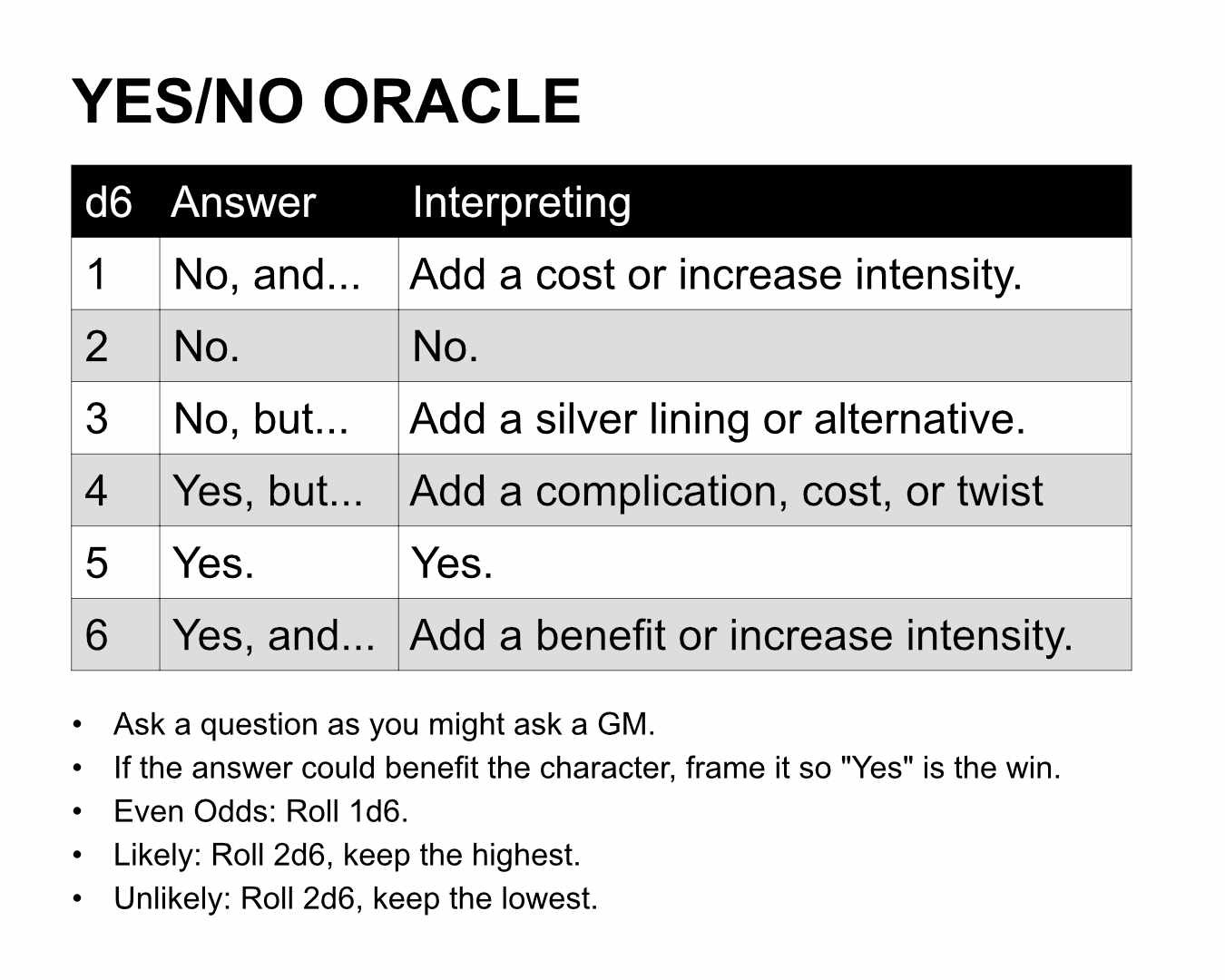
- Yes/no resolution: A d6 or d100 roll answers questions like "Is the guard asleep?", often with "and/but" modifiers
- Probability weighting: Likely or unlikely events get adjusted odds, for example by rolling 2d6 and keeping the highest or lowest
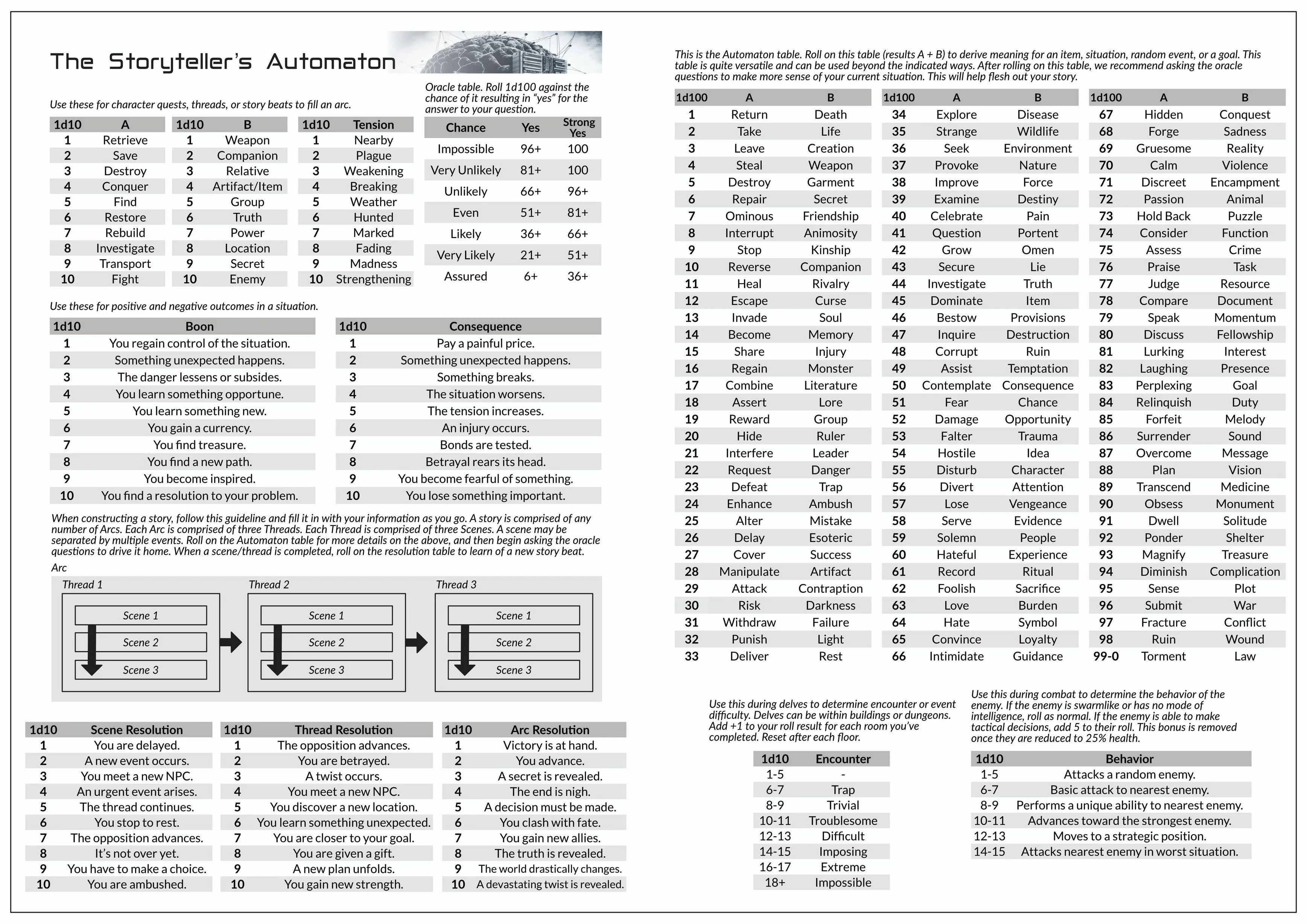
- Meaning generation: Word-pair tables such as "Verb + Noun" spark events, motives, and twists
- Story structure: Scene, thread, and arc resolution tables control pacing over a full campaign
Why Running a Solo RPG Oracle Is Harder Than It Looks
Solo play is growing alongside the wider hobby. Market estimates vary by firm, but they all point upward:
USD 2.41 billion — Estimated global TTRPG market value in 2026, projected to reach USD 6.59 billion by 2035
$2.51 billion → $5.23 billion — Projected tabletop RPG market growth from 2026 to 2034, per Fortune Business Insights
Oracles are the engine of that solo segment. As YUM/DM's guide to the d6 oracle puts it, oracles "fill in the role of GM to a large extent." The same guide names their core limitation: a basic oracle "only answers yes/no questions," so most players add word tables to get richer prompts. Communities like
and curated lists like itch.io's Oracles for Solo Play collection show how many systems now compete for space at a soloist's table.But turning those results into a satisfying story is frustratingly difficult:
- "And/but" paralysis. A "No, but…" needs a silver lining you have to invent on the spot. Do that thirty times a session and fatigue sets in.
- Abstract meaning rolls. Tables like the Automaton's A+B grid give you pairs such as "Intimidate + Guidance." That pair could mean a dozen things, or nothing.
- Coherence drift. Narrative designer Newton Narrative identifies continuity, tone, and pacing as the three ways procedural stories break down. A random oracle is procedural narrative in its purest form.
- Bookkeeping overload. Tracking NPCs, open threads, and arc progress in a notebook pulls you out of the fiction.
This is the gap Creative Fiction Writer was built to fill.
Why Creative Fiction Writer Works as Your Oracle Interpreter
Creative Fiction Writer is a storytelling partner for original fiction in any genre. In solo play, it acts as the interpretive half of the GM. You bring the roll, and it explains what the roll means in the context of your world, your character's goals, and the scenes you've already played.
The key design choice is to keep the dice physical. Language models are not true random number generators. If you ask an AI to "decide what happens," it tends to drift toward narratively convenient outcomes, and the oracle loses its bite. When you roll and report the result, the uncertainty stays real while the interpretation gets better.
| Traditional Approach | Creative Fiction Writer |
|---|---|
| Stare at "Yes, but…" until something comes to mind | Get two or three context-aware readings in seconds, then pick one |
| Meaning-table pairs feel random and disconnected | Abstract word pairs become concrete events tied to active threads |
| NPC names, clues, and debts scattered across notebook pages | Story details stay consistent from scene to scene |
| Tone swings wildly between rolls | Interpretations match the genre and mood you set |
| Prep time spent writing scene openers | Scene setups drafted from your last resolution roll |
Reads Every Oracle Result in Context
A "No, and…" in a heist means something very different from a "No, and…" in a romance. The AI weighs what your character wants and what's at stake, then grounds the complication in established facts rather than inventing new ones from nothing.
"I rolled 1 on the d6 oracle: 'No, and…' The question was whether the ferryman agrees to cross at night. Give me three readings that tie back to the smuggler debt from scene 2."
Turns Meaning-Table Pairs Into Playable Events
Feed it the Storyteller's Automaton result "Betray + Fading" and you won't get a vague mood. You'll get options such as: the informant's loyalty is fading because a rival paid more, or the betrayal happened long ago and evidence of it is fading.
"Meaning roll: Invade + Soul. Setting is a haunted coastal town. What could this mean for the lighthouse keeper NPC?"
Protects Continuity, Tone, and Pacing
Tell it you're in Thread 2, Scene 3 of your arc and you just rolled "You are closer to your goal." It will frame the next scene as an escalation rather than a reset. This is the same idea as the prerequisites and foreshadowing techniques narrative designers use to keep procedural stories coherent.
"Summarize my open threads, list every named NPC and what they want, and flag anything that contradicts earlier scenes."
Related Agents You'll Also Find Useful
If you're also working on other parts of your solo setup, these agents fit naturally into the same workflow.
Game Designer Assistant Designing your own one-page oracle, like the creator of the Storyteller's Automaton who shared it for feedback? This agent can stress-test your tables, probabilities, and procedures before you print them.
- Systems analysis of dice odds and table balance
- Documentation help for rules and "how to use" pages
- Brainstorming new tables for encounters, factions, or delves
Name Generator Oracles constantly create new NPCs, taverns, and factions, and naming them on the fly is a common stall point. This agent produces culturally consistent names that fit your setting.
- Character, place, and faction names by culture or genre
- Batches you can pre-generate into a d20 name table
- Linguistic consistency across a whole campaign world
The Mansion Some nights you'd rather not run the oracle at all. The Mansion is a self-contained interactive mystery: you wake with no memory, every room hides secrets, and your choices drive whether you escape.
- Ready-to-play solo adventure with no setup
- Persistent consequences driven by your decisions
- A good palate cleanser between oracle-driven campaigns
You can start any of these on Jenova's free tier.
How to Use a Solo RPG Oracle With AI, Step by Step
Step 1: Choose Your Oracle and Set the Odds
Pick a d6 "and/but" oracle for speed or a d100 chance chart for finer control. The d6 card above uses an advantage/disadvantage method that YUM/DM traces to MUNE. Here's what that method does to the probabilities:
| Odds | Method | Any "Yes" | "Yes, and…" | "No, and…" |
|---|---|---|---|---|
| Even | Roll 1d6 | 50% | 16.7% | 16.7% |
| Likely | 2d6, keep highest | 75% | 30.6% | 2.8% |
| Unlikely | 2d6, keep lowest | 25% | 2.8% | 30.6% |
Notice how sharply the extremes move. On a "Likely" question, a disastrous "No, and…" happens only about once in 36 rolls. For comparison, the Automaton's d100 chart gives "Even" a 50% yes (51+) and a 20% strong yes (81+).
Step 2: Frame the Question So "Yes" Is the Win
As the oracle card advises, ask the question the way you'd ask a GM, and phrase it so "yes" benefits your character. "Is the vault door unlocked?" works better than "Is the vault door locked?" because every "and" and "but" then lands in the right direction.
Step 3: Roll Physically and Report the Result
Roll real dice, or a trusted dice app, and give the result to your AI story partner along with the question and odds. Context is everything here.
"Question: Does the archivist recognize my character's family crest? Odds: Likely (2d6 keep highest). Roll: 4. That's 'Yes, but…' What's the complication?"
Step 4: Choose From Multiple Interpretations
Ask for two or three readings instead of one. Picking among options keeps you in control of the story and avoids the "AI decided for me" feeling. It also makes clear which reading is most interesting rather than just most obvious.
"Give me three ways to read 'Strike + Burden.' Make one personal, one political, and one environmental."
Step 5: Close the Scene and Log Your Threads
At the end of each scene, roll on a scene resolution table, such as the Automaton's "A new event occurs" or "You meet a new NPC," and ask the AI to update your thread log. This keeps your arc-thread-scene structure intact across sessions.
"Scene resolution roll: 8, 'It's not over yet.' Update my thread tracker and draft an opening paragraph for the next scene."
Results & Use Cases
📱 Ten-Minute Commute Sessions on Your Phone
Scenario: A player runs a hard-boiled detective campaign in short bursts on the train, rolling a dice app and typing or dictating results.
Traditional Approach: Hauling a binder of tables, then losing the thread between sessions because notes are scattered.
Creative Fiction Writer: Each micro-session starts with "Where were we?" and the AI recaps open leads, then interprets the next roll on the spot.
- Picks up right where you left off, with no re-reading of notes
- Speech input makes one-handed play practical
- Short scenes still connect into a coherent arc
🗺️ Running a Full Storyteller's Automaton Arc
Scenario: A soloist plays a three-thread fantasy arc using the Automaton's quest, tension, meaning, and resolution tables.
Traditional Approach: Hours of interpreting abstract pairs like "Assist + Temptation" and manually tracking which thread and scene you're in.
Creative Fiction Writer: Meaning rolls become concrete beats tied to the active thread, and arc resolution rolls ("A devastating twist is revealed") get set up with earlier foreshadowing.
- Abstract pairs turn into specific, playable events
- Thread and scene tracking happens in conversation
- Twists feel earned rather than random
🛠️ Designing and Testing Your Own Oracle
Scenario: An indie designer drafts a one-page oracle for itch.io and wants feedback on balance before releasing it.
Traditional Approach: Posting to forums and waiting days for scattered replies, or hand-calculating probabilities.
Game Designer Assistant: Reviews the table structure, flags results that come up too often, and suggests clearer "how to use" wording. You can then playtest the finished oracle with Creative Fiction Writer.
- Fast feedback on probability distribution
- Cleaner rules text for players who are new to soloing
- A live playtest loop before publishing
🕯️ Prompt-Driven Journaling Games
Scenario: A player enjoys journaling games, which The Soloist describes as solo games where "randomly selected prompts are catalysts to imagine settings, stories, and characters."
Traditional Approach: Freezing at the blank page when a prompt doesn't spark anything.
With AI interpretation: The AI offers angles on the prompt in your character's voice. You write the entry yourself, and the creative voice stays yours.
- Helps you push past writer's block without replacing your writing
- Keeps entries consistent with earlier journal days
- Respects the tone of the game, whether melancholy, cozy, or eerie
Frequently Asked Questions
What is the best solo RPG oracle for beginners?
The d6 "and/but" oracle is the easiest place to start. You need one six-sided die and a six-line table running from "No, and…" to "Yes, and…" Adjust odds by rolling 2d6 and keeping the highest (likely) or lowest (unlikely). Add a meaning table later when you want richer prompts. Many soloists never need anything more complex.
Can AI replace a solo RPG oracle entirely?
It can, but pairing works better. Language models aren't true random generators and tend to favor convenient story outcomes, which removes the surprise that makes solo play fun. The strongest setup is to roll real dice for outcomes and use AI for interpretation. If you want a fully AI-run experience instead, a self-contained adventure like The Mansion is built for exactly that.
Is Creative Fiction Writer free to use?
Yes, Creative Fiction Writer is available on Jenova's free tier, which includes all core features with limited usage. Regular players who run long sessions can upgrade to paid plans starting at $20/month for 30× the free usage. Usage resets monthly, with no daily caps.
How do I keep an oracle-driven story coherent?
Focus on three things: continuity, tone, and pacing. Keep a running log of NPCs, open threads, and consequences. Set your genre and mood at the start of each session. Use scene and arc resolution tables to control escalation. An AI story partner can maintain the log for you and flag contradictions with earlier scenes.
Does a solo RPG oracle work with any game system?
Yes. Oracles are system-agnostic: they answer questions about the fiction, while your chosen RPG handles combat, skills, and character mechanics. You can run D&D, Ironsworn-style games, Fallout, or a homebrew system with the same d6 or d100 oracle. Want to build tables tailored to one system? Game Designer Assistant can help you design them.
Conclusion: Let the Dice Decide and the AI Interpret
A solo RPG oracle gives you something no prewritten adventure can: a story nobody knows the ending to, including you. The hard part has always been interpretation. That means turning "Yes, but…" and "Betray + Fading" into scenes that respect your continuity, tone, and pacing, while you also play the hero.
Splitting the work keeps solo play fast and surprising. Your dice stay in charge of fate, and an AI storytelling partner handles the translation from roll to narrative. Whether you prefer a single d6, a d100 fate chart, or a dense one-page oracle like the Storyteller's Automaton, you spend less time stuck and more time playing.
Try Creative Fiction Writer at your next solo session. Explore more at Jenova.
For Developers: Creative Fiction Writer is available programmatically via the Jenova API. You can integrate context-aware story interpretation into your solo RPG app or virtual tabletop with a single API call. Full documentation →