Share AI Agents: How to Build, Distribute, and Collaborate with AI in 2026
2026-01-08
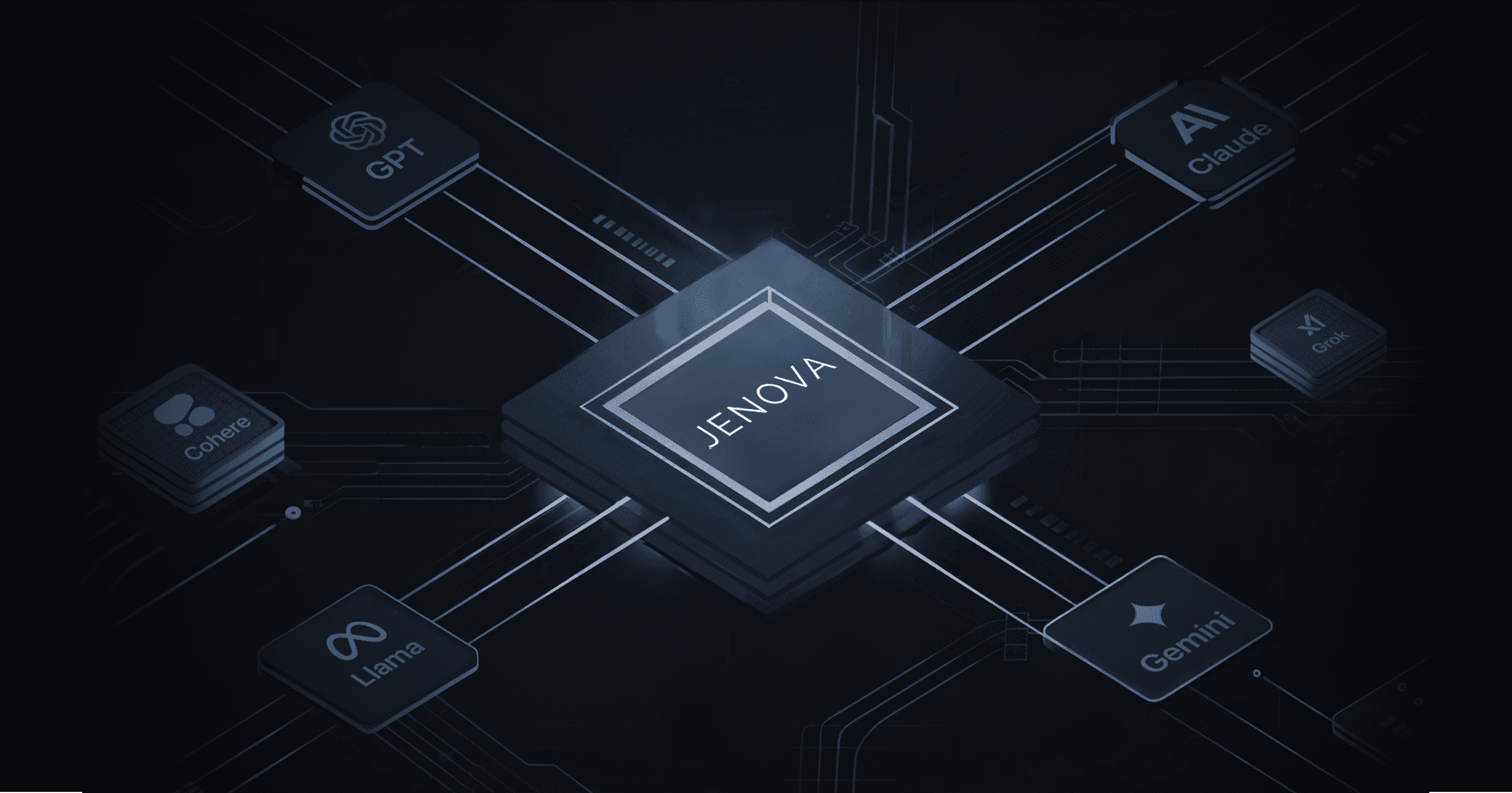
The ability to share AI agents is transforming how teams collaborate, scale expertise, and solve complex problems. Jenova provides a comprehensive platform where users can build custom AI agents with specialized knowledge and share them across organizations—powered by leading models like GPT-5.2, Claude Opus 4.5, Gemini 3 Pro, and Grok 4.1.
Whether you're distributing a sales research agent to your entire team or collaborating on multi-agent workflows that span departments, sharing AI agents eliminates the need to rebuild expertise from scratch. This article explores why sharing AI agents matters, how collaborative AI systems work, and practical strategies for distributing intelligent agents across your organization.
Key benefits of sharing AI agents:
- Eliminate redundant work by distributing proven agents across teams
- Scale specialized expertise without proportional headcount increases
- Enable multi-agent collaboration for complex, cross-functional workflows
- Maintain consistency in processes while allowing customization
Quick Answer: What Does It Mean to Share AI Agents?
Sharing AI agents refers to the ability to distribute, collaborate on, and deploy custom AI assistants across teams, organizations, or platforms. Unlike traditional software sharing, AI agents carry embedded knowledge, specialized instructions, and connected tools that make them immediately productive for new users.
- Team distribution: Deploy a single agent to multiple users with consistent capabilities
- Cross-platform collaboration: Agents communicate via protocols like MCP and A2A
- Knowledge transfer: Share domain expertise embedded in agent configurations
- Multi-agent orchestration: Multiple specialized agents work together on complex tasks
Platforms like Jenova enable users to create custom AI agents and share them instantly, with each agent retaining its specialized knowledge base, tool integrations, and behavioral instructions.
The Problem: Why Sharing AI Agents Is Now Critical
The AI agent market has exploded, growing from $5.4 billion in 2024 to $7.6 billion in 2025, with projections reaching $48.3 billion by 2030. Yet most organizations face a fundamental challenge: AI expertise remains siloed.
The Knowledge Duplication Crisis
"72% of organizations worldwide have adopted at least one AI-based automation solution, but fewer than one in four have successfully scaled them to production." — McKinsey Global Survey on AI
When teams can't share AI agents effectively, organizations experience:
- Redundant development: Multiple teams building similar agents independently
- Inconsistent quality: Varying levels of sophistication across departments
- Wasted expertise: Specialized knowledge locked in individual configurations
- Scaling bottlenecks: Manual recreation required for each new use case
- Integration fragmentation: Agents that can't communicate across platforms
The Collaboration Gap
Gartner predicts that by 2027, one-third of agentic AI implementations will use combinations of agents with different skills for complex tasks. Yet today, most AI agents operate in isolation—unable to share context, delegate tasks, or coordinate actions with other agents.
This creates a significant productivity gap. A Google Cloud report found that employees at Telus save 40 minutes per AI interaction when using collaborative agent systems, while Suzano achieved a 95% reduction in query time through coordinated agent workflows.
The Enterprise Scaling Challenge
According to Deloitte's 2025 Emerging Technology Trends study, 30% of organizations are exploring agentic AI options and 38% are piloting solutions—but scaling remains the primary obstacle. The organizations that succeed share three characteristics:
- Standardized agent architectures that enable distribution
- Protocol-based communication between agents and systems
- Centralized governance with decentralized execution
The Jenova Solution: Share AI Agents Across Teams and Platforms
Jenova addresses the sharing challenge through a unified platform that combines multi-model access, tool integration, and collaborative agent infrastructure.
| Traditional Approach | Jenova AI Agents |
|---|---|
| Rebuild agents for each team | Share once, deploy everywhere |
| Single model dependency | Access GPT-5.2, Claude Opus 4.5, Gemini 3 Pro, Grok 4.1 |
| Manual knowledge transfer | Embedded knowledge bases persist across shares |
| Isolated agent operation | MCP-enabled tool connections transfer with agents |
| Platform lock-in | Open protocol support for cross-platform collaboration |
Multi-Model Flexibility
When you share AI agents on Jenova, recipients gain access to the same multi-model capabilities. This means a Fundamental Stock Analyst agent can leverage Claude Opus 4.5 for nuanced earnings analysis while using GPT-5.2 for rapid data processing—and every team member gets the same powerful combination.
Persistent Knowledge and Memory
Unlike basic chatbots that reset with each session, Jenova agents maintain:
- Global memory that persists across conversations
- Custom knowledge bases attached to agent configurations
- Conversation history that provides ongoing context
- Learned preferences that improve over time
When you share an agent, all of this accumulated intelligence transfers with it.
Tool Integration via MCP
The Model Context Protocol (MCP) enables agents to connect with external systems—Gmail, Google Calendar, Notion, Dropbox, and dozens more. When sharing agents, these tool connections can be configured to work for new users, enabling immediate productivity without manual setup.
Specialized AI Agents for Collaborative Workflows
Jenova offers specialized agents designed for team collaboration and sharing across departments:
📊 Business & Finance Agents
The Business Co-Pilot serves as a strategic partner for founders and teams, handling business planning, financial modeling, and operational analysis. Share this agent across your leadership team to ensure consistent strategic frameworks.
For investment teams, the Technical Stock Analyst provides price action analysis, market structure evaluation, and momentum indicators—shareable across your entire research department for unified technical perspectives.
📝 Research & Productivity Agents
The Academic Research Assistant excels at literature discovery and manuscript preparation. Research teams can share this agent to maintain consistent methodology across projects, with each user benefiting from the agent's connected Google Scholar and Notion integrations.
For administrative coordination, the Personal Secretary handles calendar management, email drafting, and travel logistics—deployable across executive teams for unified scheduling protocols.
🎨 Creative & Design Agents
The Marketing Visual Designer creates logos, campaign imagery, and social media assets. Marketing departments can share this agent to ensure brand consistency while enabling individual customization for specific campaigns.
For product teams, the UI/UX Prototype Generator produces polished screen prototypes—shareable across design teams to maintain interface consistency.
🎓 Education & Coaching Agents
Educational organizations can share tutoring agents like the SAT/ACT Tutor, GRE Tutor, or MCAT Tutor across student populations. Each student receives personalized instruction while the organization maintains quality control over educational content.
How Multi-Agent Collaboration Works
The future of AI isn't single agents working in isolation—it's networks of specialized agents collaborating on complex tasks. Understanding this architecture is essential for effective agent sharing.
The Multi-Agent Architecture
According to Machine Learning Mastery, Gartner reported a 1,445% surge in multi-agent system inquiries from Q1 2024 to Q2 2025. This reflects a fundamental shift in how organizations deploy AI.
Multi-agent systems operate through:
- Orchestration layers that coordinate specialized agents
- Shared context that enables information transfer between agents
- Task delegation where complex problems are broken into components
- Feedback loops that improve system performance over time
Protocol Standardization: MCP and A2A
Two protocols are emerging as standards for agent sharing and collaboration:
Model Context Protocol (MCP): Developed by Anthropic, MCP standardizes how agents connect to external tools, databases, and APIs. TrueFoundry describes it as "the USB-C of AI"—providing universal connectivity that makes agent sharing practical.
Agent-to-Agent Protocol (A2A): Google's A2A defines how agents from different vendors communicate with each other. This enables cross-platform collaboration where a Jenova agent could theoretically coordinate with agents built on other platforms.
Real-World Multi-Agent Examples
Sprinklr reports that multi-agent customer service systems are achieving 30-45% productivity gains by distributing tasks across specialized agents:
- Routing agents analyze incoming requests and direct them appropriately
- Knowledge agents retrieve relevant information from databases
- Response agents craft personalized communications
- Quality agents review outputs for accuracy and tone
This same pattern applies across industries. A shared agent ecosystem might include:
- A research agent gathering market intelligence
- An analysis agent identifying patterns and opportunities
- A writing agent producing reports and recommendations
- A scheduling agent coordinating follow-up actions
Step-by-Step: How to Share AI Agents on Jenova
Step 1: Build Your Custom Agent
Start by creating an agent tailored to your specific use case. On Jenova, click the "Agents" button (top-right, next to the menu icon) to access the agent builder.
Define your agent with:
- Custom instructions that specify behavior and expertise
- Knowledge base attachments containing relevant documents
- Tool connections via the Apps panel (Gmail, Calendar, Drive, etc.)
- Model preferences (GPT-5.2, Claude Opus 4.5, Gemini 3 Pro, or Grok 4.1)
Step 2: Test and Refine
Before sharing, validate your agent across multiple scenarios:
- Test edge cases and unusual requests
- Verify tool integrations work correctly
- Confirm knowledge base retrieval accuracy
- Check response quality across different model selections
Step 3: Configure Sharing Settings
Determine how you want to share:
- Team access: Specific users within your organization
- Public availability: Open access for anyone with the link
- Permission levels: View-only, use, or edit capabilities
Step 4: Distribute and Monitor
Share your agent link with intended users. Monitor usage patterns to identify:
- Common queries that might benefit from additional knowledge
- Tool integrations that need adjustment
- Performance variations across different use cases
Step 5: Iterate Based on Feedback
Collect feedback from users and refine your agent:
- Update instructions based on common misunderstandings
- Expand knowledge bases to cover new topics
- Add tool connections for emerging workflows
Use Cases: Sharing AI Agents Across Industries
📱 Sales Teams: Distributed Research Agents
Scenario: A 50-person sales team needs consistent prospect research capabilities.
Traditional approach: Each rep builds their own research process, leading to inconsistent quality and duplicated effort.
Shared agent solution: Deploy the Professional Background Investigator across the entire team. Every rep gets deep professional background research capabilities—verifying credentials, assessing reputation, and identifying connection opportunities—with consistent methodology.
Result: Standardized research quality, reduced ramp time for new hires, and freed capacity for relationship building.
💼 Finance Departments: Coordinated Analysis
Scenario: Investment committee needs unified analytical frameworks across analysts.
Traditional approach: Each analyst develops independent models, making comparison difficult.
Shared agent solution: Share the Fundamental Stock Analyst for earnings analysis and valuation, combined with the Options Strategist for derivatives positioning. All analysts work from the same analytical foundation while adding individual insights.
Result: Comparable analyses across coverage universe, faster consensus building, and reduced analytical blind spots.
🏥 Healthcare Organizations: Patient Communication
Scenario: Multi-location healthcare network needs consistent patient education.
Traditional approach: Each location develops its own communication materials and approaches.
Shared agent solution: Deploy the Personal Nutritionist for dietary guidance and the Personal Medical Analyst for symptom analysis across all locations. Patients receive evidence-based guidance regardless of which facility they visit.
Result: Consistent patient education, reduced variation in care recommendations, and improved health outcomes.
📚 Educational Institutions: Scalable Tutoring
Scenario: University wants to provide 24/7 tutoring support without proportional staffing increases.
Traditional approach: Limited tutoring hours, long wait times, inconsistent quality across tutors.
Shared agent solution: Share specialized tutoring agents—GRE Tutor for graduate school prep, CFA Tutor for finance students, LSAT Tutor for law school applicants—across the student body.
Result: Unlimited availability, personalized instruction at scale, and consistent pedagogical approaches.
Results: The Impact of Shared AI Agents
Organizations implementing shared AI agent strategies report significant improvements:
Efficiency Gains
"Organizations report up to 30-45% productivity gains in customer care functions after applying advanced AI." — Sprinklr
Shared agents eliminate the learning curve for each new user. When a proven agent is distributed across a team, everyone immediately operates at the level of the agent's embedded expertise.
Cost Reduction
BCG reports that a leading consumer packaged goods company reduced content creation costs by 95% and improved speed by 50x using shared AI agents—publishing blog posts in a single day instead of four weeks.
Scalability Without Proportional Cost
According to BCC Research, the AI agent market is growing at 43.3% CAGR precisely because organizations can scale capabilities without proportional headcount increases. Shared agents amplify this effect by eliminating redundant development.
Consistency and Quality Control
When teams share agents rather than building independently, organizations maintain:
- Consistent methodologies across departments
- Unified brand voice in customer communications
- Standardized analytical frameworks
- Predictable output quality
FAQ: Sharing AI Agents
How do I share an AI agent I've created?
On Jenova, navigate to your custom agent and access sharing settings. You can generate a shareable link, invite specific users by email, or configure team-wide access. Recipients gain immediate access to the agent's capabilities, knowledge base, and tool integrations.
Can shared agents maintain different contexts for different users?
Yes. While the agent's core instructions and knowledge base remain consistent, each user maintains their own conversation history and memory. This enables personalization within a standardized framework—everyone gets the same expert agent, but interactions remain individually relevant.
What happens to tool integrations when I share an agent?
Tool connections via MCP can be configured in two ways: shared credentials (where all users access the same connected accounts) or individual authentication (where each user connects their own accounts). The appropriate choice depends on your security requirements and use case.
How do multi-agent systems coordinate when agents are shared across teams?
Multi-agent coordination happens through orchestration layers that manage task delegation and context sharing. When you share agents that are part of a multi-agent workflow, the coordination logic transfers with them—enabling complex collaborative processes across distributed teams.
Is there a cost difference for shared agents?
On Jenova, usage limits are calculated on a rolling 24-hour basis and shared across all agents on the platform. This means sharing an agent doesn't multiply costs—it distributes existing capacity more efficiently. For higher usage needs, subscription tiers (Plus, Pro, Max) provide increased limits.
How do I ensure shared agents maintain quality over time?
Implement feedback loops where users report issues or suggest improvements. Regularly review conversation logs (with appropriate privacy controls) to identify common failure modes. Update knowledge bases and instructions based on emerging patterns. Consider versioning agents so you can roll back changes if needed.
Conclusion: The Future of Collaborative AI
Sharing AI agents represents a fundamental shift in how organizations scale expertise and collaborate across boundaries. Rather than treating AI as individual productivity tools, forward-thinking teams are building agent ecosystems where specialized capabilities flow freely to whoever needs them.
The Business Co-Pilot that transforms one founder's strategic planning can empower an entire leadership team. The Academic Research Assistant that accelerates one researcher's literature review can elevate an entire department's output. The Interview Coach that prepares one candidate can standardize hiring preparation across an organization.
As multi-agent systems mature and protocols like MCP and A2A enable deeper collaboration, the organizations that master agent sharing will compound their advantages. They'll move faster, maintain higher quality, and scale capabilities that competitors must rebuild from scratch.
Start building and sharing your custom AI agents today at Jenova—where the best of AI is unified into one platform, ready to be distributed across your entire organization.