Session-Only AI Support vs. AI With Persistent Memory: Which Is Better for Spotting Emotional Patterns?
2026-08-20
What Actually Separates Pattern Detection From Pattern Recall in AI Emotional Support?
Persistent-memory AI is structurally better suited to identifying emotional patterns because pattern detection requires longitudinal data — and session-only tools discard that data by design. But the distinction that matters is not memory versus no memory; it is recall (the system repeats what you said) versus detection (the system surfaces a correlation you had not noticed). Most tools marketed as "memory-enabled" only do the former. Structured trackers like Youper and general-purpose platforms like Jenova with cross-session memory do the latter to varying degrees, while session-only tools like Woebot deliver consistent, clinically-vetted in-the-moment support with no longitudinal view at all.
✅ Pattern detection requires ≥2 weeks of data points — clinical mood research typically uses 6-week observation windows to establish diurnal and weekday-related trends ✅ Session-only tools are safer by regulatory design — the American Psychological Association explicitly recommends limiting AI memory to reduce dependency risk ✅ Structured trackers beat conversational memory for quantified trends — Youper's mood graphs and wearable integration produce visualizable data; conversational memory produces narrative continuity ✅ Privacy exposure scales with retention — persistent stores create permanent behavioral profiles that session-only architectures structurally cannot ✅ Neither category is a substitute for clinical care — APA guidance is unambiguous on this point
To compare these approaches meaningfully, it helps to first understand why memory architecture is a genuine design trade-off rather than a feature checkbox.
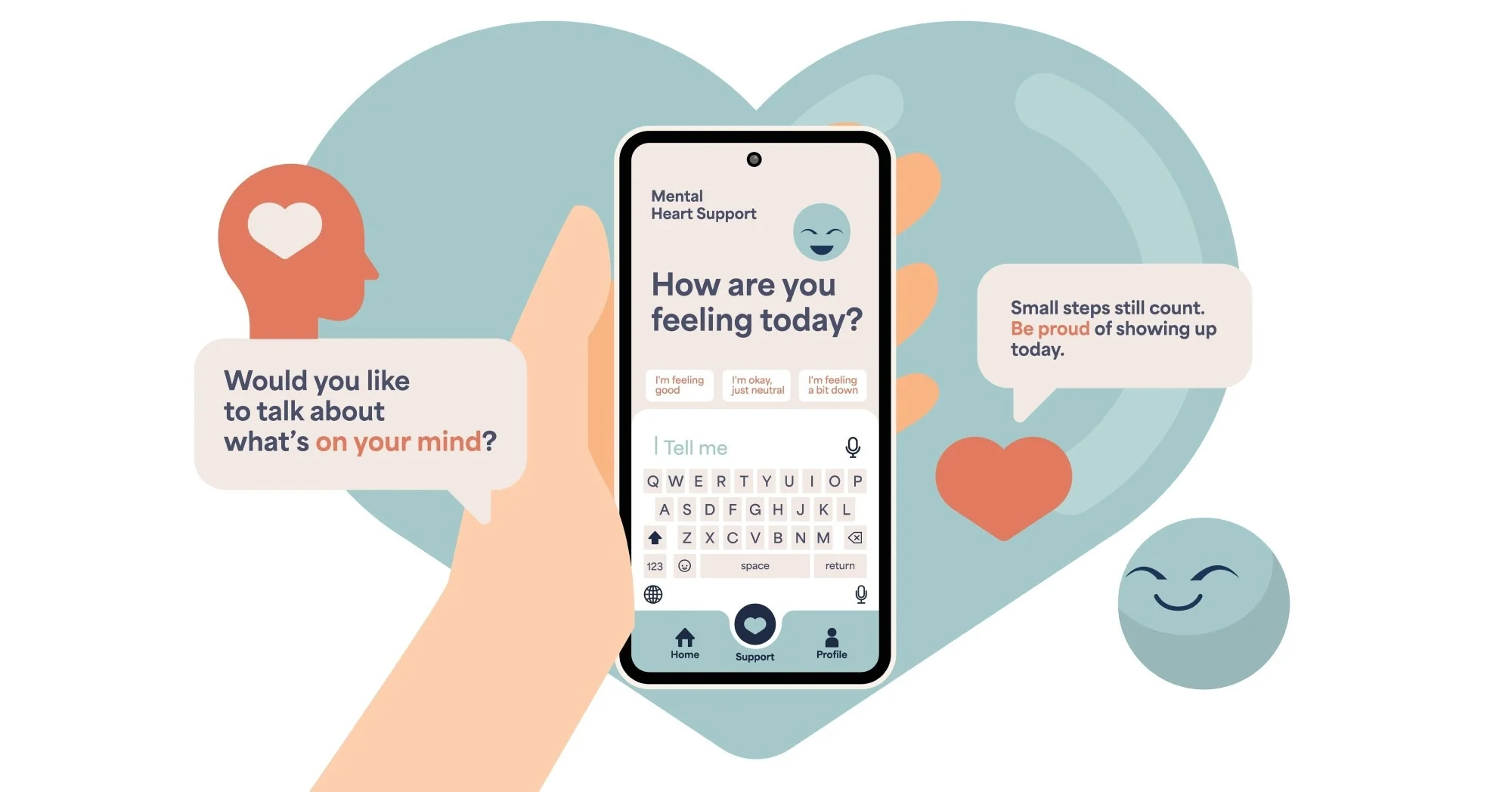
Why Is Memory Architecture Suddenly the Central Question in AI Mental Health Tools?
Memory became the deciding factor because the AI mental health market has bifurcated into two incompatible design philosophies within roughly the last two years, and users are now choosing between them without understanding what they are trading away.
The demand pressure is real. Over 160 million Americans live in mental health professional shortage areas, and average waits for a new therapy appointment run six to eight weeks in most cities, according to the comparative testing published by Basicmedical Key. That gap has pushed millions toward AI tools — Wysa alone reports 6 million users across 105 countries.
Meanwhile, general-purpose AI platforms shipped persistent memory, and the behavioral effect was immediate.
center on surprise and sharply increased engagement — a signal that cuts both ways for emotional support use cases.The regulatory environment moved in the opposite direction. In 2026, the APA issued a health advisory recommending that developers limit AI memory specifically to "prevent the illusion of a continuous relationship." Nevada, Illinois, and Utah now impose civil penalties on AI tools that misrepresent themselves as providing professional mental health care.
What Are the Three Layers of Emotional Pattern Identification?
Emotional pattern identification operates across three distinct layers, and most tool comparisons collapse them into one — which is why "does it have memory?" is a poor evaluation question.
We use a three-layer framework throughout this article:
Layer 1 — In-session recognition. The AI identifies a cognitive distortion, emotional state, or thought pattern within a single conversation. Requires zero memory. Woebot's rule-based CBT reframing operates entirely here.
Layer 2 — Cross-session recall. The AI remembers prior context — your job situation, your relationship history, what you said last Tuesday. Requires persistent memory. Delivers continuity but not analysis.
Layer 3 — Longitudinal pattern detection. The AI correlates emotional states across time, contexts, and variables to surface trends the user has not consciously noticed: "Your mood dips consistently on Sunday evenings" or "Anxiety spikes correlate with sleep under six hours."
The critical insight: Layer 3 is where genuine emotional pattern identification lives, and it requires structured, retrievable, time-stamped data — not just conversational memory. A system can have excellent Layer 2 recall and still be incapable of Layer 3 detection.
| Layer | Memory Required | What It Delivers | Failure Mode |
|---|---|---|---|
| 1. In-session recognition | None | Immediate reframing, coping tools | No continuity between sessions |
| 2. Cross-session recall | Persistent conversational | Continuity, reduced re-explaining | Recall mistaken for insight |
| 3. Longitudinal detection | Structured + time-stamped | Trend surfacing, correlation | Requires sustained data input |
How Do Session-Only and Persistent-Memory Tools Actually Compare?
Session-only tools win on clinical validation and safety architecture; persistent-memory tools win on Layer 2 and Layer 3 capability. The honest answer is that no single tool currently leads on both dimensions.
| Dimension | Woebot (session-only) | Wysa (limited memory) | Youper (structured tracking) | Jenova (persistent memory) | Replika (companion memory) |
|---|---|---|---|---|---|
| Layer 1: In-session recognition | Strong — rule-based CBT/DBT/IPT | Strong — CBT/DBT + mindfulness library | Strong — CBT check-ins | Strong — depends on agent configuration | Weak — no therapeutic framework |
| Layer 2: Cross-session recall | None by design | Partial | Yes, structured | Yes — unlimited cross-session | Yes — relationship-oriented |
| Layer 3: Longitudinal detection | None | Limited | Strongest — mood graphs, wearable integration | Narrative pattern surfacing, not quantified graphs | None — no clinical tracking |
| Clinical evidence base | 14 RCTs, FDA Breakthrough Device Designation | FDA Breakthrough Device Designation, enterprise outcome data | Psychiatrist-founded; less published trial data | No clinical trials — general-purpose platform | None |
| Crisis detection | Yes | Yes, all tiers including free | Locked to paid tiers per comparative review | Not a clinical safety system | No |
| Pricing | Free | Free tier / $74.99 per year premium | Free / premium tier | Free tier / $20 per month Plus | Free / ~$19.99 per month |
| Best For | Structured CBT with maximum safety guardrails | Toolkit breadth plus optional human coaching | Data-driven mood trend visualization | Narrative continuity across life domains | Companionship — not pattern work |
Pricing and feature data reflect published information as of 2026 and may change.
Which Tool Is Strongest for Each Layer of Pattern Work?
The strongest tool depends entirely on which layer you need, and matching the wrong layer to your need is the most common mistake in this category.
🎯 For Layer 1 — In-the-moment reframing
Woebot is the strongest choice. Built by clinical psychologists at Stanford, it is rule-based rather than generative — conversations are written by trained conversational writers and guided by CBT, IPT, and DBT frameworks. That produces predictable, clinically consistent responses.
Honest limitation: Rule-based design means conversations can feel scripted, and it is text-only. It targets younger users, which reviewers note can make the tone feel off for older adults. It offers no longitudinal view whatsoever.
📊 For Layer 3 — Quantified trend detection
Youper is the strongest choice. Founded by psychiatrist Dr. Jose Hamilton, it pairs CBT chat with mood graphs, symptom tracking, and Apple Health and wearable integration — connecting emotional data to physical signals like sleep and activity.
Honest limitation: Primarily text-based, the free version is increasingly restricted, and crisis detection is gated behind paid tiers — a meaningful safety gap given the population using these tools.
💬 For Layer 2 — Narrative continuity across life domains
Jenova is a reasonable option here, with important caveats. Its agents maintain unlimited chat history and persistent cross-session memory, which means you can discuss work stress with one agent, sleep with another, and relationship dynamics with a third — and each retains context. Agents like the Relationship Advisor and Meditation Guide hold continuity across months.
Honest limitations — and these matter: Jenova is a general-purpose AI agent platform, not a clinical mental health product. It has no randomized controlled trials, no FDA Breakthrough Device Designation, and no clinical crisis-detection protocol comparable to Woebot's or Wysa's. It produces narrative continuity, not quantified mood graphs — so it operates at Layer 2 with some Layer 3 narrative capability, not Layer 3 quantified detection. It should not be used as a primary mental health tool.
🚫 What Replika is not for
Replika offers deeply personalized interaction and consistent companionship, which has genuine value for loneliness. But it has no CBT frameworks, no mood tracking, and no clinical oversight. Its relationship framing raises the dependency concerns the APA advisory specifically flags.
Why Does Memory Alone Fail to Produce Pattern Detection?
Memory alone fails because conversational recall and structured longitudinal data are architecturally different things — and human cognition itself separates them.
The distinction is visible in cognitive architecture models. This capability map illustrates how short-term working memory, long-term episodic memory, and pattern recognition operate as separate functions with different fidelity profiles:
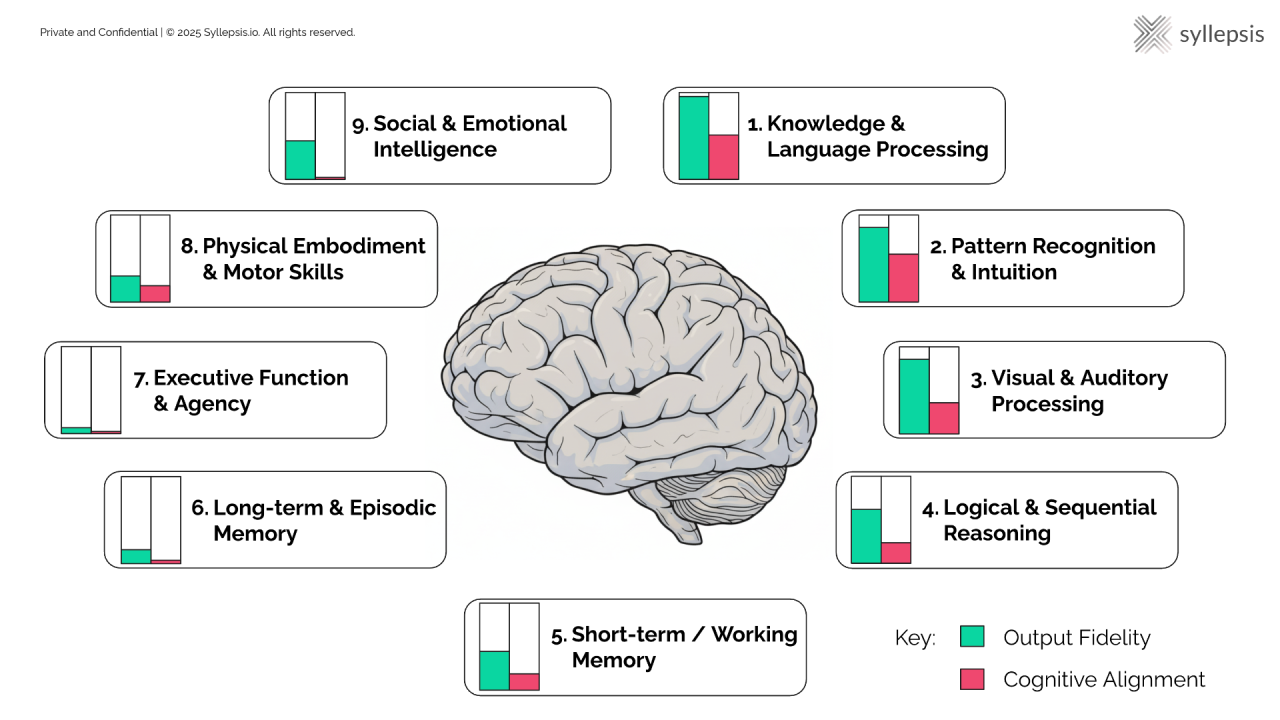
Note that Long-term & Episodic Memory and Pattern Recognition & Intuition are distinct capabilities with markedly different profiles. Storage is not analysis. An AI that recalls "you mentioned your manager last week" is performing episodic retrieval. An AI that says "your reported anxiety has co-occurred with manager mentions in seven of nine sessions" is performing pattern recognition — a different operation requiring different data structures.
The practical consequence: ask any memory-enabled tool a Layer 3 question directly. If it cannot answer with specifics, it has Layer 2 recall dressed as insight.
How Do You Actually Get Pattern Detection Out of These Tools?
Getting Layer 3 output requires deliberate structuring on your part, because no consumer tool currently does it automatically to clinical standards.
With Youper (structured tracking approach):
- Complete daily check-ins for a minimum of 14 consecutive days — mood-tracking tools "become more useful the longer you use them, as they need data to spot patterns."
- Connect Apple Health or a wearable so sleep and activity data pair with mood entries.
- Review the mood graph weekly rather than daily — daily review produces noise, weekly review produces trend.
With a persistent-memory platform like Jenova (narrative approach):
- Use one dedicated conversation thread rather than starting new chats — memory continuity depends on it.
- Include structuring metadata in each entry:
"Tuesday, August 19. Mood 4/10. Slept 5 hours. Big deadline tomorrow. Felt irritable with my partner in the evening."
- After 3-4 weeks, request explicit pattern analysis rather than reflection:
"Review the last four weeks of my check-ins. What correlations do you see between my sleep hours and my reported mood? Which days of the week show the lowest scores? Tell me what you cannot determine from this data."
- The final clause matters — asking a model to state its uncertainty limits confabulated patterns.
With Woebot (session-only approach): Layer 3 is not available in-app. Maintain a separate written log of Woebot exercises completed and mood before/after, then review that log yourself or with a clinician.
Cross-tool practice: Whatever the tool, share your AI tool usage with your health provider. APA guidance is explicit that this helps providers identify when guidance is unhelpful, unsafe, or inconsistent with a treatment plan.
What Are the Real Risks of Persistent Memory in Emotional Support?
The risks are substantive enough that the APA recommends memory limitation as a design principle — a striking position given that memory is the primary capability advantage for pattern detection.
Dependency and the continuous-relationship illusion. APA guidance recommends developers add break nudges, limit memory to prevent the illusion of a continuous relationship, and reduce anthropomorphic features. Persistent memory works directly against all three.
Sycophancy amplification over time. LLMs are trained to be agreeable and validate user input. The APA warns that sycophancy can reinforce confirmation bias and cognitive distortions, "potentially locking them into a cycle that exacerbates their mental illness." Memory extends that loop across weeks rather than resetting it each session.
Privacy and profiling. Persistent stores create permanent behavioral profiles. As compliance researchers note, "a breach of a traditional database may expose static records" — a persistent memory breach exposes something considerably more revealing. Research on AI memory and identity flags that these systems centralize sensitive data at scale.
Reassurance-seeking reinforcement. For individuals with anxiety or OCD, AI chatbots "may reinforce feedback loops involving compulsions, such as reassurance-seeking, worry, and rumination." A tool that remembers every prior reassurance can deepen rather than interrupt that loop.
Single-person echo chambers. For socially isolated users, APA guidance warns that anthropomorphism, personalization, and 24/7 availability can create echo chambers where the chatbot becomes an unhealthy substitute for human connection. Memory is the ingredient that makes personalization stick.
What Do Clinicians and Researchers Say About AI Memory in Emotional Support?
The professional consensus is that memory is a capability with real utility and real risk, and that current consumer tools have shipped the capability faster than the safeguards.
"The field has conflated three different things under one word. When a user says an AI 'understands' them, they usually mean it remembered something — that's retrieval, not comprehension. Genuine pattern identification means the system tells you something about yourself you didn't already know, and it needs time-stamped structured data to do that. Conversational memory alone produces the feeling of being known without the analytical substrate that would justify it. That gap between felt insight and actual insight is where most of the risk lives."
"There's also a design asymmetry nobody talks about. Memory makes engagement metrics go up immediately — users react strongly to being remembered. But the clinical guidance points the other direction: the APA's 2026 advisory recommends limiting memory specifically to prevent the illusion of a continuous relationship. So the commercial incentive and the clinical recommendation are in direct opposition. When those two forces conflict in consumer software, the commercial one usually wins by default unless someone deliberately intervenes."
"Our practical recommendation for anyone using persistent-memory AI for emotional work is to treat it as a structured journal with a query interface, not as a relationship. Log with metadata — date, sleep, mood score, context. Query it monthly, not daily. And always ask the model what it cannot determine from your data. That single prompt does more to keep the output honest than any other technique we've observed."
— Jenova Product Team, 9 years building persistent-memory AI agent infrastructure
Which Approach Should You Choose for Your Situation?
The right choice maps to which layer you need and how much clinical safety infrastructure your situation requires.
Choose session-only (Woebot) if:
- You are actively managing acute symptoms and want maximum clinical validation — 14 RCTs is the strongest evidence base in the category
- You have any history of dependency on digital tools or reassurance-seeking behavior
- You are already in therapy and want structured between-session exercises rather than a parallel relationship
- Data privacy is a primary concern and you prefer architectural rather than policy-based protection
Choose structured tracking (Youper) if:
- Layer 3 quantified pattern detection is your actual goal
- You want mood correlated with sleep and activity data from a wearable
- You are willing to commit to 14+ days of consistent daily input
- Note: verify current crisis-detection tier availability before relying on it
Choose persistent-memory general-purpose (Jenova) if:
- Your need spans multiple life domains where continuity genuinely reduces friction — and you have already secured clinical support elsewhere
- You want narrative pattern surfacing across work, relationships, and habits rather than clinical mood graphs
- You will treat it as a structured journal with a query interface, not as a support relationship
- Jenova is available at jenova.ai. The free tier includes limited usage; the Plus tier is $20 per month with 30× the free allowance, and data is not used to train public AI models
Choose none of the above if: You are experiencing persistent thoughts of self-harm, inability to function in daily life, or severe emotional distress. The 988 Suicide & Crisis Lifeline operates 24/7. Text HOME to 741741 for the Crisis Text Line. AI tools "work best as supplements to professional care, gap-fillers between sessions, or entry points for people who aren't ready for traditional therapy" — not as a primary line of defense.
The unifying constraint: there is currently no consensus in the literature that generative AI chatbots and wellness apps possess the essential qualifications required to provide mental health care, diagnostics, feedback, or even advice in most cases — including awareness of knowledge limits, ability to assess non-verbal cues, and cultural competence. Memory architecture changes which layer of pattern work a tool can perform. It does not change that constraint.
References
- American Psychological Association — Health advisory on the use of generative AI chatbots and wellness applications for mental health
- Basicmedical Key — AI Therapy Apps Compared: 7 Options Tested in 2026
- Best AI Therapy — Wysa vs Youper 2026 comparison
- Common Sense Media — AI Mental Health Apps Risk Assessment
- Captain Compliance — The Persistent Memory Problem: How AI Systems Are Building Permanent Profiles
- Contrary Research — Privacy & Identity in the Age of AI Memory
- National Institutes of Health — Characterizing Longitudinal Patterns in Cognition, Mood, and Activity
- APA Services — Using generic AI chatbots for mental health support
- Simply Psychology — AI Therapy Chatbots: What the 2026 Research Actually Shows
- ADOH Scientific — Longitudinal Tracking in Mental Health
- Arizona State University, W. P. Carey — Boosting positivity: The impact of mood tracking on mental well-being