RPG World Generator: How AI Builds Persistent Campaign Worlds (April 2026)
2026-04-21
In April 2026, the tabletop RPG world generator has evolved from random name tables and hex-fill algorithms into something fundamentally different. The global TTRPG market is valued at USD 2.4 billion and growing at an 11.84% CAGR toward $6.59 billion by 2035** ([Global Growth Insights](https://www.jenova.ai/en/resources/ai-rpg-generator)). Meanwhile, the AI game generator market reached **$1.64 billion in 2024 and is projected to hit $21.26 billion by 2034 — a CAGR of 29.2% (Market.us). At the intersection of these two explosions sits a question every game master has asked: How do I build a world that's deep enough to explore but fast enough to actually play in?
Jenova's Roleplay Game Master is purpose-built for exactly this. It's a specialized AI agent that generates persistent RPG worlds — complete with geography, factions, NPCs, political systems, and narrative hooks — and then runs campaigns inside them with unlimited memory, perfect character consistency, and multi-model access across GPT-5.4, Claude Opus 4.6, and Gemini 3.1 Pro.
- World generation with narrative intelligence — not random output, but coherent settings where geography shapes politics, politics shapes conflict, and conflict shapes story
- Unlimited persistent memory — every faction, NPC, location, and player decision carries forward across sessions indefinitely
- System-agnostic design — D&D, Pathfinder, Call of Cthulhu, Shadowrun, homebrew, or any system you describe
- Multi-model flexibility — switch AI models mid-campaign to match the creative demands of each session
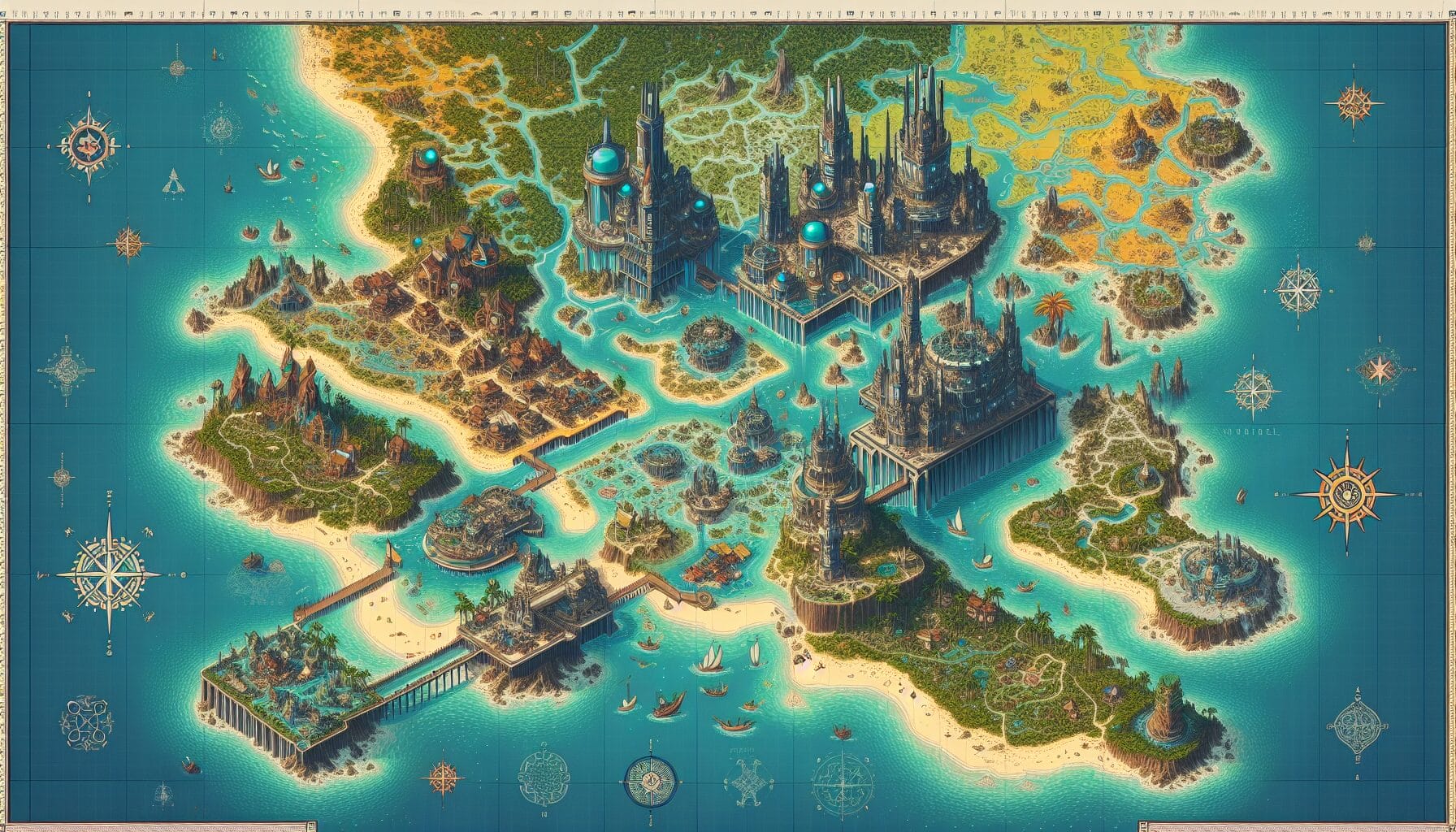
Quick Answer: What Is an RPG World Generator?
An RPG world generator is a tool that creates the settings, locations, factions, NPCs, and narrative structures that form the foundation of a tabletop or digital role-playing game campaign — from continents and kingdoms down to individual taverns and their regulars.
- Build complete campaign settings with interconnected geography, politics, and history using the Roleplay Game Master
- Generate NPCs with memory and motivation — characters with goals, fears, and agendas that evolve based on player actions
- Create faction ecosystems where alliances shift, economies respond, and consequences ripple across the world
- Maintain world-state persistence across unlimited sessions — no detail lost, no lore forgotten
The Problem: Why RPG World-Building Is So Hard
The Prep Time Crisis
World-building is the most time-consuming part of running an RPG campaign — and the part most likely to burn out a game master. According to the GDC 2025 "State of the Game Industry" report, 1 in 3 developers already use generative AI to streamline development (Friends & Fables), and the same pressure applies to GMs: the demand for rich, detailed worlds far exceeds the time available to build them.
A single session of D&D might require a new town, three NPCs with distinct personalities and motivations, a faction conflict, a map, and enough lore to make the setting feel lived-in. Multiply that across a 50-session campaign, and you're looking at hundreds of hours of prep — for a hobby that's supposed to be fun.
As one TTRPG industry professional noted in a 2025 retrospective: "AI works are flooding the market, have a low entry cost but are mediocre content at best. However, the flood of them is making it harder for human-made art to be heard above the noise." — Becky Annison, designer of Lovecraftesque (TTRPG Insider)
The challenge isn't generating content. It's generating content that's coherent, interconnected, and worth playing in.
Procedural Generation Produces Worlds Without Souls
Traditional procedural generation — random tables, hex-fill algorithms, name generators — has been part of TTRPGs since the 1970s. But as Game Developer's analysis of procedural world-building documented: "Generating procedural worlds has a number of common issues, the biggest of which is that it can lead to unoriginal or repetitive feeling gameplay" (Game Developer).
The Elder Scrolls: Daggerfall problem is instructive: a procedurally generated world of 62,000 square miles that felt emptier and less memorable than Skyrim's hand-crafted 16 square miles. The series moved away from procedural generation specifically because players preferred smaller, intentionally designed worlds over vast, algorithmically generated ones (Game Developer).
As game design writer Eric Faber put it: "When designers set out with intent to create specific emotions or moments for the player in a curated experience with a definite end, it will almost always be better than a game where they set out to give you infinitely replayable content without repetition" (The Airborne Ham Game Lab).
General-Purpose AI Chatbots Forget Your World
The most common complaint from GMs who try using ChatGPT or Gemini as world generators is memory. A highly upvoted r/dndnext post documented the problem in detail: "It is starting to hallucinate, falsify experiences and blatantly lie about content... causing extreme data loss and game integrity issues. It even admits to doing so" (
). The top comment was blunt: *"Can ChatGPT be an effective Dungeon Master? No."General-purpose chatbots don't natively track faction standings, NPC relationships, quest logs, or world-state changes across sessions. They operate within limited context windows, and once a world exceeds that threshold, older details — the treaty you brokered in session 4, the artifact hidden in the Sunken Temple, the merchant who swore revenge — get silently dropped.
The Over-Prep Trap
On the opposite end, AI makes it dangerously easy to over-generate. A top post on r/rpg with nearly 2,000 upvotes described the problem perfectly: "AI can pump out endless lore, NPCs, and plot hooks in minutes. Sounds amazing, right? But here's the catch: you have to juggle all of it during play... In my worst case, I had over 100 pages of lore I didn't actually need" (
).The most upvoted response cut to the heart of it: *"Swap all mentions of AI with over-prepping and you'd have the same post."
The ideal RPG world generator doesn't dump 100 pages of lore on you. It builds a world collaboratively, expanding detail where you need it, maintaining consistency where you don't, and adapting dynamically when players take the story in unexpected directions.
Why Roleplay Game Master
This is exactly what the Roleplay Game Master was built for.
Most RPG world generators treat world-building and gameplay as separate activities. You generate a setting in one tool, then try to run it in another — losing context, consistency, and momentum at every handoff. The Roleplay Game Master unifies both: it generates your world and runs campaigns inside it, with every detail persisting across unlimited sessions.
| Random Tables / Name Generators | General-Purpose AI (ChatGPT) | Roleplay Game Master | |
|---|---|---|---|
| World coherence | Random — no internal logic | Coherent initially, drifts over time | Persistent coherence across sessions |
| Memory | None — manual tracking | Context window limits (forgets after 20-50 turns) | Unlimited persistent memory |
| NPC consistency | Static traits on a card | Personality shifts mid-conversation | Perfect persona fidelity indefinitely |
| Faction dynamics | Manual tracking required | Forgets alliances and conflicts | Tracks standings, evolves relationships |
| System support | System-specific | Doesn't understand RPG mechanics | Any system: D&D, Pathfinder, Call of Cthulhu, homebrew |
| World + gameplay | Separate tools | Separate prompting sessions | Unified — generates and runs in one agent |
How It Generates Worlds That Actually Work
The Roleplay Game Master doesn't produce random output. It collaborates with you to build worlds where every element connects — where geography creates trade routes, trade routes create wealth, wealth creates power struggles, and power struggles create the conflicts your players walk into.
"I want a frozen archipelago where each island is controlled by a different clan. The clans trade whale oil and volcanic glass, but a new religion is spreading that forbids whale hunting. Build me this world — the geography, the three most powerful clans, and the faction that's funding the religious movement."
"Create a post-apocalyptic version of Renaissance Florence where the Medici equivalent controls the only working water purification system. I need the political structure, three rival families, and the underground resistance."
"Generate a space station setting for a Mothership RPG campaign. The station is a decommissioned military platform converted into a mining hub. Something is wrong with the AI that controls life support. Build the station layout, the corporate hierarchy, and the crew manifest."
These aren't prompts for a random generator. They're collaborative world-building conversations with an agent that understands narrative structure, political systems, and the specific demands of tabletop RPG play.
Multi-Model Flexibility for Different World-Building Tasks
Because Jenova provides access to GPT-5.4, Claude Opus 4.6, Gemini 3.1 Pro, and models from xAI and DeepSeek — all without vendor lock-in — you can match the AI model to the creative task. Need Claude's precision for intricate political systems and nuanced NPC dialogue? Use it. Prefer GPT-5.4's creative range for brainstorming wild cosmologies and magic systems? Switch in one click. The Roleplay Game Master optimizes across all of them, and your world persists across model changes.
Try the Roleplay Game Master free — no credit card required.
Related Agents You'll Also Like
Creative Fiction Writer
For GMs who want to develop their world's history, mythology, and prose-level lore beyond what emerges during play, the Creative Fiction Writer is a specialized storytelling partner. Write the founding myths of your campaign's civilizations, develop the in-world texts your players might discover, or polish session recaps into publishable fiction.
- Genre-aware craft across fantasy, sci-fi, horror, and literary fiction
- Voice matching that maintains your established world's tone
- Persistent memory for characters, world details, and stylistic choices
The Mansion
A standalone mystery RPG experience that demonstrates what AI world generation looks like in practice. Wake in a sprawling mansion with no memory, uncover secrets, and survive — in a fully dynamic environment with persistent consequences and multiple endings. No setup required.
- Atmospheric horror with branching storylines
- Environmental storytelling through object examination and spatial relationships
- Every decision carries forward — no memory resets
The Asylum
Horror investigation in a shuttered psychiatric institution. For GMs who want to experience AI-generated world-building as a player before building their own settings — or for players who want a self-contained campaign they can start immediately.
- Psychological horror with environmental storytelling
- Persistent world state that evolves based on your investigation
- Multiple endings based on accumulated choices
Prompt Generator
If you want to get the most precise, detailed world-building output from any AI tool, the Prompt Generator helps you craft exactly the right instructions. Turn vague ideas like "dark fantasy kingdom" into structured creative briefs that produce specific geography, political systems, and narrative hooks.
- Expert prompt engineering for text and image AI models
- Collaborative refinement to dial in genre, tone, and specificity
- Works across all major AI platforms
How It Works: From Concept to Living World in Minutes
Here's a step-by-step walkthrough of using the Roleplay Game Master as your RPG world generator.
1. Start With a Seed
You don't need a fully formed setting. Start with whatever inspires you — a genre, a mood, a single image, a conflict, or even just a system you want to play.
"I want to run a Pathfinder 2e campaign set in a desert empire that's collapsing from within. The emperor is dying, three heirs are scheming, and the players are mercenaries caught in the middle. Build me this world."
2. Generate the Macro Structure
The agent produces the large-scale framework: geography, political systems, major factions, economic drivers, and the central tensions that will fuel your campaign. You review, adjust, and refine.
3. Drill Into Detail Where It Matters
Ask for specifics on the locations, NPCs, and factions your players will encounter first. The agent generates interconnected detail — the tavern owner who's secretly working for the second heir, the trade route that's been disrupted by the third heir's militia, the ancient ruin that holds the key to the emperor's illness.
"Give me the capital city. I need the palace district, the merchant quarter, the slums, and the underground. Three named NPCs per district — each with a secret that connects to the succession crisis."
4. Start Playing — The World Adapts
Once you begin the campaign, the Roleplay Game Master runs it. NPCs react to player choices. Factions adjust their strategies. The world-state evolves. If your players ally with the second heir and assassinate the third, the political landscape shifts accordingly — and the agent tracks every consequence.
5. Expand On Demand
When players travel to a new region, ask the agent to generate it. The new content automatically integrates with existing world-state — trade relationships, faction influence, NPC connections all carry forward.
"The players are heading east into the nomadic territories. Generate this region — but it needs to reflect the fact that the third heir's militia has been raiding the border for three sessions."
6. Return Anytime — It Remembers Everything
Unlike general-purpose chatbots that forget your world between sessions, the Roleplay Game Master's persistent memory means every NPC, faction standing, quest thread, and world-building detail carries forward indefinitely. Return weeks later and pick up exactly where you left off.
Results & Use Cases
🗺️ The Forever GM Who Needed a World Fast
Scenario: A GM has a new group starting in two weeks. They need a complete campaign setting — geography, factions, a starting town, and enough hooks to fuel the first five sessions — but they work full-time and have maybe six hours total for prep.
Traditional Approach: Spend those six hours building a fraction of what's needed. Improvise the rest during play. Lose consistency as details pile up across sessions.
With the Roleplay Game Master: In one session, generate the macro setting, the starting region, three factions, and a dozen NPCs with interconnected motivations. The agent then runs the campaign, maintaining every detail across sessions. Prep time drops from hours per session to minutes.
🎭 The Solo Player Who Wanted a Living World
Scenario: A D&D enthusiast can't find a group. They want to explore a persistent world as a solo player — not a choose-your-own-adventure, but a genuine RPG experience where their choices reshape the setting.
Traditional Approach: AI Dungeon or ChatGPT — fun for a session, but memory degrades quickly and the world loses coherence after a few hours.
With the Roleplay Game Master: The agent generates a world, populates it with adaptive NPCs, and runs a persistent campaign where every choice carries forward. Betray a faction in session 3, and they're hunting you in session 30. Help a stranger in session 5, and they show up as an ally in session 15.
📱 The GM Prepping on Mobile
Scenario: A game master has a 45-minute train commute and wants to use it for world-building. They don't have their notes, their laptop, or their reference books.
Traditional Approach: Scribble fragments in a notes app. Try to remember what they've already established. Arrive at the session with disconnected ideas.
With the Roleplay Game Master on mobile: The agent already remembers the entire world. Ask it to generate the next town the players will visit, flesh out an NPC they met last session, or develop the political consequences of last week's battle — all from your phone, with full continuity.
📚 The Novelist Using RPG World-Building for Fiction
Scenario: A fantasy novelist uses RPG-style world-building to develop settings for their books. They want to stress-test their world by playing in it — seeing how characters interact with the political systems, whether the economy makes sense, whether the magic system creates interesting constraints.
Traditional Approach: Build the world in a wiki, then try to imagine how characters would navigate it. Limited by the author's own blind spots.
With the Roleplay Game Master + Creative Fiction Writer: Generate the world with the Roleplay Game Master, then play through scenarios to test it. When a scene produces compelling material, hand it to the Creative Fiction Writer to polish into prose. The @mention feature lets you bring both agents into the same conversation.
FAQ
What is an RPG world generator?
An RPG world generator is a tool that creates the settings, locations, factions, NPCs, and narrative structures for tabletop or digital role-playing game campaigns. In 2026, AI-powered generators like the Roleplay Game Master go beyond random output — they produce coherent, interconnected worlds with persistent memory, adaptive NPCs, and dynamic faction systems that evolve based on player choices across unlimited sessions.
How does the Roleplay Game Master compare to random generators or ChatGPT?
Random generators (name tables, hex-fill algorithms) produce disconnected fragments without internal logic. ChatGPT can generate coherent content initially but forgets your world after 20-50 turns and doesn't understand RPG mechanics. The Roleplay Game Master combines world generation with campaign management — it builds your world, runs campaigns inside it, tracks every detail with unlimited persistent memory, and supports any RPG system. It also provides multi-model access across GPT-5.4, Claude Opus 4.6, and Gemini 3.1 Pro.
Can I use it for any RPG system, not just D&D?
Yes. The Roleplay Game Master is system-agnostic by design. It supports D&D 5e, Pathfinder 2e, Call of Cthulhu, Shadowrun, FATE, Powered by the Apocalypse, homebrew systems, and any custom rule set. Describe your system's mechanics, and the AI interprets rules, manages combat, and adjudicates edge cases in real time.
Is Jenova free to use for RPG world generation?
Yes. Jenova offers a free tier that includes access to all core features, including the Roleplay Game Master and pre-built RPG experiences like The Mansion and The Asylum. Paid plans starting at $20/month provide increased usage limits and additional features like custom model selection. No credit card is required to start.
How does the Roleplay Game Master handle world consistency over long campaigns?
Unlimited persistent memory means every NPC, faction alliance, quest thread, geographical detail, and player decision carries forward indefinitely across sessions. Unlike general-purpose chatbots that operate within limited context windows and silently drop older details, the Roleplay Game Master maintains perfect world-state consistency — your 50th session picks up exactly where your 49th left off.
Does Jenova protect my campaign data and original world-building?
Yes. Your data is never used for model training. All content is encrypted in transit and at rest. Nothing is sold to advertisers. This is essential for game designers with original campaign settings or proprietary world-building they want to protect.
Conclusion
The RPG world generator in 2026 sits at the intersection of a **$2.4 billion TTRPG market** growing at nearly 12% annually and an **AI game generator market** projected to reach $21.26 billion by 2034. The demand for persistent, coherent, player-responsive campaign worlds has never been higher — and the gap between what random generators produce and what game masters actually need has never been wider.
Random tables give you fragments without logic. General-purpose chatbots give you coherence without memory. The Roleplay Game Master gives you both — worlds with narrative intelligence, unlimited memory, multi-model flexibility, and the RPG expertise to run campaigns inside the settings it generates. Every faction, every NPC, every political consequence persists across sessions indefinitely.
Try the Roleplay Game Master now — free, no credit card required. Or explore the full agent library at Jenova to find specialized AI partners for every stage of your creative process.