RPG Trap Generator: AI Dungeon Traps Players Can Actually Solve
2026-09-05
Jenova is an AI platform that works as a living RPG trap generator — designing pit traps, collapsing halls, and puzzle rooms with makers, tells, and countermeasures that fit the dungeon you actually drew. In September 2026, Game Masters still drop generic “1d10 piercing” pits into homebrew ruins that have nothing to do with who built them. Specialist agents turn a faction, a floorplan, and a reason to keep people out into hazards players can detect, bypass, or turn around.
✅ Generate traps with a maker, a motive, and a reason to exist ✅ Pair damage with puzzles, alarms, captures, and combat complications ✅ Write tells, triggers, and countermeasures instead of save-or-suffer tax ✅ Prep on web, iOS, or Android — between sessions or when they kick the wrong door
To understand why this matters, let’s examine why most generated traps feel like a slap from the screen instead of a scene.
Quick Answer: What Is an RPG Trap Generator?
An RPG trap generator is a tool that creates dungeon hazards, triggers, and countermeasures so Game Masters can challenge players without hours of extra encounter writing. On Jenova, that generator is not a static damage table — it is a set of specialist agents that remember your ruin and refine the hazard until it is table-ready.
Key capabilities:
- Systems, DCs, and bypass options via Game Designer Assistant
- Live “click,” investigation, and complex-trap rounds with Roleplay Game Master
- Historical mechanisms and cultural flavor grounded by Deep Research
- Maker motive, placement logic, and who the trap was meant to stop
The Problem: Random Traps Punish Players Instead of Challenging Them
Tabletop play is still expanding as a commercial hobby. Industry analysis values the tabletop gaming market at USD 21.43 billion in 2026, with a forecast of USD 39.14 billion by 2030 at a 16.3% CAGR. That demand shows up as more homebrew dungeons, more virtual tabletops, and more pressure on the person behind the screen to make every hallway feel intentional.
But producing traps that actually serve a session is frustratingly difficult:
- Random generators ignore your builder, your map, and last week’s fight
- Prep time is already spent before you design a single pressure plate
- Save-and-damage traps feel like a DM tax, not a puzzle
- Players leave the mapped corridor, and you need a new hazard in sixty seconds
- Traps without tells, countermeasures, or motives collapse into plot holes
Homebrew Ruins Need Homebrew Hazards
A click-to-generate pit does not know that your dungeon was a dwarven mint, a kobold warren, or a lich’s phylactery vault. Old-school room stocking often places a trap in about 5% of basic rooms — rare enough that every one should earn its space. A seeded “scythe in the hall” list cannot remember that the party already burned the garrison’s oil stores, or that the cultists need live captives, not corpses.
Designers have been blunt about this for years. Traditional mechanical traps are awkward in tabletop play when they exist only as a hidden roll. If the hazard does not participate in the dungeon’s fiction, it is noise with hit points attached.
Prep Time Does Not Include a Trap Novel
A Sly Flourish poll of 3,663 Dungeon Masters found that just about a third spent three hours or more preparing a four-hour game, while a little less than half spent an hour or less.
29% — Surveyed DMs who spend three hours or more prepping a four-hour game
Combat, maps, and NPC stats already consume that window. Hand-writing triggers, tells, countermeasures, and “what happens if they jam the gears with a shield” is the first task to get cut — until someone steps on the plate and stares at you.
Damage-Only Traps Are a Tax, Not a Scene
Luke Hart at The DM Lair argues that the common loop — fail to search, roll a save, take damage — feels like a DM screw job rather than a joyful moment. Players make few meaningful choices. Resources vanish. Nobody learned anything about the dungeon.
The better purposes are tension, puzzles, and combat complications — not resource depletion as the point of the trap. EN World discussions of trap function make the same split: slow intruders, swing a fight, protect a vault, raise an alarm. A generator that only outputs dice is solving the wrong problem.
The Party Will Leave the Mapped Hall
You prepped the trapped treasury. They rappel into the cistern. Classic generators give you another generic dart corridor that does not match wet stone, algae, or the fact that the cistern was built to keep water in, not adventurers out. The session stalls while you invent.
A Trap Without a Maker Is a Plot Hole
Creatures do not trap rooms for sport. Kobolds build primitive, resettable, cowardly devices. Dwarves build stone and metal that their own patrols can walk. Wizards leave glyphs. If your RPG trap generator cannot answer “who built this, why, and how do they not die on their own stairs?”, players will notice. Mechanical pits, wall bolts, and similar devices only sing when they match the people who live there.
This is exactly what Jenova was built for.
The Jenova Solution: Context-Aware Dungeon Traps
Jenova treats trap generation as encounter design, not a slot machine. You describe the builder, the room, the last session, and what the trap is for — kill, capture, delay, alarm, or split the party. Agents then write, stress-test, and run the result so it can be spoken at the table.
| Traditional Approach | Jenova |
|---|---|
| d100 pits and dart halls | Hazards grounded in your builder, map, and last session |
| Hidden roll, then damage | Tells, the “click,” and player choices before the save |
| Hours of handwritten trigger notes | Minutes of prompted generation, reused across delves |
| Static lists that go stale | Persistent memory of which traps already fired |
| Separate tools for stats, prose, and running | One workflow from motive → mechanics → live scene |
Systems, Countermeasures, and Fair Numbers
When the trap has to survive contact with a ruleset, start with Game Designer Assistant. Ask for trigger, effect, reset, and — most important — three countermeasures that are not “roll Thieves’ Tools.” Hart’s design sequence is the right one to steal: who made it, why it exists, what it does, then the mechanical details. Variety matters: damage, hinder, alarm, immobilize. A mint should not use the same trick as a goblin latrine.
The same agent documents DCs, area, and how the trap changes a later fight — spiked pits under flying enemies, a paralysis glyph on the door the ogres are about to kick.
Running the Click at the Table
The Roleplay Game Master is built for the moment someone hears stone grind. Unlimited conversation memory and character consistency mean the dwarf who warned you about “the widow’s step” still knows it six sessions later. You can stay in the hallway, in voice, and still generate the next beat when a player says, “I jam my crowbar under the plate.”
That matches how strong GMs already run traps: foreshadow, make the device make sense, and do not repeat the same gag. Obvious traps become puzzles. Hidden traps get a click and a choice. Complex traps drop into initiative so the rest of the party can help.
Motive, Maker, and Who Benefits
Political and faction dungeons need a different generator. Machiavelli Mentor maps incentives: who paid for the trap, who is allowed to walk it, and what second-order move fires if the alarm bell rings in the barracks. Pair that with Deep Research when you want murder holes, portcullis slots, caltrop doctrine, or real siege logic you can reskin without copying a published module.
Personality Analyzer is the right specialist when the difference between a paranoid lich and a practical kobold should show up in the kind of cruelty on the floor.
Visual Setpieces and Named Rooms
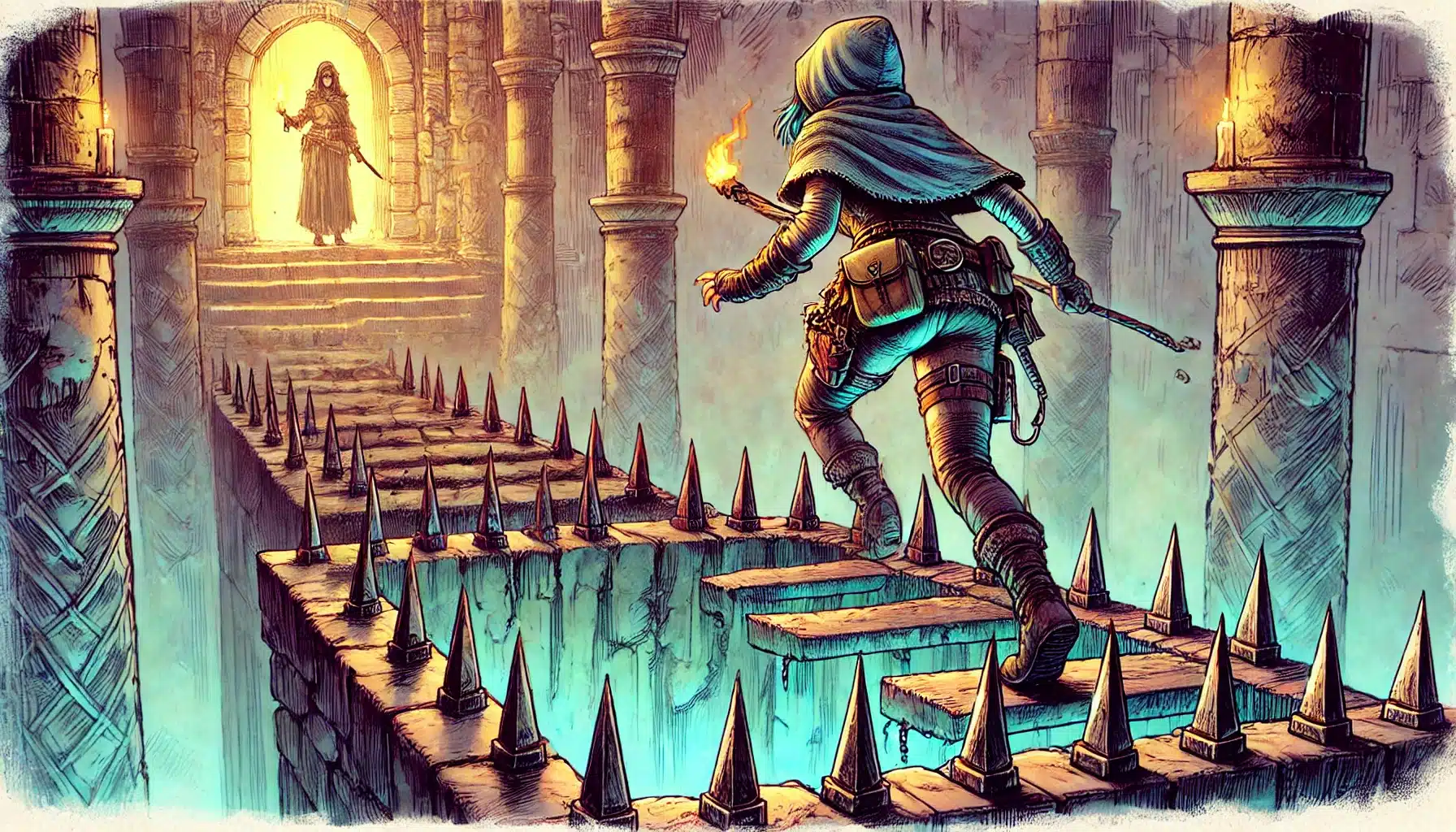
Some traps deserve a camera, not a sentence. Film Screenwriter turns a collapsing bridge into blocking, a closing image, and the one detail players will quote later. Comic Creator is useful when you need to see the room — spike lines, safe ledges, the control wheel on the far plinth — before you describe it.
Name the device so it sticks. Name Generator will give you “The Widow’s Step” instead of “pit trap 4.” Quiz Maker is the unexpected partner for riddle locks and passphrase doors: calibrated questions, fair difficulty, no “what am I thinking?” sphinx energy.
While a classic random table is excellent at surprise, Jenova specializes in traps that survive contact with your dungeon: the builder, the tell, the unfinished job.
Specialized AI Agents for RPG Trap Generation
If you are building a trap pipeline, these are the agents most GMs actually open within a month of starting.
Game Designer Assistant
Game Designer Assistant is the systems half of an RPG trap generator. Reverse-engineer a whisper of “spiked cistern” into trigger, save, reset, and three ways to beat it that are not a single skill check.
- Brainstorming and systems analysis across genres and platforms
- Documentation you can paste into a VTT notes panel
- Concept support when a trap implies a chase, a split, or a later combat
Roleplay Game Master
Roleplay Game Master is the at-table half. Stay in the hall, stay in character, and ask what the stone does when the rogue’s weight hits the plate.
- Unlimited memory so repeated rooms do not reset their state
- Perfect character consistency for NPCs who built, sold, or survived the device
- Complete creative freedom for any system, tone, or content rating
Deep Research
Use Deep Research when you want the trap to feel like engineering, not a video-game tile. Historical wells, fortress murder holes, mill-race sluices, and tomb curses become texture you can reskin.
- Hundreds of sources synthesized with inline citations
- Actionable notes instead of a bibliography dump
- Useful when players ask “how does this even work?”
Machiavelli Mentor, Film Screenwriter, and Named Rooms
Use Machiavelli Mentor when traps are weapons in a faction war. Use Film Screenwriter when they are setpieces. Use Name Generator when the room needs a name the table will remember. For domain-scale fortifications — city walls, not 10-foot halls — Civilization is the sandbox that thinks in sieges and rival nations.
Mystery-forward groups who want every hallway to withhold and reveal can study how The Mansion paces secrets room by room, then steal that cadence for a haunted estate one-shot. Investigators who prefer environmental dread over spike pits can lift atmosphere from The Asylum and ask Game Designer Assistant to turn a “wrong ward” into a fair, playable hazard.
Try Jenova free — no credit card required.
How to Generate RPG Traps Step by Step
Step 1: Name the Builder and the Job
Open the platform and tell the agent who made the trap, what they are protecting, and one fact from the last session. Specificity is the whole product: “kobold warren, live captives required, party already stole the oil” beats “give me fantasy traps.”
"Kobolds built this. They need prisoners, not corpses. The party burned their oil last session. Give me a capture trap that still works without fire."
Step 2: Choose Function Before Dice
Ask for delay, alarm, capture, split, or combat complication — not just damage. Require a tell, a trigger, an effect, and at least two countermeasures.
"One hallway trap: function is alarm plus hinder. Include a tell a careful scout could notice, a trigger, the effect, and three ways to bypass that are not a single Disable check."
Step 3: Stress-Test Against the People Who Live There
Hand the same writeup to Machiavelli Mentor or Game Designer Assistant and ask how the builders walk through every day. Cut anything that would kill the cook.
"The garrison uses this stair twice a shift. Rewrite the pressure plate so patrols have a bypass, and tell me the tell a high-Insight character might notice."
Step 4: Run the Click, Not the Tax
At the table — including on iOS or Android — stay with Roleplay Game Master. If they miss it, describe the click and give a choice before the save. If they find it, let them puzzle. If it is complex, call initiative.
"The fighter’s boot sinks half an inch and the stone clicks. Do not roll damage yet. What does each character see, and what can they try in the next three seconds?"
Step 5: Promote Survivors Into Prep
Any trap the table loved — or feared — should become a repeated language in the dungeon: the same maker’s marks, the same bypass, a later room that inverts the trick. That is how an RPG trap generator stops being a toy and starts being dungeon infrastructure.
RPG Trap Generator Use Cases for Real Dungeons
📊 Kobold Warren, Capture Not Kill
Scenario: A three-level warren. The boss wants hostages for ransom. Your notes say “trapped halls” and nothing else.
Traditional Approach: Page through a dart-and-pit chart. Thirty minutes of rewriting so the devices do not contradict “we need them alive.”
Jenova: You brief Game Designer Assistant and Roleplay Game Master on capture-first kobolds, no oil, and the stolen stores. You sit down with nets, collapsing false floors into hog-pens, and alarm gongs that summon the next room — all in the same voice.
- Function matches the faction
- Patrols have a bypass
- Players can steal the traps and use them on the way out
💼 Wizard Tomb and the Obvious Puzzle
Scenario: A sealed crypt. You want the party to see the danger and spend twenty minutes arguing, not eat a surprise fireball.
Traditional Approach: A hidden glyph, a save, a lecture about checking for traps.
Jenova: Film Screenwriter blocks the statue hall; Quiz Maker drafts a fair passphrase; Game Designer Assistant adds a trap-within-a-trap for the overconfident. Deep Research supplies burial customs so the glyphs mean something.
- The fun is the bypass, not the damage
- Failure still teaches the tomb’s language
- Later rooms rhyme with the first trick
📱 Mobile Improv When They Kick the Cistern Hatch
Scenario: You prepped the treasury. They open the well. You are on a train with a phone.
Traditional Approach: Stall, shuffle notes, or call a break while you invent wet-stone hazards from nothing.
Jenova: On iOS or Android, you open the GM agent, paste last session’s recap, and ask for a cistern trap that keeps water in, a tell in the algae, and one hook that still leads toward the treasury if they want it later.
- Full feature parity on mobile
- No laptop required for emergency dungeon texture
- The skipped room remains available as a rumor or a later approach, not a wasted map
🎯 Combat on a Spiked Bridge
Scenario: Flying enemies, a narrow span, pit traps that reclose. You want the fight and the hazard to chew on each other.
Traditional Approach: A pit on the map that nobody uses because the monsters hover and the rogue already “checked the room.”
Jenova: Game Designer Assistant places reclosing spiked panels timed to movement; Roleplay Game Master runs it in rounds; Machiavelli Mentor explains why the defenders want the party bunched on the span. For a domain-scale variant, Civilization sketches the fortress that taught this doctrine.
- The trap is a participant, not a preamble
- Disabling it is a heroic turn, not skipped content
- The same language can recur in the next fortress
FAQ: RPG Trap Generator Questions Game Masters Ask
What is an RPG trap generator?
An RPG trap generator is any tool that produces dungeon hazards, triggers, and effects for a tabletop campaign. Simple versions roll on a table or click out a damage line. On Jenova, generation is conversational: you specify builder, function, tell, and last session, then refine until the device is playable. The goal is not more pits. It is traps players will interact with.
Is Jenova’s RPG trap generator free?
Yes. Jenova has a free tier with core features and limited monthly usage, and paid tiers if you run long campaigns or several tables. You can generate hazards, run hallway scenes, and save useful lists without a credit card. Heavy weekly prep — multi-level ruins, custom agents, higher usage — is what the paid plans are for.
How is this different from a d100 trap table?
Printed tables and classic web generators are fast, system-agnostic, and good at surprise. They do not know your homebrew mint or which oil stores the party already burned. Jenova agents keep that context, let you set function (alarm, capture, delay), and can turn a surviving trap into a structured encounter via Game Designer Assistant. Many GMs still roll a table for wandering monsters, then use this platform for devices that have to fit.
Can I generate traps for D&D 5e and other systems?
Yes. Nothing in the workflow is locked to Fifth Edition. You can request 5e-shaped saves and DCs, Pathfinder 2e hazard structure, OSR “player skill” tells, or freeform fiction. Roleplay Game Master will follow the tone you set; Game Designer Assistant will document in the structure your system expects.
Does an AI RPG trap generator work on mobile?
Jenova runs with full feature parity on web, iOS, and Android, including speech-to-text if you want to dictate a recap between slices of pizza. That matters for the most common failure mode in trap prep: the party opens a hatch you did not map, and you need a tell, a trigger, and a bypass before the next player finishes ordering.
How do I keep generated traps from feeling like a screw job?
Instruct the agent the way strong published advice already does: give a tell, prefer puzzles and complications over pure damage, and use the click — a choice after the trigger, before the save. Ask Roleplay Game Master to foreshadow with architecture and maker’s marks. Players who get to interact stop treating Search as a tax and start treating the dungeon as a machine.
Conclusion
Most RPG trap generators give you a damage line. Game Masters need a dungeon that thinks: builders with motives, tells with consequences, and hazards that survive the party leaving the map. Jenova turns that problem into a workflow — name the maker, choose the function, drop it in play, and promote whatever the table feared into next week’s language.
Whether you open Game Designer Assistant for countermeasures, Roleplay Game Master when the stone clicks, or Deep Research when the murder holes have to make engineering sense, the point is the same. A trap should feel like it was already waiting before the player characters walked in.
Explore the full agent library at Jenova and generate the next thing waiting under the floor.
For Developers: RPG trap generation and the campaign agents in this article are available programmatically via the Jenova API — integrate dungeon hazards and GM tools into your application with a single API call. Full documentation →