RPG Session Notes: AI Tools for Campaign Recaps & Continuity
2026-09-05
Scattered RPG session notes are how campaigns quietly die. A forgotten NPC name, a lost plot thread, a recap nobody wrote — and next session opens with five people arguing about what actually happened. Jenova gives game masters and players a full suite of AI agents that turn raw table talk into organized campaign records, character-consistent recaps, and living lore that survives from session to session.
As of September 2026, that work no longer has to live in one person's notebook.
✅ Capture a full session recap in minutes, not hours after the game ✅ Keep NPCs, factions, and player choices consistent across a long campaign ✅ Hand players a readable recap they will actually use ✅ Prep the next session from notes that already know your table
To understand why this matters, it helps to look at how session notes fail in real campaigns — and what a dedicated AI stack changes for GMs, players, and the story between game nights.
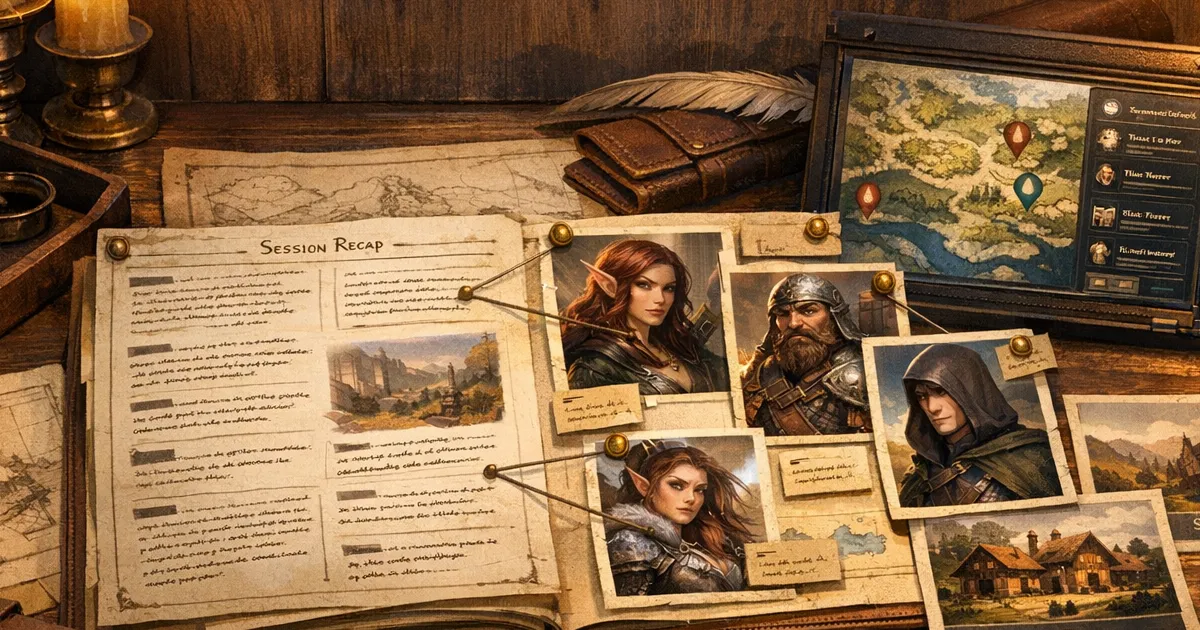
Quick Answer: What Are RPG Session Notes?
RPG session notes are a structured record of what happened at the table — plot, NPCs, loot, and player choices — written so the next session can pick up without guessing. AI tools now turn that record into recaps, lore trackers, and prep documents instead of a pile of unread Discord messages.
Key capabilities:
- Session recaps that preserve tone, consequences, and unfinished threads
- Persistent memory for NPCs and character voice via the Roleplay Game Master
- Campaign documentation, encounter design, and systems notes via the Game Designer Assistant
- Player-facing summaries, handouts, and between-session engagement materials
Why RPG Session Notes Fall Apart Mid-Campaign
Tabletop campaigns are not one-shots stacked in a folder. They are ongoing, interconnected stories that only work if conflict, cooperation, ritual, and narrative stay coherent from week to week. Session notes are the mechanism that makes that continuity possible.
But keeping that record is frustratingly difficult:
- Recaps get skipped because prep already ate the week
- NPC names, rumors, and item locations scatter across notebooks, chats, and memory
- Players who miss a session return lost — and start drifting from the table
- The GM becomes the only person who "knows" the campaign
- Between-session energy dies when nobody has a shared, readable account of last game
Recaps That Never Get Written
Most groups intend to write RPG session notes. Few actually do it while the session is still fresh. Prep already consumes a serious share of a GM's week.
29% of dungeon masters — spend three hours or more preparing for a four-hour game, according to a Sly Flourish poll of 3,663 DMs.
When prep already runs long, the recap is the first thing cut. The result is a campaign whose "official" history exists only as half-remembered jokes and conflicting player recollections.
Continuity Collapse Across NPCs and Plot Threads
A long campaign accumulates hundreds of small facts: who owes whom, which rumor was true, where the stolen reliquary actually went. Research on mega-campaigns treats a consistent setting and multi-dimensional characters as constitutive of the form, not optional flavor.
Without a living notes system, those facts degrade. The innkeeper changes names. A villain's motive resets. A player backstory hook never returns. Continuity errors are not cosmetic — they break the feeling that the world remembers the party.
Players Drop When They Lose the Thread
Retention is not only about "cool combats." Players leave when they no longer know what is going on.
"If players don't know what's going on, they'll drop." — StartPlaying's GM retention guide treats clear communication and session-to-session investment as the difference between a struggling table and a lasting one.
A missed session without a recap is a soft invitation to quit. So is a recap that is a wall of undifferentiated bullet points. Players need a story they can re-enter, not a transcript they have to decode.
Knowledge Trapped in One Notebook
In many groups, only the GM holds the campaign's true state. That is fragile. Illness, a job change, or GM burnout can freeze a year of play.
keep returning to the same need: a dedicated place to store and organize session notes so the story is not a single person's private memory.Shared, structured RPG session notes make the campaign a group artifact. They also make it possible for a co-GM, a rotating facilitator, or a returning player to pick up the thread.
Between-Session Energy Goes Quiet
The best tables do not go dark for two weeks. They send recaps, answer "what would my character do," and keep rumors moving. Professional GMs treat between-session communication as retention work, not extra credit.
When notes are a chore, that layer never happens. The campaign becomes a series of isolated evenings instead of a story people live in.
This is exactly what Jenova was built for.
The Jenova Solution
Jenova is not a single chatbot asked to "summarize last session." It is a platform of specialized agents that cover the full campaign-notes workflow: capturing what happened, preserving character voice, expanding lore, designing the next session, and giving players something worth reading.
| Traditional Approach | Jenova |
|---|---|
| Handwritten scribbles decoded days later | Structured recaps drafted from voice notes, chat logs, or bullet points |
| NPC names lost in Discord | Persistent character memory and naming tools that stay consistent |
| GM is the only source of truth | Shareable recaps, lore briefs, and player-facing summaries |
| Prep and notes compete for the same hours | Agents split recap, design, research, and handouts into parallel work |
| Continuity depends on one person's memory | Campaign context that carries across sessions and devices |
Campaign Journals and Session Recaps
The Writing Assistant turns messy table notes into a recap your players will actually finish. Paste a bullet list, a voice-to-text dump, or a Discord log and specify the audience: GM-only private notes, a player-safe recap that hides secret rolls, or an in-world chronicle written as a bard's account.
The Roleplay Game Master adds something a generic summarizer cannot: unlimited conversation memory and character consistency. Use it to replay scenes, test how an NPC would react, or keep a campaign journal that remembers the party's rival, the debt in Waterdeep, and the unfinished promise to the druid circle.
Together they produce RPG session notes that read like a story and function like a database.
Characters, NPCs, and Personality Continuity
Names are the first thing groups lose. The Name Generator produces culturally coherent names for people, taverns, ships, and spellbooks, then keeps a running list so "the elf with the scar" becomes a person with a name the table can reuse.
When an NPC needs more than a name, the Personality Analyzer and MBTI Personality Guide help you lock voice, motives, and stress behavior. That matters for session notes: a recap that says "Lord Veyra was cold" is weaker than one that records she offered the bard a place in her organization — a beat you can pay off three sessions later.
Worldbuilding, Lore, and Plot Architecture
The Game Designer Assistant is the documentation engine behind the recap. After you capture what happened, it helps you convert play into usable prep: faction trackers, encounter notes, downtime procedures, and "what this session changed about the world."
Deep Research fills lore gaps with cited historical, mythological, or setting-adjacent material when you need a plague's timeline, a city's trade routes, or a religious schism that feels real. The Film Screenwriter is unexpectedly useful for campaign notes: it turns a chaotic session into act structure, dangling questions, and a cold open for next week.
For political campaigns, Machiavelli Mentor maps incentives and betrayals so your notes track power, not just plot. Civilization is a sandbox for testing how a region might react after the party topples a duke — useful when session notes need consequences at the scale of a realm, not a dungeon room.
Player Handouts, Visual Recaps, and Table Logistics
Notes are only as good as the form players receive. The Graphic Designer and Poster Maker turn a recap into a wanted poster, a tavern handbill, or a one-page "last time on" sheet. Comic Creator can storyboard the session's key scene for groups that remember pictures better than paragraphs.
Quiz Maker builds a five-question "what happened last time" warm-up that gets the table talking before dice hit the map. Personal Secretary handles the unglamorous half of campaign continuity: scheduling the next session, sending the recap, and keeping the calendar from becoming the reason people drop.
The Microdrama Screenwriter is built for episodic hooks and cliffhangers — exactly the shape a good recap should leave the party in at session's end.
Specialized AI Agents for RPG Session Notes
These agents do the heaviest lifting once you decide session notes are part of the game, not homework after it.
Roleplay Game Master
If your notes need to remember people, not just events, this is the agent to live in. Unlimited memory and character consistency mean an NPC you established in session two still sounds like themselves in session twelve. Use it to reconstruct a scene, roleplay an absentee PC's likely choices for the recap, or keep a campaign bible that does not forget.
- Persistent memory across the whole campaign, not a single chat
- Character-consistent NPC and PC voice in recaps and interstitial scenes
- Room to explore "what would have happened if…" without derailing the live table
Game Designer Assistant
Recaps describe the past. This agent turns the past into next week's design. After you dump session notes, ask it for a faction status board, a list of dangling hooks, or a tightened encounter that follows from the party's actual choices instead of the module's assumed path.
- Systems analysis and campaign documentation in one place
- Converts play reports into prep artifacts GMs can run from
- Useful across D&D, Pathfinder, PbtA, and homebrew frameworks
Writing Assistant
Most "AI recaps" sound like a meeting transcript. This agent writes in the register you want: laconic GM bullets, a player-facing novella paragraph, or an in-world chronicle. It is the difference between notes people archive and notes people read on the train before game night.
- Adapts tone for GM-only secrets vs. player-safe summaries
- Cleans voice-to-text dumps without flattening what made the session funny
- Produces shareable recaps that fit Discord, email, or a campaign wiki
Name Generator
Session notes fail at the proper-noun layer. A culturally fluent naming agent keeps your recap from filling up with "the guard" and "that one village." Generate names in batch, lock a naming language for a region, and paste the list into your campaign bible so every recap uses the same spelling.
- Names for characters, places, ships, taverns, and artifacts
- Linguistic consistency so a region's names feel related
- Fast enough to use mid-session when an unnamed NPC suddenly matters
Deep Research
When a recap surfaces a question you cannot fake — how a medieval port actually taxed grain, how a plague moves, what a heresy trial looks like — this agent synthesizes sources with citations. That research then folds back into the next session's notes as grounded lore instead of vibes.
- Cited briefs you can drop into a campaign bible
- Useful for historical, mythic, and science-fantasy tables alike
- Saves the hours GMs spend disappearing down wiki tabs after the recap
Try Jenova free — no credit card required.
How to Keep RPG Session Notes With AI
Step 1: Capture Raw Notes Before You Sleep
Do not write the recap at the table unless that is your group's ritual. Capture. After the session — even from your phone — dump everything you remember: who was there, the cold open, the fight, the NPC who lied, the loot, the unfinished question. Voice-to-text is enough. Messy is fine. The goal is a complete raw log while the session is still warm.
"Session 14 recap dump: party entered the flooded reliquary, Kaelen refused the oath, we captured two cultists, the dwarf NPC (Thrumma) offered a river route, cliffhanger is the sealed door with the same mark as Lyra's sword."
Step 2: Split GM Notes From the Player Recap
Feed the dump to the writing agent with two jobs: a private GM file (secret rolls, unused encounter, what the villain knows) and a player-facing recap (no hidden information, clear spotlight on each PC). That split is what keeps players oriented without spoiling your prep.
"Turn this dump into (1) a GM-only session log with secrets tagged and (2) a 400-word player recap in chronicle voice. Spotlight each PC once. End on the sealed door."
Step 3: Update the Living Campaign Record
Move facts out of the recap and into trackers: NPC list, faction standing, loot, downtime clocks, unanswered questions. Ask the game design assistant to produce a one-page "state of the campaign" you will actually open next week.
"Extract from this recap: named NPCs with last-known location and attitude, loot with owners, three dangling hooks ranked by urgency, and one consequence that should land next session."
Step 4: Give the Table a Reason to Read It
Send more than a paragraph. A wanted poster, a five-question recap quiz, or a short comic of the boss fight will be read. If a player missed the session, the recap should let them play next time without a 20-minute briefing.
"Make a five-question recap quiz for players, plus a tavern rumor handbill that hints at the sealed door without spoiling the GM secrets."
Step 5: Start Next Session From the Notes, Not From Memory
Open with the recap's last image. Confirm one fact with the table ("Thrumma's river route — still taking it?"). Then run. Good RPG session notes shorten prep because you are no longer reconstructing the world before you can invent the next scene.
"Using the state-of-campaign sheet, outline a 3-hour session: one social scene that pays off Kaelen's refused oath, one travel complication on the river, one dungeon beat behind the sealed door."
Results & Use Cases
📊 Weekly Recap for a Hybrid D&D Table
Scenario: A five-player 5e campaign meets every other Saturday. Two players miss sessions to shift work. The GM used to spend Sunday night reconstructing events from Discord.
Traditional Approach: A rushed bullet list, arguments at the next session about who had the relic, and one player quietly fading out after two missed games.
Jenova: The GM voice-dumps on the drive home. The writing agent produces a player recap and a GM log. Absent players read a 400-word chronicle and a recap quiz before the next game. Continuity stops depending on whoever talked loudest.
- Recap time drops from an evening to a short capture-and-edit pass
- Absent players re-enter without a live briefing
- Secrets stay in the GM log instead of leaking through a shared doc
💼 West Marches With Rotating Players
Scenario: A drop-in sandbox with twelve players and two facilitators. Different parties hit the same hexes. Without shared RPG session notes, the world forks.
Traditional Approach: A wiki nobody updates. Duplicate dungeon clears. A town that "forgets" a fire from last month.
Jenova: Each session's recap feeds a shared campaign state. The Game Designer Assistant maintains hex status, NPC attitudes, and resource clocks. Facilitators open the same one-pager before they run.
- The world stays one world, even with rotating tables
- New facilitators can run without inheriting tribal knowledge
- Player reports become the official record instead of competing memories
📱 Mobile Recap the Night of the Game
Scenario: The GM is on a train after a four-hour session, phone only, too tired for a campaign bible.
Traditional Approach: "I'll write it tomorrow." Tomorrow becomes next week. Next week becomes "wait, what was that NPC's name?"
Jenova: Voice-to-text into the writing agent, a five-minute edit, recap posted to the group chat before anyone sleeps. Optional comic panel of the cliffhanger lands in the same thread. The notes exist while the session still feels real.
- Capture happens while memory is accurate
- Players wake up to a recap, not a blank channel
- Next-session prep starts from a document, not a reconstruction
🎯 Character-Driven Political Campaign
Scenario: A court-intrigue game where session notes must track favors, lies, and who heard what. Combat is rare; continuity is the whole hobby.
Traditional Approach: A spreadsheet the GM dreads opening. Players remember their own schemes and forget everyone else's.
Jenova: Recaps are written as court chronicles. Machiavelli Mentor updates a power map after each session. Personality tools keep each noble's stress behavior stable so a betrayal in session nine matches the person introduced in session two.
- Notes encode information flow, not just "what rooms we entered"
- NPCs remain psychologically consistent across months of play
- Players can review who owes them before they walk into court
Examining how tabletop RPGs support social-emotional skills and academic engagement makes the same point in another register: the value is in the ongoing story people share. Session notes are how that story stays shared.
FAQ
What should RPG session notes include?
A usable recap includes who played, where the session started and ended, key scenes, named NPCs, loot and downtime, player decisions with consequences, and at least one unfinished question. GM-only notes should add secrets, unused prep, and what the opposition knows. If a missed player cannot sit down next session after reading it, the recap is incomplete.
How do I write RPG session notes faster after a long game?
Capture raw, edit later. Voice-dump on the way home, then let the Writing Assistant produce a player recap and a GM log from that dump. Do not outline a novel. Lock names, consequences, and the cliffhanger. Sly Flourish's prep research is a reminder that GM time is already scarce — recaps have to ride along with prep, not compete with it.
Can AI keep NPC names and plot threads consistent across a campaign?
Yes, if you treat notes as a living record instead of a one-off summary. Agents with persistent memory, especially the Roleplay Game Master, retain character voice and prior events across sessions. Pair that with a named NPC list from the Name Generator and a state-of-campaign sheet so spelling, location, and attitude do not drift.
Are RPG session notes only for the GM?
No. Player-facing recaps are a retention tool. They re-orient people who missed a night, give quiet players a written spotlight, and create a shared object the group owns. Keep a second, secret GM file for hidden information. The public recap should be safe to read aloud at the top of next session.
Do these tools work for systems other than Dungeons & Dragons?
Yes. The workflow is system-agnostic: capture play, separate secrets, update world state, send a recap. Whether you run D&D, Pathfinder, Blades in the Dark, Call of Cthulhu, or a freeform game, the game design assistant can format trackers to that system's clocks, stress, or downtime rules.
Does Jenova work on mobile for after-session recaps?
Yes. Web, iOS, and Android have feature parity, including speech-to-text. That matters for RPG session notes because the best recap is the one written the night of the game, often from a phone on the way home rather than from a desktop the following weekend.
Conclusion
RPG session notes are not paperwork. They are how a campaign remains one story instead of a stack of disconnected nights. When recaps slip, continuity slips. When continuity slips, players leave.
Jenova gives a table the agents to capture the session, write the recap, keep NPCs consistent, research the world, and hand players something they will read — without asking the GM to add another unpaid job to an already long prep week. Start with a raw dump, split GM secrets from the player chronicle, and let the campaign bible update itself from play.
The next session should open on a remembered world. Try the recap workflow on Jenova, keep the Roleplay Game Master as your campaign's memory, and use the Writing Assistant so the notes get written while the dice are still warm. Explore the full agent library at Jenova.
For Developers: Every agent in this article is available programmatically via the Jenova API — build recap, lore, and campaign-memory features into your application with a single integration. Full documentation →