RPG Character Portrait Generator: AI Art for Tokens & Sheets
2026-09-14
Jenova helps you turn a character concept into a campaign-ready portrait, token, and visual dossier—without redrawing the hero from scratch every time the party changes armor. In September 2026, more tables want faces that stay recognizable from session one through the final boss. An RPG character portrait generator on this platform pairs image generation with specialist agents so a paladin, a savannah guardian, or a foxfolk druid keeps the same eyes, silhouette, and kit.
✅ Campaign-ready portraits from a written character concept ✅ Visual continuity across tokens, sheets, and recap art ✅ Style control for painterly fantasy, anime, and cinematic looks ✅ Full use on web, iOS, and Android with synced history
To understand why this matters, it helps to look at why getting a usable RPG portrait is still so hard—and why “one pretty image” is not the same as a character you can play.
Quick Answer: What Is an RPG Character Portrait Generator?
An RPG character portrait generator is an AI tool that turns character descriptions into consistent portraits, tokens, and visual sheets for tabletop or digital campaigns. It is not only a headshot machine. It is a way to keep one hero recognizable across every asset the table actually uses.
Key capabilities:
- Locked facial features, body type, and kit across poses and outfits
- Tokens, busts, full-body shots, and action frames from one character bible
- Sheet-ready art that sits beside stats, gear, and lore
- Narrative follow-through with agents such as Comic Creator when the portrait needs to become a scene
Why RPG Portraits Break Before the First Session
Character looks are not decoration. Research on role-playing games treats customization as a primary interface between story, player agency, and identity—not a cosmetic extra. Work on character creation and self-expression in RPGs frames avatar design as a way players move identity into the fiction. Commentators arguing that tabletop games need deep customization make the same practical point: weak characters make weak games.
The hobby itself has more people who want those characters at the table. A Merchoid survey of 1,479 entertainment fans, discussed on EN World, reported that 36.5% of respondents were playing more board or tabletop games than before pandemic lockdowns, and that interest in Dungeons & Dragons had risen 85% since 2020 on Google search data.
85% — Reported increase in interest in Dungeons & Dragons since 2020
36.5% — Share of surveyed fans playing more tabletop games than before lockdown
That demand collides with a visual problem. Players now expect a face for the VTT token, a bust for the character sheet, a full-body for the party lineup, and recap art after the dragon fight. But getting that is frustratingly difficult:
- Generic image models redraw the same hero as a different person every generation
- One character needs many assets, not a single hero shot
- Commissioned art cannot keep pace with a full party, new outfits, and weekly recaps
- Portraits, stat blocks, and play tools still live in disconnected places
- Original characters, copyright, and “close enough” fan likenesses get tangled together
The model forgets the face
Diffusion models do not remember your paladin. They denoise noise into a statistically likely picture. Character consistency means locking face, features, and identity across many generations. Creators on the OpenAI developer forum describe the same failure mode: clothing, body shape, and skin tone drift between requests.
A 2026 guide to consistent character workflows summarizing Stanford HAI research reports that richer textual description can improve consistency by up to 40%—useful, but nowhere near enough for a 20-session campaign.
Up to 40% — Reported consistency gain from more detailed character descriptions
Serious DIY pipelines then add Img2Img denoising ranges, ControlNet, and LoRA training on 10–20 curated images for 85–95% feature retention, according to that same guide’s summary of MIT CSAIL findings. That is an engineering project, not a Thursday-night prep tool.
One hero is a whole asset pack
A usable RPG portrait set is a small production. You need a recognizable bust for the sheet, a cropped token for Foundry or Roll20, a full-body for the tavern scene, and at least one action pose for the recap. Change the cloak after a magic item drop, and the pack multiplies again.
If each image is a fresh roll of the dice, the party no longer shares a visual language. The rogue in the token is not the rogue in the fight scene. Players stop trusting the art, and the GM stops generating it.
Commissions do not scale with a campaign
Human illustrators still produce the most controlled character art. They also work on turnaround, revision rounds, and per-pose pricing that most home games cannot absorb for five player characters plus recurring NPCs. When the fighter swaps plate for ceremonial armor in act three, the table either plays without new art or waits.
An RPG character portrait generator is not a replacement for a commissioned painting you plan to print. It is the missing layer for weekly play: enough fidelity to recognize the hero, enough speed to keep the visual bible current.
Sheets, minis, and portraits do not talk to each other
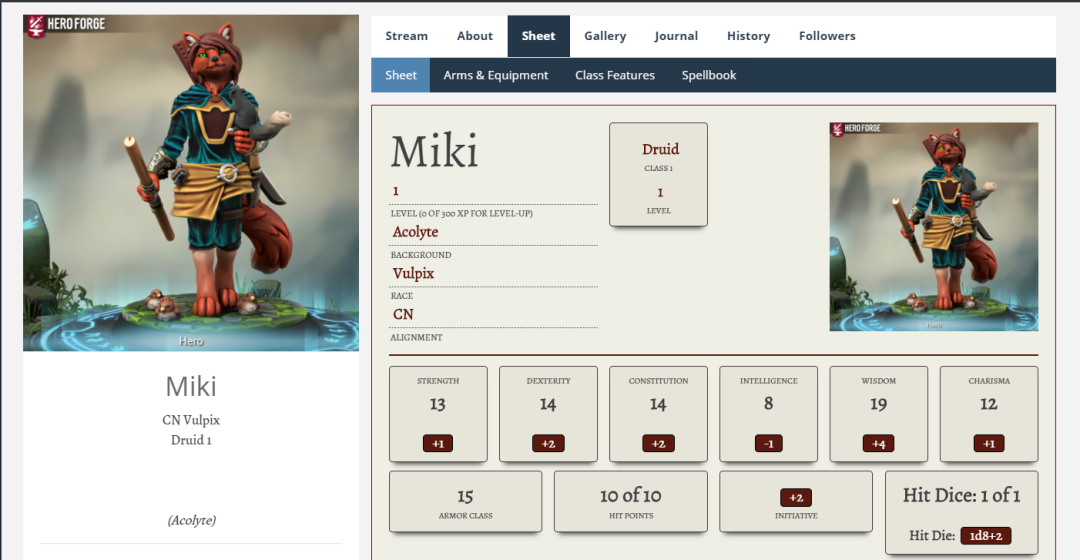
Many groups already have a 3D miniature and a digital sheet. The face on the mini, the bust on the sheet, and the token on the map are often three different people. That split is why portrait generation has to live next to stats, gear, and lore—not in a separate mood-board tab.
Original characters and copyright are not the same job
Players generating original heroes have a different problem from players trying to summon a copyrighted mascot. The U.S. Copyright Office guidance on works containing AI-generated material treats human authorship as the core of registration. Legal commentary on character protection and generative AI notes that purely AI-generated works—including characters—are generally not copyrightable under current U.S. analysis.
That is not a reason to skip portraits. It is a reason to treat the written character bible, the selection, and the edits as the human work—and to generate original heroes rather than copies of protected IP.
This is exactly what Jenova was built for.
The Jenova Solution
Jenova is not a single filter you run once. It is a workspace where you describe a hero, generate the portrait pack, keep the description in memory, and hand the same character to agents that run the game, draw the recap, or write the backstory.
| Traditional Approach | Jenova |
|---|---|
| A new face every prompt | A written character bible reused across portraits, tokens, and scenes |
| LoRA training, seed math, and denoising tables | Conversation plus image generation, without a local GPU pipeline |
| Art in one app, stats in another, play in a third | Visual agents, writing agents, and Roleplay Game Master in one place |
| One commissioned bust, then radio silence | New poses and kit updates when the story changes |
| Style drift between “anime token” and “oil-paint sheet” | A locked medium and reference description for the whole campaign |
Build the visual bible, then generate
Start with anatomy, not vibe: species or ancestry, age, skin tone, hair, scars, armor silhouette, signature weapon, and a single base outfit. Keep that block at the front of every request. Then generate a hero shot, a token crop, a full-body, and an action frame from the same text.
Manga Creator is the right specialist when the table wants a sharp anime or manga likeness that can hold across panels. Webtoon Creator is the better fit when you need full-color vertical frames for a mobile recap. Both exist to keep a character on-model, not to invent a cousin every page.
Play the same person you just drew
A portrait that disagrees with the character’s voice dies in session two. Roleplay Game Master keeps unlimited memory and character consistency in play, so the savannah guardian who looks like a lion’s shield also speaks, chooses, and remembers like one.
That loop matters. Writing on how RPG characters drive personal development treats traits and personality as part of creation, not an afterthought. The portrait generator supplies the face; the GM agent keeps the person.
Direct the portrait like a camera, not a slot machine
Bad RPG art is often a posing problem, not a “fantasy” problem. Photography Coach helps you specify lens feel, lighting, and crop so a bust reads at token size. Modeling Coach is useful when you need a readable silhouette—three-quarter stance, weapon hand, weight on the front foot—rather than a stiff catalog pose.
Tattoo Artist earns a place when the character’s identity lives on the skin: clan marks, paladin oath sigils, or a druid’s painted fur. Those details are what make two “brown-haired fighters” distinct at a glance.
Turn one portrait into a campaign document
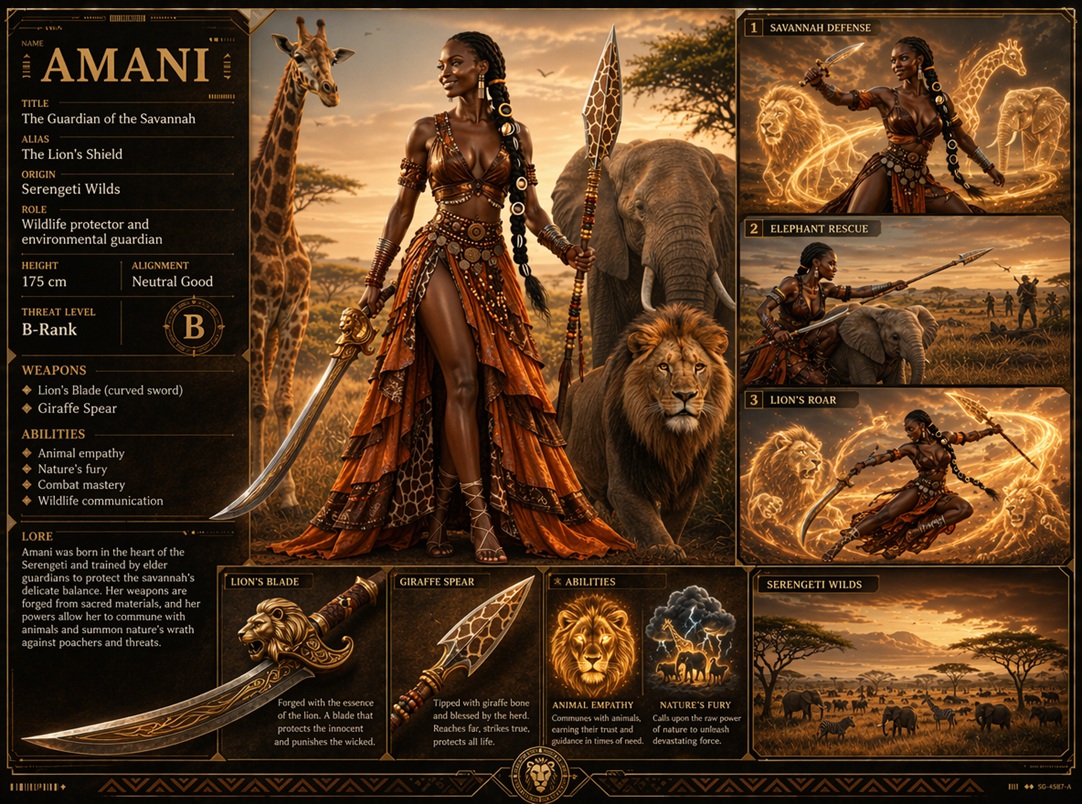
The Amani-style dossier—title, origin, weapons, abilities, lore, and action callouts—is the format many groups actually want. Film Screenwriter and Microdrama Screenwriter help you write the origin and the three signature “moves” that belong on that sheet. Children's Book Creator is the specialist for illustrated consistency across sequential pages, which is the same discipline as a campaign journal.
You do not need every agent every night. You need the portrait to remain the same person when you do.
Specialized AI Agents for RPG Character Portraits
Visual identity
Comic Creator is the sequential artist you use when a portrait must survive a page, not just a thumbnail. If you are also building a session recap as panels, this agent holds layout, style, and character likeness together.
- Dynamic full-body and action poses that still match the hero shot
- Bold graphic styles that read at token size
- Issue-length consistency for villains and party members
Manga Creator is the right call for anime-forward tables, isekai one-shots, and any game where the character sheet should look like a cast page.
- On-model faces across close-ups and wide shots
- Panel flow for duels, revelations, and rest scenes
- Style lock from one-shot to long campaign
Play and story
Roleplay Game Master is the session itself: the NPC who matches the portrait, the villain who keeps the same scars, the companion who remembers what you did last week.
- Unlimited memory across sessions
- Character consistency in voice and behavior
- Open scenarios from dungeon crawls to political courts
If you are writing the legend behind the face, Film Screenwriter develops backstory, visual motifs, and the “first appearance” beat so the portrait has something to express.
- Structure from concept through revision
- Dialogue that matches the face you generated
- Visual storytelling notes you can feed back into new portraits
Try Jenova free — no credit card required.
How to Generate an RPG Character Portrait That Stays on Model
Step 1: Write a character bible, not a mood
List immutable traits first: ancestry, age range, face, hair, skin, body type, signature kit, and one base outfit. Add the game system only after the person is specific. Vague prompts (“cool elf ranger, epic, detailed”) are how you get a different elf each time.
"Portrait of Amani, a 175 cm woman with dark brown skin, long black braids with gold cuffs, amber eyes, Neutral Good wildlife guardian. Base outfit: layered orange and russet savannah robes with coin belt, bare midriff, gold arm cuffs, strappy sandals. Always carries a lion-headed curved sword and a giraffe-bone spear. Cinematic fantasy, golden-hour Serengeti light, consistent face and outfit."
Step 2: Generate the master portrait
Ask for a single hero shot you are willing to treat as canon: usually a three-quarter bust or full-body in the base outfit. Reject anything that changes eye color, scars, or silhouette. That image becomes the reference you describe in later prompts.
"Full-body master portrait of the same Amani described above, standing, spear in right hand, lion-headed blade at her side, two lions and an elephant in the background, no extra jewelry, no hood, same face as the character bible."
Step 3: Crop the token and lock the sheet assets
From the same bible, request a head-and-shoulders crop for VTT tokens, a clean bust for the character sheet, and one action pose. Say what must not change. If you are turning the night into comic recap, hand the same bible to Comic Creator rather than starting a new description from memory.
"Token crop: head and shoulders of the same Amani, face filling the frame, orange robes visible at the collar, identical braids and gold cuffs, simple background, readable at 256 pixels."
Step 4: Attach the art to play
Drop the bust onto the sheet next to AC, HP, and gear. Put the token on the map. If you are playing tonight, open Roleplay Game Master with the same name, alignment, and personality the portrait implies so the voice and the face agree.
"You are Miki, CN Vulpix druid 1, Acolyte background, Wisdom-forward, low Intelligence, curious about shrines and small woodland spirits. Stay in character. I just generated your portrait as a foxfolk in teal robes with a wooden staff—describe yourself as that person when we begin."
Step 5: Update kit without replacing the person
When the character finds new armor or a scar, edit one clause in the bible. Do not rewrite the face. Generate the new outfit as a variation of the master, not as a new hero.
"Same Amani, identical face, braids, and skin tone. Replace the giraffe spear with a cracked spear wrapped in lion leather after the poacher fight. Add a thin cut along the left collarbone. Keep the orange layered robes and lion-headed blade."
Results and Use Cases
📊 Session-zero party lineup
- Scenario: Four players need tokens and busts before a Sunday D&D game, including a foxfolk druid whose sheet already exists in a 3D mini tool.
- Traditional Approach: One shared Pinterest board, mismatched art styles, and a druid who looks human on the map.
- Jenova: Each player writes a bible, generates a master portrait and token, and pastes the bust beside stats the way a sheet like Miki’s already combines a figure with AC, HP, and modifiers.
- Shared style notes keep the party in one visual world
- Tokens match the people sitting in the Discord gallery
- The GM can generate NPC busts in the same pass
💼 Indie GM selling a one-shot
- Scenario: A designer needs six original pregens with portraits, ability callouts, and a one-paragraph legend for a paid adventure PDF.
- Traditional Approach: Placeholder silhouettes, or a single commission that covers only the cover hero.
- Comic Creator: Sequential full-bodies plus a short origin scene for each pregen, with Film Screenwriter drafting the lore block that sits under the portrait.
- Original characters rather than lookalikes of protected IP
- Dossier layout: weapons, abilities, and three signature actions
- Art and text stay aligned when a pregen is revised
📱 Token on the train before game night
- Scenario: Your paladin’s oath changes at lunch, the VTT game is at 7, and you only have a phone.
- Traditional Approach: Reuse a token that no longer matches the armor, or skip the update.
- Jenova on iOS or Android: Edit the bible, generate a new bust and token crop, and upload before you reach the table. Speech-to-text helps if you would rather talk the description than type it.
- Feature parity with the desktop workspace
- History stays on the character, not trapped on one device
- Fast enough for a commute, not a weekend render farm
🎯 Campaign journal as a vertical comic
- Scenario: After each session you want a three-panel recap in a style players will actually read on their phones.
- Traditional Approach: Bullet notes in a wiki, no faces, fading memory of who was there.
- Webtoon Creator: Vertical recap pages using the same party likenesses, with Children's Book Creator as an alternative when you want illustrated “chapter” pages instead of scroll rhythm.
- The cleric in panel three is still the cleric from session zero
- New monsters get a one-off design without mutating the heroes
- Recaps become shareable without a separate art pipeline
FAQ
What is an RPG character portrait generator?
An RPG character portrait generator is software that turns a character description into portraits you can use in play: busts, tokens, full-bodies, and action shots. The useful versions keep the same person across those assets. On Jenova, that means a written character bible, image generation, and agents that reuse the hero in comics, scripts, and sessions rather than treating each picture as a one-off.
Is Jenova free to use for character portraits?
Yes. There is a Free plan at $0 with core features and limited monthly usage. Paid tiers raise that usage—Plus is $20/month—and add options such as custom model selection. Usage resets on the billing date with no daily cap. Start on Free if you are testing a single hero; move up if you are generating a full party plus weekly recap art.
How is this different from a 3D mini maker or a generic image model?
A 3D miniature tool is excellent at poseable figures and sheet integration; it is not trying to produce a cinematic dossier with lore panels and ability art. A generic image model can give you a stunning first frame and a stranger on the second. Jenova keeps the description, the conversation, and specialist agents together so the portrait, the token, and the person you roleplay stay aligned.
Can I keep the same face on tokens and full-body shots?
That is the whole job. Lock anatomy and kit in a reusable bible, generate a master portrait, then request crops and poses as variations. If the face still drifts, tighten the immutable traits and state what must not change. For panel-to-panel likeness, use Comic Creator or Manga Creator instead of a disconnected one-shot prompt.
Does an RPG character portrait generator work on mobile?
Jenova runs with feature parity on web, iOS, and Android, including synced history. That is the mobile case that matters for RPG prep: edit a token between work and the session, or dictate a new NPC bust with speech-to-text. You do not need a desktop GPU workflow to keep the party on-model.
Can I copyright AI-generated RPG character portraits?
Treat this as a legal question, not a marketing one. The U.S. Copyright Office has issued public guidance on registering works that contain AI-generated material, with human authorship at the center of the analysis. Commentary on purely AI-generated characters is skeptical of copyright in output that lacks sufficient human authorship. Keep your own writing, selection, and edits; generate original heroes; do not assume a prompt alone is ownership.
Conclusion
RPG tables do not fail for lack of pretty pictures. They fail when the token, the sheet, and the person in play refuse to be the same hero. An RPG character portrait generator is the fix for that split: a locked visual bible, assets the VTT can actually use, and enough speed to update kit when the story changes.
Jenova puts that generator next to the agents that need it. Draw the face, crop the token, write the dossier, then keep the same character consistent in Roleplay Game Master, Comic Creator, and Manga Creator as the campaign grows.
Explore the full agent library at Jenova and generate the portrait your character sheet has been missing.
For Developers: Every agent in this article is available programmatically via the Jenova API — build RPG portrait, recap, and character-bible features into your application with a single integration. Full documentation →