Royal Court Roleplay AI: Run Persistent Court Intrigue Campaigns
2026-08-28
Roleplay Game Master helps you run royal court roleplay AI campaigns that remember every slight, alliance, and whispered rumor. As of August 2026, character-driven AI play is growing fast — yet most chat tools still forget which duke you insulted, invent a new chancellor overnight, and collapse a succession crisis into a single tidy scene. This AI provides a living court: consistent nobles, factions that keep plotting off-screen, and etiquette that actually constrains what you can say.
✅ Persistent court memory — names, slights, letters, and succession claims survive across sessions ✅ Nobles who hold rank, faction, and temperament instead of resetting mid-audience ✅ Adaptive intrigue that reacts when you bribe, snub, or marry the wrong house ✅ Historical, fantasy, and hybrid courts from the same campaign thread
To understand why this matters, it helps to look at how royal court roleplay actually fails — for solo players, tabletop referees, Crusader-style strategy fans, and writers trying to keep a palace full of agendas honest.
Quick Answer: What Is Royal Court Roleplay AI?
Roleplay Game Master is a royal court roleplay AI that runs persistent intrigue campaigns with consistent nobles, faction memory, and adaptive plots. It treats the palace as a living political machine, not a one-shot chat.
Key capabilities:
- Continuous memory of alliances, insults, marriages, and unpaid favors
- NPCs who keep title, dialect, and private agenda across sessions
- Factions that move when you are not in the room
- Audiences, banquets, petitions, and whispered corridor scenes in-world
Why Royal Court Roleplay Falls Apart
Court stories live on continuity. Who sat where. Who smiled when the envoy stumbled. Which letter never arrived. Tabletop referees have said for years that intrigue adventures succeed when NPCs have goals, secrets, and reactions — and fail when a single bad approach shuts the whole plot down, a pattern laid out in guides to running roleplay and intrigue adventures. Writers hit the same wall: a court only feels real if you know what is taboo and who sits on which rung of the ladder.
Demand for this kind of play is not a niche hobby statistic in isolation. The character-based AI agents market is forecast to grow from USD 0.55 billion in 2026 to USD 5.45 billion by 2032. Broader conversational AI is projected at $17.7 billion in 2026. Players and writers want characters that persist. Generic tools rarely deliver a court that does.
But getting a believable palace out of a generic chatbot is frustratingly difficult:
- The queen’s favorite forgets last night’s insult and greets you as a stranger
- Factions wait their turn instead of moving while you sleep
- Etiquette, titles, and language drift until immersion dies
- The narrator breaks character to explain the plot you were supposed to discover
Scripted scenes cannot survive a real audience
Court intrigue is not a dungeon with one correct door. Goals look like convincing royalty to commit forces, exposing treachery, or pitting two enemies against each other. When you refuse the obvious marriage, leak the wrong rumor, or kneel to the wrong pretender, a branching script has nowhere to go. You need NPCs who still want things after you ruin their plan.
Memory failure kills the social ladder
A chancellor who does not remember the missing letter is not a courtier. He is a random generator in a chain of office. Royal court roleplay depends on residue — who is in disgrace, who is owed a favor, who already knows you lied to the ambassador. Session resets force you to re-brief the AI instead of playing the next audience.
Hallucinated history breaks trust
Courts punish small errors. Invent a duchy that does not exist, misname a liturgy, or hand a fifteenth-century queen a modern cabinet, and the fiction buckles. Hallucination — plausible but false output — is a documented limitation of generative systems, and research on generative AI users finds that perceived hallucination risk worsens attitude toward the tool. Court play needs constraints you can enforce: do not invent houses, do not skip the feast calendar, do not resolve the succession in one reply.
Prep overhead crowds out the actual intrigue
A referee who wants a living court must stock NPCs, secrets, and what each person will do if the players never talk to them. That is a second job. Stanford’s CRAFT materials on AI and storytelling note the real trade-off: generation can help with ideas and format, but voice, authenticity, and control still sit with the human. Solo players and writers need a referee that holds state without turning the session into world-bible maintenance.
This is exactly what dedicated royal court roleplay AI was built to handle: keep the palace, hold character, and let you practice power instead of repairing continuity.
Why Roleplay Game Master
This royal court roleplay AI is built for long-running palaces, not one-shot chats. You set the realm, the century or the invented calendar, your station, and what “winning” looks like — a marriage, a pardon, a quiet assassination of a rumor. It runs the rest of the household: rivals, clergy, merchants, foreign envoys, and a monarch who has other problems besides you.
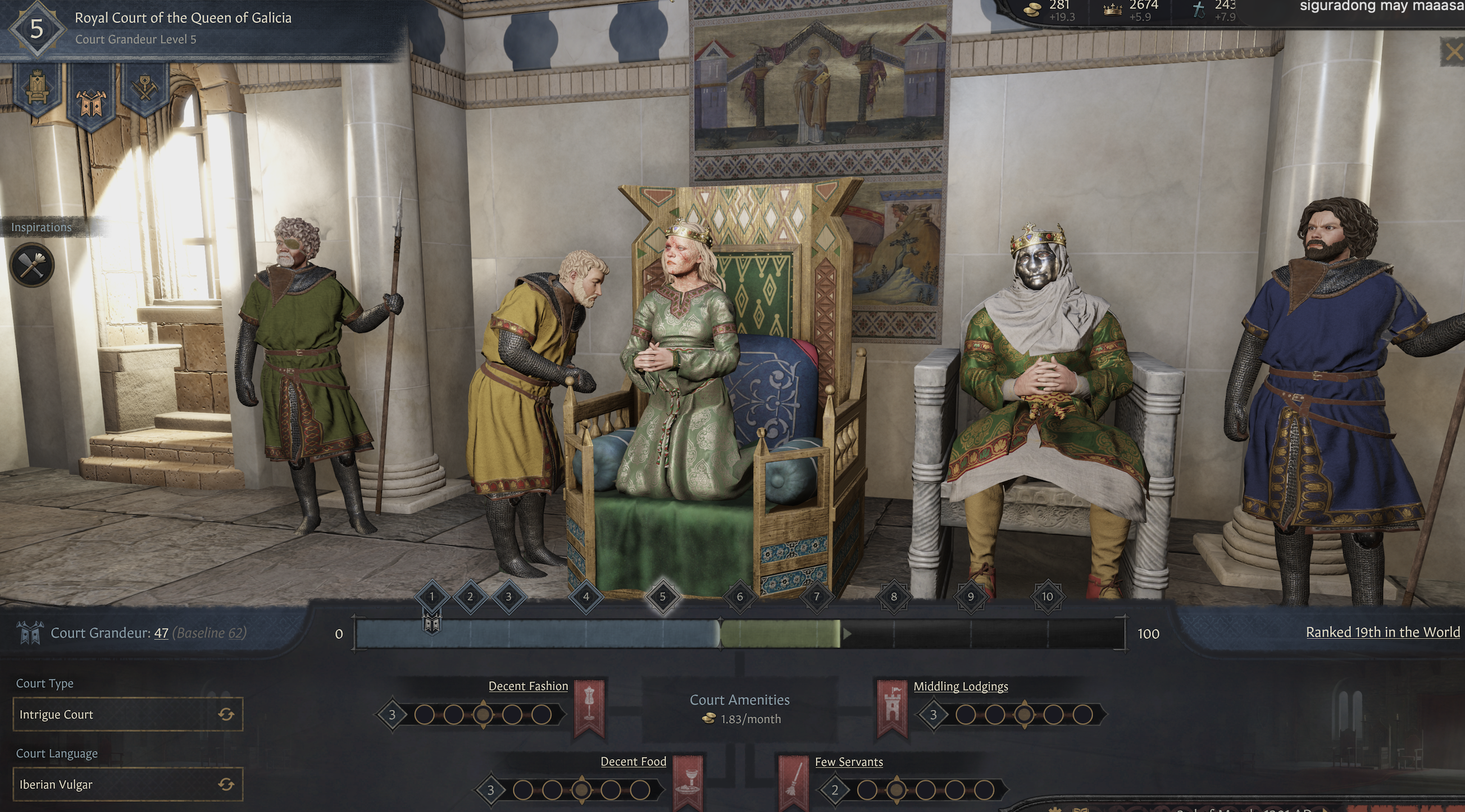
It is not a visual strategy game with a grandeur meter. It is a persistent referee that can play a queen, a spymaster, a hungry second son, or a stone-faced captain of the guard without collapsing the fiction. That is the difference between “describe a throne room” and “run the next three weeks of this court.”
| Traditional Approach | Roleplay Game Master |
|---|---|
| Modules that reset when you leave the path | Persistent campaigns that remember prior audiences |
| NPCs who forget ranks, grudges, and marriages | Character-consistent social ladder |
| Static conspiracies with a pre-written twist | Factions that adapt when you change sides |
| Hours of GM prep or a full player table | Court running from the first prompt |
| Generic chatbot tone that breaks etiquette | In-world voice: petitions, gossip, and cold council minutes |
Persistent memory that behaves like a court chronicle
The value of royal court roleplay AI is not purple prose. It is state. Who holds the seal. Which lady-in-waiting saw the letter. Whether the queen already denied your petition. Unlimited conversation memory means you can close after a disastrous banquet and reopen as the same envoy, with the same enemies, facing the same unresolved slight.
Character consistency under etiquette
A good court scene depends on people staying themselves when the mask slips. The pious confessor who will not lie in the chapel, the duke who smiles while he ruins you, the monarch who rewards loyalty until it becomes inconvenient — those voices have to hold. Perfect character consistency is what keeps a month-long campaign from turning into a parade of interchangeable extras in nicer clothes.
Factions that move off-screen
Interactive storytelling research and industry writing both point to the same shift: characters and plots that adapt to choices, not a corridor of pre-written rooms. You need houses that remarry, bribe, and leak while you are hunting in the forest. You do not need a quest marker labeled “Intrigue.”
Procedure as the drama
The AI can speak in the forms court stories actually use: petitions, banquet seating, council minutes, coded letters, and the silence after someone uses the wrong title. That is more useful than a sudden duel every scene. Pair it with Machiavelli Mentor when you want to map incentives before you walk into the hall — power, not pageantry, is what the best court scenes turn on.
Example openings you can drop in immediately:
"I am a newly arrived envoy at a small Iberian court. Keep every noble’s agenda, slights, and alliances. Do not resolve the plot in one reply. Show me the next audience, who is watching, and one decision I must make."
"The duke I insulted last session is back. Stay in character as the chancellor. Remember the feast, the missing letter, and who smiled when I stumbled."
"Run a succession crisis. I am the queen’s illegitimate child with a claim and no army. Track factions weekly. No magic solutions. Do not invent houses I did not name."
Related Agents You'll Also Find Useful
If your royal court roleplay needs more than a referee — power strategy, realm-scale pressure, or a darker court to inhabit — these sit naturally next to the campaign.
Machiavelli Mentor
If you are about to walk into an audience and you care whether the bribe, the marriage, or the public slight is the correct move, run the incentives first. This is a realist advisor for power mapping, negotiation, and multi-move campaigns — the brief you take before you speak.
- Decode who actually benefits from the succession
- Pressure-test a petition before you deliver it in-character
- Separate theater (the feast) from power (who controls the seal)
Civilization
Court intrigue is local. Realms are not. When your plot needs a famine, a rival kingdom, or a war that will not wait for your romance arc, zoom out. Civilization lets you choose an era, rule a nation, and live with rivals who pursue their own ambitions.
- Stress the court with events the palace cannot ignore
- Play the monarch’s problem, not only the envoy’s
- Keep alliances and wars moving on a clock you do not control
Vesper Court
If you want a court that is already loaded — memory loss, blood intrigue, forbidden desire — this is a ready-made dark-romance palace rather than a sandbox you stock yourself. Use it when you want to be inside a hidden court tonight, not world-build one.
- Immediate stakes without a three-page brief
- Night-by-night change instead of a slow chronicle
- A different register: intimacy and danger, not only petitions
Try Roleplay Game Master free — no credit card required. Use the strategist and realm agents when the palace has to survive contact with a map.
How Royal Court Roleplay AI Works
You do not install a simulator. You describe the court and play.
Step 1: Set the court, the era, and your station
Give the minimum a real envoy would have: realm, century or invented calendar, your rank, who holds power, and what you want before winter. Specificity is what keeps the AI from inventing a fantasy duchy.
"Galicia, high medieval. I am a landless knight with a letter of introduction and a dangerous secret. You run the queen, her favorites, and the foreign envoys. Track etiquette. I am not the protagonist of a legend — I am a problem in her hall."
Step 2: Speak in the register you want back
If you write like a petition, you get a petition. If you write like corridor gossip, you get gossip. Ask for who is listening, what you do not know, and a clock. Your court AI will hold those constraints across turns.
"Do not skip to the wedding. Give me the next twenty minutes of this banquet, three overheard lines, and one choice that will be remembered tomorrow."
Step 3: Let factions think
When you snub the obvious ally, say so and demand a reaction. Off-screen movement is the point. Privacy and trust research on generative AI also cuts the other way: users stay with tools that feel empowering and in their control. Tell the referee what it must not invent.
"I left the duke’s daughter unasked at the dance to court the bishop’s niece. What do both houses do before the next council? Stay in their characters, not mine."
Step 4: Close with intelligence, not a recap dump
End the session the way a courtier would: what the hall believes, what you suspect, what you still cannot prove. Ask for a cold spymaster voice or a gossipy lady-in-waiting. Then stop. Memory means you do not paste a chronicle next time.
"Midnight report. Be specific about who now thinks I am a threat. No omniscient summary. I only know what my people could have heard."
Step 5: Return to the same palace
Reopen the thread as the same person. The insult, the missing letter, the queen’s tired patience — they should still be there. That continuity is what generic chat never delivers and what royal court roleplay actually requires.

Results & Use Cases
📊 Solo court campaign without a full table
Scenario: You want to play an envoy, bastard, or minor noble through a season of audiences without recruiting five friends and a referee who loves seating charts.
Traditional Approach: A module that breaks the first time you refuse the obvious marriage, or a tabletop intrigue game whose prep becomes the activity — the same pitfall intrigue-adventure guides warn GMs about.
Roleplay Game Master: You get a living hall in prose — watching favorites, a monarch with other crises, houses that move when you go hunting.
- Decisions come at court tempo, not novel tempo
- Slights and favors stay on the books
- You can pause after a disastrous feast and resume as the same embarrassed guest
💼 Court-intrigue fiction that survives a picky reader
Scenario: You are drafting a novel or screenplay and the last note was “nobody in this palace wants anything.”
Traditional Approach: Prompt lists, historical court-intrigue reading, and a world bible you never open because maintaining it is a second manuscript.
Royal court roleplay plus a power brief: Play the scene until the dialogue is something a real favorite might say. Run Machiavelli Mentor when you need the incentive map before you write the council.
- Scene-level roleplay for voice; strategist-level thinking for motive
- Fewer interchangeable nobles and magic revelations
- A campaign bible that is the chat history, not a second document
📱 Corridor plots on a phone
Scenario: You have twelve minutes on a train and want to keep the palace warm.
Traditional Approach: A virtual-tabletop tab you will not open, or notes you will not reread.
Royal court roleplay AI on mobile: Full sessions on web, iOS, and Android, so you can send a coded letter, get the reply, and close the app. The next laptop session still knows who saw you in the cloister.
- No “new chat, new dynasty”
- Voice-to-text if you think faster than you type
- Useful for writers capturing a scene as well as players running one
🎯 Succession crisis as political rehearsal
Scenario: You want the cognitive reps of a realm under pressure — claims, famine, and second-order effects — without pretending you have a historical model.
Traditional Approach: Grand-strategy save files, or waiting for a group that likes talking more than combat. Character-based AI is scaling as its own market because people want agents that hold a role, not a search box.
Dedicated court play, then the map: Brief three factions, live with the claimant you backed, and when the war will not wait, step into Civilization for the realm that surrounds the hall. Keep hallucination limits honest: this is for exploring decisions and narrative coherence, not for predicting a real dynasty.
- Fast iteration on claims and marriages
- Political pressure from outside the palace walls
- Clear separation between story and history textbook
Visual court simulators and tabletop still matter for different jobs — one for spectacle and systems, one for a human group. Royal court roleplay AI covers a third layer: language, memory, and judgment you can run without a grandeur meter, a minis collection, or a full table.
FAQ
What is royal court roleplay AI?
Royal court roleplay AI is software that runs immersive palace campaigns with persistent nobles, faction memory, and adaptive intrigue. Unlike a scripted visual novel or a generic chatbot, it keeps titles, slights, and prior audiences intact so you can play an envoy, favorite, monarch, or spy across multiple sessions. Roleplay Game Master is built for that loop: you set the court and station, then speak in the register you want returned.
Is royal court roleplay AI free?
Yes. You can start on a free tier with no credit card. Paid plans increase usage if you run long, daily campaigns. For most people testing a single season of audiences or writing a few council scenes, the free tier is enough to see whether character consistency and memory hold.
How is this different from a generic chatbot?
Generic chatbots optimize for a plausible next paragraph. Royal court roleplay needs a plausible next state: who is in favor, what the hall believes, which letter is still missing. A dedicated roleplay agent keeps that state and stays in voice. For cold-blooded incentive mapping before an audience, use Machiavelli Mentor rather than asking the narrator to invent a strategy.
Can it handle historical courts and invented fantasy palaces?
Yes, if you constrain it. Name the realm, the century or the rules of magic, the houses that exist, and what must not be invented. For a darker, already-stocked palace, Vesper Court is a different product with a fixed premise. Treat sandbox play as a decision and story engine. Verify titles, dates, and institutions against primary sources when historical accuracy matters — generative systems can still produce fluent falsehoods.
Does royal court roleplay AI work on mobile?
Yes. Sessions run on web, iOS, and Android with the same campaign memory. That is what makes corridor gossip, coded letters, and between-meeting scene work practical. Speech-to-text is available if you want to dictate a petition with your hands full.
Will the nobles stay in character for a long campaign?
That is the point of a dedicated court referee rather than a fresh chat. Give rank, temperament, and private goals up front, and refuse omniscient plot dumps. Users continue with generative tools when they feel in control of the interaction; court play is the same — you set the rules of the hall, and the AI holds them.
Keep the Palace Standing When You Close the Tab
Royal court roleplay fails when the world forgets itself. Titles slip, factions wait their turn, and you spend the session repairing continuity instead of surviving the next audience. Interactive storytelling is moving toward characters that adapt; hobbyists and writers deserve a palace that does the same.
Roleplay Game Master is the royal court roleplay AI that holds the campaign: persistent memory, consistent nobles, and houses that notice the slight you thought was private. Pair it with power strategy and realm play when the plot has to survive a map.
Try it on the court you have been meaning to run — a first audience, a succession, a banquet that should have been simple. Then explore more at Jenova.
For Developers: Roleplay Game Master is available programmatically via the Jenova API — integrate persistent royal court roleplay and campaign memory into your application with a single API call. Full documentation →