Roleplay Prompt Generator: AI Scenes That Stay In Character
2026-09-13
Roleplay Game Master helps you generate roleplay prompts and then actually play them—holding character voices, plot threads, and world details without dropping the scene. While random generators spit out a one-line starter and leave you to invent everything else, this AI provides a living scene partner that remembers NPCs, last-session choices, and the tone you asked for.
✅ Instant scene, character, and plot-hook generation from a single request ✅ Persistent memory so long campaigns and multi-scene threads stay coherent ✅ Any genre or format—solo RP, TTRPG prep, collaborative fiction, or language practice ✅ Free to start, with full feature parity on web, iOS, and Android
In September 2026, players and writers are using AI less as a novelty and more as a rehearsal partner. To understand why a dedicated roleplay prompt generator matters, it helps to look at what most tools still fail to do once the first sentence is on the page.
Quick Answer: What Is a Roleplay Prompt Generator?
A roleplay prompt generator is an AI tool that turns a genre, character, or situation into a playable scene—complete with stakes, voices, and a next move. Roleplay Game Master goes further by staying in character after the prompt is written.
Key capabilities:
- Custom scene starters for fantasy, sci-fi, slice-of-life, mystery, and original worlds
- Character-consistent replies that do not break voice mid-scene
- Campaign memory across sessions so plots do not reset
- Prompt-to-play workflow: generate the hook, then continue the scene in the same chat
Why Most Roleplay Prompts Stall After the First Line
Roleplay is not a niche hobby. The tabletop and digital RPG economy is large enough that market researchers valued the role-playing games market at $28.6 billion in 2025, with forecasts running well into the next decade. At Gen Con 2025, Dungeons & Dragons alone accounted for 1,247 scheduled events—a reminder that players still hunger for scenes, not just rulebooks.
Demand for AI as a creative partner is just as real. An Authors Guild survey found that 23 percent of writers already use generative AI in their process, and among that group, 29 percent use it to brainstorm plot ideas and characters. On the model-usage side, reporting on OpenRouter’s State of Open Models study found that roleplay—not coding—consumed the most tokens among open-source model users.
But getting a usable scene from a typical roleplay prompt generator is still frustratingly difficult:
- Random generators recycle a fixed list of templates
- One-shot tools give you a hook, then abandon continuity
- General chatbots drift out of character, forget NPCs, or summarize instead of play
- You still have to track lore, relationships, and tone by hand
Static prompt lists run out of surprise
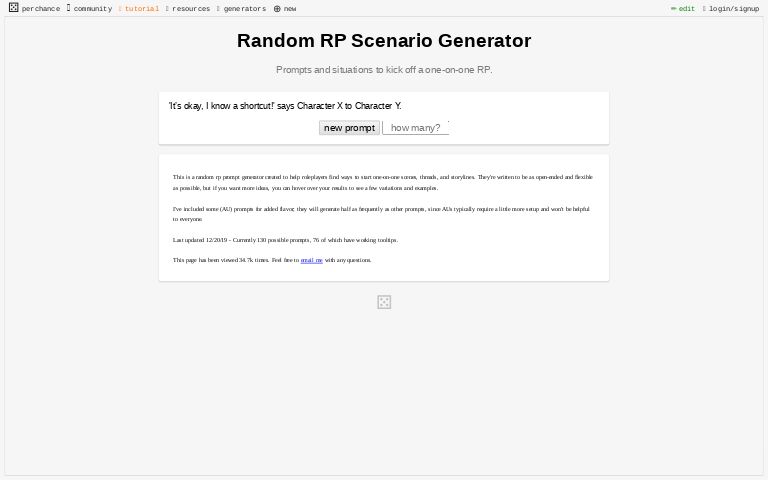
Classic web generators are useful for a spark. Perchance’s Random RP Scenario Generator, for example, currently offers about 130 possible prompts written as open-ended one-on-one starters. That is enough for a warm-up. It is not enough for a campaign, a novel outline, or a character who has to remember what happened three scenes ago.
Random starters are not playable scenes
A line like “Character X knows a shortcut” is a situation, not a scene. You still need setting texture, a reason the shortcut matters, what the other character wants, and a first beat that invites a reply. Most generators stop at the situation.
General-purpose AI forgets the table
Drop the same prompt into a generic chatbot and you often get a synopsis, a list of “ideas,” or a character who answers as an assistant. Dedicated roleplay is harder: the model has to stay in voice, advance the plot, and avoid out-of-character (OOC) breaks. Researchers training roleplay-specific models have described OOC replies as a clearly detectable failure—which is exactly what breaks immersion for players.
Continuity is unpaid labor
Solo players, GMs, and collaborative writers spend as much time tracking who knows what as they do inventing the next beat. Without memory, every session starts with a recap tax. That is the gap a real AI roleplay prompt generator has to close.
This is exactly what Roleplay Game Master was built for.
Why Roleplay Game Master
Roleplay Game Master is not a list of canned starters. It is a standalone AI game master and scene partner: you describe the world, the characters, and the tone, and it generates prompts you can immediately play—then keeps playing them with you.
It treats the prompt as the opening move, not the finished product. Ask for a rain-soaked alley confrontation, a court intrigue breakfast, or a first-session D&D hook, and you get a scene with stakes, sensory detail, and a clear turn for your character. Continue talking, and the same thread holds.
| Traditional Approach | Roleplay Game Master |
|---|---|
| Fixed banks of random one-liners | Unlimited custom scenes on demand |
| You expand the hook yourself | Playable beats, NPCs, and stakes in the first reply |
| Continuity lives in your notes | Persistent memory across sessions |
| Generic chat that slips out of character | Voice-consistent GM and NPC portrayal |
| Desktop-only idea dumps | Same experience on phone, tablet, and web |
Generate the prompt, then inhabit it
You can ask for a cold open, a meet-cute, a dungeon entrance, or a political standoff. The difference is what happens next: the AI stays in the scene, speaks as NPCs, and waits for your move instead of dumping a bullet list of “possible plots.”
"Give me a noir roleplay prompt set in a coastal city. I am a debt-ridden private investigator. Open in media res at the pier, stay in second person, and wait for my action."
Hold character when the scene gets complicated
Long scenes fail when the bartender suddenly sounds like a help desk. This AI is built to keep NPC diction, power dynamics, and secrets consistent—even when you introduce a twist, switch POVs, or jump two days ahead.
"Continue as the rival captain. Do not summarize. She knows about the forged manifest but will not admit it unless I catch her in a lie."
Carry campaigns, not just one-shots
Because conversation history and preferences persist, you can leave a dungeon mid-combat on Monday and resume Tuesday without re-explaining the party, the curse, or the innkeeper’s name. That is the practical upgrade over a random RP scenario page that resets every refresh.
Any genre, any intensity, any format
Fantasy sandbox, slow-burn contemporary, hard sci-fi, mystery, comedy, or original lore dumps—you set the boundaries. Use it for solo RP, GM prep, play-by-post openers, or as a rehearsal room before you write the scene into a script.
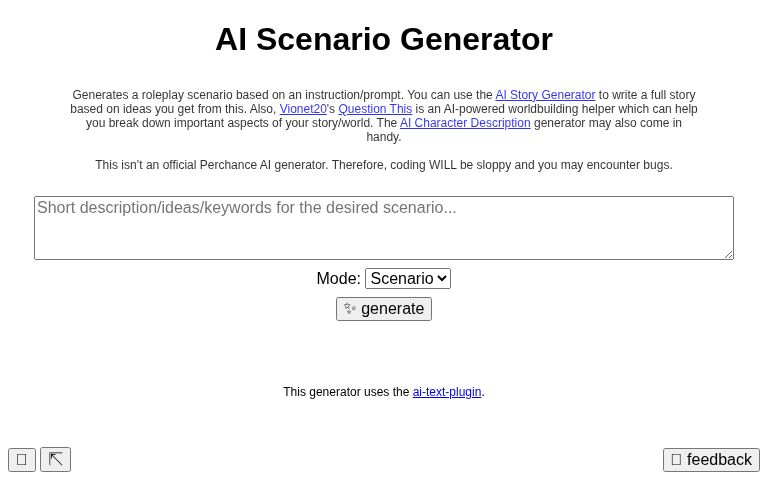
Keyword boxes like the one above are a familiar first step: type a short description, pick “Scenario,” generate. The limitation is the ceiling. A dedicated AI roleplay prompt generator should take that short description and keep the world running after the generate button is done.
Related Agents You'll Also Find Useful
If you are generating roleplay prompts as part of a larger creative or practice workflow, these agents sit naturally next to the GM chair.
Film Screenwriter
If a generated scene wants to become a script, Film Screenwriter turns the improvisation into structure, dialogue, and visual storytelling. Use it when a roleplay beat is strong enough to outline as a short film, feature sequence, or rewritten confrontation.
- Scene-to-outline and beat-sheet support
- Dialogue passes that preserve character voice
- Revision guidance from concept through draft
Manga Creator
Roleplay that lives in panels needs pacing, not just prose. Manga Creator helps you translate a generated RP scene into page flow, character acting, and serialized story structure—from a one-shot to a longer run.
- Panel rhythm and page-turn hooks
- Consistent character designs across chapters
- Adaptation of RP dialogue into manga-native speech
Learn English Through Roleplay
If your “prompt” is also language practice, immersive English roleplay puts vocabulary and idioms inside the scene instead of a worksheet. Same creative freedom, with the extra job of making the conversation teachable.
- Scenario-based speaking and writing practice
- Grammar and idiom feedback in context
- Any setting—from café small talk to high-fantasy quests
Try Roleplay Game Master free — no credit card required.
How to Generate and Play a Roleplay Prompt
Step 1: Set the table in one message
Open the AI game master and state genre, POV, tone, and what you will play. Specific constraints produce better first scenes than “give me a fantasy prompt.”
"Solo dark-fantasy RP. I play a disgraced knight. Second person, literary but not purple. No dice. Open at the city gate at dusk. Give me a prompt I can answer in character."
Step 2: Generate, then tighten the hook
If the first scene is close but too broad, ask for a sharper conflict, a named NPC, or a secret the player does not know yet. Treat the generator as iterative, not one-click-and-done.
"Keep the gate scene, but add a customs officer who recognizes my family crest. Raise the stakes without starting a fight."
Step 3: Play the prompt instead of outlining it
Reply in character. Ask the AI to stay in narration-plus-dialogue, to wait for your action, or to portray only NPCs. This is where a roleplay prompt generator becomes a session.
"I keep my cloak closed and lie that I am a courier. Stay in scene. Do not OOC-explain the officer’s motives."
Step 4: Lock continuity for the next session
Before you close the chat, pin the facts that matter: names, injuries, debts, clocks. On return, say “continue from the gatehouse” rather than pasting a recap. Memory is the feature that makes generated prompts reusable.
"Remember: I gave a false name, the officer kept my sword, and the bell tower rings at midnight. Next session starts in the holding room."
Step 5: Export the good scenes into other work
Lift a confrontation into a TTRPG session, a comic page, or a screenplay beat. The generator’s job is to produce playable material; your job is to decide where that material goes.
Results & Use Cases
🎭 Solo fantasy campaign without a human GM
Scenario: You want a weekly dark-fantasy campaign, but your group cannot meet and random prompt sites only give you a sentence.
Traditional Approach: Roll on a plot table, write your own boxed text, and keep a wiki so you do not contradict last week’s lore.
Roleplay Game Master: You generate a gatehouse hook, play it, and resume the same characters next week with names and consequences intact.
- Playable first replies instead of one-line AUs
- NPC voices that do not collapse into assistant-speak
- Continuity without a separate notes app for every scene
🎬 Turning an RP beat into a scripted scene
Scenario: A generated interrogation in a rain-soaked precinct is strong enough to become a short-film sequence.
Traditional Approach: Re-type the improvisation into Final Draft structure by hand, then discover the scene has no midpoint turn.
Film Screenwriter: You paste the RP transcript and ask for a beat sheet, camera-minded action lines, and a dialogue pass that keeps the detective’s voice.
- Faster path from play to page
- Structural checks the GM chat is not trying to do
- A clean handoff from improvisation to craft
📱 Mobile one-shot on a commute
Scenario: You have twelve minutes on the train and want a complete meet-cute or dungeon entrance you can finish before your stop.
Traditional Approach: Open a random generator, screenshot a prompt, and never get to play it.
This AI on iOS or Android: Dictate the genre, generate the scene, and reply by voice or thumb. Settings sync, so you can continue the same thread on desktop later.
- Full feature parity with the web app
- Speech-to-text for in-character replies
- Short sessions that still remember the thread
📚 Language practice inside the story
Scenario: You are fluent enough to chat, but textbook drills bore you, and you want idioms to stick to a moment.
Traditional Approach: Scripted textbook dialogues that never surprise you.
Learn English Through Roleplay: Generate a market-day argument or a spaceship customs scene, then play it until the vocabulary is attached to something you actually said.
- Grammar in context, not in isolation
- Same creative range as leisure RP
- Memorable scenes instead of flashcards
Industry context makes these workflows less niche than they look. Separate market trackers still put the broader RPG category in the tens of billions of dollars, and one publishing breakdown estimated that Dungeons & Dragons cleared around $460 million in 2025. Players are already paying for worlds. A better prompt is the cheapest way into one.
FAQ
What is a roleplay prompt generator?
A roleplay prompt generator is a tool that creates scene starters, character hooks, and situations you can play or write from. Simple versions randomize a sentence from a fixed list. An AI version, such as Roleplay Game Master, builds a custom scene from your genre and constraints, then continues the scene with you instead of stopping at the first line.
Is Roleplay Game Master free?
Yes. There is a free tier with all core features and limited monthly usage—no credit card required. Paid plans increase usage (Plus starts at $20/month) if you run long campaigns or multiple characters. Usage resets each billing cycle, and the same agent is available on web, iOS, and Android.
How is an AI roleplay prompt generator different from random RP generators?
Random sites shuffle templates—useful, but finite. Perchance’s RP generator is a clear example: a curated bank of open-ended one-on-one starters. An AI generator writes a new scene for your characters, then stays in the fiction. You are not rolling the same “I know a shortcut” line twice a month.
Can I use this for D&D and other TTRPG prep?
Yes. Ask for cold opens, rumor tables in prose form, NPC voices, dungeon approaches, or “what does the tavern know?” scenes. You can keep rules-light narrative play at the table, or steal the boxed text and run dice with your group. It will not replace your rulebooks; it will replace the blank page before session one.
Does a roleplay prompt generator work on mobile?
Yes. Roleplay Game Master runs with feature parity on iOS and Android, including speech-to-text for in-character replies. Start a prompt on your phone, continue on desktop, and keep the same memory. That is the practical answer if you write play-by-post or solo RP in spare minutes.
Will the AI stay in character, or will it break immersion?
Staying in character is the design goal—narration, NPC dialogue, and secrets held until you earn them. You can reinforce it with instructions such as “no OOC,” “wait for my action,” or “never speak as my PC.” If a reply drifts, a one-line correction usually snaps the scene back. For script polish after the RP, Film Screenwriter is the better tool; for the live scene, keep the GM in the GM seat.
Conclusion
A roleplay prompt generator should do more than shuffle a sentence. The old pattern—click, screenshot, invent the rest—leaves you with a hook and no partner. Roleplay Game Master writes the scene for your characters, plays it with you, and remembers the consequences.
If you need a one-shot for tonight, a campaign that survives until next week, or a spark you will later turn into manga pages or a screenplay, start with a specific prompt and stay in the fiction. Try it now, then explore more at Jenova.
For Developers: Roleplay Game Master is available programmatically via the Jenova API — integrate persistent, character-consistent roleplay scenes into your application with a single API call. Full documentation →