Roleplay Continuity Checker: AI Audit for Plot, Voice & Timeline
2026-09-13
Jenova is an AI roleplay continuity checker for campaigns, character chats, and serialized stories—the place you send a scene when something feels off. As of September 2026, long tables, AI roleplay threads, and multi-episode drafts fail the same way: an NPC’s eye color flips, a promise vanishes, a Tuesday becomes Thursday. Specialized agents on this platform compare new scenes against canon, voice, and timeline instead of hoping you remember every oath.
✅ Persistent memory so canon compounds across sessions instead of resetting
✅ Specialized agents for campaigns, screenwriting, comics, and language roleplay
✅ Multi-model access without juggling vendor accounts
✅ Web, iOS, and Android parity, including speech-to-text for checks on the move
To understand why this matters, treat continuity as a set of facts the table will catch if you drop them—not as a vague “vibe” you can patch with a retcon.
Quick Answer: What Is a Roleplay Continuity Checker?
A roleplay continuity checker is an AI tool that audits session logs, character chats, and drafts against established canon—characters, timeline, world rules, and voice—to flag contradictions before they ship. It is built for narrative state, not meeting minutes.
Key capabilities:
- Campaign-state audits that lock NPCs, loot, factions, and unfinished hooks—work Game Designer Assistant can turn into next-session prep
- Character-voice checks so an oath, accent, or grudge still matches last week, which is what Roleplay Game Master is built to hold
- Draft and recap passes that keep scene order, props, and causal logic intact, then hand off to Film Screenwriter when the beat needs to live on the page
- Language-roleplay reviews that catch register drift and forgotten phrases after immersive practice with Learn English Through Roleplay
Why Roleplay Continuity Breaks Down
Roleplay produces more canon than anyone can hold in working memory. A weekly table, a 40-message AI chat, and a serialized draft all create the same object: a world that is supposed to remember itself. Writers already treat that object as a story bible—a running file of characters, setting, and plot used to preserve continuity. Game groups need the same thing, whether they call it a campaign journal, a wiki, or a recap Discord pin.
But checking new play against that bible is frustratingly difficult:
- Character facts drift: hair color, injuries, titles, and who overheard what
- Timelines slip: travel time, rest days, and which night the letter arrived
- World rules get rewritten mid-scene because nobody reopened the doc
- AI chats contradict last week once context fills and memory collapses
- Notes exist, but nobody diffs them against the new scene before play
Too many of those goofs and the book heads back to the library — Writer’s Digest on catching continuity errors
Character sheets rot while the story keeps moving
Authors who keep data files for hair, eye color, height, and birthdates do it because the manuscript will invent a new fact under deadline pressure. Roleplay is worse: six people improvise at once. The paladin’s scar jumps sides. The innkeeper’s name respells itself. A vampire who could not bear a mirror last season suddenly checks their hair.
A roleplay continuity checker has to treat those facts as constraints, not flavor. If the transcript says the steward is left-handed and missing a finger, the next scene cannot hand him a two-handed bow without a flag.
Timeline is the error readers forgive least
Plot mess can be debated. Calendar mess looks like incompetence. The same Writer’s Digest piece argues that writing Thursday when it should be Tuesday is the class of mistake that ends trust. Tabletop groups hit the identical failure: a three-day ride that finishes before lunch, a full moon twice in one week, a corpse that has already been buried when the party “just left the body.”
Consistency in plot, character, timeline, and setting is what makes a story feel cohesive. A continuity pass that ignores clocks is only half a pass.
World rules are easy to violate when you are improvising
A story bible exists to keep multi-installment stories consistent across characters, world, plot, and voice. Magic systems, faction oaths, travel costs, and “who can enter the inner court” are world rules. In play they get broken because the interesting move is sitting on the other side of the rule.
That is not always wrong—tables can change canon on purpose. It is wrong when the change is accidental. Tracking traits, plot points, invented spellings, and world rules is how writers cut continuity errors. Roleplay needs the same diff: what was true yesterday versus what this scene just asserted.
AI roleplay forgets in a different direction
Long character chats do not lose a notebook. They lose the window. Once context fills, the model will cheerfully reintroduce a dead rival, reset a confession, or soften a character who already burned that bridge. Generic “summarize the chat” prompts produce a paragraph that sounds right and is wrong in the one place that matters—the promise nobody is allowed to forget.
You cannot fix that with a shorter recap alone. You need a checker that compares the new reply to locked facts: names, debts, injuries, and voice.
Notes that are never checked might as well not exist
RPG journals preserve continuity by tracking NPCs, events, loot, and player progress. Groups still lose campaigns because the journal is a graveyard.
rather than another pile of Discord messages. Campaign notes only stay useful if canon, factions, quests, and continuity remain queryable months later.A continuity checker is the missing step between “we wrote notes” and “we used them.” Every game can capture continuity somehow—but only if someone, or something, actually compares the new scene to the old one.
This is exactly what Jenova was built for.
The Jenova Solution
This AI-powered solution does not treat continuity as a vibe prompt. You paste a log, attach a scene, or talk through what just happened. The output is a structured audit: contradictions, missing follow-through, voice drift, and a corrected state sheet you can play from.
A show bible exists so writers do not contradict setting and character details once a series is in motion. A strong roleplay continuity checker should land in that same shape—short enough to scan, strict enough to argue with.
| Traditional Approach | Jenova |
|---|---|
| Reread 200 pages to find eye color | Entity pass: traits, promises, locations, injuries, dates |
| Story bible that lags a week behind play | Persistent memory plus an explicit canon diff |
| Generic “find plot holes” in a blank chat | Domain agents for tabletop, screen, comics, and language RP |
| Continuity trapped in one GM’s head | Shareable state the table can query on any device |
| AI chat that rewrites last week’s oath | Unlimited memory with a check before the next scene |
Campaign state for tabletop groups
After a session, drop the chat log or messy notes into Roleplay Game Master and ask it to list every assertion that must still be true next week. Then send the same recap to your design partner for a state board: factions, clocks, loot owners, and dangling hooks.
Mystery and horror games need a second pass against rooms and secrets. The Mansion already tracks consequences inside a persistent story. When a new scene claims a door was never opened, check it against what the investigators already found—not against the vibe of the current paragraph.
Character voice that does not reset overnight
Continuity is not only facts. It is how someone talks when they are angry, what they will not do, and which lie they are still maintaining. Learn Russian Through Roleplay is built around character consistency in immersive practice; the same discipline applies to original casts. Lock a bible (wants, bans, last promise, last injury), then flag any reply that violates it.
Custom agents on the platform can hold that bible across nights. You define instructions, attach lore, and let memory plus the audit share the load a raw context window cannot.
Serialized stories, scripts, and recap pages
Some groups need more than a bullet list. They need the night as a scene that still obeys last month’s outline. Film Screenwriter can take a continuity-clean recap and rebuild it as dialogue without inventing a new gun in the hero’s hand. Manga Creator and Comic Creator can push the same checked state into panels so a character’s scar, coat, and age do not drift issue to issue.
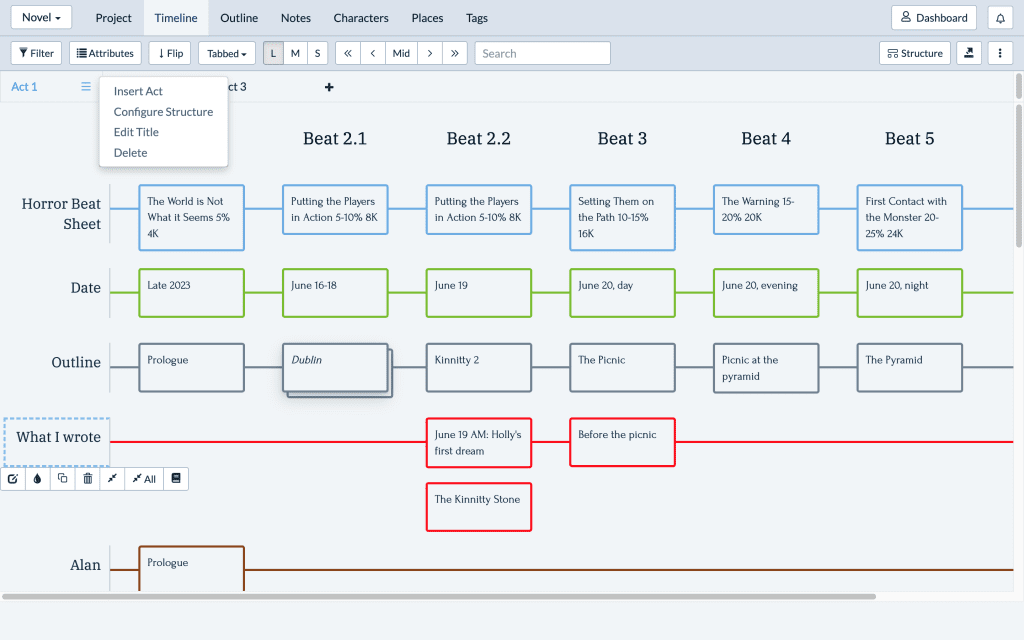
A beat grid like the one above is the visual version of a continuity check: what the structure promised, what you actually wrote, and where the timeline diverged. The job of the checker is to make that divergence visible before the next scene locks it in.
Specialized AI Agents for Roleplay Continuity
Try Jenova free—no credit card required—and start with the agents that match how you actually play.
Roleplay Game Master
If your continuity problem is people, not encounter math, live in this continuity-first game master. Unlimited memory and character consistency mean an NPC established in session two should still sound like themselves in session twelve.
- Reconstruct a scene and flag any line that breaks prior voice or facts
- Keep a campaign bible that remembers debts, rivalries, and unfinished bargains
- Test “what would this NPC do?” without silently rewriting who they are
Game Designer Assistant
Game Designer Assistant turns an audit into prep. Continuity errors often hide in systems: travel times, rest rules, faction clocks, and treasure that changed hands.
- State-of-campaign sheets: NPCs, locations, threats, and treasure
- Converts play reports into runnables instead of prose
- Useful across D&D, Pathfinder, PbtA, and homebrew frameworks
Film Screenwriter
When the recap has to survive as a scene, this screenwriting partner keeps props, blocking, and character behavior aligned with prior pages. That is the “is he still holding the gun?” class of error.
- Dialogue passes that retain subtext instead of flattening it into bullets
- Outline-to-draft workflow from audited recap → beat sheet → scene
- Visual notes a GM or producer can describe without inventing new canon
Manga Creator
Long-form visual recaps fail when faces, outfits, and locations reset. Manga Creator is built for serialized consistency from one-shots to long epics—the same muscle a campaign comic needs.
- Character designs that persist across recap pages
- Panel flow that highlights the one decision that changed the world
- A pipeline from checked notes to pages without rewriting plot
Personality Analyzer
Voice drift often starts as personality drift. Personality Analyzer helps you lock traits, stress behavior, and attachment patterns so a betrayal in session nine still belongs to the person introduced in session two.
- Trait sheets you can paste into a campaign bible
- Flags when a character’s choice contradicts established motives
- Useful for both original NPCs and language-roleplay personas
Machiavelli Mentor
Court and faction games die when the power map resets. Machiavelli Mentor updates who owes whom after each scene so a continuity check includes information flow, not just room-to-room movement.
- Power maps that survive a month of intrigue
- Incentive checks: would this NPC actually make that concession?
- Recaps that encode secrets, audiences, and broken bargains
How to Run a Roleplay Continuity Check
Step 1: Freeze the canon you already have
Do not start with “summarize.” Start with a state sheet. Export the last recap, character bible, or session notes. If you have nothing written, dictate what must still be true: names, injuries, promises, locations, dates. The model cannot protect a fact you never locked.
"Here is our campaign bible and last session’s recap. Extract a canon list: PCs, NPCs, locations, items, faction standings, injuries, and unresolved promises. Quote the line that established each fact."
Step 2: Diff the new scene against that list
Paste the new transcript, chapter, or AI reply. Ask for contradictions only—do not accept a rewrite yet. Force three buckets: hard breaks (facts), soft breaks (voice), and open questions (the log is ambiguous).
"Compare this new scene to the canon list. Flag hard contradictions, voice drift, and timeline errors. Do not fix anything yet. For each flag, quote both the old line and the new line."
Step 3: Decide which breaks are retcons
Some contradictions are the story. Mark those as intentional canon updates and write the new rule in one sentence. Everything else gets corrected or cut. This is how you avoid a checker that “helpfully” flattens a plot twist.
"Treat the broken oath as intentional. Update the canon list. Revert the innkeeper’s name, the travel time, and the scar. Give me a player-safe recap and a GM-only secrets file."
Step 4: Hand the cleaned state to the next workflow
A check that dies in chat is only half done. Send campaign state back into design prep, push a clean scene toward Microdrama Screenwriter for episodic hooks, or turn the recap into a vertical episode with Webtoon Creator. Persistent memory means you attach the updated bible and keep playing.
"Using only the updated canon list, prep the next scene: a strong start at the gate, three secrets I can reveal, and two complications if they stall. Do not reintroduce the steward we already buried."
Step 5: Recheck after you write, not only before
The error often appears in the fix. After you patch the scene, run the same diff once more. Outlining as you go is one of the few habits that actually catches chronological slips. Make the second pass a habit, not a panic edit the night before game.
"Re-audit this revised scene against the canon list. If anything still contradicts, list it. If it is clean, output a one-page state of the campaign."
Roleplay Continuity Checker Use Cases
📊 The GM who accidentally resurrected an NPC
Scenario: Session twelve opens with the steward offering a job. Session nine buried him. Nobody notices until a player says, “Wait.”
Traditional Approach: Ten minutes of table argument, a sheepish retcon, and a wiki that still has both versions.
Jenova: Paste sessions nine and twelve into the design partner, get a contradiction list, and choose: doppelganger hook or cut the scene. Walk in with one canon.
- Separates GM secrets from the recap the table can see
- Preserves loot, injuries, and death so the next scene starts honest
- Produces a “still true” list instead of a blank prep page
💼 The writer whose timeline slipped two days
Scenario: A chapter has the party reach the pyramid at night. The previous chapter spent that night at a picnic. The outline still says otherwise.
Traditional Approach: Skim 80 pages, miss the picnic, and ship the contradiction.
Film Screenwriter: Diff chapter against outline beats. Flag the doubled night, the missing travel, and the prop that changed hands. Rewrite the arrival so the clock still works.
- Catches calendar errors before a reader does
- Keeps blocking and props aligned with prior pages
- Turns the audit into a scene, not a lecture
📱 The player catching up on the commute
Scenario: You missed a session. Game starts tonight. You have a phone, a chat export, and twelve minutes on the train.
Traditional Approach: Skim 400 messages, miss a promise your character made, and slow the table down.
The platform: Open the iOS or Android app, attach the log, and ask for a player-facing continuity brief: what you would know, what you promised, what changed in your inventory. Add a voice note if you remember a detail the log dropped.
- Speech-to-text for corrections while you walk
- Short canon sheet you can reread at the table without spoiling secrets
- Sync across devices so the same notes are on your laptop at game time
🎯 The language scene that forgot its own register
Scenario: You spent a week in a café scene at a careful, polite register. The next session the same clerk suddenly talks like a close friend and drops the grammar you were drilling.
Traditional Approach: Scroll the chat, feel that it is “off,” and keep playing anyway.
Learn English Through Roleplay: Ask for a continuity check on relationship, formality, and target grammar. Replay the scene at the same intensity with the register locked.
- Study notes tied to lines you produced under pressure
- Character and language consistency in the same pass
- A short version of the scene you can run again tomorrow
FAQ: Roleplay Continuity Checker
What is a roleplay continuity checker?
A roleplay continuity checker is an AI audit for session logs, character chats, and drafts. It compares new text to locked canon: who people are, what happened, what the world allows, and how characters speak. Unlike a meeting assistant, it is judged on narrative state—names, clues, voice, and open threads—not on action-item lists.
Is this roleplay continuity checker free?
Yes. The platform has a free tier with all core features and limited monthly usage, which is enough to audit a campaign night or a long chat and see whether the flags are actually playable. Paid tiers raise usage if you are checking long recordings every week. Usage resets on your billing date with no daily cap.
How is a roleplay continuity checker different from ChatGPT?
General chatbots will shorten text or “look for plot holes” in a vacuum. Roleplay needs state: the steward who is dead, the phylactery that is still missing, the formal register you were practicing in French. Specialized agents plus persistent memory keep that state available instead of asking you to paste the novel into a blank chat every time. Game Designer Assistant turns the same audit into next week’s prep rather than a paragraph you will not trust.
Can it check D&D campaigns, VTT chat, and AI roleplay logs?
Yes. Paste Discord or virtual-tabletop chat, attach a transcript, or dictate what happened after a voice session. Ask for a contradiction list, a player-safe recap, or an NPC dossier. For AI character chats, run the check at scene boundaries so continuity survives when context gets long—the same job Roleplay Game Master is built to do with unlimited memory and character consistency.
Does a roleplay continuity checker work on mobile?
Yes. Web, iOS, and Android share the same agents, memory, and files. That is the missed-session use case: audit on the phone, pin the “still true” list, and walk into the session without scrolling four hours of chat. Speech-to-text is available when your hands are full and you only remember one correction—“the innkeeper lied about the cellar.”
How accurate is the check with names, voice, and plot details?
Accuracy tracks the canon you freeze and the transcript you provide. If the log says “Day Shift Worker,” the audit should not invent a captain. Ask for quotes on every flag, keep a running NPC page, and treat intentional retcons as updates rather than errors. Persistent memory helps the next check stay consistent with the last one, which is the failure mode that makes tables stop trusting notes.
Keep Canon Playable
A roleplay continuity checker earns its keep at the start of the next scene, not at the end of the last one. Raw logs are cheap. Continuity is not. When the audit still knows who blocked the door, what the party promised, and which thread is next, you spend the night playing instead of reconstructing.
Whether you need campaign state from Game Designer Assistant, character memory from Roleplay Game Master, a scene pass from Film Screenwriter, or language notes from Learn English Through Roleplay, the job is the same: turn dialogue into canon you can reuse.
Explore the full agent library at Jenova and check the scene while you still remember why it mattered.
For Developers: Every agent in this article is available programmatically via the Jenova API — integrate roleplay continuity checks, campaign memory, and custom canon-audit agents into your application with a single integration. Full documentation →