RAG Memory Roleplay AI: Persistent Characters, Coherent Campaigns
2026-09-15
Roleplay Game Master helps you run immersive campaigns that remember every vow, scar, and secret by retrieving story state instead of hoping it still fits in a prompt. While most chatbots drop NPCs the moment a thread overflows, this AI treats lore, session logs, and character sheets as searchable memory.
✅ Retrieval over campaign notes, not a recap you paste every week ✅ Character voice and plot promises that survive across sessions ✅ Knowledge you attach once — maps, house rules, backstory docs ✅ The same continuity on web, iOS, and Android
As of September 2026, roleplay is one of the hardest tests of conversational AI: it is almost never a one-shot question. To understand why RAG memory now decides whether a scene feels lived-in or amnesiac, it helps to look at how models fail once the adventure leaves the first message.
Quick Answer: What Is RAG Memory Roleplay AI?
RAG memory roleplay AI is a retrieval-backed roleplay system that stores story state, character facts, and lore as embeddings so the model can recall them across sessions. It is how a campaign stays coherent when the context window cannot hold the whole chronicle.
Key capabilities:
- Embed scenes, NPCs, and attached lore for semantic recall, not keyword matching
- Pull only the relevant memories into each turn so the window stays focused
- Keep unlimited chat history so last month’s bargain still exists
- Ground improvisation in your documents instead of generic fantasy tropes
- Continue the same table from a desk session onto a phone without a recap
Why Roleplay AI Forgets Mid-Campaign
Foundation models are trained on the public web. Fine-tuning can bake in a house style. Neither is a substitute for your table. A 2025–2026 survey of agent memory treats memory as a first-class primitive and draws a sharp line between parametric weights, RAG over external stores, and the experiential memory an agent must form while it acts.
Roleplay sits at that intersection. You need the model’s improvisational skill and a non-parametric store of what already happened. But keeping that store accurate in a live scene is still frustratingly difficult:
- Multi-turn chat degrades even when retrieval is present
- Context windows overflow, so early vows vanish mid-arc
- Fine-tuning cannot be rerun every time an NPC changes allegiance
- Keyword search misses paraphrases (“the red-sash captain” vs. “Captain Veyra”)
- Homegrown RAG (chunking, indexes, eval) is an infrastructure project, not a game night
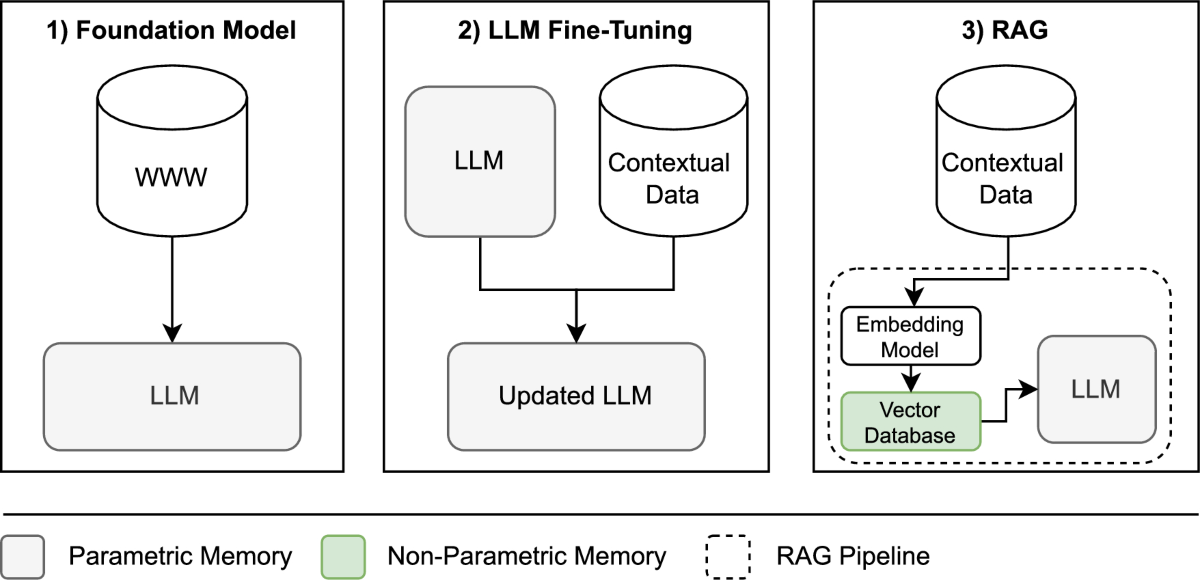
The diagram above is the architectural reason roleplay chatbots “reset.” Parametric memory lives in weights. RAG memory lives in embeddings and a vector index you can update without retraining.
Multi-turn RAG is where the story actually lives
IBM Research’s MTRAG benchmark was built because one-off question answering is the easy case. Annotators ran extended, enterprise-style conversations with a live RAG agent. Two patterns showed up across leading models: performance dropped on questions that should have been refused or clarified, and every model did better on the first turn than on later ones. Roleplay is later turns, indefinitely. A dungeon master that only nails session zero is not a dungeon master.
First-turn advantage — IBM MTRAG found all tested models stronger on the opening question than on subsequent turns in conversational RAG
A context window is not a campaign bible
Larger windows do not retire retrieval. The same IBM work notes that stuffing more text into the window produces overload, and that RAG remains the practical way to search a large corpus or reconcile conflicting passages. Your 40-session Discord log is that corpus. Long-term memory research similarly treats durable recall as the foundation for systems that improve across a lifetime of interaction, not as a bigger paste buffer.
Fine-tuning cannot keep up with play
If an assassin defects in session nine, you do not retrain a model. You update non-parametric memory. RAG exists so private, fast-changing facts never have to wait for a training run — a distinction agent-memory surveys now make explicit versus classic RAG-for-documents. Roleplay needs both layers: retrieved lore and remembered events.
Recaps punish the player
The workaround — “here is a 2,000-word summary, please continue” — is unpaid labor. Semantic retrieval should find the oath from chapter three when a player alludes to it, without a human librarian in the loop.
This is exactly what Roleplay Game Master was built for.
Why Roleplay Game Master
Roleplay Game Master is a standalone roleplay product: unlimited memory, stable characters, and complete creative freedom over scenario. You describe the table you want. The agent retrieves prior scenes, attached lore, and standing constraints, then improvises inside that continuity.
You do not operate a vector database. You do not maintain a RAG eval harness. You play.
| Traditional Approach | Roleplay Game Master |
|---|---|
| Paste a recap every session | Persistent memory across the campaign |
| Fine-tune a model on your wiki | Attach lore; retrieval updates instantly |
| Keyword search through notes | Semantic recall of people, places, promises |
| Context window dumps early sessions | Retrieve only the beats this scene needs |
| Desktop-only threads that die on mobile | Same memory on web, iOS, and Android |
Character consistency as retrieval, not luck
Voice is a memory problem. If the innkeeper whispered in session two, a later visit should not turn her into a town crier unless the story earned it. The agent stores character facts and prior dialogue as retrievable state so “perfect character consistency” is an engineering outcome, not a prompt slogan.
World state you can query
Factions, clocks, inventory, and unresolved hooks are facts. When a player says “we go back to the quay,” retrieval should surface the smuggler’s debt, not invent a new dock. That is RAG memory roleplay AI in the narrow sense: the right passage, at the right turn.
Documents as canon
Upload a map legend, a lineage chart, or house rules. Those files are indexed for meaning. Later prompts retrieve them the way enterprise RAG retrieves policy docs — the same pattern RAG benchmarks exist to measure, applied to a campaign instead of a knowledge base article.
Freedom without amnesia
Complete creative freedom is only fun if the world does not contradict itself. The agent will follow dark, surreal, or slice-of-life premises; memory is what keeps that premise from collapsing when you return next week.
Example prompts the table actually types:
"You are running a slow-burn political campaign in a canal city. House rules: no resurrection, secrets stay secret until discovered, the rain never stops. Continue from the council vote — do not remind me of the assassin's name unless a character would."
"Retrieve the bargain we made with the river priests in session four and play the consequences. I am not summarizing it for you."
Related Agents You'll Also Find Useful
If the same memory problem shows up in language practice, campus fiction, or another long arc, these agents sit next to the game master rather than replacing it.
Learn English Through Roleplay
Grammar sticks when it is attached to a scene you already lived. This tutor runs any scenario at any intensity so idioms and register arrive inside a story, not a worksheet.
- Immersive scenes instead of isolated drills
- Idioms and natural speech tied to moments you remember
- A practice loop you can resume without restarting beginner scripts
Learn Russian Through Roleplay
This mentor is built on the same continuity thesis: unlimited scenarios, unlimited memory, and character consistency so each conversation is practice, not a reset.
- Vocabulary gaps stay in memory between sessions
- Character and setting remain stable while the language gets harder
- Retrieval-backed review of forms you already missed
College Life
Open-world campus fiction lives or dies on social memory — who you embarrassed, who still has the letter, which roommate knows. Emergent friendships and fallout need RAG-style recall of prior choices.
- Relationships that unfold from what you already did
- Social consequences that do not vanish at the context boundary
- A sandbox you return to, not a one-shot scene
Try Roleplay Game Master free — no credit card required.
How RAG Memory Roleplay AI Works
You start a campaign. The system embeds what you say, what the agent says, and what you attach. Each new turn retrieves a relevant slice, assembles a prompt, and generates the next beat. That is the same retrieve-then-generate loop enterprises use for grounded Q&A, applied to play.
The architecture in that diagram is the production pattern: ingest, embed, store, retrieve, generate. In roleplay the “client data” is your lore and session history; the “query” is whatever the player just did.
Step 1: State the Table You Want Open the game master and define tone, constraints, and what must never be spoiled. That brief becomes part of memory, not a one-time system message that drifts away.
"Play a grounded noir in 1947 Havana. Second person, short scenes, no mind-reading. My character is a disgraced translator. Do not reveal who burned the archive."
Step 2: Attach Canon Upload character sheets, a city primer, or a banned-trope list. Retrieval will prefer those files when a later scene collides with them. This is how you stop the model from inventing a third moon.
"The attached PDF is canon. If a name is not in it, do not introduce a Great House."
Step 3: Play Across Sessions Without Recapping Close the thread. Come back days later. Ask to continue from a sensory detail, not a synopsis. Persistent memory and unlimited history mean the agent can retrieve the unfinished clock.
"We left me on the ferry stairs. The priest still has my passport. Continue — do not recap."
Step 4: Pick Up on a Phone Web, iOS, and Android share history and settings. A commute scene can retrieve the same vectors you built at a desk. Speech-to-text is available when you cannot type a paragraph of stage directions.
"Walking home. One short scene: the neighbor who recognized me from the docks. Keep it quiet."
Results and Use Cases
RAG memory shows up as contradictions that never happen — and as hours you do not spend writing recaps.
🎭 A weekly campaign that must honor its own past
Scenario: Six players, named NPCs, a secret the table has not earned, and a tone you set in session one.
Traditional Approach: Session notes in another app. The chatbot introduces a new villain because it cannot retrieve the old promise. Someone pastes a recap that still misses the offhand detail a player will quote.
Roleplay Game Master: Story state is memory. When a player cites a throwaway line from three sessions ago, retrieval can bring it back into the room.
- Character voice remains stable
- Plot promises remain queryable
- Long arcs stay internally consistent
📚 Language practice that does not loop week one
Scenario: You want Russian (or English) inside a persistent story — a train compartment, a kitchen argument — not a phrasebook.
Traditional Approach: Each session the tutor forgets the words you already own and the formality level you asked for.
Learn Russian Through Roleplay: Unlimited memory keeps character, setting, and your error pattern. The next scene raises difficulty without erasing the last one.
- Missed forms get retrieved, not randomly reintroduced
- The story compounds instead of resetting
- Practice feels like returning to a place
Harvard Business School Publishing has documented AI role-play as a teaching method for a reason: rehearsal only works if the scenario remembers its own stakes.
📱 A scene from the train, canon intact
Scenario: You blocked a heist at the desk — no guns, rain as a character, the safe combination already established. On the commute you want one quiet scene with the lookout.
Traditional Approach: Screenshot your own notes. Hope a mobile chatbot infers constraints it has never seen.
The same roleplay thread on a phone: Preferences and the heist plan are already in memory. A short prompt retrieves them and plays one beat without rebuilding the crew.
- Constraints survive the device switch
- Canon numbers (the combination, the alias) do not drift
- You do not retype the brief in a crowded car
🏫 Campus fiction with social consequences
Scenario: An open-world college story where last week’s rumor should still be in the air.
Traditional Approach: A new chat, a new roommate personality, a forgotten slight.
College Life: Prior choices remain part of the world. Retrieval is what makes emergent drama feel earned rather than randomized.
Examining these tables shows the same failure conversational RAG benchmarks isolate: models that look fluent on turn one lose the thread when the conversation — or the campaign — gets long.
FAQ
What is RAG memory roleplay AI?
It is roleplay in which story facts, character state, and attached lore are stored outside the model’s weights and retrieved by similarity when you take an action. The retrieved passages are inserted into the prompt so the reply can use your campaign, not a generic setting. That is why a later session can honor an early vow without a human recap.
Is Roleplay Game Master free?
A free tier includes core features with limited monthly usage. Paid tiers raise usage headroom and can add options such as custom model selection. Usage resets on the billing date, with the full allowance available from day one rather than a daily cap. You can start a campaign without a credit card.
How is this different from a chatbot with a long context window?
A window is working memory. It still drops what does not fit, and stuffing it can hurt quality — a point IBM’s conversational RAG work makes against the idea that huge contexts retire retrieval. RAG memory roleplay AI keeps a store you can search. Agent-memory research treats that store as distinct from both raw context engineering and one-shot document RAG.
Can I ground the campaign in my own documents?
Yes. Attach the files that should win over the model’s priors: maps, lineages, tone guides, safety lines. Retrieval prefers that corpus when a scene collides with it. The same idea that reduces hallucination on enterprise knowledge bases keeps a homebrew world from growing extra continents.
Does RAG memory roleplay AI work on mobile?
Yes. Web, iOS, and Android share history, settings, and memory. Speech-to-text is available when you cannot type. The commute scenario above is the intended design: retrieve the same story vectors from a phone that you established at a desk.
Will the agent stay accurate about secrets and continuity?
Memory improves consistency; it does not make a model infallible. Retrieval quality and faithfulness remain open problems in the RAG literature. For a game, treat attached canon as the source of truth and correct drift when you see it — the store can be updated without a retrain. For anything involving real people’s wellbeing, use a dedicated tool such as a Personal Therapist rather than a game master.
Continuity Is the Product
Stateless roleplay wastes the only scarce input a table has: the history you already played. RAG memory roleplay AI stores that history as embeddings, retrieves it on demand, and lets characters remain themselves. The research record is blunt: multi-turn RAG is harder than single questions, and memory is now treated as core agent infrastructure, not a novelty toggle.
Try Roleplay Game Master on the campaign you are tired of recapping. Keep language arcs in immersive English practice or a Russian roleplay mentor that does not forget your last scene.
Explore more at Jenova.
For Developers: Roleplay Game Master is available programmatically via the Jenova API — integrate retrieval-backed roleplay and persistent character memory into your application with a single API call. Full documentation →