Productivity AI App: How Intelligent Agents Are Transforming Work in 2026
2026-01-08
The productivity landscape has fundamentally shifted. With AI apps generating $4.5 billion in revenue in 2024—a figure expected to more than triple in 2025—professionals are no longer asking whether to adopt AI tools, but which ones will deliver real results.
Jenova represents the next evolution in this space: a productivity AI app that unifies access to the world's most powerful AI models—GPT-5.2, Claude Opus 4.5, Gemini 3 Pro, and Grok 4.1—while connecting to the apps you already use. The result? A comprehensive productivity system that adapts to your workflow rather than forcing you to adapt to it.
Here's what makes this approach different:
- Multi-model access — Switch between frontier AI models based on task requirements
- App integration via MCP — Connect Gmail, Google Calendar, Notion, and dozens more
- Specialized AI agents — Purpose-built experts for research, writing, analysis, and more
- Persistent memory — AI that remembers context across sessions
Quick Answer: What Is a Productivity AI App?
A productivity AI app is software that uses artificial intelligence to automate tasks, enhance decision-making, and streamline workflows. Unlike traditional productivity tools that require manual input for every action, AI-powered apps can draft content, analyze data, manage schedules, and execute multi-step workflows autonomously.
Key capabilities include:
- Automated content generation and editing
- Intelligent task prioritization and scheduling
- Real-time research and information synthesis
- Workflow automation across connected applications
- Natural language interfaces for complex operations
Platforms like Jenova take this further by combining multiple AI models with specialized agents—giving users access to purpose-built AI experts for everything from academic research to business strategy.
The Productivity Crisis AI Is Solving
The modern knowledge worker faces an unprecedented challenge: information overload combined with fragmented tooling. According to McKinsey's 2025 State of AI survey, 88% of organizations now report regular AI use in at least one business function—up from 78% just a year ago. Yet most remain stuck in experimentation, unable to translate pilots into enterprise-level impact.
The Core Pain Points
Information Overload
Professionals drown in emails, reports, meeting notes, and market intelligence. Manually processing this information consumes hours that could be spent on high-value work. Research from Lenny's Newsletter found that 55% of tech workers say AI has exceeded their expectations, with more than half reporting AI saves them at least half a day per week.
Tool Fragmentation
The average professional juggles dozens of applications—each requiring context switching, separate logins, and manual data transfer. This fragmentation creates friction that compounds throughout the workday.
Model Lock-In
Most AI tools force users into a single model ecosystem. But different models excel at different tasks: GPT-5.2 for creative generation, Claude Opus 4.5 for nuanced analysis, Gemini 3 Pro for multimodal reasoning. Being locked into one limits capability.
The "Pilot Purgatory" Problem
"95% of generative AI pilots at companies are failing to achieve rapid revenue acceleration." — MIT NANDA Report, 2025
The core issue isn't model quality—it's integration. Generic tools like ChatGPT excel for individuals but stall in enterprise use because they don't learn from or adapt to workflows.
The Jenova Solution: Unified AI for Real Productivity
Rather than adding another siloed tool to your stack, Jenova functions as a productivity AI app that connects everything—models, apps, and specialized expertise—through a single interface.
Traditional Approach vs. Jenova AI Agents
| Challenge | Traditional Approach | Jenova Solution |
|---|---|---|
| Model access | Single provider lock-in | GPT-5.2, Claude Opus 4.5, Gemini 3 Pro, Grok 4.1 |
| App integration | Manual copy-paste between tools | Native MCP connections to Gmail, Calendar, Notion, Drive |
| Specialization | Generic chatbot for all tasks | Purpose-built agents with domain expertise |
| Memory | Conversation resets each session | Persistent cross-session memory |
| Workflow execution | Single-step responses | Multi-step orchestrated workflows |
Multi-Model Architecture
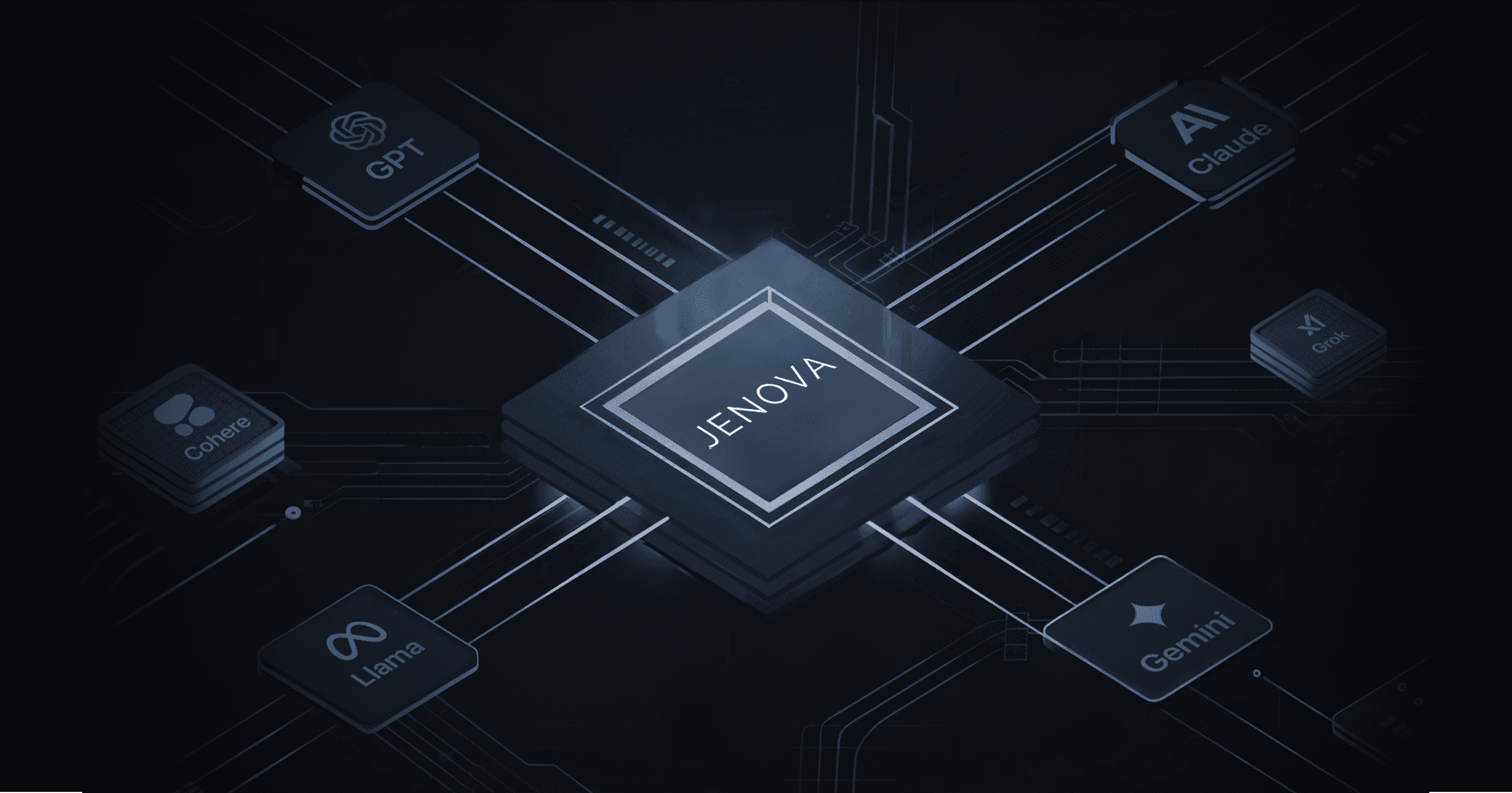
The image above illustrates Jenova's core architecture: a central hub connecting to frontier AI models from OpenAI, Anthropic, Google, xAI, Meta, and Cohere. This isn't just about choice—it's about using the right model for each task.
Why this matters:
Different models have distinct strengths. Claude Opus 4.5 excels at nuanced analysis and long-context reasoning. GPT-5.2 leads in creative generation and coding. Gemini 3 Pro offers superior multimodal capabilities. Grok 4.1 provides real-time information access. A true productivity AI app should leverage all of them.
App Integration via MCP
The Model Context Protocol (MCP) enables AI to interact directly with your existing tools. Through Jenova, AI agents can:
- Read and send emails via Gmail integration
- Manage calendar events through Google Calendar
- Access and organize files in Google Drive and Dropbox
- Search and synthesize across Google, Google Scholar, YouTube, and Reddit
- Update project databases in Notion
This transforms AI from a conversation partner into an active participant in your workflow.
Specialized AI Agents for Every Productivity Need
Generic AI assistants handle generic tasks. For specialized work, you need specialized expertise. Jenova's agent library provides purpose-built AI experts across domains:
Research & Analysis
The Academic Research Assistant functions as an elite research partner, combining Google Scholar integration with document generation capabilities. It handles literature discovery, citation management, and manuscript preparation—tasks that traditionally consume weeks of researcher time.
For market and competitive intelligence, the Fundamental Stock Analyst and Technical Stock Analyst provide institutional-grade analysis. They process earnings reports, SEC filings, and price action data to deliver actionable insights.
Business Operations
The Business Co-Pilot serves as a strategic partner for founders and executives. It assists with business planning, financial modeling, and operational decisions—the kind of high-leverage work that McKinsey research shows delivers the greatest AI ROI.
For e-commerce operators, the E-Commerce Business Partner handles product research, listing optimization, and PPC strategy—combining multiple specialized skills into a single agent.
Personal Productivity
The Personal Secretary manages calendar coordination, email triage, and daily logistics. Unlike basic AI assistants, it connects to your actual tools via MCP, executing tasks rather than just suggesting them.
For document creation, specialized generators produce professional PDFs, Word documents, and spreadsheets with adaptive design—eliminating the friction between ideation and deliverable.
Professional Development
The Interview Coach prepares candidates for behavioral, case, technical, and executive interviews. The MBA Admissions Consultant guides applicants through business school positioning. These agents encode expertise that would otherwise require expensive human consultants.
How Jenova Works: A Step-by-Step Walkthrough
Step 1: Access the Platform
Visit jenova.ai and create a free account. The platform works across web, iOS, and Android.
Step 2: Choose Your Agent
Browse the agent library or start with the general Jenova AI. Each agent comes pre-configured with domain expertise, relevant app connections, and optimized prompts.
Step 3: Connect Your Apps
Through the Apps panel, connect the tools you use daily: Gmail, Google Calendar, Notion, Dropbox, and more. These connections enable agents to take action on your behalf.
Step 4: Describe Your Task
Use natural language to describe what you need. For complex workflows, the agent breaks tasks into logical steps, executing each while keeping you informed.
Step 5: Review and Refine
Agents provide outputs for your review. Persistent memory means context carries forward—no need to re-explain your preferences or prior work.
Real-World Productivity Gains
The data on AI productivity impact is compelling—and accelerating.
📊 Time Savings by Role
According to Lenny's Newsletter survey of 1,750 tech workers:
- Founders: 49% report AI saves over 6 hours per week
- Product Managers: 63% report 4+ hours saved weekly
- Engineers: 51% report quality improvements (though 21% note mixed results)
- Designers: 47.5% report 4+ hours saved weekly
💼 Enterprise Adoption Patterns
McKinsey's 2025 survey reveals that high-performing organizations share common traits:
- They use AI for growth and innovation, not just cost reduction
- They redesign workflows around AI capabilities
- They deploy AI across multiple business functions
- Senior leaders actively champion AI adoption
📱 Mobile Productivity
Productivity apps generated over $32.5 billion in revenue in 2024. The shift to mobile-first AI access means professionals can maintain productivity regardless of location—a capability Jenova supports through native iOS and Android apps.
Use Cases: Productivity AI in Action
🎯 For Founders & Executives
Scenario: A startup founder needs to prepare for investor meetings while managing daily operations.
Traditional Approach: Hours spent manually researching competitors, drafting pitch materials, and coordinating schedules across multiple tools.
Jenova Solution: The Business Co-Pilot handles competitive analysis and financial modeling. The Personal Secretary manages calendar coordination and email follow-ups. Document generators produce polished pitch decks. All through natural language requests.
📚 For Researchers & Analysts
Scenario: A market analyst needs to synthesize quarterly earnings across 50 companies.
Traditional Approach: Days of manual report reading, data extraction, and spreadsheet compilation.
Jenova Solution: The Fundamental Stock Analyst processes earnings reports and SEC filings, extracting key metrics and identifying trends. The Academic Research Assistant handles literature reviews when academic sources are needed.
✍️ For Content Creators
Scenario: A marketing team needs to produce localized content across multiple markets.
Traditional Approach: Separate workflows for content creation, translation, and localization—often requiring external agencies.
Jenova Solution: The Creative Fiction Writer handles initial content development. Specialized translators—Spanish, French, German, Chinese, Japanese—provide nuanced localization. The Marketing Visual Designer generates accompanying assets.
🗓️ For Busy Professionals
Scenario: An executive assistant manages complex scheduling across time zones while handling correspondence.
Traditional Approach: Constant context-switching between calendar, email, and communication tools.
Jenova Solution: The Personal Secretary connects directly to Gmail and Google Calendar, handling scheduling conflicts, drafting responses, and managing follow-ups—all through conversational requests.
Frequently Asked Questions
How does Jenova differ from ChatGPT or Claude?
While ChatGPT and Claude are powerful general-purpose AI assistants, Jenova provides three key advantages: multi-model access (use GPT-5.2, Claude Opus 4.5, Gemini 3 Pro, or Grok 4.1 based on task requirements), app integration (connect to Gmail, Calendar, Notion, and more via MCP), and specialized agents (purpose-built AI experts for specific domains). This transforms AI from a conversation tool into a productivity system.
Is my data secure on Jenova?
Jenova prioritizes data privacy: your information is never used for model training, all data is encrypted in transit and at rest, and nothing is sold to advertisers. The platform is developed by Azeroth Inc., a New York-based company serving users in over 70 countries.
What does Jenova cost?
Jenova offers tiered pricing: Free (core features with limited daily usage), Plus ($20/month with 20× usage and custom model selection), **Pro** ($100/month with 100× usage), and Max ($200/month with 200× usage and priority support). Visit jenova.ai for current details.
Can I create custom AI agents?
Yes. Jenova allows users to create custom AI agents with specific instructions, knowledge bases, and app connections. This enables organizations to build specialized assistants tailored to their unique workflows.
Which AI models are available?
Jenova provides access to frontier models including GPT-5.2 (OpenAI), Claude Opus 4.5 (Anthropic), Gemini 3 Pro (Google), and Grok 4.1 (xAI). Users can select models based on task requirements or use intelligent routing to automatically match tasks to optimal models.
How do app integrations work?
Through the Model Context Protocol (MCP), Jenova connects to your existing tools. Once connected via the Apps panel, AI agents can read emails, manage calendar events, access files, and execute actions directly—transforming AI from advisor to active assistant.
The Future of Productivity Is Unified AI
The productivity tools of the past decade were defined by fragmentation—dozens of apps, each solving a narrow problem, none talking to each other. The next era belongs to platforms that unify AI capabilities, app integrations, and specialized expertise into coherent systems.
IBM's 2026 predictions describe this as "Connected Intelligence"—where people, data, and AI agents work together seamlessly. Microsoft's research points to AI evolving "from instrument to partner." MIT Sloan emphasizes the shift from individual AI tools to enterprise-level resources.
Jenova embodies this evolution. By combining multi-model access, app integration, specialized agents, and persistent memory, it delivers the productivity AI app that professionals have been waiting for—one that adapts to how you work rather than forcing you to adapt to it.
Ready to transform your productivity? Explore Jenova's specialized agents and discover what's possible when AI truly works alongside you.