Procedural Quest System AI: Design Branching RPG Missions
2026-09-11
Game Designer Assistant helps you design a procedural quest system by turning genre rules, quest templates, and branch constraints into playable mission graphs. While hand-authored quests stall production and collapse under unused branches, this AI provides structured quest trees, reconverging paths, and implementation-ready design docs.
As of September 2026, teams still spend years assembling content players finish once. A well-specified procedural quest system is how you keep missions feeling authored without writing every variant by hand.
- ✅ Branching quest graphs from a single root objective
- ✅ Reuse of rooms, NPCs, and loot across unique missions
- ✅ Scope control through reconverging end-states
- ✅ Design docs programmers can implement without guesswork
To understand why this matters, let's examine the production problems RPG and dungeon-crawler teams still hit when quests are treated as one-off scripts.
Quick Answer: What Is a Procedural Quest System?
A procedural quest system is a rules-based pipeline that generates missions — objectives, branches, rewards, and end-states — from templates so players get varied quests without designers writing every path. Game Designer Assistant turns those rules into graphs, sample quests, and production notes.
Key capabilities:
- Quest-tree architecture with a root objective, child quests, and leaf outcomes
- Template libraries for kill, fetch, escort, puzzle, and moral-choice missions
- Reconvergence so branches share assets instead of exploding scope
- Dungeon-aware placement so generated quests fit rooms, keys, and combat beats
- Implementation notes for graphs, flags, and journal text
Why Hand-Authored Quests Break at Scale
Procedural content generation (PCG) has been used in games since the late 1970s, from early roguelikes through modern open worlds. The method is no longer a niche trick: surveys of recent research treat quests as a first-class content type alongside maps, items, and rulesets in standard PCG references.
The commercial pressure is real. A 2024 survey of PCG research notes that the video game industry surpassed combined music and movie revenue in 2022, while building a complete game can still take several years. Players expect more missions, more replay, and more consequence. Hand-authored quest lines do not scale to that demand.
Several years — Typical time required to create a complete game
207 papers (2019–2023) — PCG studies from major AI-and-games conference series
But shipping a good procedural quest system is frustratingly difficult:
- Branching explodes faster than teams can write. Each extra choice multiplies dialogue, scripting, VO, and QA. GDC analysis of branching narrative is blunt: consequential branching costs time, money, crunch, and content players never see.
- Generated missions feel disconnected. Designers on Game Dev Stack Exchange keep asking the same question: how do you make procedural quests feel causal, not like a random bulletin board?
- Replay is not the same as meaning. praise mission variety in games such as Deep Rock Galactic, then note that individual jobs still lack long-term narrative weight.
- Dungeons and quests are designed in different tools. A generated catacomb with keys, combat, and loot is useless if the quest layer still says “talk to NPC, fetch item, return.”
Authored branching still matters. Research on procedural branching quests points to titles such as Mass Effect 2, The Witcher 3: Wild Hunt, and Assassin's Creed Valhalla as the player-facing standard: choices should fork, matter, and still land in a finishable structure. The production problem is that those graphs are expensive to invent, document, and keep coherent.
This is exactly what a dedicated game-design partner was built for.
Why Game Designer Assistant for Procedural Quest Design
Game Designer Assistant treats a procedural quest system as a design object: templates, graphs, constraints, and failure cases — not a pile of one-off quest text. You bring genre, fantasy, and production limits. It returns quest architecture you can playtest, cut, and hand to engineering.
That distinction matters. A general chatbot will invent colorful errands. A quest system has to answer harder questions: What is the root objective? How many child quests are legal? Which branches reconverge? Which flags persist? Which rooms in the dungeon can host which objectives without breaking pacing?
| Traditional Approach | Game Designer Assistant |
|---|---|
| Hand-write every quest and every unused branch | Specify templates and generate only legal graphs |
| Flowcharts that drift from the build | Systems analysis plus implementation-facing docs |
| Scope explosion from “just one more choice” | Reconverging end-states and shared objectives |
| Dungeon layout and quest logic designed apart | Missions that reuse rooms, keys, enemies, and loot |
| Playtest feedback trapped in chat logs | Persistent design memory across iterations |
Quest trees instead of quest lists
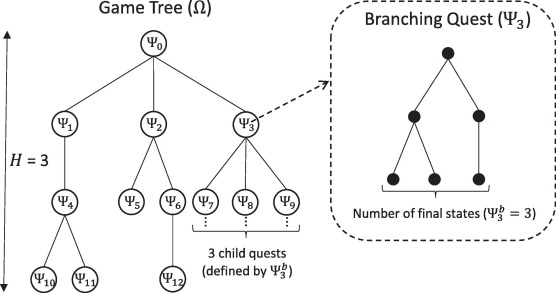
A robust procedural quest system is usually a tree or directed graph: a root quest, child quests, and a bounded set of final states. The figure above is the right mental model — height limited, children explicit, some nodes defined as branching quests that spawn a fixed number of outcomes. That is how you get variety without an infinite plot.
Academic work on branching quest generation and event-driven systems such as StoryWorld starts from the same idea: simulate or sample structure first, then fill in fiction. This AI works the same way at design time. You cap tree height, name the legal quest types, and force reconvergence so QA can actually finish a path.
Templates that still feel authored
Quest design is the craft of mid-game tasks that teach the world. Procedural systems fail when they only randomize “kill 8 wolves.” Strong templates encode why the wolf hunt exists: a faction debt, a blocked road, a moral fork, a key the next room needs.
Ask for that explicitly:
"Design a procedural quest system for a dark-fantasy dungeon RPG. Root objective: cleanse the Necropolis. Legal child types: lock-and-key, elite hunt, moral choice, escort, and relic fetch. Max tree height 3. Every branch must reconverge on a single boss gate. Output the graph, flag list, and 6 sample quests."
Scope as a first-class constraint
Iterative quest designers have long argued that a side quest should have one end-objective, with different outcomes rather than different finish lines. That rule is even more important when an algorithm is spawning content. The assistant can draft diamond-shaped graphs, hub-and-spoke NPC quests, and “three ways to say yes” branches that change characterization without cloning entire acts — the same spectrum narrative designers use to avoid overscope.
From design session to build notes
Systems analysis is only useful if engineering can implement it. A complete pass should leave you with:
- Node IDs, parent/child links, and completion flags
- Objective verbs mapped to gameplay verbs (unlock, slay, deliver, choose)
- Shared assets (keys, rooms, bosses) so PCG dungeons and PCG quests talk to each other
- Journal text patterns, not just one-off flavor
- Playtest scripts for the happy path and the ugly path
"Convert this quest tree into a data schema: QuestID, ParentID, ObjectiveType, RequiredFlags, RewardTable, FailState, ReconvergenceNode. Call out any node that cannot be generated without a unique VO line."
Related Agents You'll Also Find Useful
If you are building a procedural quest system, design is only one seat at the table. Narrative, implementation, and playtest each need their own pass.
C++ Coding Assistant
When the graph leaves the doc and enters the engine, C++ Coding Assistant helps you express quest nodes, flag sets, and dungeon-to-quest queries in engine-grade C++. That is the difference between a pretty flowchart and a weighted graph you can serialize, seed, and debug.
- Graph and state-machine sketches that match your design flags
- Save-safe quest progress and reconvergence checks
- Performance-conscious generation loops for runtime PCG
Writing Assistant
Templates still need words. Writing Assistant turns node types into NPC briefs, journal entries, and branch-aware dialogue that can be slotted into generated missions without sounding like a loot table.
- Voice-consistent giver/target text per faction
- Short, reusable lines for fetch, hunt, and moral-choice nodes
- Failure and reconvergence copy so every leaf still reads as a story beat
Roleplay Game Master
A quest graph can be valid and still feel hollow. Roleplay Game Master lets you walk a generated branch as a player — with memory of prior choices — before you spend an art or scripting budget on it.
- Table-read a moral fork and see which option players actually want
- Stress-test whether reconvergence feels earned or like a railroad
- Capture “this beat is boring” notes while the system is still cheap to change
Try the design partner free — no credit card required. Then pull writing, engine code, and playtest into the same pipeline.
How to Design a Procedural Quest System Step by Step
You do not start by asking for “100 unique quests.” You start by locking the grammar of missions, then you sample from it.
Step 1: Define the game, the verb list, and the hard limits
State genre, camera, session length, and what the player can actually do. A first-person dungeon crawler with attack, keys, and potions cannot host a court-intrigue tree. A 20-minute mobile run cannot host a three-act tragedy.
"I am building a pixel-art dungeon RPG. Verbs: move, attack, unlock, drink potion, pick up relic. Runs last 15–25 minutes. Design a procedural quest system that never requires an objective the verbs cannot complete."
Step 2: Draw the quest grammar before the fiction
Specify root, legal children, max height, and how many final states you will support. Force reconvergence. Name the flags. This is the same discipline as limiting a hand-authored quest to one end-objective before you add extra strands.
"Root: 1-1 Necropolis. Height 3. Each elite room may spawn up to 3 child quests. All paths reconverge at the boss gate. Output a tree with node IDs and the list of shared flags."
Step 3: Bind quests to the dungeon, not the other way around
Procedural dungeons fail when quests ignore geometry. Keys belong on locked doors. Elite hunts belong in rooms with space to kite. Escorts should not path through spawn closets. Attach each objective type to room tags.
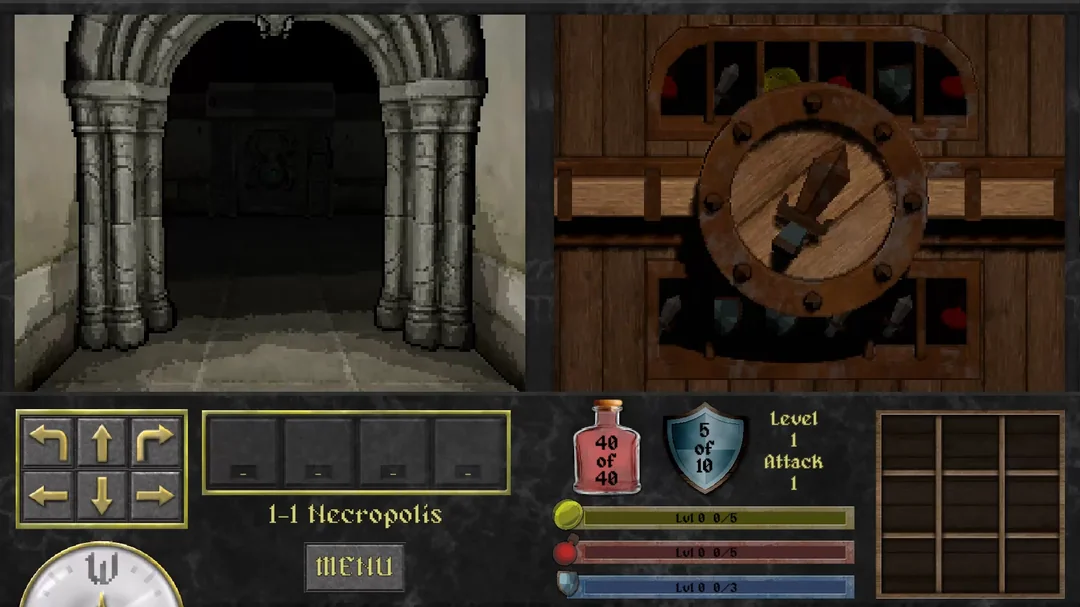
"Here is a Necropolis floor: entrance arch, barred weapon cache, potion pickup, three locked side rooms. Assign procedural quests so the cache, the potion, and the side rooms are each used by at least one generated mission."
Step 4: Write one vertical slice, then multiply
Finish a single strand — giver, obstacle, payoff — until it is playable. Only then duplicate templates. That iterative strand method is how experienced quest designers avoid discovering too late that a branch is unimplementable.
"Write the kill-the-warden strand from briefing to boss-gate reconvergence. Include journal text, two fail states, and the exact flags engineering must set. Do not add extra branches yet."
Step 5: Playtest for meaning, then freeze the grammar
Walk the graph. If every mission is a fetch, tighten weights. If players cannot tell why a choice mattered, move consequence earlier. When the grammar is stable, freeze it and let runtime PCG sample — do not keep inventing new quest types mid-production.
"I playtested 12 generated Necropolis quests. Eight were fetch variants. Rebalance weights, add two causal links between child quests, and keep the same reconvergence node."
Results & Use Cases
📊 Indie Action-RPG With a Branching Main Spine
- Scenario: A five-person team needs a main quest that forks at a prison break, then returns to a single act break, plus side missions that reuse the same valley.
- Traditional Approach: Weeks of flowcharts, duplicated VO plans, and a side-quest list that does not share objectives — the same trap mod and freelance quest designers describe when branches multiply.
- Game Designer Assistant: A height-capped tree, two authored strands, and side-quest templates that share the “find the key” objective across kill and free paths.
- One end-objective for the spine
- Child quests that borrow rooms and NPCs
- A flag list engineering can implement without reverse-engineering the fiction
- Sample prompts ready for Writing Assistant to voice
💼 Dungeon Crawler With Replayable Floor Quests
- Scenario: A roguelike-like dungeon crawler needs every Necropolis run to roll different objectives on the same tile set — lock-and-key, elite hunt, relic fetch — without feeling like a random number generator.
- Traditional Approach: Designers hand-place a handful of floor events; after three runs players have seen the set. Runtime PCG for maps exists, but the quest layer stays static.
- The AI design partner: Room tags mapped to quest types, weighted tables, and reconvergence at the floor boss so variety never strands a run.
- Missions that consume the barred cache, potions, and side rooms you already built
- No objective that the combat/inventory verbs cannot complete
- Seeds and flags documented for a C++ Coding Assistant implementation pass
📱 Mobile Design Pass Between Playtests
- Scenario: You are on a train after a messy playtest. Three testers ignored the moral choice and power-gamed the fetch. You need a revised grammar before tonight’s build.
- Traditional Approach: Notes in a phone memo, a whiteboard photo, and a morning meeting to reconstruct intent.
- The same design partner on web, iOS, or Android: Dictate the playtest result, get a reweighted tree, and send the new flag list to the build channel before you sit down at a desk.
- Speech-to-text for messy debriefs
- Persistent memory of last night’s graph
- A 15-minute pass you can actually finish on a phone
🎯 Live-Service Board That Needs Causal Quests
- Scenario: Weekly boards must feel connected — a supply run that explains tomorrow’s siege — rather than a list of unconnected dailies, the gap .
- Traditional Approach: Writers invent 20 dailies. Players complete them as chores. Nothing persists.
- Structured generation: Event-driven templates in the spirit of systems like StoryWorld — world state in, quest graph out — then a Roleplay Game Master table-read to check whether the causality is readable.
- Child quests that consume yesterday’s flags
- Boards that reconverge on a weekly boss or faction beat
- Fewer unique assets, more perceived story
FAQ
What is a procedural quest system in an RPG?
A procedural quest system is a constrained generator for missions. It samples objectives, branches, rewards, and end-states from templates and world flags instead of relying on a fixed quest list. The quality bar is not “infinite quests.” It is legal quests: every branch completable, every dungeon asset used on purpose, every path able to reconverge so the story and the build can finish.
Is Game Designer Assistant free to use?
Yes. Game Designer Assistant is available on a free plan with core features and limited monthly usage. Paid tiers increase usage if you are running long design sessions, attaching large lore bibles, or iterating graphs daily. You can start a quest-system pass without a credit card and upgrade only if the workload needs it.
How is this different from designing quests in a general chatbot?
A general chatbot improvises errands. This AI is a game-design partner: systems analysis, genre constraints, documentation, and iteration across sessions. You can attach design docs, keep flag names stable from Monday to Friday, and ask for graphs that a programmer can implement. The output is a procedural quest system — grammar, weights, reconvergence — not a pile of disconnected side-quest pitches.
Can a procedural quest system work with a procedural dungeon?
Yes, and it should. Tag rooms (entrance, lock, cache, arena, boss gate), then let quest types bind to tags. A relic fetch that ignores the barred weapon cache is a wasted asset; an elite hunt in a corridor with no strafe space is a failed template. Bind verbs to geometry first, then generate. That is how dungeon PCG and quest PCG stay on the same map.
Does Game Designer Assistant work on mobile?
Yes. Web, iOS, and Android share the same design workflow, so you can revise a quest tree after a playtest without waiting for a desktop. Speech-to-text helps when you are dumping notes from a session. Settings and history sync, which matters when a flag list has to stay exact across devices.
How do I stop generated quests from feeling repetitive?
Cap the grammar. Weight templates so fetch cannot dominate. Require causal flags between child quests. Reconverge on a meaningful gate rather than a floating “return to giver.” Then playtest. If testers cannot tell two missions apart, the problem is almost never “need more random names” — it is that two nodes share the same verb, the same room tag, and the same reward.
Start Building Your Procedural Quest System
Hand-authored quests run out. Unconstrained generators feel cheap. The workable middle is a procedural quest system with a visible grammar: a root, legal children, a height cap, shared flags, and an end-state every path can hit.
Game Designer Assistant is built for that job — quest trees, dungeon-aware objectives, and docs you can implement. Pair it with writing, engine code, and playtest when you are ready to move from graph to build.
Try Game Designer Assistant now. Explore more at Jenova.
For Developers: Game Designer Assistant is available programmatically via the Jenova API — integrate procedural quest design into your application with a single API call. Full documentation →