Private AI Agents: Secure, Customizable Intelligence for Enterprise Operations
2026-01-08
The enterprise AI landscape has reached an inflection point. With 78% of organizations now using AI and 87% experiencing AI-driven cyberattacks in the past year, the question is no longer whether to adopt AI—it's how to deploy it without exposing sensitive data to public models, third-party training, or regulatory violations.
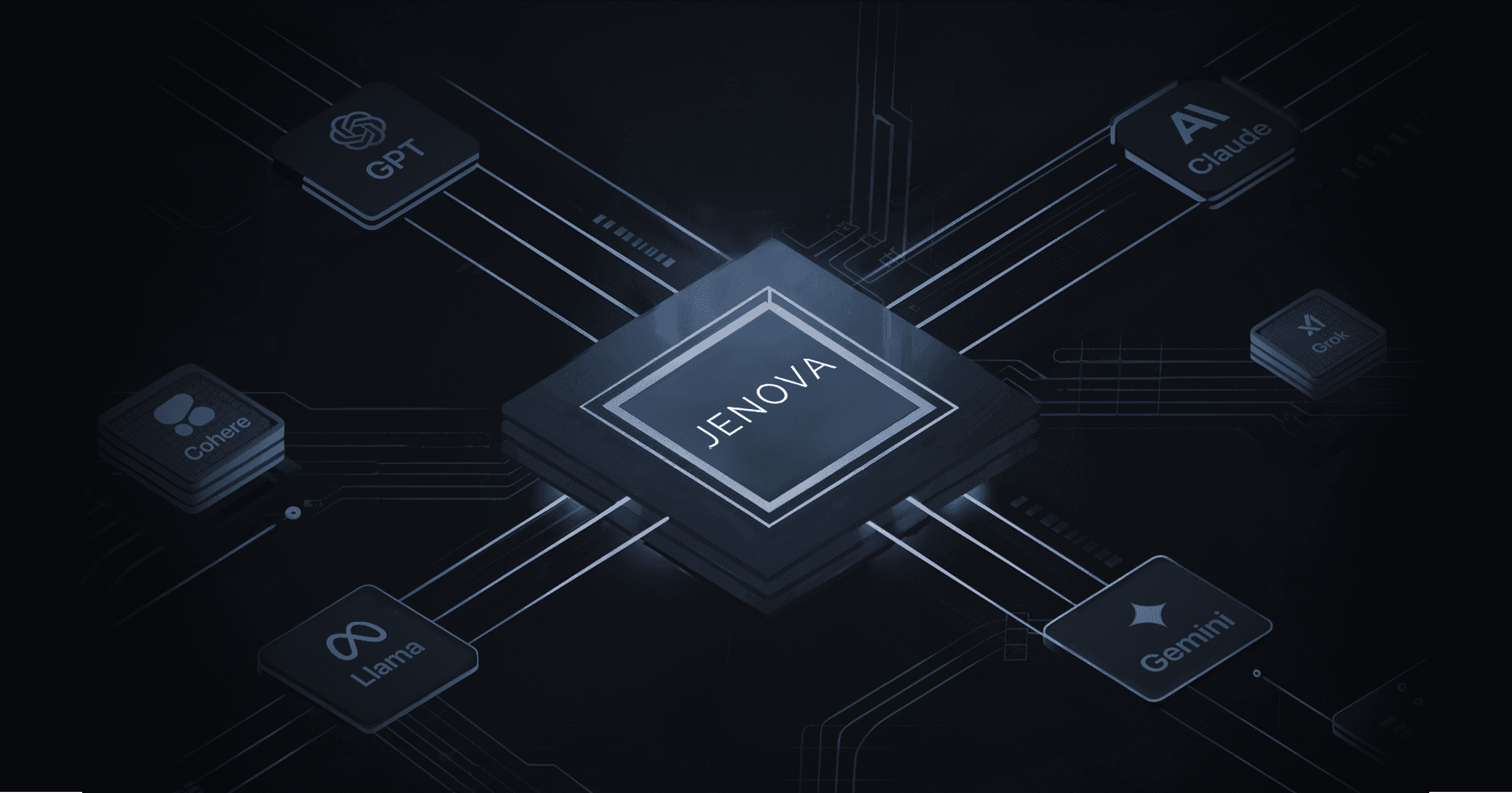
Private AI agents solve this fundamental tension. These specialized systems operate within controlled environments, process proprietary data without external exposure, and deliver domain-specific intelligence that generic chatbots simply cannot match. Jenova offers a comprehensive platform for deploying private AI agents across multiple frontier models—GPT-5.2, Claude Opus 4.5, Gemini 3 Pro, and Grok 4.1—all within a secure, enterprise-ready architecture.
What you'll learn in this guide:
- Why private AI agents are becoming essential for regulated industries
- The security, customization, and compliance advantages over public models
- How to evaluate and deploy private AI agent solutions
- Specialized agents for finance, healthcare, legal, and business operations
Quick Answer: What Are Private AI Agents?
Private AI agents are AI systems deployed within controlled environments—on-premise infrastructure, private clouds, or secure platforms—where organizational data never leaves the protected perimeter and is never used for external model training.
Key characteristics:
- Data sovereignty: All processing occurs within your security boundary
- No training exposure: Your prompts and data never improve public models
- Custom fine-tuning: Agents trained on proprietary workflows, terminology, and processes
- Regulatory compliance: Built-in support for GDPR, HIPAA, CCPA, and industry-specific requirements
- Multi-model access: Choose the optimal AI model for each task without vendor lock-in
The Problem: Why Public AI Models Create Enterprise Risk
The convenience of public AI comes with hidden costs that many organizations discover too late. Understanding these risks is essential before evaluating private alternatives.
Data Privacy and Training Exposure
When employees use public LLMs like ChatGPT or Gemini, their prompts may be used to train future model versions. According to Matillion's enterprise security analysis, this creates a fundamental compliance violation: "Data privacy regulations like GDPR, CCPA, and HIPAA aren't just about preventing data breaches—they're about ensuring data is only used for the purposes originally agreed upon with data subjects."
The training data risk: When customer data, employee information, or confidential business intelligence becomes part of an LLM's training dataset, it violates core principles of data governance—even if no breach occurs.
The Regulatory Compliance Maze
The regulatory landscape for AI is fragmenting rapidly:
- U.S. federal agencies issued 59 AI-related regulations in 2024—more than double the previous year
- EU AI Act requirements for high-risk AI systems take full effect by August 2026
- State-level laws in California, Colorado, Texas, and Indiana are creating overlapping compliance obligations
- GDPR fines have exceeded €6.7 billion across 2,500+ enforcement actions
Organizations using public AI models face the impossible task of proving their data isn't being used for training purposes they never consented to.
Security Vulnerabilities and Shadow AI
The cybersecurity implications are equally concerning:
- 87% of organizations experienced an AI-driven cyberattack in the past year
- 40% of data breaches by 2027 are predicted to stem from "shadow AI"—unauthorized AI use by employees
- Only 26% of security experts express high confidence in detecting AI-driven attacks
- Organizations with unmonitored AI faced breach costs averaging $670,000 higher than those with strict controls
The Customization Gap
Public models are trained on generic internet data. They lack understanding of:
- Your company's specific terminology and product codes
- Internal processes and compliance requirements
- Historical customer interactions and preferences
- Domain-specific knowledge that creates competitive advantage
This limitation means public AI delivers generic outputs that require extensive human review and correction—negating much of the promised efficiency gains.
The Private AI Agent Solution
Private AI agents address each of these challenges through architectural decisions that prioritize security, customization, and control.
Comparison: Public vs. Private AI Agents
| Dimension | Public AI Models | Private AI Agents |
|---|---|---|
| Data Location | Third-party servers, often multi-tenant | Your infrastructure or dedicated secure environment |
| Training Usage | May use your data to improve models | Guaranteed data isolation—never used for training |
| Customization | Limited to prompt engineering | Deep fine-tuning on proprietary data |
| Compliance | Difficult to audit and verify | Built-in compliance controls and audit trails |
| Performance | Shared resources, variable latency | Consistent performance, no throttling |
| Model Selection | Single vendor lock-in | Multi-model access, best tool for each task |
| Cost Structure | Per-token pricing, unpredictable at scale | Predictable costs, better economics at volume |
How Jenova Enables Private AI Agent Deployment
Jenova provides the infrastructure for organizations to deploy private AI agents without building from scratch:
Multi-Model Architecture: Access GPT-5.2, Claude Opus 4.5, Gemini 3 Pro, and Grok 4.1 through a unified interface. Select the optimal model for each task—reasoning-heavy analysis with Claude, creative generation with GPT, or rapid processing with Gemini—without managing multiple vendor relationships.
Data Sovereignty by Design: Your data never leaves the secure environment. Prompts, responses, and conversation history remain within your control, with encryption at rest and in transit.
Custom Knowledge Integration: Upload proprietary documents, connect internal databases, and fine-tune agents on your specific workflows. The platform's RAG (Retrieval-Augmented Generation) architecture ensures agents reference your actual data rather than generic training.
Enterprise App Integration: Connect agents to Gmail, Google Calendar, Drive, Notion, Dropbox, and other business tools via the Model Context Protocol (MCP)—enabling agents to take action within your existing workflows.
Specialized Private AI Agents for Enterprise Functions
The real power of private AI agents emerges when they're specialized for specific business functions. Generic chatbots can't match the depth of domain-trained agents operating on proprietary data.
Financial Analysis and Investment Research
For finance teams handling sensitive market data and proprietary strategies, private deployment is non-negotiable.
The Fundamental Stock Analyst agent processes earnings reports, SEC filings, and valuation models without exposing your research methodology to competitors. It maintains context across quarters of financial data, identifying trends that generic models miss.
For technical traders, the Technical Stock Analyst provides price action analysis, market structure assessment, and momentum indicators—all processed within your secure environment.
The Cryptocurrency Analyst delivers institutional-grade intelligence on on-chain fundamentals, derivatives positioning, and narrative dynamics—critical for firms where alpha depends on information security.
Healthcare and Clinical Operations
Healthcare organizations face the strictest data privacy requirements. HIPAA violations can result in penalties up to $1.5 million per incident category.
The Personal Medical Analyst enables secure symptom analysis and result interpretation without patient data ever touching public servers. For mental health applications, the Personal Therapist provides evidence-based guidance within a privacy-first architecture.
The Personal Nutritionist demonstrates how private agents can deliver personalized health recommendations while maintaining the data isolation that healthcare compliance demands.
Legal and Compliance Automation
Law firms and corporate legal departments handle attorney-client privileged information that cannot be exposed to public AI training.
Private AI agents can summarize new regulations, flag high-risk clauses, and generate draft policy updates—all while keeping confidential documents within the firm's security perimeter. As AIVeda's enterprise analysis notes: "Private LLMs can read and reason through thousands of pages of legislation, identify conflicts, and suggest language that aligns with existing policies."
Business Operations and Strategy
For strategic planning and competitive analysis, the Business Co-Pilot serves as a private strategic partner—processing financial models, operational data, and market research without exposing your business intelligence to external systems.
The E-Commerce Business Partner provides product research, listing optimization, and PPC guidance for online retailers who need AI assistance without sharing proprietary sales data with public models.
Research and Academic Work
The Academic Research Assistant enables literature discovery and manuscript preparation while keeping unpublished research confidential—essential for institutions where pre-publication data exposure could compromise patent applications or competitive grants.
How Private AI Agents Work: Technical Architecture
Understanding the technical foundation helps organizations evaluate private AI solutions effectively.
Step 1: Secure Environment Configuration
Private AI agents operate within isolated infrastructure—either on-premise servers, dedicated private cloud instances, or secure multi-tenant platforms with strict data segregation. The key requirement: your data never crosses into shared processing environments.
Step 2: Model Selection and Routing
Rather than being locked to a single AI vendor, private platforms like Jenova provide intelligent routing across multiple frontier models. A complex legal analysis might route to Claude Opus 4.5 for its reasoning capabilities, while a rapid customer service response uses Gemini 3 Pro for speed.
Step 3: Knowledge Base Integration
Private agents connect to your proprietary data sources:
- Internal document repositories
- CRM and ERP systems
- Historical conversation logs
- Domain-specific databases
This Retrieval-Augmented Generation (RAG) architecture ensures responses are grounded in your actual data rather than generic training.
Step 4: Workflow Orchestration
Through MCP (Model Context Protocol) integrations, private agents can take action within your existing tools—scheduling meetings, sending emails, updating records—while maintaining the security boundary.
Step 5: Continuous Learning and Refinement
Unlike public models that learn from all users, private agents can be fine-tuned exclusively on your feedback and data, improving performance on your specific use cases without benefiting competitors.
Results: What Organizations Achieve with Private AI Agents
The business case for private AI agents extends beyond risk mitigation to measurable operational improvements.
📊 Productivity and Efficiency
According to McKinsey's State of AI 2025 survey, organizations seeing the greatest AI impact share a common characteristic: they "fundamentally redesigned individual workflows" rather than simply automating existing processes.
- Software development: 40-60% reduction in engineering effort when AI agents run multi-step design processes
- Document processing: Claims validation and contract review cycles reduced from weeks to hours
- Customer service: 40% improvement in resolution rates with domain-trained conversational agents
💼 Compliance and Risk Reduction
Private deployment eliminates entire categories of regulatory risk:
- Training data isolation: Guaranteed protection against data being used for external model improvement
- Audit trails: Complete logging of all AI interactions for compliance verification
- Access controls: Role-based permissions ensuring sensitive data reaches only authorized agents
- Geographic compliance: Data residency controls for GDPR, DPDPA, and regional requirements
📱 Competitive Differentiation
BCG's research on agentic AI found that "AI-native firms already achieving 25 to 35 times more revenue per employee compared to traditional peers." The advantage comes not from AI itself, but from proprietary intelligence embedded in private systems.
When your AI agents are trained on your data, processes, and customer interactions, they deliver insights and capabilities that competitors using generic public models cannot replicate.
Frequently Asked Questions
How do private AI agents differ from enterprise versions of ChatGPT or Claude?
Enterprise versions of public models (ChatGPT Enterprise, Claude for Business) offer improved security over consumer versions but still process data on vendor infrastructure. Private AI agents operate within your controlled environment, with guaranteed data isolation and no training exposure. Jenova provides access to multiple enterprise-grade models through a single platform, combining the security of private deployment with multi-model flexibility.
What infrastructure is required to deploy private AI agents?
Modern private AI platforms don't require on-premise hardware. Jenova operates as a secure cloud platform where your data remains isolated and encrypted. Organizations with strict data residency requirements can deploy within specific geographic regions. The platform handles model management, scaling, and updates—you focus on configuring agents for your use cases.
How do private AI agents handle compliance with GDPR, HIPAA, and other regulations?
Private deployment addresses the core compliance requirements: data minimization (only necessary data is processed), purpose limitation (data used only for specified purposes), and data subject rights (ability to delete data without it persisting in model weights). Jenova's architecture ensures data never leaves your security boundary and is never used for external training—the two most common compliance failures with public AI.
Can private AI agents integrate with existing enterprise software?
Yes. Through MCP (Model Context Protocol) integrations, Jenova agents connect to Gmail, Google Calendar, Drive, Notion, Dropbox, and other business tools. This enables agents to take action within your existing workflows—scheduling meetings, sending emails, updating records—while maintaining security controls.
What's the cost difference between public and private AI agents?
Public AI pricing (per-token) can become unpredictable at scale. Private platforms typically offer more predictable cost structures. More importantly, the cost of a single data breach or compliance violation—[averaging $670,000 higher](https://www.bakerdonelson.com/2026-ai-legal-forecast-from-innovation-to-compliance) for organizations with uncontrolled AI—often exceeds years of private platform investment. Jenova offers tiered pricing from free access through enterprise plans at $200/month for maximum usage.
How quickly can organizations deploy private AI agents?
Unlike building custom AI infrastructure (which can take 12-18 months), platform-based deployment enables production use within days. Jenova's pre-built specialized agents can be configured with custom knowledge bases and connected to existing tools immediately. Organizations typically start with specific use cases and expand as they validate results.
Conclusion: The Strategic Imperative for Private AI
The era of treating AI as a generic utility is ending. As TrustArc's 2026 privacy analysis concludes: "Privacy leaders are not just avoiding fines; they are building the trust that fuels the digital economy."
Private AI agents represent the convergence of three critical enterprise requirements:
- Security: Data sovereignty and protection from training exposure
- Customization: Domain-specific intelligence trained on proprietary data
- Compliance: Built-in controls for evolving regulatory requirements
Organizations that deploy private AI agents now will build institutional intelligence that compounds over time—agents that understand their specific workflows, terminology, and competitive context. Those relying on generic public models will find themselves perpetually behind, using the same tools as everyone else.
Jenova provides the platform to deploy private AI agents across frontier models—GPT-5.2, Claude Opus 4.5, Gemini 3 Pro, and Grok 4.1—with the security, customization, and compliance controls that enterprise operations demand. Whether you need specialized agents for financial analysis, business strategy, or research assistance, the platform enables deployment without the infrastructure complexity of building from scratch.
The question isn't whether your organization will adopt AI agents. It's whether you'll deploy them privately—maintaining control over your data and building proprietary intelligence—or publicly, where your competitive insights become training data for everyone else.