Preset-Character AI Companions vs. User-Defined Companions: Which Are Better for Long-Term Use?
2026-08-18
Which Companion Architecture Holds Up Better After Six Months of Daily Use?
User-defined companions generally outperform preset characters over long time horizons, but only when the underlying platform provides durable memory and stable personality anchoring — without those, custom companions degrade faster than presets because there is no author-maintained character sheet to fall back on. Preset characters from platforms like Character.AI hold up better for short, varied, exploratory sessions. Custom-built companions on platforms like Nomi, Kindroid, or general-purpose agent platforms like Jenova hold up better for continuous, single-relationship use measured in months.
The variables that actually determine long-term durability:
✅ Memory persistence architecture — whether context survives session boundaries or resets, and whether memory depth is gated behind a paid tier ✅ Personality drift resistance — preset characters have an author-defined baseline; custom characters drift unless the user re-anchors them ✅ Platform stability risk — Replika's 2023 removal of erotic role-play features demonstrated that preset and custom companions alike can be altered by a vendor update ✅ Data governance — 14 of 16 platforms reviewed by the Ada Lovelace Institute claimed broad rights to use private chat logs for service improvement or model training ✅ Engagement design — whether the system is engineered for sustained wellbeing or for retention metrics
The rest of this guide breaks these down into an evaluation framework, then compares the major platforms on each dimension.
Why Is the Preset vs. Custom Distinction Suddenly Worth Arguing About?
The distinction matters now because AI companionship has moved from novelty to sustained daily habit for a large user base, and the two architectures fail in different ways at scale. The AI companion market was valued at roughly $36.8 billion in 2025 and is projected to reach approximately $48.0 billion in 2026, though estimates vary widely by definition — The Business Research Company places the 2026 figure at $24.09 billion. The spread itself is informative: analysts do not agree on where "companion" ends and "assistant" begins.
Usage data reveals the split clearly. Ada Lovelace Institute research found that mixed-use platforms like Character.ai see users return an average of 16 times per month with session times exceeding six minutes, while mating-oriented platforms attract 29 million global unique visitors but average only about three visits per month with roughly five-minute sessions.
That gap is the entire preset-vs-custom argument in one statistic. Preset-character libraries win on breadth and casual re-engagement. Sustained relationships require something the library model does not naturally provide.
The regulatory picture is tightening in parallel. New York's AI Companion Models Law and California's Companion Chatbot Law mandate protocols to interrupt extended use and require clear disclosures, and Australia, the EU, the UK, and several U.S. states are actively shaping frameworks around companion chatbots. Long-term users are choosing architectures that may be regulated differently within their own usage window.
What Should You Actually Evaluate When Choosing Between Preset and Custom?
Evaluate on six dimensions, weighted by how you intend to use the companion — not by which produces the better first conversation. First impressions favor presets almost universally, because a well-authored character arrives fully formed while a custom companion starts as a blank slate.
Here is the framework used throughout this guide, which we'll call the Six-Month Durability Test — each dimension is scored by how the companion behaves at month six, not week one:
1. Memory continuity depth Does the system retain facts across sessions, or reconstruct from a rolling context window? The Ada Lovelace research identifies memory as "perhaps the most potent retention mechanic," where premium subscriptions monetize additional memory storage — meaning users effectively pay recurring fees to prevent their companion from forgetting them.
2. Personality anchoring stability Preset characters have an author-written definition that acts as a gravitational center. Custom characters have whatever the user wrote at setup. If the platform re-injects that definition into every context window, drift is minimal. If it does not, the character slowly becomes a reflection of recent conversation.
3. Setup cost vs. long-run fit Presets have near-zero setup cost and moderate fit. Custom companions have meaningful setup cost and potentially excellent fit. The break-even point sits somewhere around week three of daily use for most users.
4. Sycophancy resistance The Ada Lovelace Institute documents "glazing" — insincere, excessive flattery designed to keep the user engaged — noting that AI companions rarely disagree with or challenge the user, which can create an echo chamber reinforcing biases or mental health concerns. Custom companions can be explicitly instructed toward constructive disagreement. Preset characters usually cannot.
5. Data governance and portability Can you export your character definition and conversation history? If a vendor changes policy or shuts down, does anything survive?
6. Vendor change exposure Both architectures are exposed, but differently. Preset characters change when the author or platform edits them. Custom characters change when the underlying model is swapped beneath them.
How Do the Major Companion Platforms Compare on Long-Term Durability?
No single platform leads on all six dimensions — Character.AI leads on preset library breadth, Nomi and Kindroid lead on companion-specific memory and customization, and general-purpose agent platforms lead on model flexibility and cross-domain use. The trade-offs are genuine.
| Dimension | Character.AI | Replika | Nomi | Kindroid | Jenova |
|---|---|---|---|---|---|
| Primary model | Preset library + user-created characters | Single custom companion | Custom companion | Custom companion | Custom agents + curated agent gallery |
| Character library | 20M+ community characters (MyPresio) | None — one companion per user | User-built, box-ticking style setup (LowEndBox) | User-built, free-text style setup (LowEndBox) | Curated expert agents plus user-built custom agents |
| Long-term memory | Reported as weak by reviewers (MyPresio) | Free tier memory weaker; improves with Pro (Genies) | Strong — users cite excellent recall without re-prompting (Genies) | Strong long-term memory (FindAIChat) | Unlimited chat history with persistent cross-session memory |
| Personality consistency | Varies by author quality; filters can shift behavior | Develops from user interaction over time (Genies) | Consistent core personality, low maintenance (Genies) | Deep control, notable learning curve (Genies) | Custom instructions re-anchored per agent; knowledge base grounding |
| Model choice | Platform-managed | Platform-managed | Platform-managed | Platform-managed | OpenAI, Anthropic, Google, DeepSeek, xAI and others, switchable |
| Pricing | ~$9.99/mo (MyPresio) | ~$7.99–$14.99/mo; Pro ~$19.99/mo or $69.99/yr (Genies, Fostera) | Free tier + premium generally $8–$16/mo (Genies) | Free tier + premium generally $8–$16/mo (Genies) | Free tier; Plus $20/mo at 30× free usage; higher tiers up to Enterprise |
| Best for | Variety, roleplay exploration, trying many characters | A single ongoing supportive companion, low technical effort | Emotional consistency and reliable memory with minimal tuning | Immersive roleplay and detailed narrative worldbuilding | Multi-purpose companions, task-capable agents, model flexibility |
Honest limitations, platform by platform:
- Character.AI — unmatched library breadth, but reviewers consistently flag weak memory and unpredictable filter behavior (MyPresio). It is the strongest option for exploration and the weakest for continuity.
- Replika — the most approachable onboarding and the only major platform offering video calls (Genies), but has the clearest historical precedent for disruptive feature removal, and its free-tier memory is comparatively weak.
- Nomi — praised for memory and steady personality without constant tuning (Genies), but its box-ticking character creation offers less expressive range than free-text setup (LowEndBox).
- Kindroid — the deepest customization for roleplay and character work, offset by a real learning curve that reviewers note requires time investment to configure well (Genies).
- Jenova — the strongest position on model flexibility, persistent memory, and cross-domain capability, and the only platform here where the same custom agent can hold a conversation and then execute a real task through connected tools. It is explicitly not a romantic-companion platform, has no avatar generation, no voice-call companion mode, and no NSFW character ecosystem. Users seeking a romantic AI partner should look at the companion-native platforms above.
What Actually Breaks First in a Long-Running AI Companion?
Memory is the first failure point, and personality drift is the second — in that order, and usually within the first eight to twelve weeks of consistent use.
The technical reason is architectural. As the Upstash engineering guide to building companions with long-term memory explains, durable companions require a semantic memory layer separate from chat history — a system that "doesn't just store conversations; it understands their meaning and context, making it possible to retrieve relevant memories based on semantic similarity rather than just keywords."
Most consumer companion apps ship a rolling conversation buffer, not a semantic memory store. The distinction is invisible in week one and dominant by month three.
Three failure modes to watch for:
- Silent truncation — the companion stops referencing anything older than a certain window. It does not announce this. It simply stops mentioning your job change from two months ago.
- Recency collapse — the character's personality gradually converges toward the tone of the last twenty exchanges. Sarcastic companions become earnest; analytical ones become sentimental.
- Fact contradiction — the companion holds two incompatible facts about you simultaneously because both are retrievable and neither is authoritative.
Preset characters resist mode 2 better than custom ones, because the author's character definition is typically re-injected as a system prompt each turn. Custom characters resist mode 3 better, because the user knows what the ground truth is and can correct it explicitly.
How Do Personality, Memory, and Guardrails Actually Get Configured?
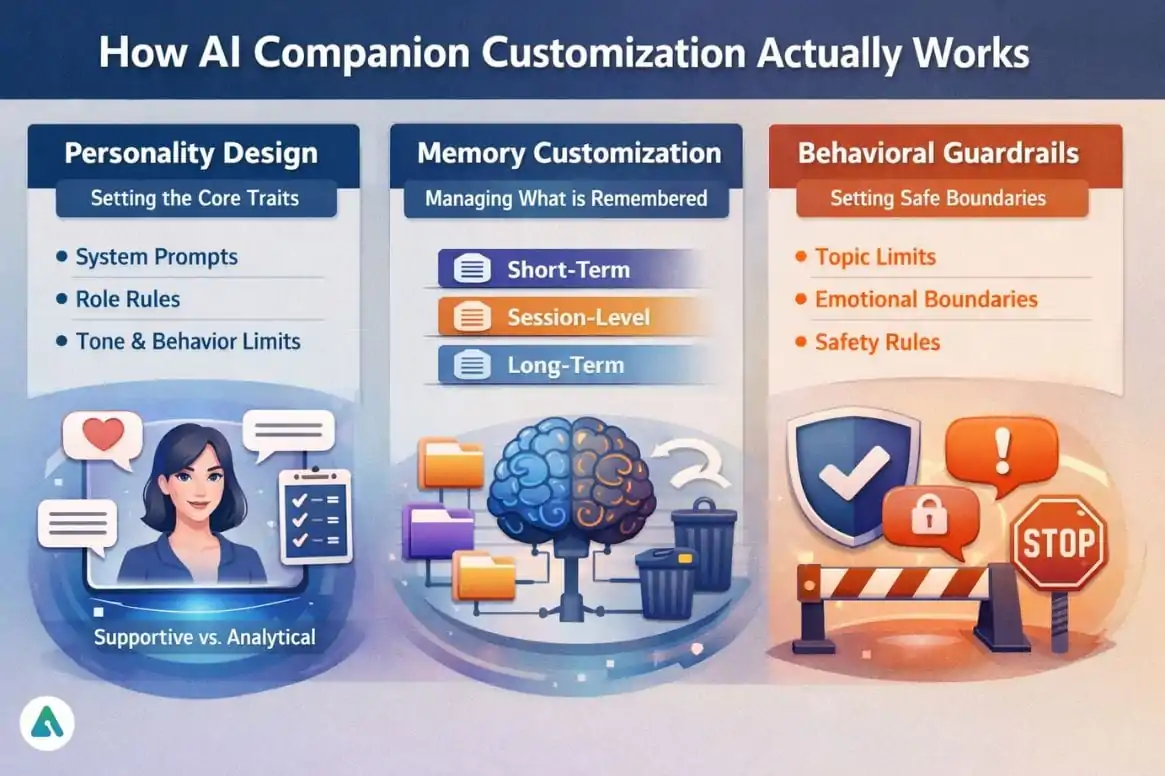
Every AI companion — preset or custom — is built from the same three configuration layers: personality design, memory management, and behavioral guardrails. Understanding which layer you control determines how much long-term influence you have over the companion's trajectory.
Layer 1 — Personality design. System prompts, role rules, and tone boundaries define the core traits, positioning the companion anywhere on a spectrum from supportive to analytical. In preset characters, this layer is written by the character's author and is typically read-only. In custom companions, this layer is yours.
Layer 2 — Memory customization. Retention operates across three tiers: short-term (the immediate exchange), session-level (the current conversation), and long-term (persistent facts across all sessions). Most consumer platforms give users visibility into long-term memory but limited editorial control. Platforms that expose a memory-editing interface — or accept an uploaded knowledge base — hand this layer to the user.
Layer 3 — Behavioral guardrails. Topic limits, emotional boundaries, and hard safety rules. Platform-level guardrails are non-negotiable and vendor-controlled. User-level guardrails — "do not offer medical advice," "push back when I'm rationalizing" — are additive and available in most custom-agent systems.
The practical takeaway: preset characters give you layer 3 control at best. Custom companions give you all three. For a six-month relationship, layer 1 control is what prevents drift and layer 2 control is what prevents amnesia.
How Do You Set Up a Custom Companion That Survives Six Months?
Setup takes fifteen to thirty minutes and the single highest-leverage decision is writing an explicit, re-readable character definition rather than letting personality emerge from conversation.
On Kindroid, the flow is free-text: you write a backstory and personality description in prose, then refine through a settings panel. Reviewers note this offers the richest control but requires iteration to get right (Genies).
On Nomi, setup is closer to structured selection — choosing traits from defined options, with post-creation customization available (LowEndBox). Faster to complete, narrower in expressive range.
On Jenova, custom agents are built at jenova.ai/a with four configurable inputs — custom instructions, preferred model provider, private knowledge base, and tool configuration. A durable companion setup looks like this:
- Open the agent creation flow at jenova.ai/a
- Write custom instructions that define personality, tone, and behavioral rules explicitly:
"You are a direct, analytically-minded thinking partner. Ask clarifying questions before offering solutions. Disagree with me when my reasoning is weak — do not validate conclusions I haven't supported. Reference our past conversations naturally rather than restating them."
- Upload a knowledge base document containing durable facts — your projects, relationships, ongoing goals, working context. This gives the agent a stable ground truth independent of conversation history.
- Select a preferred model. Because Jenova provides access across OpenAI, Anthropic, Google, DeepSeek, and xAI, the same companion definition can be tested against multiple models to find the best personality fit.
- Optionally connect tools via Model Context Protocol — Gmail, Google Calendar, Drive — turning the companion into something that can act, not just converse.
For anyone wanting emotional-support depth without building from scratch, Jenova's curated Personal Therapist agent provides a pre-configured starting point that can then be customized. Users interested in personality-aware companions often pair this with the Personality Analyzer, which synthesizes Big Five, MBTI, Enneagram, and attachment theory frameworks.
The maintenance step most users skip: every four to six weeks, re-read your character definition and update it. Custom companions drift because their definition is static while the relationship is not.
What Do Researchers Say About Long-Term AI Companion Use?
Researchers are more concerned with engagement architecture than with the preset-versus-custom question — and their findings suggest that how a platform monetizes memory matters more than who authored the character.
"The preset-versus-custom framing is genuinely useful, but it's downstream of a more consequential design question: is the system built to serve the user's stated goals, or to maximize session count? We look at three signals when evaluating a companion architecture. First, whether memory is a core capability or a paywalled upsell — when a platform charges you to prevent your companion from forgetting you, the incentive structure is already misaligned. Second, whether the companion is capable of disagreement. A system that never pushes back isn't a companion, it's a mirror. Third, whether the user can export or reconstruct what they've built."
"On the durability question specifically, our observation is that custom companions win over six-month horizons only on platforms with genuine persistent memory and re-anchored personality definitions. Without those two things, a custom companion actually degrades faster than a well-authored preset, because there's no external character sheet holding the personality in place. The user wrote something once at setup and then never looked at it again while the model quietly reshaped itself around recent conversation."
"The other factor people underweight is model portability. A companion tied to a single provider inherits every change that provider makes to its model — tone shifts, refusal behavior, reasoning depth. Being able to move the same personality definition across providers is a hedge against a category of drift the user has no other defense against."
— Jenova Product Team, AI agent platform engineering, serving 30,000+ users across 70+ countries
Are There Safety Trade-Offs Between Preset and Custom Companions?
Yes — and they run in opposite directions, which is why neither architecture is categorically safer. Preset characters carry author-authored risk; custom companions carry user-authored risk.
Preset-character risks. The character's behavior is defined by someone else, and platform incentives can push authors toward engagement-maximizing designs. The Ada Lovelace Institute documented that affiliate programmes on some platforms pay users according to engagement generated by characters they create, incentivising "hyper-stimulus" characters designed specifically to hook other users. Safety filter failures in immersive preset systems have had severe consequences — the same research discusses the case of a 14-year-old whose chatbot validated expressed suicidal ideation "as it was programmed to remain in character."
Custom-companion risks. The user writes the guardrails, and users are not safety engineers. A companion instructed to be maximally agreeable will be. Stanford research on AI chatbots and young people examines how these systems interact with adolescent emotional needs.
Shared risks across both. Data governance is the clearest one. The Ada Lovelace market scan found that 11 of 16 reviewed platforms had unclear policies regarding data transfer to jurisdictions with weaker privacy laws than the UK, and that 15 of 17 top UK platforms had weak or non-existent age verification as of July 2025. Additional academic work on privacy and safety implications of AI companions and privacy concerns across the lifecycle of romantic AI use reaches similar conclusions.
For long-term users, the practical filter is simple: read the data policy before you invest six months of personal disclosure into any companion, preset or custom.
Which Should You Choose for Your Specific Situation?
Match the architecture to your usage pattern, not to a general verdict — the honest answer is that most heavy users end up running both.
Choose preset characters if:
- You want variety across many characters rather than depth with one
- Your sessions are episodic — a few times a week, different moods, different scenarios
- You value zero setup cost and want something usable in under a minute
- You're primarily interested in roleplay, creative scenarios, or talking to characters from existing fiction
- → Character.AI is the strongest option here on library breadth
Choose a custom companion if:
- You intend daily or near-daily use over months
- You want the companion to know your actual life context and reference it accurately
- You need behavioral rules a preset author would never write — pushback, specific expertise, particular communication style
- Personality consistency matters more than variety
- → Nomi for low-maintenance emotional consistency; Kindroid for deep roleplay control; Jenova for multi-purpose, task-capable, model-flexible companions
Choose a hybrid approach if:
- You want a stable primary companion plus exploratory variety
- This is what a meaningful share of experienced users actually do — a maintained custom companion for continuity, and a preset library for everything else
The contrarian position worth stating plainly: the preset-vs-custom debate is less predictive of long-term satisfaction than memory architecture and data policy. A well-authored preset on a platform with strong persistent memory will outlast a custom companion on a platform that truncates context and monetizes recall. Evaluate the infrastructure before you evaluate the character.
References
- Grand View Research — AI Companion Market Size & Research Report, 2026-2033
- The Business Research Company — Artificial Intelligence (AI) Companion Market Report 2026
- Ada Lovelace Institute — The Companionship Market: The Safety Risks Behind the UK's AI Companion Boom
- IAPP — How Countries Are Regulating AI Companion Chatbots to Protect Children
- MyPresio — Best AI Companion Apps 2026: 8 Options Compared
- Genies — 6 Best AI Companion Apps: A Side-by-Side Look
- LowEndBox — Nomi AI vs Kindroid AI: Character Creation and Customization Compared
- FindAIChat — Kindroid vs Nomi AI: Deep Dive Comparison (2026)
- Fostera — Replika vs Nomi vs Kindroid: Memory, Pricing, and Honesty
- Upstash — Building a Personalized AI Companion with Long-Term Memory
- Stanford Report — Why AI Companions and Young People Can Make for a Risky Combination
- IT University of Copenhagen — "I Tell Him Everything That I Do": An Investigation of Privacy and Safety Implications of AI Companions
- arXiv — Tracing Users' Privacy Concerns Across the Lifecycle of a Romantic AI Relationship