AI Political Compass Tester: Map Your Ideology in 30 Propositions
2026-08-28
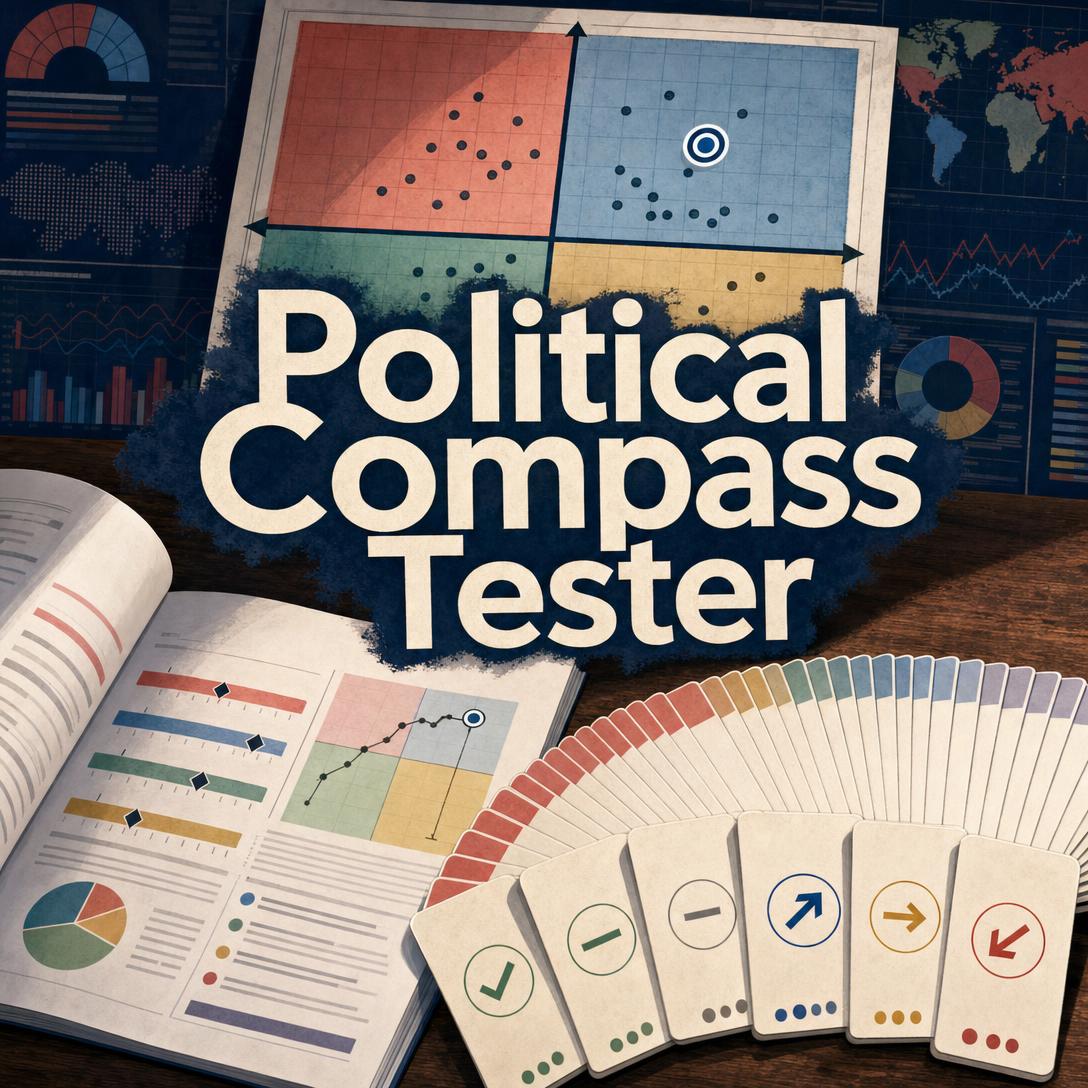
Political Compass Tester helps you locate your real political orientation by measuring reactions to 30 value-based propositions across two independent axes: economic Left–Right and social Authoritarian–Libertarian. While everyday debate still flattens people into a single “left or right” label, this AI assessment produces coordinates, a quadrant, and a structured analytical report — without advocating for any position on the map.
✅ 30 propositions spanning markets, taxation, civil liberties, law and order, and personal freedom ✅ Independent scores from −10.0 to +10.0 on each axis, with quadrant classification ✅ Topic-by-topic lean, internal consistency, and comparison with notable political figures ✅ A formal report you can turn into a visual compass map or a downloadable file
Left–right language is familiar, which is why it survives. It is also too thin for how people actually hold beliefs. To see why a two-axis reading matters, it helps to look at how political identity is measured — and how often a one-word label conceals more than it explains.
Quick Answer: What Is Political Compass Tester?
Political Compass Tester is an AI political orientation assessment that maps your views on economic and social axes through 30 propositions, then delivers a detailed two-axis report. It measures underlying values, not trivia about current bills or campaign slogans.
Key capabilities:
- Separate economic (Left–Right) and social (Authoritarian–Libertarian) scores
- Four-point responses: Strongly Disagree, Disagree, Agree, Strongly Agree
- Quadrant placement plus near-center notes when a score sits close to 0.0
- Axis breakdowns by topic, profile analysis, and comparative context
- Optional compass map, PDF export, and a retake with a new proposition set
Why Left vs. Right Fails to Capture Political Ideology
Ask someone “where they stand” and you will usually get a party name or a single word: liberal, conservative, left, right. That shorthand is convenient. It is also a poor description of political instincts. A voter can favor strong safety nets and still want tight criminal-justice policy. Another can want low taxes and still reject state control over private life. A one-dimensional line cannot hold both facts at once.
Political scientists have treated ideology as multidimensional for decades. Two-axis models — from work associated with Hans Eysenck through Milton Rokeach’s freedom-and-equality framework and the later Nolan Chart — exist because economic and social values do not always move together. The well-known Political Compass site plots opinions on those same two dimensions: economic and social.
Recent measurement work makes the cost of the old line even clearer. A 2025 study in Nature Human Behaviour embedded American National Election Studies responses in a two-dimensional ideological space and found that Democrats and Republicans have become ideologically more distant over the past 30 years, with both parties moving away from the center. The authors argue that a two-dimensional map gives a more nuanced picture than a simple liberal/conservative axis.
The social consequences are not abstract. Affective polarization — dislike of “the other side,” not just disagreement on policy — now shapes everyday interaction and erodes trust. Among young adults, the strain shows up as silence as much as as argument:
Only 35% — Young Americans who believe people with opposing views still want what is best for the country
When conversation feels risky, people borrow ready-made labels instead of examining their own trade-offs. That produces three practical problems:
- The binary trap. “Left” and “right” collapse labor policy, speech, surveillance, trade, and tradition into one team jersey.
- Values hidden behind headlines. Opinions on a current bill are a weak proxy for deeper instincts about markets, authority, and personal autonomy.
- No language for mixed profiles. Cross-cutting views — economically left and socially libertarian, for example — get treated as confusion rather than a coherent pattern.
Survey design itself can nudge those labels. Pew Research Center experiments found that even small changes in ideology scales (a 7-point endpoint-labeled scale versus a fully labeled 5-point scale) shift how people place themselves, with the midpoint often the most common choice. A serious orientation exercise needs more than a single slider.
This is exactly what Political Compass Tester was built for: a structured, non-judgmental reading of political instincts across two axes, not a loyalty test.
How the AI Political Compass Test Works
Political Compass Tester runs as a 30-proposition assessment. You react to statements. It scores those reactions. You receive a formal report. The tone stays analytical throughout — no praise, no scolding, no implied “correct” quadrant.
The compass uses two independent dimensions:
| Axis | Negative pole (−) | Positive pole (+) |
|---|---|---|
| Economic (horizontal) | Left: collectivism, redistribution, public provision, labor protections | Right: free markets, privatization, low taxation, property-rights primacy |
| Social (vertical) | Libertarian: civil liberties, personal autonomy, skepticism of authority | Authoritarian: social order, strong state authority, traditional hierarchy |
Each axis is scored from −10.0 to +10.0, with 0.0 as center. Combined, those coordinates fall into one of four quadrants: Libertarian Left, Authoritarian Left, Libertarian Right, or Authoritarian Right. If either score sits within ±1.0 of center, the report flags a near-centrist reading so a quadrant label is not over-interpreted.
Step 1: Open the Assessment
Start a session and you receive a short briefing in the first message: two axes, 30 propositions, four response options, and a request to answer with your honest first reaction rather than the position you think you “should” hold. Proposition 1 begins in that same message. No account gymnastics, no pre-test lecture.
"Start the political compass assessment. I want a two-axis reading, not a left-right label."
Step 2: Answer 30 Propositions, One at a Time
Each item is a statement, not a current-events quiz. You reply Strongly Disagree, Disagree, Agree, or Strongly Agree (SD, D, A, and SA are accepted). Strongly-worded answers carry more weight. Propositions rotate across economic and social topics so you are not answering a block of tax items followed by a block of speech items.
Coverage is deliberate. Economic items (about 14–16) touch markets and regulation, taxation and redistribution, public versus private services, labor and corporate relations, and trade. Social items (about 14–16) cover civil liberties, law and order, personal freedom, state authority, and tradition. Some statements are reverse-scored or cross-load on both axes so a transparent “agree = left” pattern is harder to game.
Proposition 7/30 · Economic
"The freer the market, the freer the people."
After each answer, the next proposition is the entire reply — no commentary, no “interesting.” That discipline keeps the session from turning into a debate club. If you want to argue a premise, the assessment will ask you to respond first and discuss after the report.
If you later want the political-science context behind those axes — what “authoritarian” means in this model versus everyday insult, or how ideology scales are built — Political Science Tutor is a natural next step for structured study rather than another quiz.
Step 3: Read the Formal Report
After proposition 30, you get a full Political Compass Assessment Report in the chat. It includes:
- Coordinates and quadrant, plus a plain-language description of the instincts that position reflects
- A reminder of the axis definitions and where most people in Western democracies tend to cluster (often within −5 to +5 on both axes)
- Topic-area leans (slight / moderate / strong) for five economic clusters and five social clusters
- Profile analysis: whether your answers form a coherent ideological pattern or a set of cross-cutting instincts
- Internal consistency, notable tensions, and strongest convictions (where “Strongly” answers clustered)
- Comparative context: approximate placements of eight internationally known figures spanning all four quadrants, with your point highlighted
The report is explicit about what it is not. It is an orientation estimate from a limited proposition set, not a validated psychometric instrument, and not a tool for hiring or academic classification.
Step 4: Map, Export, or Retake
When the write-up is in front of you, you can request a visual compass plotting your marker against those figures, download the report, or email it. A retake uses a new proposition set; prior results stay in the conversation history rather than being overwritten.
"Generate a Political Compass map of my position next to the figures in the comparative table."
Try the tester free — no credit card required.
Political Compass Test Use Cases
📊 Seeing Past a Party Label
Scenario: A university student is told they are “on the left” because they support public healthcare. In seminar they also argue for speech protections and against expanding police powers. The label and the actual mix of views do not match, and they cannot explain the mismatch without sounding evasive.
Traditional Approach: Online left–right quizzes, party identification, or a single ideology scale that forces a midpoint or a team. Multidimensional survey research has long shown that social and economic preferences can diverge at the mass level.
Political Compass Tester: A Libertarian Left coordinate (for example, economic −4.2, social −5.1) names the pattern instead of treating it as inconsistency. The topic table can show a strong left lean on public services and a strong libertarian lean on personal freedom — useful before the next seminar, not as a badge.
- Separates economic collectivism from social authoritarianism
- Flags near-center scores so a weak lean is not oversold as a tribe
- Gives vocabulary for mixed profiles without requiring a political-theory degree
💼 Checking Instincts Before a High-Stakes Conversation
Scenario: A product manager is asked, in a hiring loop or a public panel, to “describe their politics.” They have policy opinions but no map of the underlying trade-offs — markets versus regulation, security versus privacy, tradition versus personal autonomy.
Traditional Approach: Rehearse a party talking point, or refuse to answer and look evasive. In a polarized climate, Pew’s polarization research documents how readily partisan identity becomes the whole story.
This political orientation test: Thirty value propositions, answered privately, produce a report you can read before you speak. You might discover that your “moderate” self-image hides a strong conviction on labor rights and a near-center view on trade. That is more useful than a slogan.
If you also want a psychological reading of how you decide, not only what you believe, Personality Analyzer can sit beside the compass as a second, non-political profile — Big Five, attachment, and related frameworks rather than another ideology quiz.
- Private session; no audience while you answer
- Profile analysis that distinguishes coherent ideology from issue-by-issue reactions
- Comparative figures as orientation, clearly labeled as approximate
📱 A Mobile Check Before a Family Argument
Scenario: You are on a train home for a holiday weekend. Group chats are already filling with election commentary. You suspect your relatives will flatten you into “the other side,” and you are not sure how you would describe yourself without borrowing their vocabulary.
Traditional Approach: Scroll headlines, take a viral 10-question quiz with no scoring disclosure, or stay silent. Nearly half of young adults already avoid political talk because they fear the reaction.
The assessment on your phone: Full sessions run on web, iOS, and Android with the same structure. Answer 30 propositions in one sitting, read the quadrant and topic breakdowns, and decide what you actually want to defend — or what you are willing to leave alone at dinner.
After you know your coordinates, Political Analyst can help you unpack a specific election, institution, or policy fight in operative terms, without requiring you to relitigate your identity on every thread.
- Same assessment on a phone as on a desktop
- Four-option answers that work as short taps (SD / D / A / SA)
- Report you can screenshot or export rather than reconstruct from memory
FAQ: Political Compass Tester Questions
Is Political Compass Tester free?
Yes. You can run the full 30-proposition assessment on the free plan, with usage limits that reset monthly. Paid tiers increase usage and add options such as custom model selection. There is no separate “test fee” and no requirement to enter a card to see your coordinates and report. If you only need a single orientation reading, start on free and upgrade only if you retake often or export heavily.
How is this different from a left–right quiz or the original Political Compass site?
Classic left–right quizzes return one number. The original Political Compass popularized a two-axis economic/social plot using a large fixed questionnaire (62 propositions on the well-known site). Political Compass Tester keeps that two-axis logic but runs as a conversational 30-item session with reverse-scored and cross-loading items, topic-level leans, consistency analysis, and a comparative table of figures. It is an estimation exercise with a full write-up, not a party-identification widget.
Is the AI political compass test scientifically validated?
No, and the report says so. It is a structured orientation estimate, not a peer-reviewed survey instrument, and it should not be used for research samples, hiring, or official classification. Two-axis thinking is well established in political-spectrum research, and multidimensional polarization can be measured in large election studies, but this specific 30-proposition set is not offered as a validated scale. Treat coordinates as a clear, limited snapshot of your reactions.
Does Political Compass Tester work on mobile?
Yes. Sessions have feature parity across web, iOS, and Android, including speech-to-text if you prefer to answer out loud. Short responses (Agree, SA, Strongly Disagree) are built for a phone keyboard. You can complete all 30 propositions on a commute and read the report on the same device, then request a map or file export when you are at a desk.
Can I argue with a proposition or change an earlier answer?
During the test, previous answers are final, and debate is deferred until after proposition 30. If a reply is unclear, you will be asked to choose SD, D, A, or SA. Neutral “I don’t know” is not scored as a fifth option; you are asked for the closer lean, even if slight. That design measures reaction, not a seminar performance. After the report, you can discuss results, request a map, or start a new assessment with different propositions.
What do the four quadrants actually mean?
They are combinations of the two scores, not moral ranks. Libertarian Left pairs economic left with social libertarian instincts; Authoritarian Left pairs economic left with stronger state and order preferences; Libertarian Right pairs markets with personal freedom; Authoritarian Right pairs markets with social authority. No quadrant is described as smarter or more ethical. If either axis is near 0.0, the quadrant label is downplayed because the center is doing more work than the corner.
Map the Axes You Actually Occupy
A single left–right sticker cannot describe a person who wants public healthcare and loose speech rules, or low taxes and strict public order. Polarization research shows parties drifting apart in a multidimensional space, while many people still lack a private, structured way to locate themselves before the argument starts.
Political Compass Tester gives you that reading: 30 propositions, two scores, a quadrant with caveats, and an analytical report that describes your instincts without grading them. Try it now, then explore more at Jenova.
For Developers: Political Compass Tester is available programmatically via the Jenova API — integrate two-axis political orientation assessment into your application with a single API call. Full documentation →