Political Campaign Simulator AI: War-Game the Path to Victory
2026-08-30
Political Analyst helps you war-game a political campaign by mapping power, testing electoral strategy, and thinking like an operative before a dollar leaves the account. While board-game sims freeze a race into cards and generic chatbots invent promises they cannot keep, this political campaign simulator AI treats every poll shift, coalition, and media cycle as a live contest.
In August 2026, that distinction is practical, not cosmetic. Campaigns cannot afford to learn coalition math, message discipline, or GOTV timing on Election Day.
✅ War-game races at any level — local, statewide, national, or another country's system ✅ Map voters, money, and message under realistic constraints ✅ Pressure-test opposition research, coalitions, and turnout timing ✅ Keep the same campaign thread on web, iOS, or Android
To understand why a dedicated political campaign simulator AI is different from a trivia bot or a presidential board game, it helps to look at how real campaigns actually decide — and where generic tools break.
Quick Answer: What Is Political Campaign Simulator AI?
Political Analyst is a political campaign simulator AI that lets you war-game races, map voters, and pressure-test electoral strategy before you spend. It thinks like an operative across systems, levels, and countries.
Key capabilities:
- Power mapping and electoral strategy for any office, from city council to a national ticket
- Operative thinking: coalitions, contrast, field, and the sequence of a 12-week sprint
- Policy and message testing that stays internally consistent across voter groups
- Persistent campaign memory so yesterday's gaffe still shapes today's debate prep
Why Most Political Campaign Simulator AI Still Falls Short
Political campaigns are a bad fit for both lecture slides and generic language models. Strategists still use polls to set an opening plan and then adjust as the electorate moves. Classroom research shows that putting students inside those tradeoffs — budget, targeting, timing — teaches the process in a way a lecture cannot.
Over 95% — students in a campaign-budget simulation said the exercise should be offered in future classes (PS: Political Science & Politics)
4.5 / 5 — mean rating for how much that simulation helped students learn about campaigns and elections (Cambridge University Press)
Those results are encouraging. They are also a warning. A two-day classroom budget game still has a predetermined vote sheet. A commercial campaign board game still turns persuasion, field, and the information environment into collectible cards. Neither is how a real race compounds.
But getting a serious political campaign simulator AI experience is frustratingly difficult:
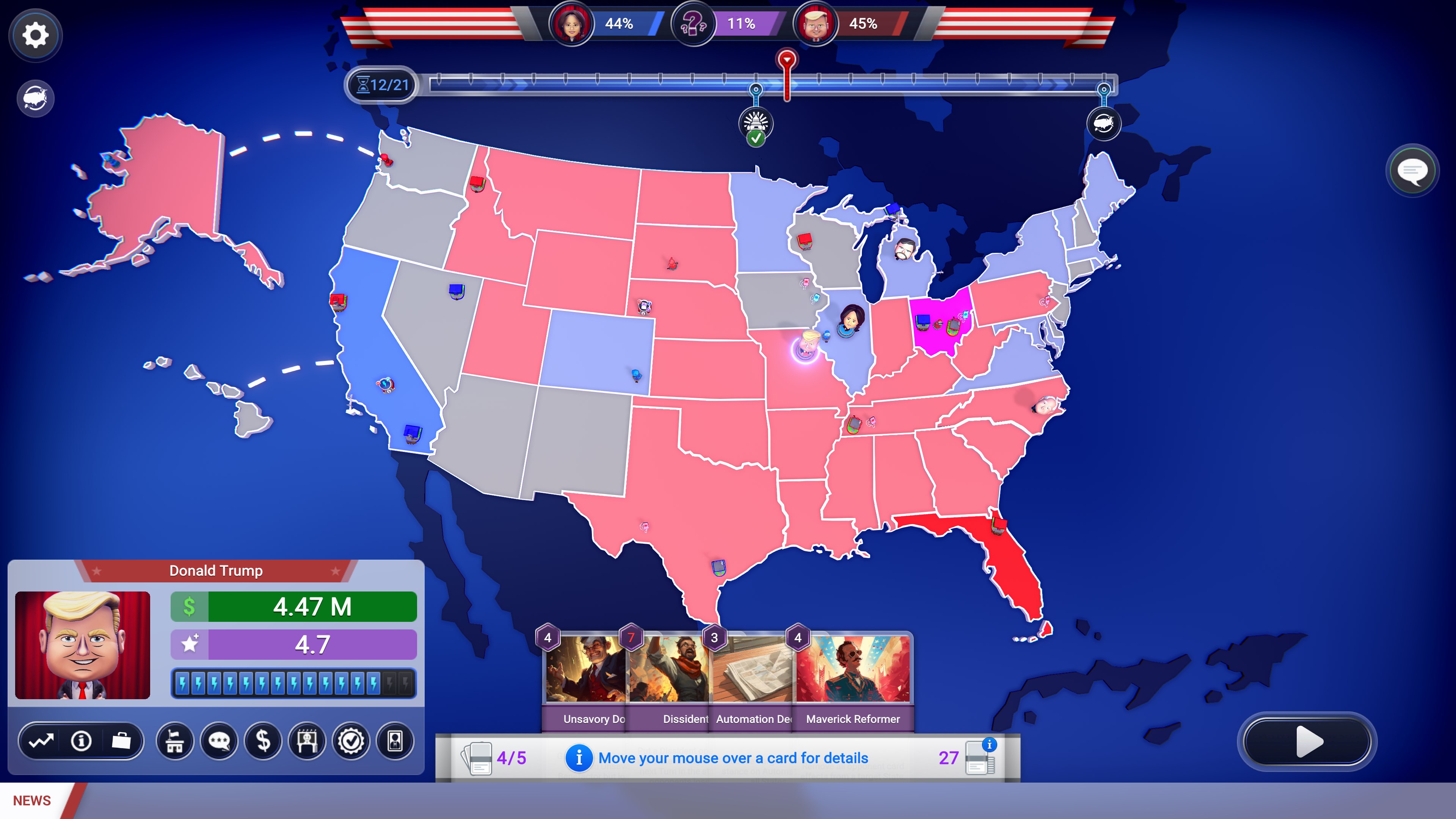
- Packaged election games reward spectacle — including information-warfare cards — without modeling law, reputation, or field capacity
- General-purpose chatbots draft ads that sound fine and then invent promises, URLs, and issue stances the candidate never approved
- Data-heavy targeting plans ignore the organizers who actually move votes
- Long races need memory across weeks; most chat tools reset the war room every session
Hundreds to thousands of times daily — how often generative AI can refine messages for voter subgroups at campaign scale (Brennan Center for Justice)
That throughput is the opportunity and the failure mode. The Brennan Center documents how cheap generative tools can help under-resourced campaigns produce ads and fundraising copy — and how the same tools hallucinate facts, flatten distinctive voice into generic slogans, and commit a candidate to policies that were never in the brief. A Toronto mayoral platform even shipped an AI image of a person with three arms. Scale without a strategist in the loop is not strategy.
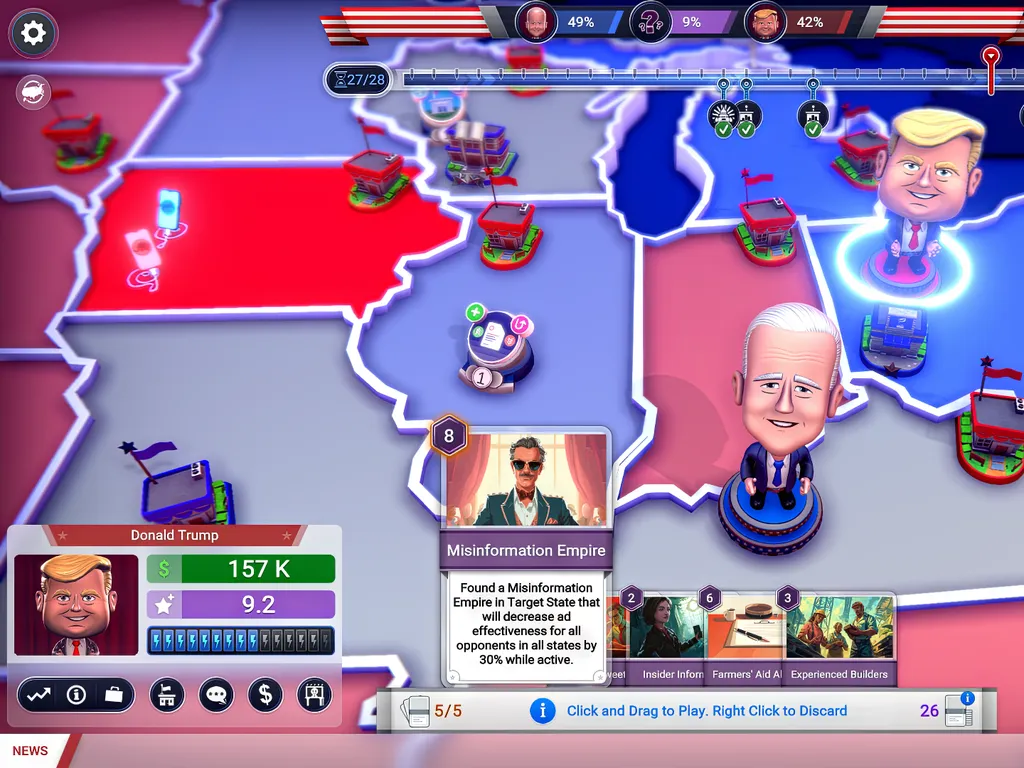
Game UIs make the problem visible. A card that “decreases ad effectiveness for all opponents by 30%” is a fun mechanic. It is a poor model of a legal, reputational, and operational environment where U.S. states have been writing disclosure and deceptive-media rules for AI in elections, and where at least one broad California restriction was later blocked on First Amendment grounds. A political campaign simulator AI that only teaches you to play the dirty-tricks card is training the wrong muscle.
The evidence on actual voter contact is more modest than the hype. Research reviewed in the LSE Public Policy Review finds that digital social ads often show minimal effects on vote choice and turnout, while more personal interactions still outperform mass digital spray. Conversations with a simple campaign chatbot did increase turnout in one U.S. RCT — a real, limited gain, not a magic wand. After the 2024 cycle, organizers also argued that campaigns over-indexed on data marketing and under-weighted local ground expertise.
This is exactly what a political campaign simulator AI was built to practice: the sequence, the constraints, and the second-order effects — not a highlight reel of viral ads.
Why Political Analyst
Political Analyst is a standalone political campaign simulator AI: you name the office, the map, and the constraints, then play against an electorate and an opposition that do not wait for your next prompt. Power mapping, electoral strategy, policy analysis, and operative thinking sit in one continuous campaign — not a slideshow, and not a 4X clone with flags.
That is a different product from a chatbot that roleplays a candidate, and a different product from a presidential board game that scores you for playing “Unsavoury Docs.”
| Traditional Approach | Political Analyst |
|---|---|
| Board-game maps and tactic cards with cartoon win conditions | Live electoral strategy: voters, coalitions, contrast, and turnout clocks |
| Generic LLM copy that invents promises and blurs the message | Operative briefs that stay on-message across voter groups |
| Classroom sims with a predetermined vote sheet | Open-ended races at any level or country's system |
| War rooms that forget last week's gaffe | Persistent memory of research, endorsements, and unforced errors |
| Desktop-only campaign games | The same thread on web, iPhone, and Android |
Power mapping before you spend
You do not start with a slogan. You start with who holds the map: incumbency, party infrastructure, media markets, donor networks, and the groups that can actually deliver votes. The simulator should force you to name those actors before you buy a single point of TV.
Electoral strategy that has a clock
Campaigns are timed machines. Registration deadlines, absentee windows, debate nights, and early-vote periods change the value of the same tactic. Classroom budget sims already showed that sending an absentee chase in the wrong week costs votes. This AI keeps that clock in the room so “we will do digital” is not a plan.
Operative thinking, not vibes
An operative asks what the other side does next. If you go up on crime in the suburbs, who do you lose in the cities? If you skip the rural radio buy, which county clerk still has to staff Election Day? Political Analyst is built for that second move — the one generic models skip because the prompt looked like a press release.
Prompts that open a war room, not a tutorial
You do not need a 400-page campaign manual. You need a district, a budget, and a problem.
"Open a 12-week general for a swing-state U.S. Senate race. I am the challenger, down six with a $4.5M cash-on-hand disadvantage. Build a path that does not require me to win the largest media market."
"City council, nonpartisan, low turnout. Unions are with the incumbent. Map a field-first plan for renters in two precincts and tell me what I should not say on housing."
"Resume yesterday's campaign. The opposition just dropped a contrast ad on my tax vote. Give me a 48-hour response that does not take me off my jobs message, plus the legal and reputational risks of going negative."
Related Agents You'll Also Find Useful
If you are already thinking in precincts and persuasion universes, these agents sit next to a political campaign simulator AI in a natural workflow.
Machiavelli Mentor
When the race is less “issue matrix” and more “who can actually make the deal,” Machiavelli Mentor works the power map: incentives, negotiation, and multi-move campaign architecture.
- Decode what each faction needs versus what it claims
- Sequence endorsements, appointments, and quiet bargains
- Stress-test a plan against betrayal, not just a poll average
Marketing Strategist
Field wins close races; wasted media still bankrupts them. Marketing Strategist is the CMO seat: media mix, channel strategy, budget allocation, and campaign planning when you have to turn a message into a buy.
- Media mix that matches the persuasion universe, not last cycle's habit
- Channel strategy from door to SMS to connected TV
- Budget discipline so the last three weeks still have oxygen
Geopolitics Analyst
National and some statewide races inherit foreign policy, trade, and escalation risk whether the candidate wants them or not. Geopolitics Analyst brings structural analysis and game theory when a debate question or a crisis headline lands on your map.
- Power dynamics and escalation analysis without cable-news theater
- Geoeconomics that can become kitchen-table contrast
- Scenario work for the event you cannot schedule
Try this political campaign simulator AI free — no credit card required.
How It Works
Step 1: Name the office, the map, and the constraints Open Political Analyst and be specific. Office, geography, incumbency, cash, and the one structural problem you cannot buy your way out of give the AI something to push against.
"Mayor, midsize Sun Belt city, open seat. I have labor and a thin donor base. The other side has the police union and the daily paper. Turnout usually dies in apartment precincts."
Step 2: Declare what winning actually means “Win” is not a vibe. Say whether you need a coalition expansion, a base surge, a runoff, or a plurality in a fragmented field so the opposition can attack the plan you actually have.
"I will not chase conservative crossover. I need +8 among renters and a quiet 2-point lift with suburban women. Punish any plan that spends the last week on national cable."
Step 3: Play the week as a decision, not a press release Ask for the crisis, the hidden risk, and the move. Generic models fixate on the trending attack. Demand the second-order problem — the field capacity you do not have, the legal line, the county you are not looking at.
"It is week 7. Summarize each opponent's likely close, then recommend one field move and one paid move. Flag the threat I am probably ignoring."
Step 4: Let consequences compound Bring last week's gaffe, the broken endorsement, and the early-vote numbers into the next session. A political campaign simulator AI is only as good as the history it refuses to forget.
"Resume the thread. Early vote in the collar counties is running against me. I want options that do not require a new TV creative by Friday."
Step 5: Continue on the device you have A war room that only lives on a desktop is a war room you will abandon. Pick the thread up on your phone between events; the opposition will not pause out of courtesy.
Results & Use Cases
📊 Challenger Senate path with a cash disadvantage
Scenario: You are down mid-single digits, outspent in the largest media market, and you have twelve weeks. You need a path that does not require matching the incumbent dollar-for-dollar on broadcast.
Traditional Approach: Build a 40-tab targeting spreadsheet, commission a poll you cannot afford to repeat, and hope a generic chatbot writes ads that do not invent a healthcare plan. Or play a presidential board game whose win condition is a tactic card.
Political Analyst: You brief the map, the money, and the coalition you refuse to chase. The simulator returns a sequence — field, contrast, and the markets you actually need — and remembers the plan when the first attack ad lands. Pair the media-mix questions with Marketing Strategist if the buy itself is the bottleneck.
- A path defined by voters, not vibes
- Contrast that stays on your jobs frame
- A thread you can resume after the next tracking dump
💼 Low-turnout local race where doors still decide it
Scenario: City council or school board. Name ID is low. The incumbent has the institutional list. Your only surplus is volunteers who will actually walk.
Traditional Approach: National-style digital spray, which research suggests is a weak instrument for vote choice and turnout, plus a slogan that could belong to anyone.
This AI: You force the plan onto precincts, registration deadlines, and volunteer hours. The output is a field calendar, a persuasion universe, and a list of lines that will cost you the apartments. When the politics turns factional — endorsements, appointments, who can deliver a bloc — bring in Machiavelli Mentor for the bargain, then return to the race.
- Ground game treated as capacity, not flavor text
- Targeting that matches who actually votes in off-years
- Message discipline small campaigns usually lose by week three
📱 Ten-minute mobile session after a gaffe
Scenario: You are in a rideshare between events. A clip is circulating. You have time for one decision, not a two-hour war-room meeting.
Traditional Approach: A laptop, a shared Google Doc, and a wait for the comms director. Or a game client that needs a desk and a mouse.
Political Analyst: You open the campaign on your phone, ask for the 48-hour response that does not take you off message, and close it. The race is still there after the next stop.
- Full campaign continuity on iOS and Android
- Decision-sized sessions instead of evening-sized matches
- No board-game overlay required to think like an operative
🎯 National security debate week you did not schedule
Scenario: A crisis headline lands in a gubernatorial or Senate race. Your candidate is not a foreign-policy specialist. The opposition is about to make them one.
Traditional Approach: Cable hits and a rushed memo that overclaims expertise.
Political Analyst + Geopolitics Analyst: War-game the domestic electoral effect in the campaign simulator, then pull structural analysis for what you can honestly say. The goal is not to sound like a think tank. It is to avoid a sentence that collapses under the first follow-up.
- Crisis response that still serves the existing coalition
- Game-theory framing without conspiracy theater
- A record of what you already promised on the economy
FAQ
What is a political campaign simulator AI?
A political campaign simulator AI is software that lets you run a race against an electorate and an opposition that have their own incentives — not a quiz about historical election results. Political Analyst is built for that loop: power mapping, electoral strategy, policy analysis, and operative thinking across systems and countries. It is not a pixel-driver for a board game, and it is not a content mill for undisclosed synthetic ads.
Is Political Analyst free to try?
Yes. You can open a campaign thread without a credit card. Usage scales with optional paid tiers if you run long, frequent sessions. For a political campaign simulator AI, continuity matters more than a demo: you should be able to name a district, take a punch, and see whether the advice still remembers the map.
How is this different from The Political Machine or a generic chatbot?
Presidential board games are useful for teaching Electoral College cartography and resource tension. They also gamify tactics — including information-warfare cards — that a real campaign cannot treat as costless. Generic chatbots can draft copy at enormous scale, but they hallucinate promises and drift off-message. This product is the war room: you brief the race, the opposition moves, and the constraints stay in force.
Does a political campaign simulator AI work on mobile?
Yes. Play on the web, iPhone, or Android with the same campaign thread. That matters because campaigns are not evening hobbies; if strategy only fits a desktop, most plans die between events. A mobile session should be a real decision — response, field call, or budget cut — not a stripped-down demo.
Can I simulate a race outside the United States?
That is an intended use. Name the system, the electoral rules, and the political problem. Parliamentary coalitions, runoff rules, and multi-party fields change the operative math. If the race inherits trade, borders, or alliance politics, sketch the structural layer with Geopolitics Analyst, then return to the campaign.
Will this AI actually think like an operative?
Dedicated campaign design beats a general model asked to “write a stump speech.” Evidence from advertising research and campaign studies keeps showing the failure modes: invented commitments, generic language, and digital tactics with small effects. Political Analyst is scoped to electoral strategy and power mapping so the second-order threat — turnout clocks, coalition math, legal and reputational risk — stays in the room. It is still a simulation. Demand the hidden risk every few turns, and do not treat output as legal, compliance, or election-administration advice.
War-Game the Race, Then Walk Into It
A political campaign simulator AI is only worth opening if the other side wants something and the map can punish you. Board games score tactic cards. Generic models write fluent copy and then invent a healthcare plan. Classroom budget sims prove the method — students learn more when they have to spend scarce money on real clocks — but they still end when the vote sheet is tallied.
Political Analyst is the other path. Name the office. Map the power. Meet an opposition that does not wait. Coalitions will shift, messages will collide, and the thread will remember what you already promised.
Try Political Analyst now. Explore more at Jenova.
For Developers: Political Analyst is available programmatically via the Jenova API — integrate electoral strategy, power mapping, and campaign war-gaming into your application with a single API call. Full documentation →