Play by Post AI RPG: An Always-On Game Master for Async Campaigns
2026-10-22
Roleplay Game Master lets you run a play by post AI RPG on your own schedule. It acts as a game master that is always available and remembers every character, clue, and consequence across your campaign. Human-run play-by-post games often stall when the GM gets busy or a thread goes quiet. This AI replies whenever you post, so your story keeps moving in October 2026 and long after.
- ✅ Unlimited memory and character consistency. NPCs, factions, and plot threads stay intact across weeks of async play.
- ✅ Any genre, any system. It handles dark fantasy, sci-fi salvage, cosmic horror, or a homebrew d100 ruleset.
- ✅ Post from anywhere. It works the same on web, iOS, and Android, and speech-to-text lets you dictate turns.
- ✅ Free to start. Core features are available on the free tier.
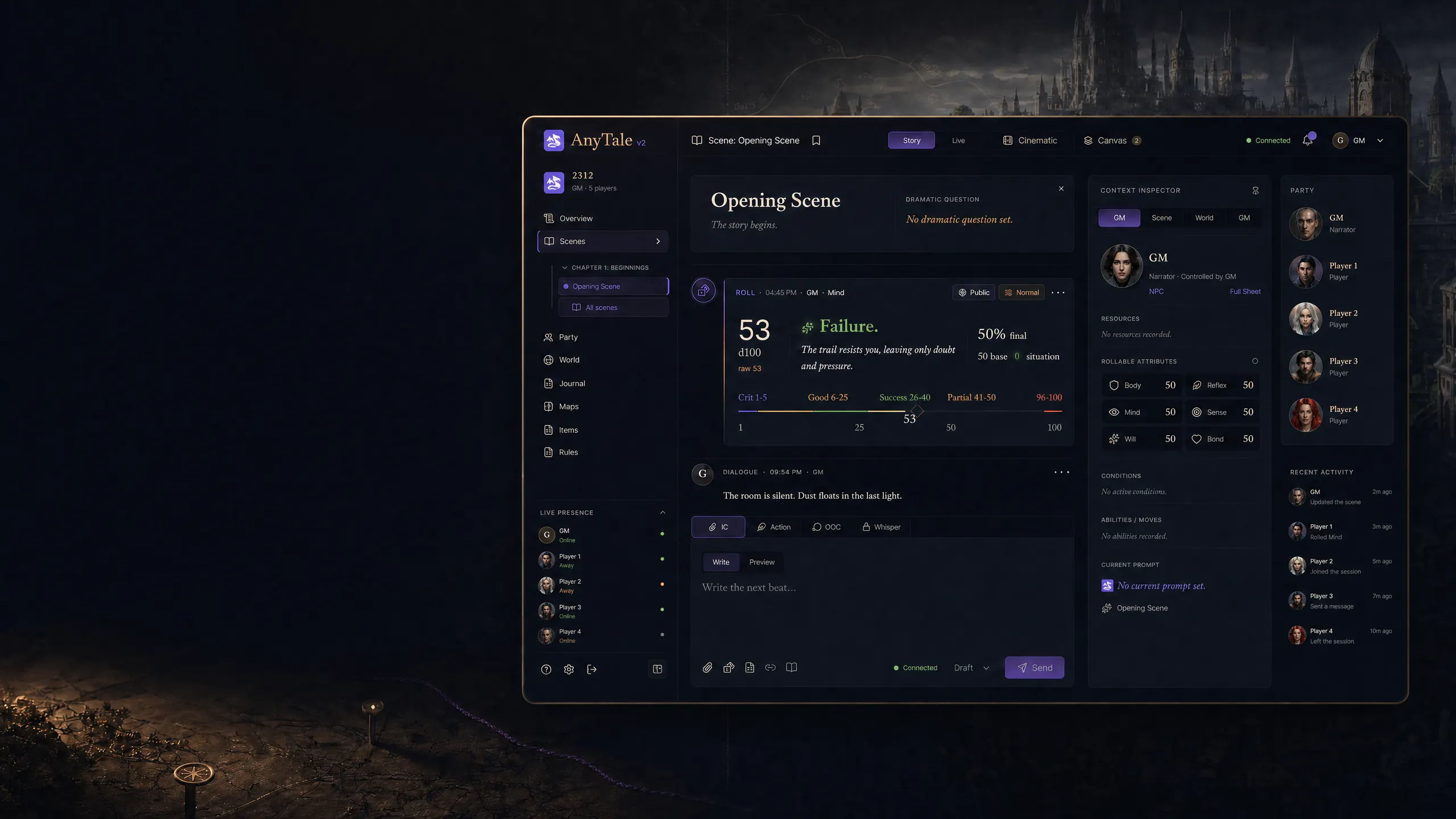
Play-by-post has always rewarded writers and punished schedules. Narration, a resolved roll, and a string of in-character replies make a story you can read top to bottom. That only works if someone keeps the scene moving. To see why an AI game master fits this format, it helps to look at where traditional play-by-post campaigns break down.
Quick Answer: What Is a Play by Post AI RPG?
A play by post AI RPG is a text-based, asynchronous roleplaying game where an AI game master narrates scenes, voices NPCs, and resolves player actions whenever you post, so the story advances on your schedule instead of a shared session time.
Key capabilities:
- Scene narration and NPC dialogue generated as soon as you post your turn
- Persistent memory of characters, locations, inventory, and unresolved plot hooks
- Action resolution using the rules you set (d20, PbtA 2d6, d100, or a freeform system)
- Pacing control: slow-burn mystery, tactical combat, or quick one-shots
Why Play-by-Post Campaigns Stall Without a Reliable GM
Tabletop roleplaying is a large and growing hobby. Much of that play now happens online, between sessions, and across time zones.
USD 2.41 billion — Estimated global tabletop RPG market size in 2026, projected to reach USD 6.59 billion by 2035
46.0% — North America's share of global tabletop RPG spending in 2025, growing 6.5% a year
36.5% — Survey respondents playing more board or tabletop games than before pandemic lockdowns
Play-by-post (PbP) grew out of internet forum culture, where large groups collaboratively and asynchronously built an unfolding narrative. Today, communities like
.But keeping a PbP campaign alive is frustratingly difficult:
- GM workload. One Discord GM found virtual tabletops ultimately too laborious for the GM. Moving to PbP didn't remove the need to write narration, track monster health, and enforce posting cadence.
- Broken pacing. The Angry GM argues that asynchronous text kills "dynamic exchanges." Quick back-and-forth scenes, like negotiations, become painfully slow when each reply takes a day.
- Lost continuity. Discord threads auto-archive after a configurable number of days. Weeks-long gaps also make it easy to forget who knew what.
- Tool sprawl. Bots and scripts help, but the same guide warns that it's very easy to over-engineer a server and make roleplay harder rather than simpler.
This is exactly what Roleplay Game Master was built for.
Why Roleplay Game Master Fits Play-by-Post
Roleplay Game Master is an AI storyteller built for immersive, long-running roleplay. Two problems sink most PbP campaigns: an overloaded or absent GM, and a story that loses its shape over long gaps. This AI addresses both.
You post your turn whenever you have five minutes. The GM replies with narration, consequences, and a new decision point. Every previous beat stays available in its memory.
| Traditional Play-by-Post | Roleplay Game Master |
|---|---|
| Wait hours or days for the GM to post | Narration arrives as soon as you submit your turn |
| GM burnout ends the campaign | The game master is never too busy |
| NPC voices drift as the GM forgets details | Persistent memory keeps characters consistent |
| Archived threads bury earlier plot hooks | Unlimited chat history keeps every scene accessible |
| Bots needed for dice, notes, and trackers | Rules, rolls, and tracking handled in one conversation |
Memory That Survives Long Gaps
Asynchronous play means you might step away for a week. When you return, the innkeeper still owes you a favor, the cursed ring is still in your pack, and the cultist you spared still remembers your face. You don't need to reread forty posts to catch up. You can ask for a recap.
"Summarize what my character knows about the Ashen Order and list any open threads from the last three scenes."
Async Freedom With Responsive Pacing
PbP's flexibility is its biggest draw. Dialogue-heavy scenes are where it suffers, because one exchange can take days. With an AI GM, a tense negotiation with a smuggler captain can play out in a dozen fast back-and-forth posts. You can still pause mid-scene and come back tomorrow.
Any System, Any Genre
Tell the AI GM how you want outcomes resolved. It can use a d20 system, PbtA-style 2d6 bands, a d100 percentile table, or pure narrative judgment. You can also roll physical dice and report the result. That honor-system approach is already common in text-based PbP games.
"Run a grim sci-fi salvage campaign. Use d100 roll-under for skill checks: 1–5 is critical, 96–100 is a disaster. I'll roll my own dice and report results."
Characters Who Stay in Character
Long campaigns depend on NPCs who feel real. A quartermaster who speaks in clipped military jargon should still sound that way in week six. A rival who betrayed you should still carry that history into future scenes.
"Introduce a recurring rival for my rogue. She should be smarter than me, petty about small slights, and never forget a debt."
Related Agents You'll Also Find Useful
Character Creator
If you're building a protagonist or a cast of NPCs before your first post, Character Creator designs characters for roleplay and fiction.
- Quick-generated or guided character builds
- Research into existing media for fan-inspired characters
- Character portraits across genres
Game Designer Assistant
GMs designing their own PbP system or campaign setting can use this assistant to stress-test mechanics before players see them.
- Brainstorming and systems analysis
- Design documentation and rules writing
- Concept art for settings and factions
The Mansion
If you want a ready-made story instead of building one, The Mansion drops you into a mystery from the first post. You wake in a mansion with no memory of how you arrived, and every room hides secrets.
- Pre-built horror-mystery scenario
- Choices shape how the story unfolds
- Works well for short, contained sessions
Learn French Through Roleplay
If you're also studying a language, this agent turns roleplay into immersive French practice. Vocabulary, grammar, and cultural nuance come through emotionally rich stories.
- Full scenarios in French with tutoring built in
- Grammar and vocabulary taught in context
- Any theme you choose
Try Roleplay Game Master free — no credit card required.
How to Start a Play by Post AI RPG
Step 1: Define Your World and Tone Open Roleplay Game Master and describe the setting, mood, and boundaries you want. Specific details help: name the era, the central conflict, and the kind of ending you're hoping for.
"A dying fantasy kingdom where magic is rationed by the crown. Tone: tense political intrigue with occasional dark humor."
Step 2: Introduce Your Character Share your character's name, background, motivation, and key traits or stats. If you're using a system, paste your character sheet so the GM can reference it during checks.
"I play Maren Vale, a disgraced royal cartographer with a forged map that could start a war. Skills: Lore 65, Stealth 40, Persuade 55."
Step 3: Set Your Rules and Pacing Explain how actions resolve and how fast you want the story to move. You can ask for slower, atmospheric scenes or tighter, action-forward turns.
"Resolve checks with d100 roll-under. Keep each GM post under 200 words and always end on a clear choice."
Step 4: Post Your Turns Whenever You're Free Write your action, dialogue, or internal thoughts, then submit. The GM narrates the outcome and moves the scene forward. You can come back an hour or a week later and continue where you left off.
"Maren slips into the archive after closing, lantern shuttered, looking for the original survey of the eastern border."
Step 5: Request Recaps and Course Corrections After long breaks, ask for a summary of recent events and open threads. If the story is drifting, steer it out of character, just as you would in a forum OOC channel.
"OOC: Let's raise the stakes. Have the crown's inquisitors start closing in by the next scene."
Results & Use Cases
📱 The Commuter's Solo Campaign
Scenario: A nurse working rotating shifts wants a long fantasy campaign but can't commit to a weekly session.
Traditional Approach: She joins Discord PbP groups, but her irregular hours mean she misses turns. The GM eventually writes her character out.
Roleplay Game Master: She dictates turns on her phone during breaks, and the story waits for her.
- No posting deadlines or group pressure
- Speech-to-text for quick turns on mobile
- Full campaign continuity across devices
🎲 The Burned-Out Discord GM
Scenario: A GM runs a B/X-style dungeon crawl for five friends on Discord and is falling behind on narration.
Traditional Approach: Hours each week go to writing room descriptions, tracking monster stats, and voicing NPCs. Updates slow to a crawl.
With an AI co-pilot: The GM uses the AI to draft room descriptions, generate NPC reactions, and brainstorm complications. The GM edits and posts the results to the group thread.
- Faster turnaround on narration posts
- Consistent NPC voices across months of play
- More energy for the creative decisions that matter
🌍 Language Practice Inside an Adventure
Scenario: An intermediate French learner wants practice that feels more engaging than flashcards.
Traditional Approach: Textbook dialogues and app drills that are disconnected from anything the learner cares about.
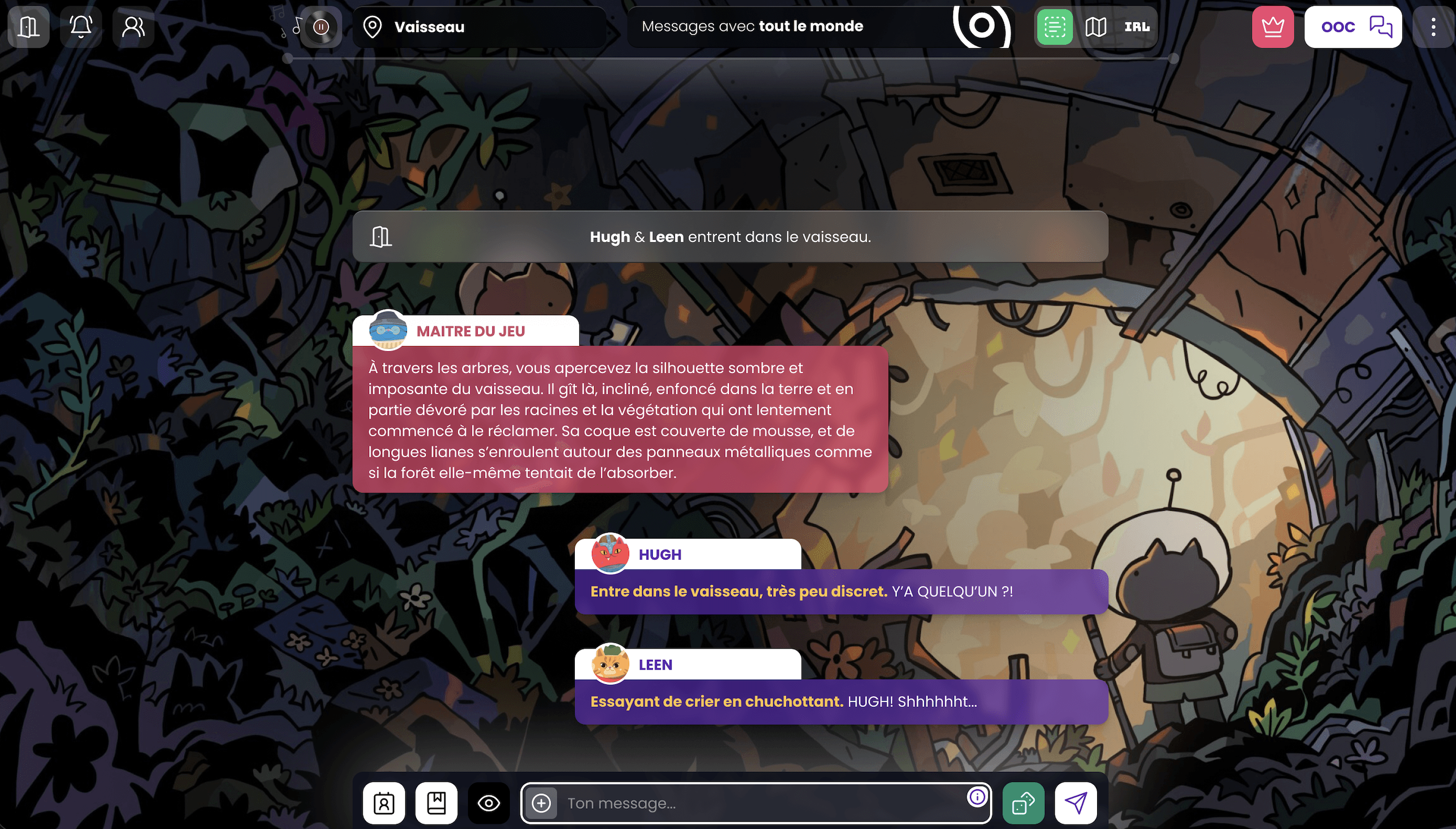
With Learn French Through Roleplay: The learner explores a sci-fi wreck reclaimed by a jungle, with every line of dialogue and narration in French.
- Vocabulary tied to memorable story moments
- Natural phrasing, including tricky lines like crier en chuchotant (shouting in a whisper)
- Corrections offered without breaking immersion
🕯️ A Horror One-Shot With No Prep
Scenario: A player wants a tense, self-contained story over a weekend.
Traditional Approach: Searching forums for an open game, waiting for a group to form, and hoping it doesn't fizzle after the first scene.
With The Mansion: A pre-built mystery starts on the first post, and the player's choices decide whether they escape.
- Instant start with no group coordination
- Self-contained narrative arc
- Easy to pause and resume across days
Frequently Asked Questions
Is a play by post AI RPG free to play?
Yes. Jenova offers a free tier with all core features and limited usage, which is enough to try a campaign. Heavier players can upgrade to Plus at $20/month for 30× the free usage and custom model selection. Higher tiers exist for very long or frequent campaigns. Usage resets monthly on your billing date, with no daily caps.
How is Roleplay Game Master different from a human-run Discord PbP game?
Roleplay Game Master is always available, so the story never stalls waiting for a GM post. It also keeps characters and plot threads consistent through persistent memory. A human GM still offers things an AI can't fully replicate, especially the social bond of playing with friends. Many groups use both: a human-run table for social play, and an AI GM for solo campaigns or GM prep.
Can an AI game master run D&D or other tabletop systems?
You can describe the system you want, such as a d20 framework, Powered by the Apocalypse 2d6 moves, a d100 percentile system, or homebrew rules. The AI GM adjudicates within those rules. For full transparency, you can roll physical or digital dice yourself and report results. For complex official rulebooks, paste the relevant rules or your character sheet so rulings match your table.
Does a play by post AI RPG work on mobile?
Yes. Jenova has full feature parity across web, iOS, and Android, and your campaign syncs across devices. Speech-to-text lets you dictate turns, which suits play-by-post's quick, whenever-you-have-a-minute rhythm.
Will the AI remember my campaign after a long break?
Yes. Jenova keeps unlimited chat history and persistent cross-session memory, so characters, inventory, and unresolved threads carry forward after weeks away. Ask for a recap when you return. To build out a larger cast before or during a campaign, Character Creator can generate detailed NPCs to add to your story.
Keep Your Play-by-Post Campaign Moving
Play-by-post gives roleplayers a way to keep playing when schedules, time zones, and life get in the way. The format usually breaks down in the same places: GM burnout, slow pacing, and lost continuity. An AI-powered play-by-post RPG removes those bottlenecks. You get the async freedom that draws writers to the format, plus a game master who replies instantly and keeps every detail straight.
Whether you want a solo text RPG for your commute, a co-pilot for your Discord campaign, or an immersive story in another language, an AI GM keeps the narrative going.
Try Roleplay Game Master now. Explore more at Jenova.
For Developers: Roleplay Game Master is available programmatically via the Jenova API. You can integrate persistent, memory-driven AI storytelling into your game or community platform with a single API call. Full documentation →