Pirate Roleplay AI: Command Persistent High-Seas Campaigns
2026-08-27
Roleplay Game Master helps you command a living pirate campaign by running high-seas adventures with unlimited memory and perfect character consistency. In August 2026, too many pirate sessions still collapse when a generic chatbot forgets a mutiny, a buried cache, or the quartermaster's name. While finding a human game master who can sustain prize law, port intrigue, and long-arc revenge is hard, this pirate roleplay AI keeps the ship, the crew, and the grudge intact between scenes — so you can play a captain, a privateer, or a wanted smuggler without rebuilding the Caribbean every time you log in.
- ✅ Persistent campaigns that remember articles of agreement, blood feuds, and quiet debts
- ✅ Character consistency across bosuns, governors, navy captains, and rival crews
- ✅ Complete creative freedom — historical Golden Age, pulpy adventure, or original seas
- ✅ Cinematic boarding actions without scheduling a table or herding five players onto a call
To understand why dedicated pirate roleplay AI matters, let's examine the challenges facing nautical roleplayers today.
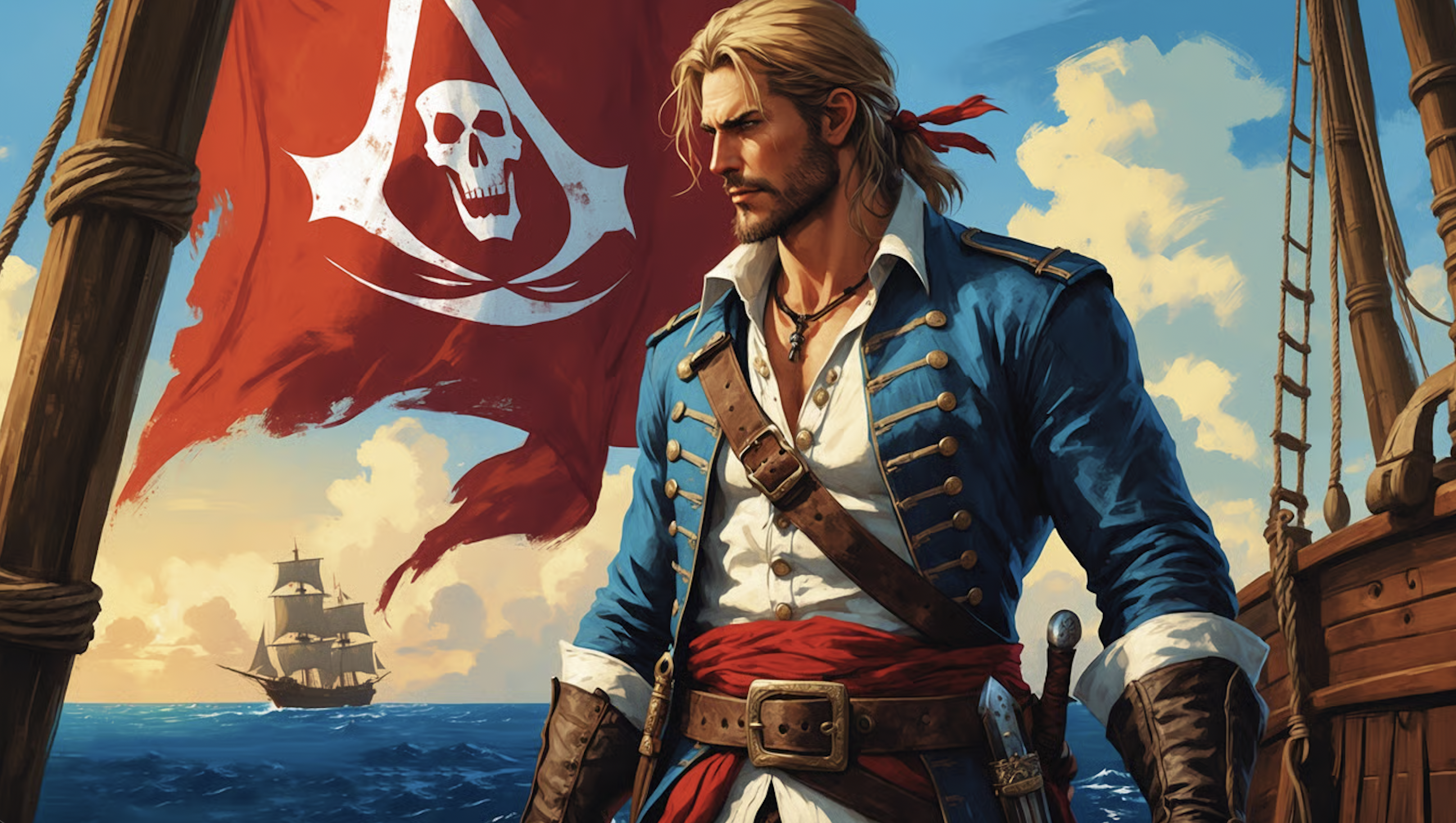
Quick Answer: What Is Pirate Roleplay AI?
Pirate roleplay AI is an immersive storytelling tool that runs persistent Golden Age campaigns so you can play captains, privateers, and mutineers with memory that does not reset. It treats your ship and ports as a continuing saga, not a one-off chat.
Key capabilities:
- Long-running campaigns that retain crew rosters, buried caches, and personal history
- NPCs who stay in character across betrayals, romances, and time jumps
- Open-ended scenes — boarding actions, prize courts, tavern deals, or quiet night watches
- Player-led tone control, from rum-soaked pulp to morally gray privateering
Why Pirate Campaigns Fall Apart
Pirate stories ask a storyteller to hold a ship, a code, a coastline, and a private grudge in the same frame — the way Treasure Island, Black Sails, Pirates of the Caribbean, and tabletop games in the 7th Sea tradition do. Demand for that kind of interactive story is not niche. The interactive fiction market was valued at $6.4 billion in 2025](https://dataintelo.com/report/interactive-fiction-market) and is projected to reach [$14.8 billion by 2034. Long-form fiction still sells at scale too: the fiction books market was about $11.07 billion in 2025. People want worlds they can inhabit, not just watch.
AI conversation has gone mainstream alongside that appetite. Pew Research Center found that 64% of U.S. teens already use AI chatbots, with Character.ai among the named tools — a signal that character conversation is a common use case, not a fringe hobby. Research on chatbot roleplay notes that Character.ai had attracted over 20 million users by 2025. Players are ready. The bottleneck is a storyteller who can actually hold a ship.
But running that saga is frustratingly difficult:
- Human game masters are scarce, and tabletop crews collapse around calendars
- Generic chatbots drop continuity after a few thousand words
- Scripted pirate games offer polish but not true agency
- Crew lists, rum ledgers, and navy patrols become unpaid second jobs
Scheduling Kills More Campaigns Than Broadsides
A pirate table needs a referee who can improvise a hurricane, a hanging, and a forged letter of marque in the same night. Coordinating that person plus a party is the classic failure mode of nautical RPGs. When the session is canceled, the ship sits in irons. When the GM burns out, the Spanish Main goes quiet.
Memory Failure Breaks Immersion Faster Than a Split Mast
Pirate stories live on callbacks. The gunner who lied in session two must still be lying — or finally telling the truth — in session twelve. An academic survey of role-playing with language models flags persona consistency and dynamic personal profiles as core unsolved problems: characters who drift, forget, or reset. A forgotten sibling, a misnamed brigantine, or a resurrected rival you already marooned will yank you out of the story.
Choice-Based Adventures Cannot Honor Your Weird Idea
Episode-style interactive stories prove the appetite. Ethnographic work on chatbot roleplay as a form of play shows people already treat character AIs as stages, not search boxes. Scripted branches still cannot let you defect mid-boarding, marry the enemy admiral, or spend three scenes arguing salvage law in Port Royal. Pirate roleplay AI has to accept unscripted moves and still keep the sea coherent.
Worldbuilding Overhead Turns Play Into Homework
Articles of agreement, prize shares, house flags, and hurricane seasons are half the fun — until they become a wiki you dread updating. Players want to be the captain, not maintain the encyclopedia between watches. The market for AI characters is already large enough that brands treat virtual personas as a serious category; the gap for players is a GM who remembers your crew, not a generic pirate skin.
This is exactly what a dedicated pirate roleplay AI was built for.
Why Roleplay Game Master
Roleplay Game Master treats your campaign as a continuing ocean, not a disposable prompt. You set the premise — Golden Age Caribbean, North African corsairs, an original archipelago with living figureheads — and it plays every other role with continuity. Governors remember your bribes. Crews remember who got the larger share. The ship remembers who died in the powder room.
That matters because pirate stories are opera at sea: scale plus memory plus emotion. A one-shot boarding is easy. A two-month arc about a forged pardon, a stolen rutter, and a hanging that did not take is not. Unlimited memory and character consistency are the difference between a tavern brawl generator and a saga.
| Traditional Approach | Roleplay Game Master |
|---|---|
| Weekly table that dies after two no-shows | Play in any spare hour; the tide waits |
| Chatbot that forgets your quartermaster | Unlimited memory across the whole campaign |
| Scripted branching apps with four endings | Complete creative freedom — any flag, any stakes |
| You as unpaid lore-keeper and rules referee | The AI holds NPCs, ports, and cause-and-effect |
| Tone drift from grimdark to cartoon without warning | Consistent voice for each crew, court, and coast |
A Sea That Actually Remembers
Tell it that you burned the customs house at Nassau, and the next port should feel that shortage of paper and goodwill. Ask it to track a three-sided hunt — navy, rival pirates, and a merchant house — and later scenes should show which harbors closed. Persistent memory is the feature pirate campaigns cannot fake. Without it, every landfall is a soft reboot.
Characters Who Stay Themselves
A good pirate cast is a repertory company: the pious gunner, the exhausted surgeon, the cook who quotes scripture while sharpening a cleaver. Perfect character consistency means those people do not swap personalities when the scene changes. They can grow. They should not randomly become someone else.
Creative Freedom Without a Rules Committee
Want a clean Pirates of the Caribbean tone? A hard-edged Black Sails political war? An original setting with letter-of-marque bureaucracy and funerary shanties? You are not locked to a licensed module. Complete creative freedom means you define physics, culture, and rating, then play.
Cinematic Pacing on Your Clock
Pirate stories thrive on set pieces — the silent approach under fog, the prize-court accusation, the last cutter covering a civilian sloop. You can request a full fleet action or a ten-minute conversation in a chapel. The story scales to the time you have.
Example openings you can drop in immediately:
"I am Captain Maren Voss of the brigantine Night Heron. We just rounded the Caymans with a Spanish prize in tow, and the navy cutter on the horizon is closing. What do I see, and who on my deck breaks first?"
"Three sessions ago, Governor Hale swore he would never arm the wreckers. Confront him at the state dinner with the powder kegs we found in his warehouse."
"Skip the combat. I want a tense rum ration with the bosun who saved my sister — she wants the rutter in return."
Related Agents You'll Also Find Useful
If your pirate campaign outgrows a single ship and starts looking like a novel, a comic, or a shanty cycle, these partners cover the next step.
Film Screenwriter
If a campaign scene keeps replaying in your head as a movie, Film Screenwriter turns that arc into structure, dialogue, and visual set pieces. Pirate stories already think in widescreen — hanging docks, moonlit reefs, silent hull breaches.
- Concept-to-draft guidance for feature-length nautical adventure
- Character work that preserves the voices you already roleplayed
- Scene craft for spectacle without losing political intimacy
Comic Creator
Some boardings deserve panels, not paragraphs. Comic Creator helps you stage fleet actions, duels, and harbor architecture as sequential art — from a single issue to a long graphic-novel war.
- Dynamic layouts for yardarm fights and prize-court intrigue
- Visual consistency across ships, flags, and uniforms
- Issue-level pacing that still feels like your campaign
Music Composition Assistant
If the campaign needs a work song, a funeral dirge, or a tavern lie set to melody, this is the composer at your elbow. Useful when you want the crew to sing the articles, not just recite them.
- Notation-aware help for shanties, ballads, and drum signals
- Arrangement support from a one-line hook to a full tavern set
- Theory guidance so the song matches the culture you already built
Try this pirate roleplay AI free — no credit card required.
How Pirate Roleplay AI Works
You do not need minis, a VTT, or a five-person Discord. Open your pirate campaign GM, state the ocean, and play. Each step below is a complete action you can take in a single sitting.
Step 1: Declare the Sea Give tone, scale, and one live conflict. Name the year-feel, the FTL-equivalent (sailing time, storms, rumor), and what is about to break. Specificity beats a generic "pirate universe."
"Hard-edged Golden Age, no magic. The Caribbean is split between a decaying imperial station and wrecker cartels. Tonight, a navy audit cutter has boarded my tramp sloop, and I am hiding a political refugee in the cable tier."
Step 2: Plant Your Character and Stakes Say who you are, what you cannot lose, and one secret the table does not know yet. Stakes turn a tour of ships into drama.
"I am Commander Ilya Sen, loyal on paper. My secret is that the refugee is my husband. If the auditors find him, I either become a traitor or I let him die. Play the boarding party as competent, not cartoon evil."
Step 3: Play the Scene and Force Consequences Act in character. Ask for sensory detail, NPC reaction, and the next decision — not a novel dump. When you do something irreversible, say so.
"I stall the lead auditor with cargo manifests while my carpenter vents a harmless bilge alarm. If they buy it, I want a cost: someone on my crew now suspects me. If they don't, start the arrest."
Step 4: Leave and Return — Continuity Is the Point End on a hook: a sealed order, a damaged rudder, a name you should not have heard. Next session, remind the AI of the hook in one sentence. Unlimited memory should carry the rest; the reminder keeps you oriented.
"Pick up after the fake alarm. The auditor left, but she took a copy of our transponder — our sailing papers. My husband is still in the cable tier, and the carpenter wants an explanation."
Step 5: Widen the Opera When You Are Ready Zoom from one ship to a whole coast only after personal consequences exist. Pirate epics earn their fleets. Request a time skip, a council scene, or a war montage once the character price is real.
"Six weeks later. The refugee's testimony has sparked a wrecker strike. I am summoned to a cartel moot. I want three factions with distinct voices, and I have to pick a side in this scene."
Results & Use Cases
📊 The Independent Captain Campaign
Scenario: You want a solo Black Sails-meets-Treasure Island run: one ship, a morally gray crew, and a coast that reacts to your jobs.
Traditional Approach: Recruit a weekly group, write a setting doc, and hope the GM remembers which station you blacklisted. Many campaigns die before the third prize.
This pirate roleplay AI: You play three scenes a week on your own clock. The cartel still hates you for the rum heist. The surgeon still will not forgive the passenger you marooned. Continuity does the worldbuilding.
- Jobs have aftershocks instead of reset buttons
- Crew NPCs develop private agendas
- You can pause mid-voyage and resume days later
💼 From Campaign Arc to Screenplay
Scenario: A succession crisis you roleplayed — twin heirs, a silent fleet, a forbidden marriage in Port Royal — feels like a feature film. You want pages, not just chat logs.
Traditional Approach: Reverse-engineer a structure from messy session notes, then fight your own lore contradictions.
Roleplay first, then write: Keep playing the political scenes until the ending is earned. Hand the spine to Film Screenwriter for acts, scene purpose, and dialogue polish. The roleplay supplies lived-in character turns; the screenwriter supplies craft.
- Test character choices in play before locking a draft
- Preserve the voices you already discovered
- Convert set pieces (the funeral at sea, the empty throne in the governor's house) into visual scenes
📱 Lunch-Break Diplomacy on Mobile
Scenario: You have twelve minutes on a train. You are not starting a fleet battle. You are a legate walking into a cliff monastery that controls the only accurate rutter for the windward passage.
Traditional Approach: Mobile story apps give you three dialogue buttons. A desktop chatbot is awkward to steer one-handed and will forget the monastery's vows by dinner.
Play on your phone: Full sessions work across web, iOS, and Android, so the same campaign follows you. Ask for a short scene with a hard choice and a single image of the hall in your mind. Next time, the abbot remembers whether you knelt.
- Short scenes that still change the map
- No need to re-explain your title or the treaty
- Serious tone available even in a spare moment
🎯 War Comic From a Battle You Already Fought
Scenario: The boarding of the hymn-ship was the best scene of the campaign. You want it as sequential art — not a recap paragraph.
Traditional Approach: Commission an artist from a written summary and watch details drift (wrong hull markings, wrong dead).
Capture, then draw: Replay or recap the beat-by-beat blocking with the AI game master, then take that shot list to Comic Creator. You already know who hesitated at the rail.
- Canonical blocking from the scene you played
- Visual continuity for ships and uniforms
- A keepable artifact of a campaign that usually lives only in chat
FAQ
What is pirate roleplay AI, and how is it different from a regular chatbot?
Pirate roleplay AI is built to run a continuing nautical saga: crews, ports, and private betrayals that persist between sessions. A general chatbot can mimic a scene for a few turns, then drop names, factions, and tone. A dedicated GM-style agent is optimized for unlimited memory, character consistency, and unscripted choices — the difference between a cutscene generator and a campaign you can inhabit for weeks.
Is Roleplay Game Master free?
Yes. You can start on a free plan with core features and limited usage — enough to test a premise, a captain, and a first crisis. Paid plans increase usage if you run long daily campaigns; Plus starts at $20 per month. No credit card is required to try the AI game master. Usage resets monthly, so you are not rationed by the day.
Can this AI run a Pirates of the Caribbean-style or fully original campaign?
Yes. Complete creative freedom means you can request a rebellion-versus-empire tone, a Black Sails-like ecology of power, a Treasure Island treasure hunt, or a setting with no licensed fingerprints at all. State what is allowed (magic, gore, romance, comedy) up front. The useful constraint is consistency with your rules, not a single studio canon.
Does pirate roleplay AI work on mobile?
Yes. Play on the web or in the iOS and Android apps with the same campaign history. That is the practical answer to "can I play a diplomatic scene on the commute?" Speech-to-text is available if you would rather talk like a captain than type like one. Settings sync, so the ocean does not fork between devices.
Will it remember a long campaign, or do I have to paste recaps forever?
The design center is unlimited chat history and persistent memory — the exact failure point of generic tools in this genre, and a problem role-playing research still treats as hard. A one-line reminder of the last hook still helps you re-enter the headspace, but you should not need to paste a wiki every session. If a detail is load-bearing (who holds the rutter, who is secretly married), state it once, clearly, when it happens.
How is this different from scripted pirate adventure games?
Scripted apps shine at production value and fixed plots. They cannot honor a truly novel move. Pirate roleplay AI improvises inside your premise: defect, negotiate, waste a week in dry dock, or refuse the chosen-one arc. You trade predetermined branches for a living continuity — the same reason chatbot roleplay already looks like a play space rather than a menu.
Command the Sea, Not the Spreadsheet
Pirate campaigns fail in practice for boring reasons: no GM, no schedule, no memory. The genre needs a storyteller who can hold a coronation and a bilge leak in the same week without dropping either. Roleplay Game Master is that pirate roleplay AI — persistent campaigns, consistent characters, and the freedom to play any ocean you can describe.
You do not need a full table to start. You need a ship, a problem, and one decision that cannot be undone. Try it now, then keep the rest of your creative stack close: Film Screenwriter if the arc wants to become a movie, Comic Creator if a boarding wants panels. Explore more at Jenova.
For Developers: Roleplay Game Master is available programmatically via the Jenova API — integrate immersive pirate roleplay into your application with a single API call. Full documentation →