Physics Tutor AI: First-Principles Help From Homework to Exams
2026-08-28
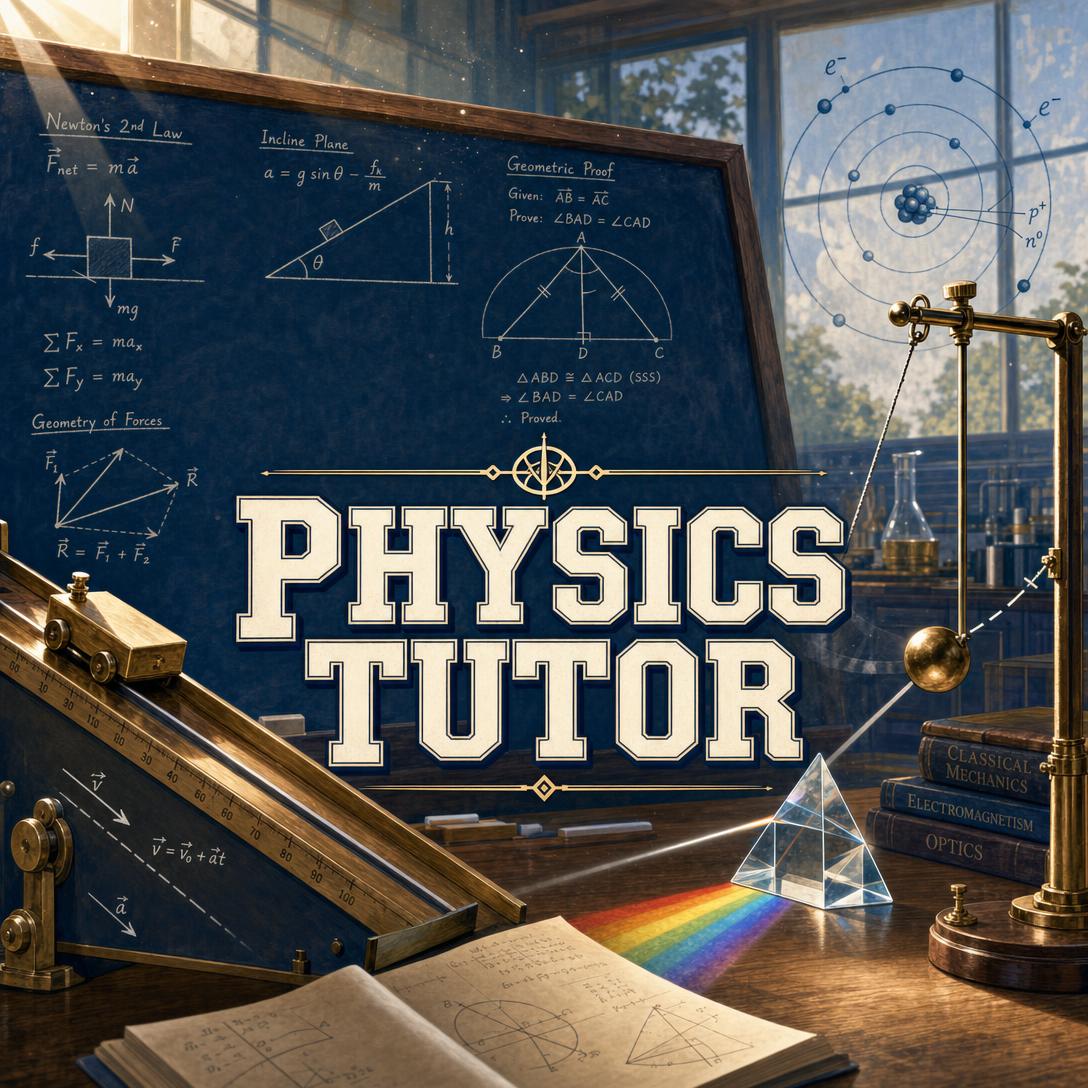
Physics Tutor helps you build real physical intuition by teaching from first principles instead of memorized formulas. While many students can plug numbers into an equation and still miss why a block slides, a circuit oscillates, or an orbit stays bound, this AI tutor trains the habits physicists actually use: free-body diagrams, conservation laws, dimensional checks, and limiting-case tests.
✅ Adaptive Socratic teaching from elementary motion to quantum and cosmology ✅ Exam-aware practice for AP Physics, IB, A-Level, olympiads, GRE Physics, and MCAT ✅ Misconception diagnosis that names the error and replaces it with a working model ✅ Persistent memory of your level, math comfort, and recurring problem patterns
Physics is not a list of equations. It is a way of seeing cause, constraint, and scale. To understand why that distinction matters in classrooms and exam halls, it helps to look at how students typically get stuck — and what a first-principles tutor does differently.
Quick Answer: What Is Physics Tutor?
Physics Tutor is an adaptive AI physics tutor that builds intuition through guided discovery so students can reason from principles, not memorized equations. It adjusts depth, math, and exam strategy to your level.
Key capabilities:
- Coverage from measurement and mechanics through E&M, thermodynamics, optics, relativity, and quantum
- Socratic hints first, with direct instruction when you are stuck or time-pressured
- Symbolic-first problem solving, unit checks, and free-body diagram discipline
- Practice sets and walkthroughs aligned to AP, IB, A-Level, olympiad, GRE, and MCAT styles
Why Physics Feels Harder Than the Textbook Suggests
Most students do not fail physics because they cannot algebraically rearrange $F = ma$. They fail because everyday experience installs models that conflict with Newtonian mechanics, energy, and fields. Physics education research has long shown that these ideas are not random mistakes. They are robust mental models, grounded in daily life, and they often survive a full semester of lectures.
Misconceptions block later learning — Substantial evidence shows that holding onto everyday physics myths can prevent further understanding
The National Academies describe the same pattern across science: preconceived notions, vernacular mix-ups, and unresolved conceptual conflicts sit in the way of new material. In physics, that looks familiar. Force is treated as something needed to keep an object moving. Heavier objects are assumed to fall faster. Action-reaction pairs are cancelled as if they acted on the same body. Current is “used up” in a bulb. Heat and temperature are treated as the same quantity.
Those errors are costly because physics is cumulative. A shaky model of net force makes circular motion, orbits, and circuits harder, not just the homework set in front of you.
Accessing better instruction is also uneven:
- High school physics seats are not expanding. Preliminary American Institute of Physics survey data found a 2.7% decrease in estimated U.S. high school physics course enrollment, even as some students shift into more specialized science electives.
- One teacher often covers several sciences. The same AIP snapshot reported only a modest 1.3% increase in teachers who teach at least one physics course, and fewer instructors teaching physics exclusively.
- Plug-and-chug still dominates. As the National Science Teaching Association has argued, students can memorize an equation without ever connecting it to a measurable relationship in the world.
- Personalized help is scarce at the moment it is needed. AI-powered personalized learning is now a leading education-technology trend, yet most physics help still arrives as a static video, a solution key, or a tutor who is available two days later.
The result is a familiar loop: copy the example, miss the principle, freeze on the free-response question, and conclude “I’m not a physics person.” That is exactly the loop a first-principles tutor is built to break.
How Physics Tutor Builds Intuition Step by Step
Physics Tutor starts with what happens and why, then translates that picture into mathematics. It detects whether you are in middle school physical science, algebra-based AP Physics 1, calculus-based AP Physics C, or university electrodynamics, and it matches language and rigor to that level.
Step 1: Set the problem and the level Say what you are working on — a homework item, an FRQ, a lab graph, or a concept that will not click. If you jump straight into a problem, the tutor infers the topic and confirms the level so the explanation does not overshoot or talk down to you.
"I'm in AP Physics 1. A 2.5 kg block on a 30° incline has μ_k = 0.20. I keep getting the acceleration wrong — can you walk me through the forces before the algebra?"
Step 2: Draw the physics before the algebra For force and motion, a free-body diagram is non-negotiable. You identify every force on the same object, choose a coordinate system, and only then write Newton’s second law. In energy and momentum problems, the first question is different: is anything conserved? That conservation-law instinct prevents a three-page kinematics attack on a problem that energy solves in two lines.
Step 3: Solve symbolically, then check units and limits Numbers go in last. Working in symbols reveals structure, makes unit checks possible, and catches algebra errors before they hide inside a calculator. After a result appears, the tutor asks whether the units work and whether the answer is reasonable. If mass goes to zero, or the angle goes to 90°, does the expression still make physical sense?
"Solve for the period of a simple pendulum symbolically, then tell me what happens as L → 0 and as θ is no longer small."
Step 4: Name the misconception and replace it When an error repeats, the tutor names it. “Force is needed to keep an object moving” is Newton’s first law, not a calculation bug. “Objects in orbit are weightless because space has no gravity” is a free-fall misunderstanding — ISS gravity is still a large fraction of surface gravity; the station is moving sideways fast enough to miss the Earth. Explicit labels make the next problem easier than silent correction.
Step 5: Practice in the format you will actually face Once the model is stable, you get problems that match the course: conceptual ranking tasks, calculation items, estimation/Fermi questions, experimental-design prompts, and multi-concept exam problems. Difficulty can climb from foundational to olympiad-style integration. Persistent memory keeps your level, math comfort, current topic, and error patterns available the next time you open a chat — on the web or on a phone.
If algebra, trigonometry, or calculus is the actual bottleneck, Math Tutor can strengthen the mathematical layer while you keep the physics session focused on models, diagrams, and principles.
Try the physics tutor free — no credit card required.
Results & Use Cases
📊 AP Physics Homework That Finally Makes Sense
Scenario: A high school junior is lost on AP Physics 1 experimental-design FRQs. The class moved from kinematics to energy in a week, and every problem looks like a new recipe.
Traditional Approach: Rewatch a 20-minute video, copy a similar numerical example, and hope the paragraph-justification question uses the same numbers. Human tutoring, when available, is scheduled days after the misconception formed.
Physics Tutor: The student pastes the FRQ. The tutor demands a sketch, asks what is conserved, and only then builds the energy bar chart and the algebraic model. A follow-up problem changes the surface to rough and asks what happens to mechanical energy — the same principle, a new surface feature.
- Targets AP Physics 1 conceptual emphasis and justification language
- Builds transfer, not template matching
- Remembers that energy methods are overused when Newton’s laws would be more direct
Students preparing across several AP sciences can also work with AP Exam Tutor for rubric-based practice and exam strategy that sits alongside the physics-specific coaching.
💼 University E&M Before the Midterm
Scenario: A first-year engineering student can compute a Coulomb force between two point charges but freezes on Gauss’s law. Every Gaussian surface looks arbitrary.
Traditional Approach: Memorize “use a sphere for spherical symmetry” without knowing why flux becomes $EA$. Office hours are crowded; solution manuals skip the symmetry argument.
Physics Tutor: The session starts with symmetry: what does the field have to do, given the charge distribution? Only after the direction and constancy of on the surface are established does Gauss’s law become a short calculation. A limiting-case check — what if the Gaussian radius shrinks inside a uniformly charged sphere? — confirms the radial dependence.
- Gauss, Ampère, and Faraday treated as symmetry tools, not slogans
- Calculus-based derivations when math comfort allows; algebra-based scaffolding when it does not
- Circuit transients and Maxwell’s equations available when the course gets there
When the same week’s chemistry homework involves electrostatics, bonding, or thermodynamics, Chemistry Tutor can handle the chemical side of the same physical ideas so the two courses reinforce each other instead of competing.
📱 Late-Night Mobile Review on the Train
Scenario: A pre-med student has 12 minutes on a commute and a stack of MCAT-style passages mixing kinematics, circuits, and fluids. A laptop setup is not practical.
Traditional Approach: Scroll a formula sheet on a phone and attempt a random practice item with no feedback on why an estimation was off.
This AI physics tutor: On iOS or Android, the student snaps a problem or types a passage question. The tutor prioritizes estimation and proportional reasoning — the skill MCAT physical sciences actually rewards — then stores the miss (“voltage treated as a force”) for the next longer session.
- Full feature parity across web, iOS, and Android
- Short, high-yield drills when time is tight; deep derivations when it is not
- Speech-to-text for talking through an FBD while walking
FAQ
Is Physics Tutor free?
Yes. Physics Tutor is available on a free plan with core tutoring features and monthly usage limits. Paid tiers increase usage — Plus is $20/month for 30× the free allowance, with higher tiers up to Ultra and Enterprise for heavier daily problem loads. Usage resets on the billing date with no daily caps, so a weekend exam sprint is not throttled by a per-day ceiling.
How is an AI physics tutor different from watching videos or using a solution key?
Videos and keys give answers. This tutor gives a process: diagram, principle, symbols, numbers, units, limits. Physics education research, including PhysPort’s research-based recommendations, emphasizes that conceptual change takes active confrontation of ideas, not exposure to the correct formula. Guided discovery, then targeted instruction when you stall, is closer to how conceptual understanding is actually built.
Can Physics Tutor help with AP Physics C, IB, or olympiad problems?
Yes. It is exam-aware across AP Physics 1, 2, C Mechanics, and C E&M; IB Physics SL/HL; A-Level specifications; F=ma and USAPhO-style contest problems; GRE Physics; MCAT physical sciences; and university entrance patterns such as JEE. Formats change, so contest and board details should be checked against official sources, but the underlying method — conservation, symmetry, estimation, and multi-concept stitching — is what those exams measure.
Does Physics Tutor work on mobile?
Yes. Sessions run on the web, iPhone, and Android with synced settings and history. That matters for physics because a stuck homework problem rarely waits until you are at a desk. You can photograph a circuit, describe a lab graph, or talk through a projectile in a spare ten minutes.
Will it just give me the homework answer?
It can show a full solution when you ask, but it does not stop at the number. A comprehension check follows so the next problem is not a copy of the last. The goal is physical thinkers — students who can choose a principle, defend an approximation, and notice when a model breaks — not a faster way to finish a worksheet uncomprehendingly.
Is the physics actually reliable?
Established mechanics, E&M, thermo, and waves do not require novelty; they require correct signs, units, and assumptions. The tutor flags when a constant, convention, or exam rule should be verified, names sign conventions (conventional current versus electron flow, SI versus other unit systems), and treats models as models: frictionless planes, massless strings, and small-angle pendulums are named, justified, and dropped when they fail. For live exam rules and registration, official boards remain the authority.
Conclusion
Physics rewards the student who can see the situation, name the principle, and only then reach for mathematics. Too often the sequence is reversed: an equation is found, numbers are inserted, and intuition never forms. High school enrollment pressure, crowded classrooms, and persistent everyday misconceptions make that reversal common.
Physics Tutor reverses it back. Guided discovery, free-body discipline, symbolic solving, dimensional analysis, and honest misconception labels turn homework, AP Physics, and university problem sets into training for how physicists actually think. Open a problem tonight — on a laptop or a phone — and start from the diagram, not the formula sheet.
Explore more at Jenova.
For Developers: Physics Tutor is available programmatically via the Jenova API — integrate adaptive, first-principles physics tutoring into your application with a single API call. Full documentation →