Persistent World Text RPG AI: Living Campaigns That Remember
2026-09-17
Roleplay Game Master helps you run a living text RPG — a world that keeps its map, factions, loot, and grudges after you log off. While most chat adventures improvise a vivid scene and then forget the vault door you already opened, this AI holds campaign state so location, companions, and consequences stay true.
✅ Unlimited memory across sessions, not a disposable chat window ✅ Character consistency so NPCs do not reset personality mid-arc ✅ Open-ended play for any setting: fantasy archipelago, space opera, noir, or original lore ✅ Continuity you can resume on web or mobile without recapping the bible
As of September 2026, it is easy to start an AI text adventure and still hard to inhabit one. To understand why persistent world text RPG AI matters, look at how generated prose and durable game state keep coming apart.
Quick Answer: What Is Persistent World Text RPG AI?
Roleplay Game Master is a persistent world text RPG AI that remembers locations, inventory, NPCs, and plot so campaigns continue across sessions. You type actions; the world keeps the ledger.
Key capabilities:
- Holds who is where, what you carry, and which doors already closed
- Keeps companion voices, loyalties, and private knowledge stable
- Lets you resume a heist, a voyage, or a siege days later without a lore dump
- Supports any genre you can describe — no pre-authored module required
Why Text RPGs Lose the World
A text RPG is not only narration. Classic designs treat the world as a place that continues: rooms stay looted, credits stay spent, and an NPC who watched you miss the turret still knows it. Guides to the form describe the strongest AI text RPGs as systems that pair generated prose with tracked stats, persistent world state, and consequences that survive the next prompt.
That standard is older than large language models. Long-running text worlds such as Achaea have kept shared rooms and economies in play since 1997. Generative tools changed the writing cost. Titles such as AI Dungeon and 1001 Nights showed that player choices can reshape a scene in real time. The market around those experiences is no longer niche:
**$12.4 billion** — [Narrative game platforms market value in 2025](https://dataintelo.com/report/narrative-game-platforms-market), with projections to $28.9 billion by 2034
But inhabiting a persistent world with AI is still frustratingly difficult:
- The model narrates brilliantly, then drops the ship name, the ammo count, or the ally who told you to move
- Inventory, location, and faction standing live only in the last few paragraphs
- Builders trying to roll their own stack discover that “remember everything” is not a prompt — it is architecture
- Players learn to ignore the map because the island they burned last week has quietly grown back
Solo players testing AI text RPGs report the same failure mode:
.
Chat logs are not a world
When the transcript is the only memory, every turn competes for space. Builders who want a
quickly hit the same wall: the LLM is asked to remember everything, simulate everything, and narrate everything at once. Practitioners who separate systems argue that canonical facts — location, inventory, injuries, quest flags, time — should not live only in the prompt. NPC grudges and universe truth are different kinds of data. Mixing them is how a companion “remembers” a sword you never dropped.Some tools keep memory only inside a single session. Others save a world file but still let the narrator overwrite it. Either way, the player cannot trust the map.
Generation without a ledger feels like a demo
Research on adaptive NPCs and generated content treats engagement as a function of systems that actually respond. If credits do not fall when you bribe the guard, the economy was flavor. If Kaelen yells “get inside” and then forgets the turret line, the firefight was a cutscene. Industry writing on AI-assisted game storytelling keeps promising responsive narrative; players judge it by whether the next scene still knows the last one.
This is exactly what Roleplay Game Master was built for.
Why Roleplay Game Master
Roleplay Game Master runs immersive, choice-driven play with unlimited memory and character consistency. You describe a world, take an action in prose, and the campaign continues from the state you left — including the island you already mapped, the credits you already spent, and the secret your companion should not know.
It is not a generic chatbot with a “you are a GM” preamble. It is a dedicated game master for persistent world text RPG play: complete creative freedom over setting and tone, with a memory that treats last session as canon.
| Traditional approach | Roleplay Game Master |
|---|---|
| Chat adventures that forget the vault after a few scenes | Unlimited memory across the campaign |
| MUDs that persist rooms but cannot improvise your plot | Open-ended stories inside a world that still has rules |
| Hand-tracked wikis, stat sheets, and recap posts | Continuity carried in the session itself |
| NPCs who reset personality when you switch devices | Character consistency as the default |
| DIY stacks of models, vector stores, and flag databases | Play first — the ledger travels with the story |
A world you can point to on a map
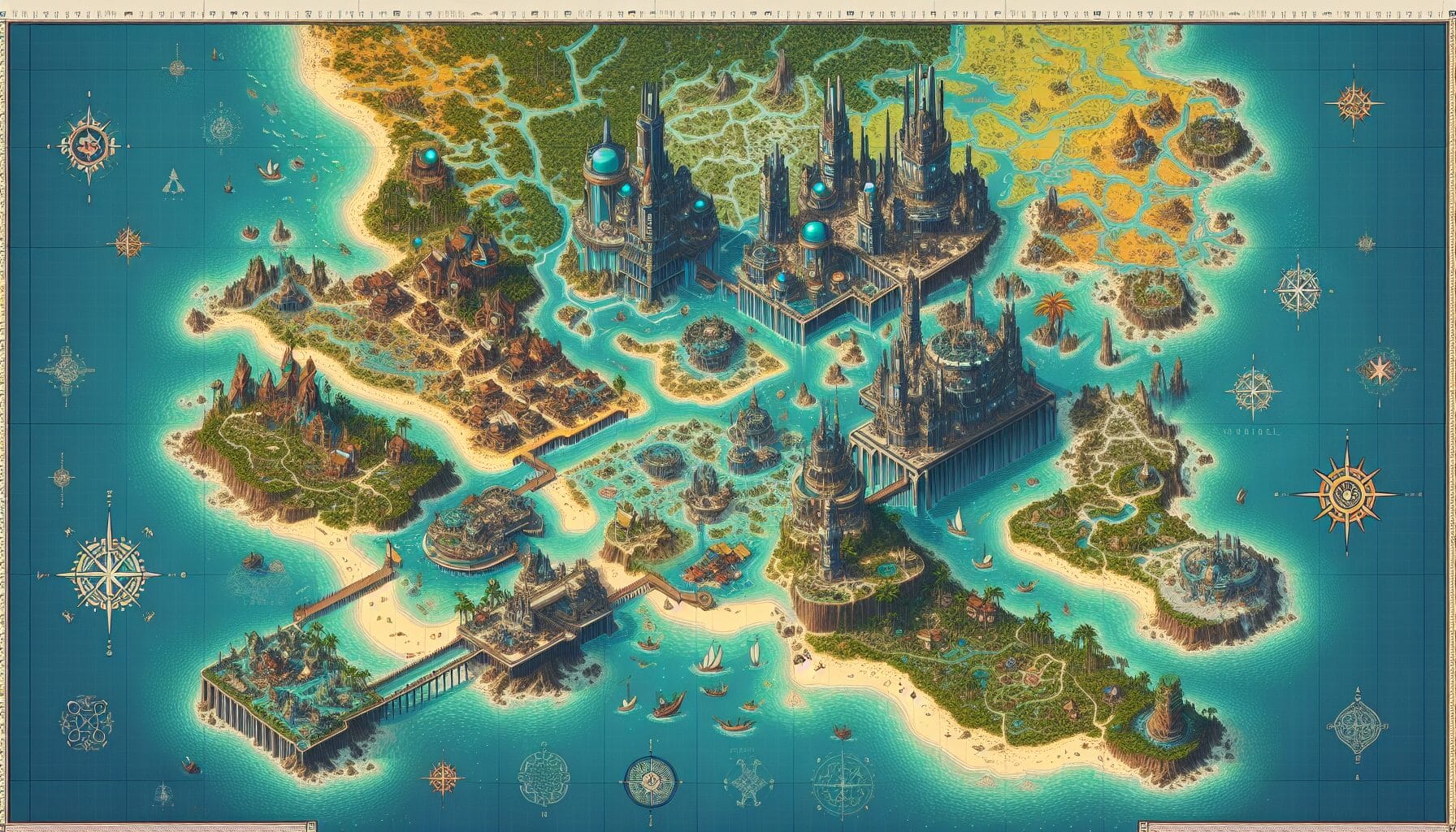
Persistent play starts with geography. An archipelago with causeways, desert mesas, and a capital of spires is not flavor text if returning to the harbor still costs a berth and the eastern keep still flies last week’s banner. This AI is built so those facts do not evaporate when the scene changes. You are not regenerating a postcard. You are walking a place that already exists.
State that reads like a HUD, written in prose
Serious text RPG sessions surface a compact status block: location, who is with you, credits, concealed gear, the ship waiting in orbit, armor that is already worn. That is world state, not atmosphere. Ask the game master to keep those lines honest after every exchange. The narration can be cinematic; the ledger should be dull and correct.
Characters who share the world, not a prompt
A mercenary who is friendly and a squad that is skeptical should not swap attitudes because the context window got crowded. Adaptive NPC design only pays off if the same person greets you tomorrow. Roleplay Game Master treats voices, relationships, and private knowledge as durable — the difference between a one-shot and a campaign.
While AI Dungeon is built for open-ended generated adventures, this game master specializes in unlimited memory and character consistency so a long-running text RPG can stay a world.
Example prompts that put persistence to work:
"You are the game master. Setting: the Shattered Reach archipelago. I already burned the south watchtower. The harbor master thinks I am a merchant. Track ships, coin, and who saw the fire."
"Continue the Kestrel Prime run. Location: exterior, Imperial Vault. Kaelen is friendly; the hired guns are skeptical. I still have the T-21, a concealed blaster, and a worn vest. Do not restore shields I already lost."
"Two nights later, same crew, same ship. If the vault door closed behind us, we are inside. If it did not, the turrets are still live. Narrate only what my character can see."
Related Agents You'll Also Find Useful
If you want a persistent world without inventing the whole atlas, or you need to turn a campaign log into a design doc, these agents sit next to a long-running game master.
The Mansion
If you want pressure-tested rooms instead of a blank map, The Mansion drops you into a house with no memory of how you arrived. Every corridor is a bet; every careless search can be your last.
- Choice-driven exploration with high-stakes rooms
- Clue chains that punish sloppy reveals
- A compact way to feel persistence before you worldbuild an archipelago from scratch
The Asylum
If your preferred text RPG is investigation, The Asylum sends you into a shuttered institution where every ward hides a secret. The layout should stay cruelly consistent: a locked door you already tried should still be locked.
- Investigator framing with environmental clues
- A single site that behaves like a persistent dungeon
- Useful when you want horror continuity without running a full sandbox
Game Designer Assistant
If the end product is a game other people can ship, Game Designer Assistant helps with systems analysis, documentation, and genre-aware design so “persistent world” is specified instead of implied.
- Document flags, fail states, and what must never regenerate
- Translate a roleplay log into mechanics a team can argue with
- Stress-test whether a choice is readable as a rule, not only as prose
Try Roleplay Game Master free — no credit card required.
How It Works
Step 1: Name the world that must not reset
Open a session and declare the facts that survive every scene: map, tone, who is alive, what you carry, which clocks are ticking. Specificity gives the AI a ledger to protect. Builders of playable AI RPG worlds start the same way — player role, conflict, NPC motives, progression, and memory — before they chase prettier paragraphs.
"You are the game master for a persistent text RPG. I am a smuggler on the Ghost-Sliver. 737,940 credits. Compact blaster concealed. Armor vest worn. Kaelen is with me. Track location and inventory after every action."
Step 2: Take a concrete action
Write what your character does, not a wish list of endings. Fire at the turret. Jump the gap. Bribe the clerk. Agency is clearer when the next beat is caused by you, which is the same standard developers use when they wire evolving RPG narratives to player choices.
"I keep firing at the turrets with the rifle, then dive through the blast door Kaelen is holding. Narrate recoil, shield hits, and only what I perceive."
Step 3: Force the world to answer in state, not vibes
After a few exchanges, ask for a status pass: location, people present, credits, gear, ship. If a miss shattered obsidian instead of the gun, that miss should still be true. Designers working on AI-assisted interactive stories treat causal strength as a success metric. You can feel it when the HUD and the prose agree.
"Print a state block: location, characters and attitudes, credits, inventory, ship. Then continue from the interior. Do not refill my shield."
Step 4: Leave and come back without a novel-length recap
Resume on phone or desktop. Mention the last concrete beat. Persistent world text RPG AI should already know the vault, the skeptic mercenaries, and the torn photograph in your pocket.
"Pick up after we sealed the inner hatch. Same crew. I still have the concealed blaster. The Outer Rim does not get a reset."
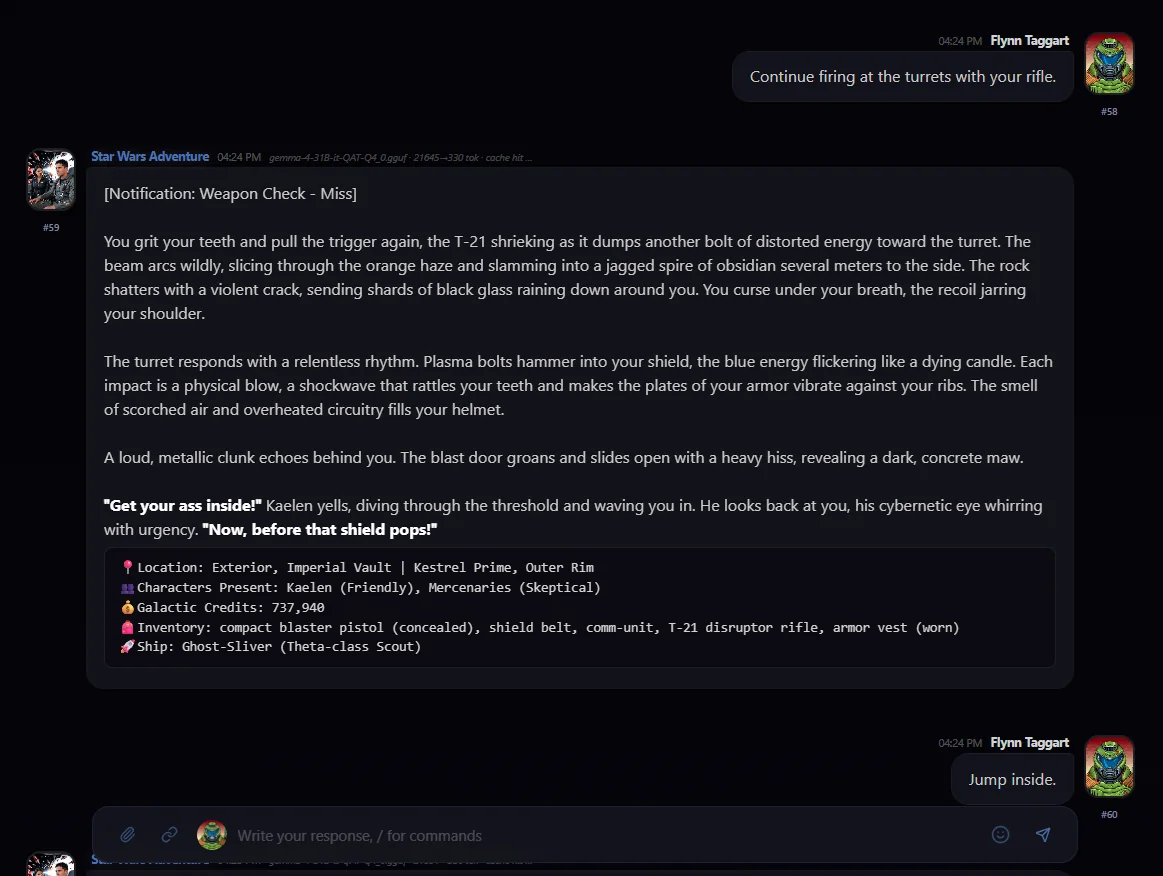
That screenshot is the difference between a story generator and a campaign: the turret line, the companion shouting you inside, and a status block that still lists the T-21, the worn vest, and the ship in the well. The game master is doing its job when those lines would still be true tomorrow.
Results & Use Cases
🗺️ Run a sandbox that still has a coastline
Scenario: A solo fantasy campaign across a mapped archipelago — trade winds, rival keeps, and a desert isle you have not landed on yet.
Traditional approach: A human GM with binders, or a chatbot that regenerates the capital’s layout every session. You spend the first twenty minutes re-establishing which bridge still stands.
Roleplay Game Master: The watchtower you burned is still a ruin. The harbor master still thinks you are a merchant. The eastern causeway is still the expensive route.
- No wiki maintenance between sessions
- Travel has cost because geography does not reshuffle
- New islands stay unknown until you actually sail
🚀 Play a mechanics-aware sci-fi crawl
Scenario: A vault assault with a named rifle, failing shields, a friendly cybernetic-eyed partner, and skeptical hired guns.
Traditional approach: Cinematic paragraphs that restore your armor because the model likes survivors. Credits float. The ship’s class changes spelling.
This persistent world text RPG AI: Misses stay misses. The blast door still groans. The status block still shows 737,940 credits and a worn vest.
- Combat has weight because resources do not refill on a whim
- Companion urgency stays in character
- You can pause mid-firefight and resume without a continuity edit
📱 Steal a dungeon room on a commute
Scenario: Twelve minutes on a train, horror investigation in progress, one door you have not opened.
Traditional approach: Notes apps, lost threads, a desktop-only tool that will not sync.
The game master on mobile: One voice-to-text action — “I open the east ward without calling for backup” — and a scene that still knows you burned the patient files last night.
- Full play on iOS or Android, not a stripped toy
- State waits at the next stop
- Short sessions still move flags, so the evening run starts further in
If you would rather be the investigator inside a prepared building, The Mansion and The Asylum apply the same continuity pressure to a single, hostile site.
📋 Turn a living campaign into a pitch
Scenario: You need evidence that your text RPG is a world, not a writing sample.
Traditional approach: A flowchart that looks dense and a vertical slice that regenerates rooms.
Game Designer Assistant: Fold a live session log into flags, fail states, and readable choice grammar stakeholders can argue with.
- Separate flavor choices from plot-changing ones
- Show two transcripts that disagree because the world remembered
- Specify what must persist before you hire an engineer
FAQ
What is persistent world text RPG AI?
It is an AI game master that treats the campaign as a place with durable facts — map, inventory, NPCs, clocks — not a fresh prompt each turn. Later scenes change because earlier actions still exist. Roleplay Game Master is built for that kind of long-form, choice-driven play.
How is a persistent world text RPG different from a normal AI story?
A story generator optimizes for the next plausible paragraph. A text RPG has to optimize for continuity: who has the rifle, whether the vault is interior or exterior, and whether the mercenaries still distrust you. Research on world state versus NPC memory exists because those are easy to conflate and expensive to repair.
Does Roleplay Game Master track inventory and location?
You can instruct it to keep a running ledger — location, party, credits, gear, ship — and to update it after every action. Unlimited memory is what makes that ledger survive overnight. Character consistency is what keeps the companion who yelled you through the door from becoming a stranger.
Is Roleplay Game Master free?
You can start on a free plan with no credit card. Paid tiers increase usage if you run long campaigns or several worlds at once. Core play — persistent scenes, stable characters, web and mobile access — is available from the first session.
Will my world remember me if I switch from laptop to phone?
Yes. Sessions and memory sync, so a choice made on the train is still true at the desk. That is the practical test of persistent world text RPG AI: the map does not reset when the device does.
Can I use this to design a game, not only to play one?
Yes. Play the world until the flags are obvious, then hand the surviving structure to Game Designer Assistant. You get evidence of persistence — two sessions that still share a coastline — instead of a slide that says “living world.”
Conclusion
Most AI text adventures fail in a predictable way: they can describe a world, and they cannot keep one. Persistent world text RPG AI attacks that gap. You get open-ended play without a pre-written module, and you get a campaign whose islands, inventories, and allies still exist next week.
Roleplay Game Master is the agent to use when the vault must stay looted, the credits must stay spent, and the companion who told you to jump inside must still remember the turret line. Name the world, take a real action, and see whether the next scene still knows your ship.
Explore more at Jenova.
For Developers: Roleplay Game Master is available programmatically via the Jenova API — integrate persistent world text RPG AI into your application with a single API call. Full documentation →