Palm Reading by Photo AI: Upload a Palm Photo for a Free Multi-Tradition Reading (March 2026)
2026-03-24
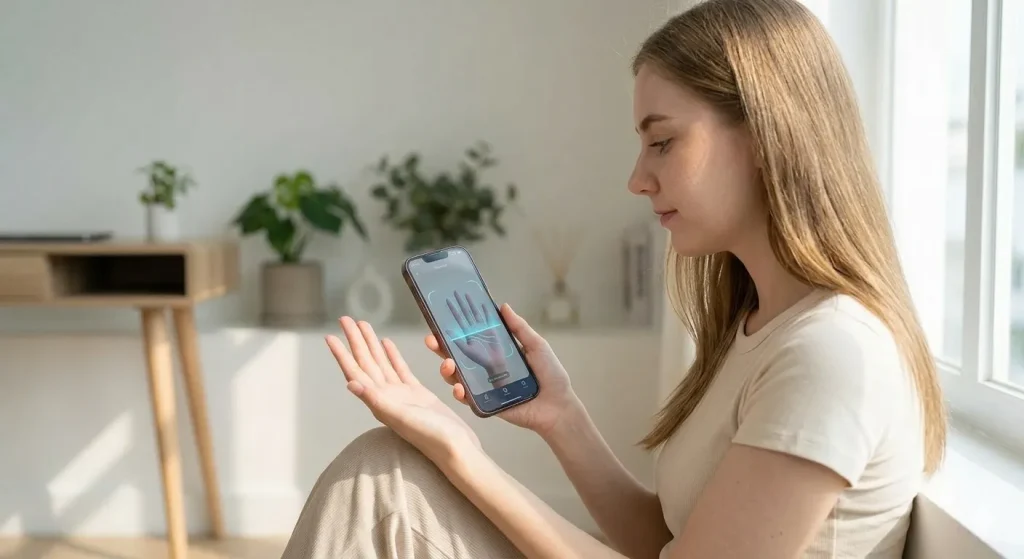
All you need is a photo. In 2026, palm reading by photo AI has transformed an ancient practice that once required finding a skilled practitioner, booking weeks in advance, and paying $100+ per session — into something you can do from your phone in minutes. The [astrology app market — which tracks palmistry apps as a sub-segment — is valued at USD 5.69 billion in 2026](https://www.researchandmarkets.com/reports/6090017/astrology-app-market-report), growing at a 20.2% CAGR, while the [U.S. psychic services industry generates $2.3 billion annually](https://www.ibisworld.com/united-states/industry/psychic-services/4413/). Pew Research Center's 2024 survey found that 30% of U.S. adults consult astrology, horoscopes, tarot, or a fortune teller at least once a year, with 43% of women aged 18–49 engaging with these practices. The demand for photo-based palm reading has never been higher — and neither has the frustration with tools that fail to deliver depth.
Jenova's Palm Reader is the palm reading by photo AI built for this moment: a dedicated AI palmist that analyzes photographs of both your hands to deliver comprehensive, multi-tradition chiromancy readings — covering elemental hand typing, major and minor lines, mount topography, rare markings, bilateral comparison, and couple compatibility — all from a simple photo upload, with persistent memory that lets you return weeks later to ask follow-up questions.
Whether you're uploading your first palm photo out of curiosity, exploring career direction through your Fate line, or comparing palms with a partner for compatibility insights, this guide covers how palm reading by photo AI works in 2026, why photo quality determines reading depth, and how to get your first expert-level reading in minutes.
Quick Answer: What Is Palm Reading by Photo AI?
Palm reading by photo AI uses artificial intelligence to analyze photographs of your palms — uploaded from your phone camera or gallery — and interpret the lines, mounts, markings, and hand shape through conversational, multi-tradition chiromancy analysis.
- ✋ Photo-based palm analysis with elemental hand typing, all major and minor lines, and mount topography — Palm Reader handles this conversationally
- 🔍 Rare marking detection including the Mystic Cross, Ring of Solomon, Simian Line, and Medical Stigmata
- 🤝 Couple compatibility across six relational dimensions from two sets of palm photos
- 🔄 Bilateral comparison mapping inherited potential (non-dominant hand) against lived experience (dominant hand)
The Problem With Photo-Based Palm Reading in 2026
The concept is simple: take a photo of your palm, upload it, get a reading. But the experience most people encounter when searching for palm reading by photo AI remains deeply unsatisfying — and the app marketplace has become a minefield.
Most Photo-Based Apps Are Shallow Line Detectors
As Palmyst's analysis of AI palm reading technology explains, most palm reading apps "use computer vision and machine learning to analyze photographs of the hand" through a three-stage process: image capture, feature extraction, and interpretation. But the interpretation stage is where they fail. Most apps "concentrate on the four major lines" and return "pre-written paragraphs" that could apply to anyone with a similar line length. They don't assess mount elevation, special markings, hand shape, or the relationship between features.
The frustration is real. One App Store listing for Palmistry GPT — rated 1.0 out of 5 stars — drew reviews like "They make you pay to buy 'coins' and then say they need a better picture of your palm. Every time you take a new pic, they use up your coins. Never got my reading." Another user called it a "Fake-Garbage-Waste of Time App" that charges for coins but delivers no meaningful analysis. This is the reality of most photo-based palm reading apps in 2026.
Photo Quality Determines Everything — But Most Apps Don't Help
As Palmyst explains, "shadows distort line detection significantly" and photo quality directly determines what the AI can analyze. Yet most apps provide no guidance on how to photograph your palm, no quality verification before attempting a reading, and no feedback when the image is insufficient. They simply return a generic result regardless of input quality.
No Synthesis, No Memory
What separates a meaningful palm reading from a data dump is synthesis — connecting your Heart line pattern to your elemental hand type, interpreting your Fate line break in the context of your Jupiter mount prominence, articulating the tension between what your Head line suggests and what your Venus mount reveals. As Palmyst notes, "the gap appears in interpretation: the quality of a line (deep, chained, broken, fringed), the marks that intersect it, and its relationship to the mounts require the trained eye of a practitioner." Most photo-based apps skip this entirely. And every visit starts from zero — no follow-up questions, no memory of previous readings, no continuity.
Why Palm Reader Is the Best Palm Reading by Photo AI
This is exactly what Palm Reader was built for. Unlike line-detection apps that return a generic paragraph per line, or general-purpose chatbots that approximate palmistry without real depth, Palm Reader performs comprehensive multi-tradition chiromancy through conversational AI — synthesizing Western, Vedic (Hasta Samudrika Shastra), and Chinese palmistry into a single, coherent reading from your uploaded photos.
| Feature | Typical Photo Palm App | General AI Chatbot | Palm Reader |
|---|---|---|---|
| Traditions covered | Western only | Approximated | Western, Vedic, and Chinese |
| Line analysis | ⚠️ 3-4 major lines | ⚠️ Surface-level | ✅ All major + minor lines |
| Mount analysis | ❌ | ❌ | ✅ Full mount topography |
| Rare marking detection | ❌ | ❌ | ✅ Mystic Cross, Simian Line, Ring of Solomon |
| Elemental hand typing | ❌ | ❌ | ✅ Earth, Air, Water, Fire |
| Photo quality verification | ❌ | ❌ | ✅ Feedback before reading |
| Bilateral comparison | ❌ | ❌ | ✅ Dominant vs. non-dominant |
| Couple compatibility | ❌ | ❌ | ✅ Six dimensions |
| Follow-up questions | ❌ | ✅ Limited context | ✅ Unlimited, with memory |
| Cross-session memory | ❌ | ❌ | ✅ Remembers everything |
| Cost | Free (shallow) or coin-gated | Varies | Free to start |
While general-purpose chatbots like ChatGPT can attempt photo-based palm readings — and as
, "the feedback was surprisingly positive, most said it felt accurate" — they lack the structured six-phase methodology, tradition-specific vocabulary, and persistent memory that a dedicated agent provides. A general chatbot won't remember your reading next week, won't perform bilateral comparison by default, and won't synthesize across three palmistry traditions without extensive prompting.Why Your Photo Matters More Than You Think
As Palmyst's detailed analysis explains, what traditional Vedic palmistry sees that most AI photo tools miss includes the Parvat (mounts) — "the fleshy pads at the base of each finger and along the palm." A well-developed Guru Parvat (Jupiter Mount) indicates leadership potential, while a prominent Chandra Parvat (Moon Mount) points to deep intuition. "No camera app currently assesses mount elevation, firmness, or the quality of lines that cross them" — but Palm Reader performs this analysis conversationally from high-quality photographs, interpreting mount prominence within the context of your full hand structure.
Cross-System Synthesis From a Single Photo Upload
When you upload your palm photos, Palm Reader performs contextual interpretation — every line observation is interpreted within the context of your elemental hand type, mount prominence, and finger proportions. As Palmyst explains, in Vedic tradition a Heart line that ends under the Guru Parvat (Jupiter Mount) indicates idealistic love, while one ending under the Shani Parvat (Saturn Mount) suggests emotional restraint. Most photo apps can't distinguish between these — Palm Reader can.
Contradiction Reading
When your Head line suggests analytical caution but your Jupiter mount indicates bold ambition, the AI articulates this inner tension rather than ignoring it. These contradictions — where different features of your palm point in different directions — are often where the most personally meaningful insights emerge.
Six-Phase Progressive Reading
The reading unfolds across six structured phases, building from foundation to synthesis:
- First Impression & Elemental Nature — hand shape classification (Earth, Air, Water, Fire)
- The Four Pillars — Heart, Head, Life, and Fate lines in narrative sequence
- Personality Architecture — mounts and fingers reveal structural foundations
- The Subtleties — minor lines and special markings, including rare features
- Bilateral Comparison — dominant vs. non-dominant hand divergences
- The Synthesis — all threads woven into a unified portrait
Related Agents You'll Also Like
🌟 Personal Astrologer
Cross-reference your photo-based palm reading with your natal chart for a multi-system personality profile. Your elemental hand type may align with — or productively tension against — your astrological placements, creating a richer self-understanding than either system alone.
- Full natal chart construction with transit tracking
- Synastry and compatibility analysis
- Cross-session memory that connects readings over time
👤 Face Reader
Add Chinese face reading (面相) to your palm analysis for a complete body-based personality assessment. The Five Officers and Twelve Palaces of the face complement what your palms reveal about temperament, career trajectory, and relational patterns.
- Upload a selfie for full facial analysis
- Five Officers and Twelve Palaces interpretation
- Five Elements facial typing
🏮 Chinese Fortune Teller
Pair your palm reading with BaZi (八字) Four Pillars of Destiny analysis. Compare the elemental balance in your palms with the elemental composition of your birth chart for a comprehensive Eastern metaphysics assessment.
- Complete Four Pillars chart with Day Master strength assessment
- 10-year Luck Pillar cycle mapping
- Remedial counsel based on Five Element theory
How It Works: Your First Palm Reading by Photo AI
1. Open Palm Reader
Visit Palm Reader from any browser or mobile device. No forms, no account setup required to begin. You'll receive a warm introduction and specific guidance on how to photograph your palms for optimal results.
2. Take the Right Photos
Photo quality directly determines reading depth. This is the most important step — and where most apps fail their users by providing no guidance. For the best results:
Place your hand flat on a plain, contrasting surface. Spread your fingers naturally — not forced apart. Use bright, even lighting (natural daylight works best). Hold your camera directly above the palm so fine lines are clearly visible. Capture both hands separately.
As Palmyst advises: "Take the photo in good natural light with the palm flat and fully extended — shadows distort line detection significantly." A well-lit, high-resolution photo reveals minor lines, special markings, and line quality details that blurry or shadowed images obscure.
The AI will ask which hand is your dominant hand, since this determines which palm reflects lived experience versus inherited potential.
3. Upload and Quality Verification
Upload both photos. Unlike apps that attempt a reading from any image regardless of quality, Palm Reader evaluates image quality before proceeding — if lighting is insufficient, the angle is too steep, or resolution is too low, it provides specific feedback and requests a retake. It won't attempt a reading from poor-quality images, because accuracy matters more than speed.
4. Request Your Reading
Start broad or go specific — the AI adapts to your interest:
"Give me a complete six-phase reading of both palms."
"I'm considering a career change. What do my Fate line and Jupiter mount suggest about my professional path?"
"My partner and I want a compatibility reading — I'll upload their palms next."
5. Ask Follow-Up Questions
Unlike static photo apps, the conversation continues. Dig into any observation:
"Tell me more about the break in my Fate line around the middle of my palm — what does that suggest about career transitions?"
"You mentioned a Mystic Cross between my Head and Heart lines. What does that mean in the Vedic tradition specifically?"
"How does my elemental hand type interact with the strong Mercury mount you identified?"
6. Return Anytime
Your reading and palm data persist across sessions. Return weeks or months later to ask new questions, request a compatibility reading with a partner, or explore how the AI's observations connect to life events. Your palm reading by photo becomes a living document that grows with you.
Results & Use Cases
🖐️ Self-Discovery From a Single Photo
Scenario: A 28-year-old wants a comprehensive understanding of what their palms reveal about temperament, tendencies, and latent potential.
Traditional Approach: Research local palm readers, read reviews, book an appointment weeks out, travel to their location, pay $100+, and hope the practitioner has genuine expertise.
Jenova Solution: Upload two photos to Palm Reader. Receive a six-phase reading within minutes. Identify elemental hand type, map all major lines with cross-references, flag rare markings, and receive a synthesized portrait. Ask unlimited follow-up questions. Return weeks later to revisit specific observations.
💼 Career Direction at a Crossroads
Scenario: A product manager weighing a career pivot wants perspective on natural strengths and professional tendencies.
Traditional Approach: A career coach charges $150–$300/hour. A palmist might offer career-relevant observations but rarely connects them to a structured framework.
Jenova Solution: Ask Palm Reader to analyze your Fate line for career trajectory patterns, Jupiter mount for leadership tendencies, Mercury mount for communication and business acumen, and Sun line for creative fulfillment — all contextualized within your elemental type. Then @mention Personal Astrologer for transit-based timing guidance on when to make the move.
🔗 Couple Compatibility From Two Sets of Photos
Scenario: A couple wants to explore their relational dynamics through a shared spiritual experience.
Traditional Approach: Finding a palmist who performs compatibility readings is rare. When available, both people need to attend in person, and sessions can exceed $200.
Jenova Solution: Both partners upload their palm photos to Palm Reader. The AI performs individual assessments, then produces a relational analysis covering elemental harmony, Heart line and Venus mount comparison for emotional wavelength matching, Mercury analysis for communication style compatibility, and growth trajectory alignment through Fate line comparison — across six dimensions.
📱 Social Readings From Your Phone
Scenario: You're at a dinner party — as shown in the image above — and someone mentions palmistry. Everyone wants to try it.
Traditional Approach: Not available outside business hours or your home city.
Jenova Solution: Open Palm Reader on your phone, photograph each person's palms, and get instant readings for the table. The AI remembers each person's data — follow up individually later.
🔮 Multi-System Spiritual Deep Dive
Scenario: A spiritual seeker wants to cross-reference palmistry with Chinese metaphysics and face reading for a comprehensive body-based assessment.
Traditional Approach: Consult three separate practitioners across different modalities, spending $400+ and weeks of scheduling.
Jenova Solution: Start with Palm Reader for the full chiromancy analysis, then @mention Face Reader for a 面相 assessment and Chinese Fortune Teller for a BaZi reading — all within the same platform, with shared context.
FAQ
How accurate is palm reading by photo AI?
AI palm reading excels at consistent, comprehensive analysis — identifying line patterns, mount prominence, hand shape classification, and rare markings with the same depth every time. As AstroBotLab's analysis concludes, AI palm reading "can be remarkably accurate and insightful for analyzing the physical features of the palm and providing a comprehensive interpretation based on established palmistry principles." As Palmyst explains, the scientific basis lies in dermatoglyphics — "the study of skin ridge patterns and their relationship to genetics, prenatal development, and certain health conditions." Unlike human practitioners — whose quality varies widely with no standardized certification — Palm Reader delivers consistent multi-tradition synthesis on every reading.
Can AI predict the future from a palm photo?
No — and neither can any responsible palmist. As Palmyst's analysis explains, "the leap from biological markers to personality and destiny predictions is where both AI apps and some human practitioners overreach." Palm Reader frames all observations as tendencies and potential, never as deterministic predictions. Your agency is always preserved.
What kind of photo do I need?
A well-lit, high-resolution photo of your full palm taken from directly above, with your hand flat on a plain, contrasting surface and fingers naturally spread. As Palmyst advises, "take the photo in good natural light with the palm flat and fully extended." Palm Reader verifies image quality before attempting a reading — if your photo isn't clear enough, it tells you exactly what to fix rather than returning a shallow result.
Do I need photos of both hands?
Both hands are strongly recommended. As Palmyst advises, "use your dominant hand for career, personality, and current life trajectory; use the non-dominant hand for inherited tendencies and potential." The bilateral comparison — where these two diverge — is often where the most personally resonant insights emerge. If you upload only one hand, the AI will provide an initial impression but request the second for a complete reading.
Is palm reading by photo AI free?
Yes — you can start using Palm Reader for free with no credit card required. Free accounts include all core features with limited usage. Paid plans starting at $20/month increase usage limits significantly for users who want extended readings, follow-up sessions, and compatibility analyses.
How is this different from apps like Palmistry GPT or AstroGuru?
Most photo-based palm reading apps use basic computer vision to detect 3–4 major lines and return pre-written paragraphs — or worse, gate results behind coin-based microtransactions. As App Store reviews for Palmistry GPT document, users report being charged repeatedly without ever receiving a complete reading. Palm Reader goes far deeper: it analyzes elemental hand type, all major and minor lines, mount topography, and rare markings — synthesizing Western, Vedic, and Chinese traditions into a coherent narrative you can interrogate through unlimited follow-up questions with persistent memory across sessions.
Conclusion
The promise of palm reading by photo AI is simple: take a photo, upload it, understand yourself better. But in 2026, most tools delivering on that promise are shallow at best and predatory at worst — gating generic results behind coin systems while providing no genuine synthesis. Meanwhile, the astrology and divination app market surges at 20.2% annually toward $11.71 billion by 2030, and 30% of U.S. adults engage with astrology and related practices yearly. The demand for deep, personalized palm reading by photo has never been clearer — and most tools still aren't delivering the depth users seek.
As Palmyst's analysis concludes, "AI palm reading represents an exciting entry point into the ancient science of hand analysis," but "the mounts, the Shubh Chinh, the texture and flexibility of the hand: these dimensions remain largely unexplored by current apps." Palm Reader bridges this gap — delivering six-phase, multi-tradition chiromancy readings from your photos that you can interrogate, revisit, and build on across sessions.
Try Palm Reader now — photograph both palms, upload, and experience what real palm reading by photo AI feels like. No credit card required.
For users drawn to multi-system self-discovery, Jenova's library includes dedicated agents for astrology, face reading, BaZi, tarot, numerology, aura reading, and more — all accessible from a single platform. Explore the full agent library at Jenova.