NPC Relationship System: Build Living AI Character Bonds
2026-09-10
Game Designer Assistant helps you design an NPC relationship system that players remember — affinity, gifts, mood, and dialogue that react to what they actually did. While most worlds still freeze townspeople into static quest-givers, this AI turns relationship maps, social graphs, and romance flags into documented, playable systems. As of September 2026, studios and solo developers are under real pressure to make virtual people feel socially coherent, not just well-animated.
✅ Maps player–NPC and NPC–NPC bonds before you write a single line of dialogue ✅ Turns gift, mood, and friendship loops into systems you can ship ✅ Documents romance, rivalry, family, and faction webs in designer-ready language ✅ Works across life sims, RPGs, otome titles, and open-world social sandboxes
To understand why this matters, let's examine why so many NPC relationship systems stall between a heart meter and a living social world.
Quick Answer: What Is an NPC Relationship System?
An NPC relationship system is a game design framework that tracks bonds between characters — and the player — to drive dialogue, gifts, mood, and story outcomes. It is not a single heart icon. It is the rules that decide who trusts whom, who gossips, who refuses a quest, and who shows up at the festival.
Key capabilities:
- Player–NPC affinity (friendship, romance, rivalry, fear)
- NPC–NPC graphs (family, marriage, unrequited love, battle partners)
- Gift, mood, and dialogue locks tied to relationship state
- Persistent memory of player actions across sessions and locations
A well-built NPC relationship system makes the town feel like a society. A weak one makes every villager feel like a vending machine with extra lines.
The Problem With Most NPC Relationship Systems
Players do not only want prettier models. They want social consequence. Research on interactive characters keeps returning to the same demand: virtual people should behave as if they have histories with each other, not only with the protagonist. Industry reporting now treats NPC generation AI as a multi-billion-dollar category precisely because lifelike, adaptive characters are no longer a novelty feature — they are a market expectation.
US$75.1 billion by 2033 — Forecast size of the AI-in-gaming market
That spend does not automatically produce better bonds. Many shipped games still treat relationships as a dyad: one meter between the player and each NPC. The blacksmith never notices that you married his daughter. The rival never hears that you gifted his enemy. The “best friend” forgets yesterday’s confession the moment a new quest flag fires.
But accessing a believable social layer is frustratingly difficult:
- Heart meters with no NPC–NPC graph
- Gift tables disconnected from mood, schedule, and reputation
- Dialogue trees written before social rules exist
- Romance flags that ignore family, jealousy, and faction pressure
Heart Meters Without a Social Graph
A numeric friendship value is easy to code and easy to explain. It is also easy to see through. Designers who run four or more relationships per NPC get dynamic maps — parents, siblings, rivals, mentors, lovers — but the bookkeeping explodes. Spreadsheets drift. Writers contradict systems. QA cannot tell whether a cold line is a bug or a broken bond.
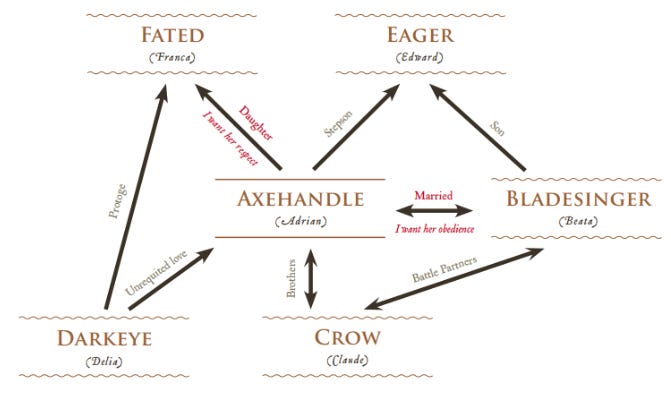
Relationship maps like the one above are the real design document. Marriage, daughter, stepson, unrequited love, fostering, and battle partnership are not flavor text. They are edge types. If your NPC relationship system cannot represent those edges, your world cannot react when the player pulls on one of them.
Gifts and Mood That Do Not Talk to Dialogue
Life sims taught a generation of players that peaches, minerals, and cooked meals are social language. When gift taste, daily mood, and spoken lines live in three different tools, the loop breaks. The NPC accepts a loved gift, stays “neutral,” and recites a generic hello. Players feel the seam immediately.
Romance Without Social Cost
Otome and dating-sim research shows how intensely players construct meaning around reciprocal affection. One study drew on 293 open-ended player responses to examine how people articulate emotionally meaningful bonds in otome games. Those players notice when a confession has no witnesses, no family reaction, and no rival consequence. Romance that cannot collide with the rest of the graph is costume jewelry.
Worlds That Remember Nothing
Academic work on NPC social believability has long tested whether modeled social relationships produce richer behavior. Newer production write-ups describe AI-driven characters with real-time adaptation, emotional signals, and persistent memory. Most indie pipelines still store “heart level 6” and call it a day. The gap between research and a shippable NPC relationship system is documentation, rules, and iteration — not another mood board.
This is exactly what this AI design partner was built for.
Why Game Designer Assistant
Game Designer Assistant treats your NPC relationship system as a standalone design problem — not a pile of disconnected dialogue files. You bring a cast, a genre, and a constraint (12 townspeople, a six-heart cap, a faction war). It returns systems analysis: edge types, affinity rules, gift economies, mood modifiers, and the documentation your writers and programmers can actually share.
| Traditional Approach | Game Designer Assistant |
|---|---|
| One heart meter per NPC, no NPC–NPC graph | Full webs: family, rivalry, romance, fostering, faction |
| Gift lists that never touch mood or schedule | Gift, mood, and dialogue locks designed as one loop |
| Romance flags with no jealousy or witnesses | Social cost: family pressure, rivals, public reputation |
| Design notes trapped in chat or a stale wiki | Systems docs, tables, and iteration prompts in one place |
| Genre rules copied from a famous life sim | Rules tuned to your fantasy RPG, otome, or social sandbox |
That table is the difference between cloning a heart event and designing a society. Designers who think in NPC-to-NPC relationships already know the world is the graph. This assistant helps you specify that graph before art lock and before voice recording.
Relationship Graphs, Not Just Player Meters
Ask for edge types first: blood, marriage, mentorship, unrequited love, battle partnership, debt, feud. Then ask who can see which edges. A foster parent who wants respect, a spouse who wants obedience, a sibling who shares a battlefield — those motives become dialogue filters and quest gates. The output is a map you can pin in a design doc, not a vague “they should feel close.”
Gift, Mood, and Friendship Loops
A production NPC relationship system needs three clocks talking to each other: what you gave, how they feel today, and what they will say. The assistant can draft loved/liked/hated tables, mood multipliers (rain, festival, grief), and the exact heart thresholds that unlock cooking recipes, follow requests, or a confession scene. You stay in designer language — thresholds, flags, cooldowns — not engine trivia.
Dialogue Locks and Memory
Branching conversation dies when every NPC has the same three greets. Better practice is lock lists: lines that require “saw player steal,” “attended sibling’s funeral,” or “gifted rival this week.” Case studies of kinship in games show that narrative, mechanics, and presentation have to agree before a bond feels embodied. The assistant’s job is to force that agreement onto the page.
Genre Fluency Without Copy-Paste Design
Life sim, CRPG, otome, extraction shooter with a hub town — each needs a different social physics. A farming village wants daily gift cadence and seasonal festivals. A war camp wants trust, rumor, and desertion. Testing across genres is the point of a dedicated systems partner: you describe the fantasy, it returns rules that match the fantasy.
"Design an NPC relationship system for a 14-person coastal town: six-heart friendship, eight-heart romance, gift tastes, rain mood penalties, and NPC–NPC jealousy if I date two siblings."
"Convert this family web into affinity rules, public vs private knowledge, and quest locks for a grimdark RPG."
"List every social action a player can take in a life sim hub — hold hands, gift, gossip, work together — and map each action to relationship deltas."
Related Agents You'll Also Find Useful
If you are also naming a full cast, Name Generator can produce culturally coherent NPC names, house names, and pet names that match the region you already locked. Relationship systems fall apart when the blacksmith, his daughter, and the visiting duke sound like they were drawn from three different setting bibles.
If you are also working on interior life, Personality Analyzer helps you specify attachment style, Big Five traits, and conflict patterns so “kind baker” is not your only personality template.
- Trait stacks you can drop into bios
- Compatibility notes for romance candidates
- Stress behaviors that justify mood swings
If romance and rivalry need a voice, Acting Coach pressure-tests confession scenes, breakup monologues, and gossip delivery so the system’s flags sound like people, not UI.
If you want to feel emergent social physics from the player side, College Life is an open-world campus romance where friendships, heartbreak, and connections unfold from your choices — useful reference when you are tuning how fast a bond should form.
Try this design partner free — no credit card required.
How It Works
Step 1: State the Social Fantasy Describe genre, cast size, and what “winning” a relationship means in your game. Be concrete: farming life sim, 12 townspeople, marriage in year two, or a mercenary company of eight with loyalty that can snap.
"I am designing a cozy life sim. Players can hold hands, gift, and complete chores with NPCs. I need a relationship system with mood, friendship, and one romance track."
Step 2: Build the Graph Before the Heart Meter Upload or paste your cast list. Ask the AI design assistant for edge types between NPCs — not only between NPCs and the player. Demand parents, rivals, foster ties, and secret affections. The first deliverable should look like a relationship map, not a dialogue spreadsheet.
"Here are 10 NPCs. Give me a relationship map with family, work, unrequited love, and one feud. Then list which edges the player can discover vs which stay private."
Step 3: Define Actions, Gifts, and Mood List every social verb: talk, gift, hold hands, dance, work a shift, overhear, betray. For each verb, specify relationship delta, mood filter, and public witnesses. This is where life-sim UX and RPG reputation meet.
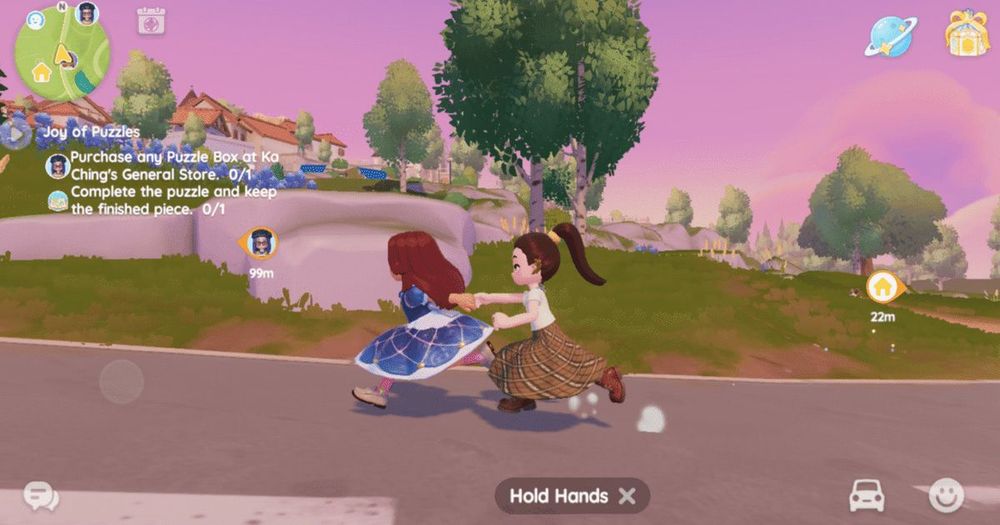
A hold-hands prompt is not decoration. It is a verb in the NPC relationship system: a visible, cooperative action with a cooldown, a location, and a friendship threshold. If the system cannot explain why that prompt appeared, players will assume it is random.
Step 4: Lock Dialogue and Ship the Doc Ask for heart-event outlines, refusal lines, and gossip that fires when NPC–NPC edges change. Export the result as a table writers and engineers can share: NPC, edge, threshold, verb, outcome. Iterate on one broken loop (gifts that ignore grief, for example) instead of rewriting the whole town.
"Write the lock list for Mira: lines if I am dating her brother, if I missed her festival, and if I gifted her rival twice this week."
Step 5: Playtest the Social Physics Run tabletop scenarios. “Player marries A, still at eight hearts with B, B is A’s battle partner.” If the assistant cannot tell you who confronts whom, the system is not done. Repeat until every major edge has a visible consequence.
Results & Use Cases
📊 Shipping a Life-Sim Friendship and Romance Loop
- Scenario: A solo developer has 12 villagers, a gift table, and no idea when hold-hands, cooking, or confession should unlock.
- Traditional Approach: Copy a famous heart-event cadence, then spend weeks patching NPCs who congratulate a wedding they should resent.
- Game Designer Assistant: A full NPC relationship system: six-heart friendship, eight-heart romance, mood modifiers, gift tastes, and jealousy rules for dating two people in the same family.
- Daily verbs mapped to deltas, not just “talk for +20”
- Festival and weather mood as first-class multipliers
- Writer-ready lock lists for each heart threshold
💼 Building an RPG Family and Faction Web
- Scenario: A CRPG lead has a noble house, a mercenary company, and a marriage that should split a war camp.
- Traditional Approach: Companion approval sliders that never mention the spouse waiting in camp.
- This design partner: Edge types for marriage, brotherhood, fostering, and battle partnership, plus public vs secret knowledge so gossip can actually spread.
- Pair with Name Generator so house names, courtesy titles, and aliases stay consistent across the graph
- Quest gates tied to loyalty, not only player level
- Confrontation scenes when the player pulls two incompatible edges
📱 Designing Relationship Tables on a Phone Between Classes
- Scenario: A student designer commutes with a cast list in notes and a vertical slice due Friday.
- Traditional Approach: A messy phone note that never becomes a table programmers can read.
- The AI systems partner: Voice or type a cast, get a relationship matrix, gift economy, and mood rules before the train ride ends. Web, iOS, and Android keep the same thread.
- Iterate on one NPC’s entire social orbit in a single sitting
- Screenshot-ready tables for the next standup
- No need to open a wiki on a laptop to keep designing
🎯 Tuning Otome-Style Reciprocal Romance
- Scenario: A visual-novel team wants confession routes that feel mutual, not like a points faucet.
- Traditional Approach: Hidden scores and a finale CG, with no family or rival cost.
- Game Designer Assistant: Reciprocity rules, witness scenes, and rival routes informed by how players already describe authentic romance in otome play.
- Use College Life as a live reference for how fast bonds should form when every choice is social
- Route bibles that include refusal, cooldown, and repair
- Personality-driven conflict instead of generic “tsundere flag”
FAQ
What is an NPC relationship system in game design?
An NPC relationship system is the set of rules that tracks how the player and non-player characters feel about each other — and how NPCs feel about one another. It typically includes affinity values, relationship types (friend, rival, family, lover), social verbs (gift, talk, hold hands, betray), mood, and dialogue locks. The system is working when a change in one bond produces a visible change somewhere else in the town, party, or house.
Is Game Designer Assistant free to use?
Yes. Game Designer Assistant is available on Jenova’s free tier with core features and limited usage — no credit card required to start. Paid plans increase usage if you are iterating on large casts, multiple routes, or daily design dumps. Usage resets monthly on your billing date, with the full allowance available from day one rather than a daily drip.
How is an NPC relationship system different from a dialogue tree?
A dialogue tree is a set of lines. An NPC relationship system is the physics underneath those lines. Trees ask “which branch did the player click?” Systems ask “who is married, who is jealous, who saw the gift, and what mood is this NPC in?” You still need trees or barks. They should read from the graph instead of pretending the graph does not exist.
Can this AI help with romance, rivalry, and family systems?
Yes. The assistant is strongest when you specify edge types and costs: marriage that angers a battle partner, fostering that demands respect, unrequited love that changes gift reactions. For interior motivation, Personality Analyzer can add attachment and trait language so rivals and lovers do not share the same emotional skeleton. You remain the director; the AI supplies structured options and documentation.
Does Game Designer Assistant work on mobile?
Yes. Jenova offers full feature parity across web, iOS, and Android, including speech-to-text if you want to dictate a cast list on the move. Relationship matrices, gift tables, and lock lists are text-first, so a phone session is enough to advance an NPC relationship system between classes or during a commute.
Will an NPC relationship system designed this way work in my engine?
The assistant outputs design: graphs, tables, thresholds, verbs, and scene outlines. You still implement in Unity, Unreal, Godot, Ren’Py, or a custom RPG framework. That split is useful. Engine plugins do not tell you which jealousy rule your story needs. A documented NPC relationship system does. Engineers get flags and numbers; writers get lock lists; you get fewer contradictions in QA.
Conclusion
A heart meter is not an NPC relationship system. Players stay when gifts, mood, family, rivalry, and dialogue all read from the same graph — when holding hands, missing a festival, or marrying the wrong sibling actually changes the town. Game Designer Assistant is built to specify that graph: edge types, social verbs, affinity rules, and the documents your team can ship against.
If your next vertical slice still treats every villager as a solo dyad, start with the map, not the bark. Design the bonds, then let lines and animations catch up.
Try Game Designer Assistant now. Explore more at Jenova.
For Developers: Game Designer Assistant is available programmatically via the Jenova API — integrate NPC relationship system design into your game-dev application with a single API call. Full documentation →