NPC Behavior Generator: Design Adaptive AI Game Characters
2026-09-10
Game Designer Assistant helps you generate NPC behavior by turning character goals, world rules, and constraints into decision logic you can actually ship. While most games still lean on brittle scripts and one-off state machines, this AI produces behavior trees, priority rules, schedules, and reaction patterns that designers and engineers can share. As of September 2026, that gap between “smart-looking” NPCs and production-ready character AI is one of the costliest problems in game development.
✅ Build behavior trees, utility scores, and daily routines from a character brief ✅ Rank survival, combat, social, and quest priorities before anyone writes code ✅ Generate barks, failure states, and memory hooks that match personality ✅ Iterate faction AI and player-facing reactions in one design conversation
To understand why an NPC behavior generator matters, it helps to look at how character AI is still authored — and where those pipelines break.
Quick Answer: What Is an NPC Behavior Generator?
An NPC behavior generator is an AI design tool that converts character briefs into behavior trees, priority rules, and interaction logic you can hand to engineering. It sits between narrative intent and engine implementation, so NPCs act on goals instead of a single scripted path.
Key capabilities:
- Goal-driven trees for hunger, combat, work, social, and quest states
- Blackboard-style variables you can map into Unreal, Unity, or custom engines
- Personality-consistent dialogue hooks, barks, and memory of player actions
- Reusable archetypes for guards, vendors, companions, and open-world civilians
- Design documentation that programmers can implement without reverse-engineering intent
Why NPC Behavior Is Still Hard to Design
Players now expect non-player characters to notice them, remember previous encounters, and stay in role when a plan goes wrong. Research on intelligent NPC dialogue notes that conventional characters are still constrained by pre-established scripts, which limits immersion when players go off the authored path. Studios are investing in AI for this reason: a Google-commissioned survey of more than 600 developers found widespread use of AI agents in game production, while GDC’s latest industry survey reported that 36% of respondents said their companies already use generative AI.
The market around this work is growing quickly.
$4.8 billion — Estimated AI in games market value in 2025
$22.6 billion — Projected AI in games market value by 2034
NPC-specific tooling is part of that expansion. Industry analysis of non-player character generation AI points to demand for more immersive worlds, online multiplayer, and characters that can hold up under unscripted player behavior.
But designing that behavior is still frustratingly difficult:
- Finite state machines explode in edge cases the moment a player improvises
- Behavior trees are expressive, yet slow to author, review, and debug by hand
- Dialogue, animation, and action logic usually live in disconnected tools
- LLM-driven NPCs without a decision structure can break quests or drop out of character
- Playtests reveal missing priorities — flee, eat, report, return item — too late in production
Scripted Paths Collapse Under Player Freedom
A shopkeeper who can only play one “greet / sell / goodbye” loop feels fake the first time a fight starts in the square. Designers then patch special cases: combat interrupt, stolen goods, closing time, faction standing. Each patch is another state, another animation set, another line of dialogue. The character becomes a pile of exceptions instead of a readable set of goals.
Behavior Trees Work — If You Can Afford to Author Them
Behavior trees are a standard model for plan execution in games and robotics because they compose complex actions from reusable selectors, sequences, and conditions. Engine vendors teach the same pattern: Unreal’s workflow uses trees plus blackboards to store AI variables, and classic primers still describe trees as the practical way to make NPC decision-making inspectable. The cost is authorship. A living village may need dozens of trees that share inventory, hunger, job, and combat rules. Most teams do not have time to draw all of that by hand.
Dialogue AI Without Decision Logic Is Not Character AI
Studios already use models so NPCs can remember conversations and vary replies. That helps barks and open-ended talk. It does not decide whether the blacksmith should finish a commission, eat, flee, or report a crime. Without a generator that outputs priorities and failure states, language models improvise lines while the gameplay brain stays dumb.
GDC data also shows a real trust gap: 52% of surveyed developers said generative AI harms the industry, up from prior years. That skepticism is earned when tools dump unreviewed text into quest NPCs. Structured generation — trees, conditions, and testable priorities — is how design stays in control.
This is exactly what Game Designer Assistant was built for.
Why Game Designer Assistant for NPC Behavior
Game Designer Assistant treats NPC behavior as a design system, not a chat novelty. You describe the character, the world rules, and the failure conditions. It returns decision logic, documentation, and implementation notes you can drop into a GDD, a Confluence page, or an engine task.
| Traditional Approach | Game Designer Assistant |
|---|---|
| One-off state machines per character | Reusable goal-driven trees and archetypes |
| Weeks of designer–engineer translation | Behavior specs, blackboard keys, and acceptance checks in one pass |
| Scripted lines that ignore player history | Personality-consistent reactions and memory hooks |
| Engine graphs that do not travel | Engine-agnostic design for Unreal, Unity, Godot, or custom AI |
| LLM dialogue with no action layer | Dialogue plus combat, survival, work, and social priorities |
That split matters in production. The same GDC survey found 42% of developers building on Unreal Engine and 30% on Unity. An NPC behavior generator that only emits a proprietary graph locks the design. An assistant that emits priorities, conditions, and tree structure lets each discipline implement in the engine they already use.
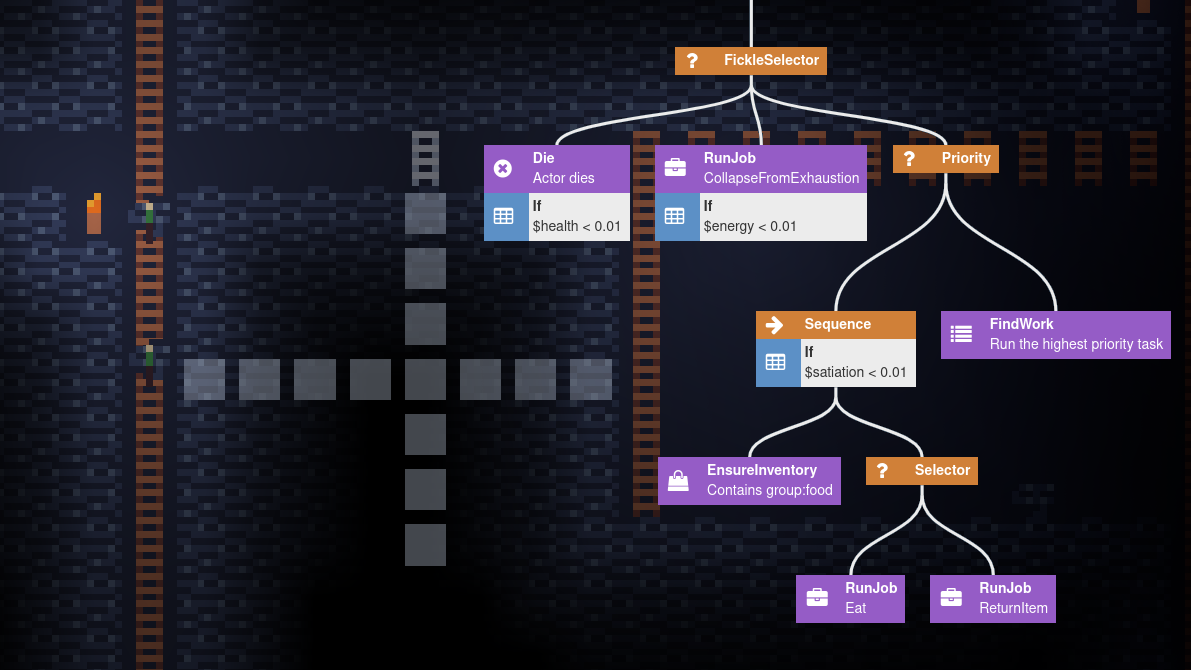
The tree above is the kind of artifact teams actually need: a root selector, lethal and exhaustion interrupts, a hunger sequence that checks inventory, then work. Colonist-style AI write-ups make the same point — behavior trees become a small language for NPC jobs when eating, sleeping, and labor compete. Generating that structure from a brief is faster than drawing every node from memory.
Goal Hierarchies Instead of Exception Piles
Ask for survival first, then job, then flavor. The assistant returns selectors and sequences with explicit thresholds — health, energy, satiation, threat — so programmers are not guessing designer intent. You can demand Unreal blackboard names, Unity sensor hooks, or Godot state names in the same request.
Personality That Constrains Action, Not Just Voice
A cowardly guard and a fanatic guard should not share the same chase subtree. The generator binds traits to utility weights: how long they search, when they call allies, whether they abandon a post. That is character design expressed as numbers engineers can tune.
Docs Engineers Can Implement
Output is not a mood board. It is node lists, conditions, cooldown rules, animation hooks, and playtest cases (“player steals while NPC is eating”). If you later need engine-side code, pair the spec with a C++ Coding Assistant for Unreal tasks or behavior components.
Example briefs to run:
"Design a behavior tree for a frontier blacksmith who must eat, sleep, craft player orders, and flee when health drops below 20%. Name blackboard keys for Unreal."
"Generate utility AI scores for a stealth guard: patrol, investigate, chase, search last known position, and return to post. Include noise and line-of-sight modifiers."
"Write daily schedules and social rules for three rival merchants, including how each reacts if the player steals from one of them."
Related Agents You'll Also Find Useful
If you are also writing barks, implementing trees, or prompting a runtime dialogue model, these partners cover the rest of the NPC pipeline.
Prompt Generator
Runtime NPC chat still needs tight prompts: persona, banned topics, quest flags, and memory format. Prompt Generator turns your behavior spec into model-ready instructions so the talking layer cannot invent loot, skip objectives, or break tone.
- System prompts with inventory, faction, and secret constraints
- Few-shot barks for idle, combat, and quest failure
- Refinement loops when a model drifts out of character
C++ Coding Assistant
Once the tree exists on paper, someone still has to implement tasks, decorators, and perception in engine code. A C++ partner is the natural next step for Unreal AI controllers, custom task nodes, and performance-sensitive update loops.
- Behavior tree task and decorator stubs from your spec
- Blackboard key setup and service tick logic
- Safe, modern C++ for game-engine constraints
Writing Assistant
Behavior is only half of presence. The Writing Assistant drafts character bibles, branching dialogue, and bark tables that match the priorities in the tree — a merchant who flees should not deliver a brave monologue mid-combat.
- Voice sheets tied to traits and utility weights
- Conditional lines for success, failure, and interrupt states
- Lore-safe quest dialogue that respects flags the AI will set
Try Game Designer Assistant free — no credit card required.
How to Generate NPC Behavior Step by Step
Step 1: Brief the Character Like a Systems Designer
Open your game design partner and state role, traits, resources, and hard stops. Name the engine if you have one. Specificity is what turns a vibe into a tree.
"Open-world innkeeper. Traits: greedy, conflict-averse. Must serve drinks, collect tab, sleep upstairs, hide during raids. Unity + sensor range 12m."
Step 2: Demand a Priority Architecture
Ask for a root selector, interrupt conditions, and what happens when a branch fails. Require named variables so the spec maps to a blackboard or animator parameters.
"Root priority: Die if health < 1%. Collapse if energy < 1%. If satiation < 10%, get food or return to kitchen. Else run highest-priority job. List selector vs sequence nodes."
Step 3: Generate Content That the Tree Can Fire
Behavior without lines and tells still feels empty. Request barks, animation tags, and player-memory hooks for each leaf. If dialogue volume is high, hand the voice sheet to writing support and keep the tree as source of truth.
"For each leaf — Eat, Hide, CollectTab, Sleep — write 5 barks, an animation tag, and one memory flag if the player helped or robbed the inn."
Step 4: Add Playtest Cases Before Anyone Implements
Have the assistant enumerate exploits: steal during Eat, start a fight at closing, block the path to bed. Those cases become QA scripts and acceptance criteria on the engineering ticket.
"List 10 player actions that should interrupt this NPC, the correct branch, and what should happen if the required item is missing."
Step 5: Translate the Spec Into Engine Work
Export the tree into your GDD, then implement tasks in Unreal, Unity, or C++. Keep tuning weights in data so design can iterate without a code drop for every personality change.
NPC Behavior Generator Results and Use Cases
📊 Open-World Civilian Schedules
-
Scenario: An indie RPG needs 40 town NPCs with jobs, meals, sleep, and festival variants in one district.
-
Traditional Approach: Designers hand-draw trees for days; programmers copy-paste tasks; schedules desync after the first content patch.
-
Game Designer Assistant: One archetype (worker, vendor, guard, child) plus per-character modifiers yields shared survival branches and unique jobs.
-
Reusable Eat / Sleep / Flee interrupts across the cast
-
Festival overrides that do not destroy weekday logic
-
QA cases for missing inventory and blocked navmesh
💼 Faction Combat and Boss Phases
-
Scenario: A mid-size Unreal project needs bandit AI that flanks, retreats at 30% health, and calls reinforcements once.
-
Traditional Approach: Combat designers write a phase chart; AI programmers discover missing perception rules in vertical slice.
-
Game Designer Assistant: Utility scores and a phase tree with cooldowns, ally counts, and retreat destinations, ready for blackboard keys.
-
Interrupt rules that beat leftover patrol logic
-
Named perception events for noise vs line of sight
-
Implementation notes a C++ specialist can turn into tasks
📱 Live-Ops Event NPCs on Mobile
-
Scenario: A live-ops designer is on a train with a phone, and a weekend event needs a limited-time vendor who only sells if the player finished a qualifying quest.
-
Traditional Approach: Wait for office hours, then a full engineering ticket for one flag check and a handful of lines.
-
The NPC behavior generator: On web or mobile, the designer generates the condition tree, stock table, and rejection barks, then files a ticket with acceptance tests attached.
-
Quest-flag gates spelled out before code
-
Short bark sets that fit mobile UI
-
Event teardown rules so the vendor disappears cleanly
🎯 Companion AI That Protects Quest Flow
-
Scenario: A story game needs a companion who chats freely but must never skip a required escort or reveal a late-act secret.
-
Traditional Approach: Writers add more scripted scenes; an unconstrained chat model leaks plot.
-
Game Designer Assistant: Behavior gates plus a prompt pack. Prompt Generator locks secrets and quest flags; writing support fills allowed topics.
-
Talk vs follow vs combat as explicit priorities
-
Banned-knowledge list bound to story act
-
Failure lines when the player abandons the escort
NPC Behavior Generator FAQ
What is an NPC behavior generator in game development?
An NPC behavior generator is a design tool that produces the decision structure of a non-player character — priorities, conditions, schedules, and reactions — rather than only writing dialogue. Used well, it outputs behavior trees, utility scores, and playtest cases that match engine practice in Unreal, Unity, and similar tools. Game Designer Assistant focuses on that systems layer so characters stay consistent when players improvise.
Is Game Designer Assistant free to use?
Yes. You can use Game Designer Assistant on a free plan with core features and limited usage, without a credit card. Paid tiers raise usage limits if you are generating full districts, combat factions, or live-ops casts. Start with one archetype, lock the interrupt rules, then scale to the rest of the roster.
How is an AI NPC behavior generator different from Unreal or Unity trees?
Engine trees are the runtime. A generator is the design step before those graphs exist. Unreal’s own tutorials still center on behavior trees and blackboards; this assistant drafts node structure, variables, and failure handling so you are not authoring every civilian from a blank graph. You still implement and tune in-engine.
Can it generate both combat AI and dialogue?
Yes. Combat, stealth, work, and social branches belong in the same priority list, and barks should fire from those leaves. For large line counts, keep the tree as source of truth and use a writing partner for voice. For runtime chat, add a constrained prompt so language cannot override quest flags.
Does this work on mobile for designers on the go?
Yes. The same design flow runs on web, iOS, and Android, which is why live-ops and narrative designers can iterate event NPCs from a phone. Speech-to-text helps when you are walking through a paper map and want to capture a guard’s priorities before you forget them. Implementation still happens in the engine; the mobile session is for specs, not shipping binaries.
Is generated NPC behavior production-ready?
Treat output as a high-quality first implementation spec, not an unchecked drop-in. Review weights, navmesh assumptions, and animation tags with design and engineering. That review is still far cheaper than discovering a missing Flee branch in QA. The teams getting value from generative tools in games are the ones using them for structured production assets, not unsupervised quest dialogue.
Design Better NPC Behavior With Less Rework
Scripted NPCs fail when players go sideways. Raw chat models fail when they talk past the gameplay brain. An NPC behavior generator closes that gap by turning goals, traits, and world rules into trees, utility scores, and test cases you can implement.
Game Designer Assistant gives you that systems layer: interrupts that make sense, jobs that yield to hunger and fear, and documentation engineers can code. Pair it with prompts, C++, and writing support when you need the full character pipeline.
Try this AI game design partner on your next guard, vendor, or companion. Explore more at Jenova.
For Developers: Game Designer Assistant is available programmatically via the Jenova API — integrate NPC behavior generation into your tools or live-ops pipeline with a single API call. Full documentation →