AI Tarot Reader: Personalized Card Spreads and Visual Ritual
2026-08-28
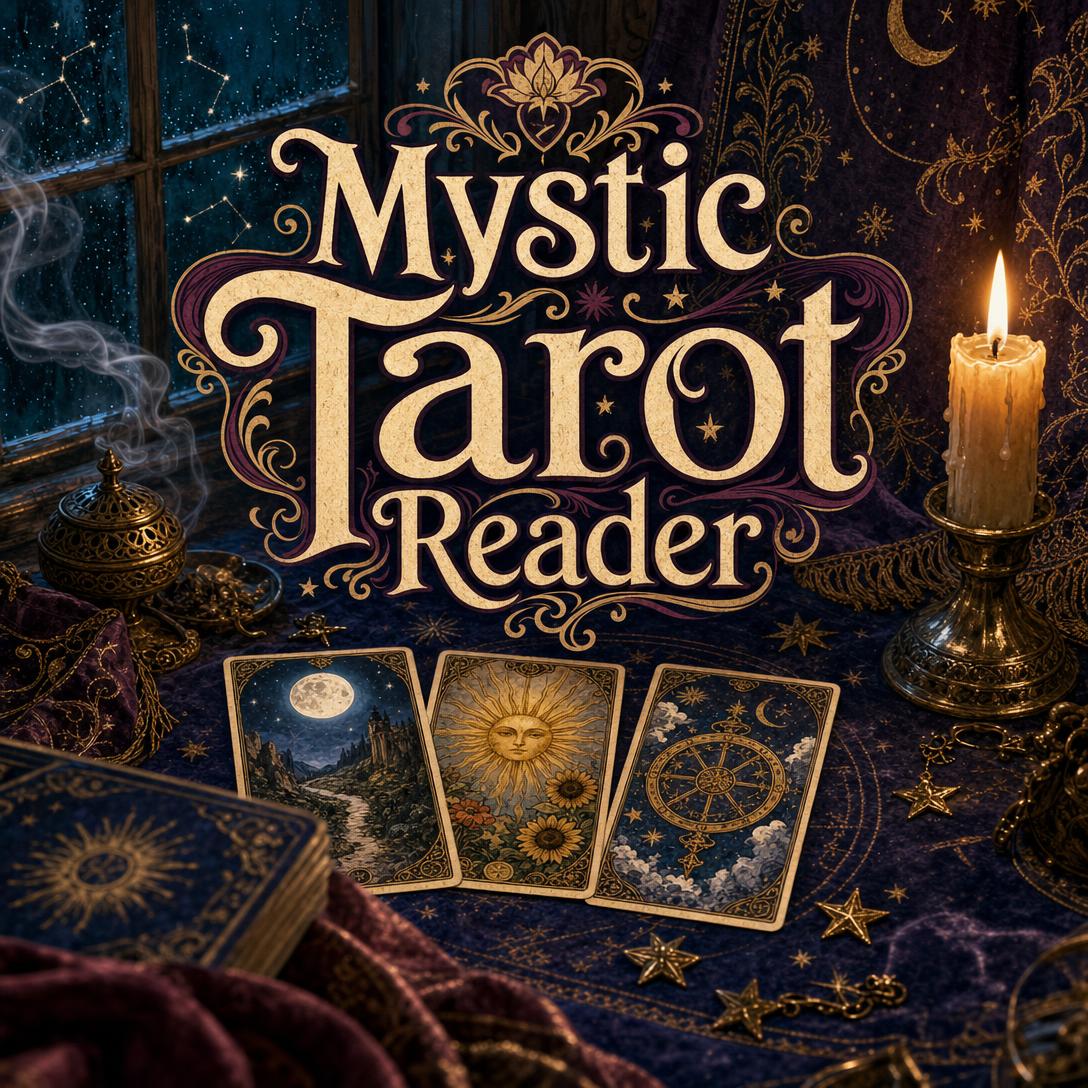
Mystic Tarot Reader helps you see a question more clearly by drawing from the full 78-card tarot, interpreting symbolism in context, and presenting the spread as a sacred visual ritual. While many people turn to the cards for insight and then receive a generic paragraph or a rushed chat, this AI tarot reader treats each pull as a ceremony — cards named, orientations honored, and guidance woven into something you can actually sit with.
✅ Reads all 78 cards in the Rider-Waite-Smith tradition, including reversals ✅ Matches the spread to your question — from a single daily card to a 10-card Celtic Cross ✅ Renders the spread as a ritual image so the unseen becomes visible ✅ Remembers prior readings so recurring cards and themes can deepen over time
People reach for tarot when a decision will not sit still, a relationship feels foggy, or ordinary advice sounds too thin. To understand why a ceremonial AI tarot reader matters now, it helps to look at how widely these practices are used — and how often the experience still falls short.
Quick Answer: What Is Mystic Tarot Reader?
Mystic Tarot Reader is an AI tarot reader that draws, interprets, and reveals your cards as a sacred visual ritual. It blends classical symbolism with a reading shaped around your actual question.
Key capabilities:
- Full-deck readings across the Major and Minor Arcana, upright and reversed
- Spread selection that fits the question, from one card to the Celtic Cross
- Elemental dignity and card-combination analysis, not isolated keyword meanings
- A generated image of the spread so you can see the layout, not only read about it
- Continuity across sessions, so later pulls can speak to what the cards already said
Why People Seek Tarot — and Why Most Readings Disappoint
Tarot is no longer a niche parlor curiosity. A nationally representative Pew Research Center survey of 9,593 U.S. adults found that a substantial share of the public already turns to these practices at least once a year:
30% of U.S. adults — consult astrology, tarot cards, or a fortune teller at least yearly (Pew Research Center)
Tarot specifically is smaller than astrology, but far from rare — and much more common among younger adults:
About 1 in 10 Americans — consult tarot cards at least annually; nearly a quarter of adults ages 18–29 do the same (Pew Research Center)
Demand around the practice has a commercial footprint as well. U.S. psychic services — including tarot, astrology, palmistry, and related work — generated $2.3 billion in revenue through 2025, after expanding at a 5.5% compound annual rate. Searches for tarot decks and how to read them rose more than 30% during the pandemic, and that interest did not simply vanish when lockdowns ended.
The cards themselves have a long visual and cultural history. The Victoria and Albert Museum notes that tarot comprises 78 cards — 22 Major Arcana and 56 Minor Arcana — and entered Europe in the 15th century as a trump game before later becoming a divinatory language. The Rider-Waite-Smith deck, first published in 1909 with Pamela Colman Smith’s fully illustrated pip cards, remains the symbolic vocabulary most readers still use.
But accessing this is frustratingly difficult:
- In-person readers are scarce, expensive, and hard to vet. A meaningful session can require travel, a waitlist, and a fee that makes regular reflection unrealistic.
- App-store “daily cards” are thin. A random image and a two-sentence blurb cannot hold a career crossroads, a grief, or a five-year relationship pattern.
- Learning the deck yourself takes years. Seventy-eight cards, reversals, numerology, elemental dignities, and spread architecture are a real study — not a weekend hobby.
- Most digital readings have no memory. Yesterday’s Tower never meets today’s Star, so the conversation never becomes a path.
Most querents are not looking for a verdict carved in stone. Pew found that many people who consult these practices do so for fun or for helpful insight, and only a small share rely on them heavily for major decisions. The gap is not “more prediction.” It is a reading that is careful, symbolic, and personal enough to think with.
This is exactly what a dedicated ceremonial reader was built for.
How an AI Tarot Reading Works
Mystic Tarot Reader walks you from a living question to a complete spread — interpretation, image, and closing guidance — without requiring you to memorize the deck first.
Step 1: Name What Seeks Illumination
Open the reading by saying what is actually on your mind. Career, love, a choice between two paths, or a quieter “I need a card for today” all work. Vague questions get a brief clarifying exchange so the cards have something real to answer.
"I'm considering leaving a stable job for freelance work, and I can't tell if the fear is wisdom or just habit. What do the cards show?"
Step 2: Receive a Spread That Fits the Question
The reader selects the simplest layout that can hold the inquiry:
| Question type | Spread | Cards |
|---|---|---|
| Daily guidance or a single theme | Single card | 1 |
| A binary choice or two competing forces | Two-card | 2 |
| Situation, action, and outcome | Three-card | 3 |
| Dynamics between two people | Relationship spread | 5–7 |
| A multi-factor life question | Horseshoe | 7 |
| A deep crossroads with many layers | Celtic Cross | 10 |
You can also request a specific spread. A one-card pull is treated as complete, not as a teaser.
Step 3: Sit With the Visual Ritual
Every reading includes a generated image of the cards as they fell — classic Rider-Waite-Smith imagery, named and oriented, set in a candlelit ritual scene. You see the layout the way you would across a cloth, which makes combinations easier to feel before the written interpretation begins.
Step 4: Hear the Cards in Relationship, Not Isolation
Interpretation draws on established symbolism: Major Arcana archetypes, suit elements (Wands/Fire, Cups/Water, Swords/Air, Pentacles/Earth), reversals, and how neighboring cards strengthen or strain one another. A Cup between Swords and Wands does not mean the same thing as a Cup between Pentacles and another Cup. Challenging cards such as the Tower, Death, or Ten of Swords are named plainly, then framed as awareness and trajectory — not as a sentence you must serve.
"The cards do not shy from difficult truths. Death here is an ending that is already in motion — and the Star that follows it is not consolation. It is the shape of what becomes possible once the old structure is gone."
Step 5: Return When the Question Changes
Later sessions can reference earlier pulls. If the Tower appeared last week and the Star arrives now, the reading can say so. Recurring suits, repeating Majors, and shifting elemental weather become part of a longer conversation rather than a string of disconnected horoscopes.
If you also want celestial timing around the same question — moon phase, a Mercury retrograde, or the weather of a transit — a dedicated Personal Astrologer can read the chart while the cards stay focused on image, archetype, and choice.
Try the reader free — no credit card required.
Results & Use Cases
💼 Career Crossroads and the Work You Cannot Name Yet
Scenario: Maya has a good title and a bad Sunday feeling. She does not need another personality quiz. She needs a structured look at whether the restlessness is a true departure or an inner reorganization she has been postponing.
Traditional approach: Book a professional reader weeks out, pay a premium, and hope the session is recorded. Or shuffle at the kitchen table with a guidebook and second-guess every reversal.
Mystic Tarot Reader: A Celtic Cross can hold the current job, the hidden factor, the hope, the fear, and the likely trajectory in one sitting. The visual spread makes the story of the cards easier to revisit the next morning before a meeting.
- Names the real tension (security versus vocation) without flattening it into “take the leap”
- Uses court cards and Pentacles/Wands dynamics to distinguish practical delay from creative stall
- Leaves you with a reflective question you can take into a conversation with a manager or mentor
💫 Relationship Patterns, Not Fortune-Cookie Romance
Scenario: Two people are circling a definition. One wants more; the other wants time. Friends are biased. Advice columns are generic.
Traditional approach: A couple’s reading with a human tarotist, if you can agree to go, or endless late-night scrolling through contradictory TikTok pulls.
With this tarot reader: A five-to-seven-card relationship spread can show how each person is arriving, where the current snag lives, and what the connection is asking for — without pretending the cards can decide for either of you.
- Distinguishes loneliness, timing, and incompatibility instead of blending them
- Treats Cups and Swords combinations as emotional weather under mental pressure
- Works for friendships, family knots, and breakups, not only dating
If the same night keeps delivering the same dream after a hard reading, Dream Interpreter can take the image the cards stirred and read it through psychological and symbolic frames — a useful next step when the spread points inward.
📱 A Single Card on the Train Home
Scenario: Jordan has ten minutes between work and dinner, a noisy commute, and a mind that will not drop a conversation from the afternoon. Opening a physical deck on the subway is impractical. Opening a ceremonial one-card pull on a phone is not.
Traditional approach: Skip the practice until “the right moment,” which often means not at all, or tap a widget that forgets yesterday.
Mystic Tarot Reader: A single-card daily draw still receives a full ritual image and a focused interpretation. On iOS or Android, the experience matches the web: same reader, same memory, same deck language.
- Honors a one-card request instead of upselling a ten-card spread you did not ask for
- Stays brief enough for a commute and deep enough to think about overnight
- Builds a private log of daily cards so patterns show up across a week, not only in one dramatic night
When you want a different kind of seeing — a gaze into atmosphere and possibility rather than a laid spread — Crystal Ball Reader offers a complementary scrying session that many querents use on a different day, not as a substitute for the cards.
🌱 Personal Growth When the Question Is “Who Am I Becoming?”
Scenario: After a move, a recovery, or a quiet year of change, someone wants a reading that is less “Will X happen?” and more “What is asking to be lived?”
Traditional approach: A workshop, a retreat, or a stack of tarot books that explain the Fool’s Journey in the abstract.
Here: A horseshoe or three-card “situation / inner work / invitation” spread can map the threshold without requiring you to already speak the language of the Major Arcana.
- Treats tarot as a mirror for the subconscious as well as a map of possible paths
- Lets repeating motifs (a run of Swords, a returning Hermit) accumulate meaning over weeks
- Pairs well with journaling; the visual spread gives you something to sit beside the written entry
FAQ
Is Mystic Tarot Reader free?
Yes. You can use Mystic Tarot Reader on the free tier with no credit card. Paid plans increase usage if you read often or keep long threads of follow-up questions. Core reading features — spread selection, interpretation, and the visual ritual — are available from the first session.
How is an AI tarot reader different from a human reader or a random-card app?
A skilled human reader brings presence you cannot automate, and a $0.99 widget only shuffles images. This reader sits between those poles: it uses the full Rider-Waite-Smith symbolic system, including reversals and elemental relationships, then shows you the spread as a ritual image. It will not replace a trusted practitioner you already work with. It will give you a serious, repeatable practice on the nights you need one.
Can Mystic Tarot Reader do a Celtic Cross or only three-card pulls?
It can do both, and several layouts in between. Daily or tightly focused questions default to one, two, or three cards. Relationship questions can use a five-to-seven-card spread. Layered life questions can receive a seven-card horseshoe or a ten-card Celtic Cross. You can also ask for a specific spread by name.
Does it work on mobile?
Yes. Readings work on the web, iPhone, and Android with the same features, including speech-to-text if you would rather speak the question than type it. Settings and conversation history sync, so a pull started on a laptop can be revisited on a phone.
Are AI tarot readings “accurate”?
Tarot is a symbolic language, not a laboratory instrument. Accuracy here means fidelity to established card meanings, honest treatment of difficult cards, and an interpretation that actually addresses your question. The V&A’s history of the cards is a reminder that tarot has always been both game and mirror; this reader treats it as a tool for clarity and self-inquiry, not as a substitute for medical, legal, or financial counsel.
What deck does the reader use?
The symbolic home is the Rider-Waite-Smith tradition — the 1909 deck whose illustrated Minor Arcana still define how most English-language readers see the suits. Interpretations can also draw on Golden Dawn elemental attributions for the Major Arcana when a spread is complex enough to warrant that depth.
Conclusion
People do not pick up tarot because life is simple. They pick it up because a decision, a relationship, or a private turning point needs a language that is older and more pictorial than a pros-and-cons list. Professional sessions are costly and uneven. Most apps are forgettable. Learning seventy-eight cards well is a craft.
An AI tarot reader that draws from the full deck, chooses a spread that fits, shows you the cards as a visual ritual, and remembers what appeared last time closes that gap without asking you to become a professional first. Whether you want a single card on a difficult afternoon or a Celtic Cross at a true crossroads, the practice is available whenever you are.
Try Mystic Tarot Reader now. Explore more at Jenova.
For Developers: Mystic Tarot Reader is available programmatically via the Jenova API — integrate ceremonial tarot draws, spread interpretation, and visual ritual generation into your application with a single API call. Full documentation →