Military Roleplay AI: Immersive Tactical Scenarios & Wargames
2026-08-28
Roleplay Game Master helps you run military roleplay AI campaigns that stay in character, remember every fragmentary order, and adapt when the situation changes. As of August 2026, professional military education and serious hobby wargaming are both moving toward adaptive, language-model-supported scenarios — yet most chat tools still drop ranks, forget call signs, and lose the thread of a multi-day operation. This AI provides persistent tactical roleplay with consistent NPCs, a coherent command climate, and scenarios that survive more than a single firefight.
✅ Persistent campaign memory across sessions — units, logistics, and prior decisions stay intact ✅ Rank, call-sign, and character consistency that does not reset mid-mission ✅ Adaptive opposing force that reacts to your plan instead of reciting a script ✅ Land, sea, air, staff, and multi-domain scenarios from the same campaign thread
To understand why this matters, it helps to look at how military roleplay actually fails in practice — for tabletop referees, fiction writers, students of strategy, and anyone trying to rehearse command decisions under pressure.
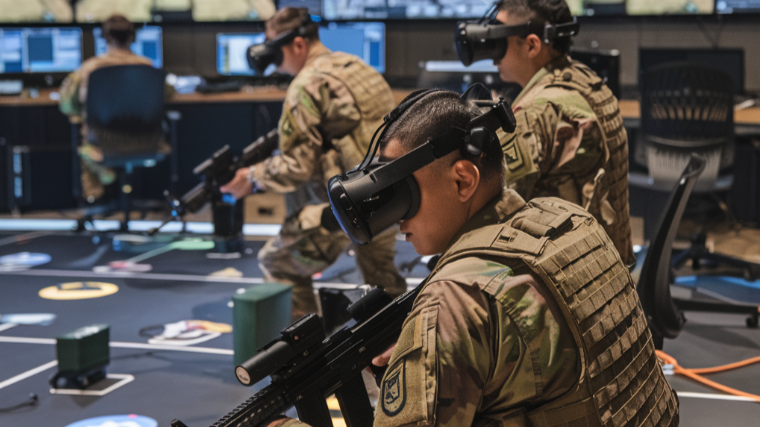
Quick Answer: What Is Military Roleplay AI?
Roleplay Game Master is a military roleplay AI that runs persistent tactical scenarios with consistent characters, adaptive adversaries, and full campaign memory. It treats your operation as a living campaign, not a one-off chat.
Key capabilities:
- Continuous memory of orders, casualties, logistics, and prior turns
- NPCs that hold rank, doctrine, and personality across sessions
- Adaptive red-team behavior that changes when you change the plan
- After-action reviews, fragmentary orders, and staff-estimate style play
Why Military Roleplay Breaks Down
Military roleplay is harder than fantasy adventure for a simple reason: the fiction has to carry procedure. Call signs, rules of engagement, logistics, time-distance, and chain of command are the story. When those details slip, immersion dies — and so does any training value.
That gap is not imaginary. Defense institutions are investing heavily in simulation because live training cannot cover every contingency. The military simulation and training market was valued at USD 14.29 billion in 2026, and other forecasts put the category on a path toward USD 23.45 billion by 2034. Parallel to that, professional military education is experimenting with large language models to speed adjudication and keep students focused on planning rather than rulebooks — a shift documented at the U.S. Army War College.
Hobbyists, writers, and amateur commanders face a smaller version of the same problem. They want the texture of a real operations order without a full umpire staff.
But getting that texture from generic tools is frustratingly difficult:
- Characters forget yesterday’s casualty list and invent a new battalion overnight
- The opposing force either steamrolls you or collapses on cue
- Time, distance, and logistics are hand-waved until the plot needs them
- The “GM” voice breaks character to explain mechanics mid-contact
Scripted modules cannot keep up with your decisions
Traditional modules and branching chatbots assume a path. Military operations do not. When you refuse the obvious axis of advance, divert a logistics convoy, or hold fire under tight ROE, a scripted scene has nowhere to go. Air University analysis of AI in professional military education makes the same point at institutional scale: static crisis models cannot replicate the tempo of modern multi-domain problems. Your kitchen-table campaign has the identical failure mode, just fewer staff officers.
Memory failure destroys command climate
A platoon sergeant who does not remember the missing squad from last session is not a character. He is a random number generator with a rank insignia. Military roleplay lives on continuity — who is tired, who is short on water, who already argued with the company commander. Generic chat sessions wipe that state. You end up re-briefing the AI instead of issuing orders.
Adjudication overhead crowds out the actual decision
Tabletop wargames and rigid professional games share a cost: the rules become the activity. The Army War College’s Pacific Strategy experiment found that strict rulesets and heavy adjudication pulled attention away from learning outcomes. Solo players feel this as hours of prep for a two-hour session. Writers feel it as world bibles that never get used because maintaining them is a second job.
Realism without a research staff is guesswork
If you want a Taiwan scenario, a Sahel convoy problem, or a contested littoral defense to feel plausible, you need more than vibes. Force structure, doctrine, and political constraints matter. Most roleplay tools will confidently invent a brigade that does not exist. RAND has warned that using AI as a substitute for human judgment in wargames can produce a “mirage of knowledge” — a useful caution for roleplayers who want texture, not false precision.
This is exactly what a dedicated military roleplay AI was built to handle: keep the campaign state, hold character, and let you practice decisions instead of babysitting the narrator.
Why Roleplay Game Master
This military roleplay AI is built for long-running scenarios, not one-shot chats. You set the theater, the unit, the ROE, and your role. It runs the rest of the battlespace — adjacent units, civilian traffic, weather, higher headquarters, and an opposing force that notices when you mass on an obvious approach.
It is not a video game with a fixed mission list. It is a persistent referee that can play a fire-team leader, a battalion S3, a ship’s TAO, or a hostile brigade commander without collapsing the fiction. That is the difference between “describe a firefight” and “run the next 72 hours of this operation.”
| Traditional Approach | Roleplay Game Master |
|---|---|
| Scripted modules that reset when you leave the path | Persistent campaigns that remember prior turns |
| NPCs that forget ranks, wounds, and grudges | Character-consistent command climate |
| Static opposing force with a pre-written plan | Adaptive red team that reacts to your scheme of maneuver |
| Hours of GM prep or a full umpire cell | Scenario running from the first prompt |
| Generic chatbot tone that breaks immersion | In-world voice: FRAGOs, SITREPs, and after-action notes |
Persistent memory that behaves like a campaign log
The value of military roleplay AI is not purple prose. It is state. Who holds the bridge. Which squad is down to two magazines. Whether higher already denied your request for aviation. Unlimited conversation memory means you can close the session after a night attack and reopen it as the same commander, with the same exhausted company, facing the same unresolved contact.
Character consistency under stress
A good military scene depends on people staying themselves when the plan dies. The veteran platoon sergeant who hates wasted motion, the ambitious S3 who wants a clean slide, the opposing company commander who will not suicide his battalion for your plot — those voices have to hold. Perfect character consistency is what keeps a three-week campaign from turning into a parade of interchangeable extras.
Adaptive adversaries, not a damage sponge
Analysts arguing for generative AI in wargaming point to a practical benefit: more people can explore operational problems without a warehouse of facilitators. The same logic applies at the table. You need an opposing force that repositions, feints, and exploits a gap you left while chasing a high-value target. You do not need an HP bar.
Procedure as the drama
The AI can speak in the formats military roleplay actually uses: warning orders, fragmentary orders, staff estimates, battle-damage assessments, and cold after-action reviews. That is more useful than cinematic explosions. It is also closer to how institutions already use language models — the War College’s faculty used LLMs to produce operations and intelligence summaries so students could stay on planning, not paperwork.
Example openings you can drop in immediately:
"You are the battalion S3. We lost contact with 2nd Platoon after they crossed Phase Line Blue. Issue a FRAGO, track time, and show me the opposing force reaction. Stay in character."
"Run a 72-hour urban defense of a coastal airfield. I am the company commander. Tight ROE, ammunition tracked by squad, civilians still in the blocks."
"Adjudicate this staff estimate: two brigades, contested logistics, a 48-hour weather window. Speak as the division G3. Do not invent units I did not give you."
Related Agents You'll Also Find Useful
If your military roleplay needs more than a referee — doctrine, political context, or sharper character work — these agents sit naturally next to the campaign.
Military & Defense Analyst
If you are building a scenario and you care whether the order of battle is plausible, this is the research cell you run before kickoff. It is built for strategy, doctrine, force assessment, wargaming, and defense-industry analysis rather than scene-by-scene roleplay.
- Ground your campaign in real force structure and published doctrine
- Stress-test a course of action before you play it
- Separate what a unit can actually do from what fiction usually pretends
Geopolitics Analyst
Modern military roleplay is rarely “two armies in a blank desert.” Escalation ladders, alliances, sanctions, and domestic politics shape what your commander is allowed to do. This analyst is the right brief before you set ROE for a Taiwan, Baltic, or Red Sea scenario.
- Map power dynamics and likely third-party reactions
- Keep your campaign’s political constraints honest
- Avoid cartoon villains when the conflict is contemporary
Acting Coach
Writers and serious players often want the voice to match the rank. Military dialogue is clipped, coded, and full of things people will not say on a recorded net. An acting coach helps you lock dialect, bearing, and emotional temperature so your captain does not sound like a novelist narrating a captain.
- Scene work for command presence and radio brevity
- Dialect and register that fit the service and era
- Feedback when a character’s choices stop matching their training
Try Roleplay Game Master free — no credit card required. Use the analyst agents when you want the world to survive contact with a map.
How Military Roleplay AI Works
You do not install a simulator. You describe the operation and play.
Step 1: Set the theater, the unit, and your role
Give the minimum a real commander would have: location, timeframe, task organization, ROE, and what “winning” looks like for this mission. Specificity is what keeps the AI from inventing a fantasy brigade.
"Black Sea, present day. I am skipper of a corvette escorting a grain convoy. NATO ROE. Fog, AIS spoofing, and a drone threat. You run the rest of the picture."
Step 2: Issue orders in the voice you want back
If you write like a radio net, you get a radio net. If you write like a staff estimate, you get staff work. Ask for time hacks, ammunition counts, and what you do not know. Your campaign AI will hold those constraints across turns.
"Do not resolve the whole battle in one reply. Give me the next 20 minutes, what my sensors show, and one decision I have to make."
Step 3: Let the opposing force think
When you mass on the obvious axis, say so and demand a reaction. Adaptive red-teaming is the point. Institutional wargaming is moving the same direction — the U.S. Air Force has even explored AI-enabled platforms for high-intensity wargames — because scripted enemies teach scripted habits.
"I left the western wadi uncovered to mass on the highway. What does the opposing battalion commander do in the next hour? Stay in his character, not mine."
Step 4: Run the after-action review before you close
End the session the way a real unit would: what was the mission, what happened, what will you change. Ask the AI to stay in a senior-mentor voice or a blunt first sergeant voice. Then stop. Memory means you do not need to paste a recap next time.
"AAR, 15 minutes. Be specific about my sequencing and my logistics. No pep talk."
Step 5: Continue the same war tomorrow
Reopen the thread as the same commander. The wounded, the missing convoy, the political constraint from higher — they should still be there. That continuity is what generic chat never delivers and what military roleplay actually requires.
Results & Use Cases
📊 Solo command-post exercise
Scenario: You want to practice being a company commander through a 48-hour defense without recruiting six friends and a referee.
Traditional Approach: Buy a module, spend an evening on setup, then watch the script break the first time you refuse the obvious counterattack. Or run a rigid wargame whose overhead becomes the activity, the same problem War College faculty described with strict pedagogical games.
Roleplay Game Master: You get a living COP in prose — adjacent units, higher’s bad timing, an opposing force that probes the seam you ignored.
- Decisions come at operational tempo, not novel tempo
- Logistics and fatigue stay on the books
- You can pause after a night fight and resume as the same tired company
💼 Military fiction that survives a subject-matter reader
Scenario: You are drafting a novel or screenplay and your last workshop note was “this staff meeting could not happen.”
Traditional Approach: Forums, scattered doctrine PDFs, and a beta reader who served. Weeks of notes for one scene.
Military & Defense Analyst plus the roleplay thread: Research the force, then play the scene. Let characters argue the plan until the dialogue is something a real S3 might say. Pair with geopolitics when the conflict is contemporary and the politics are doing as much work as the guns.
- Scene-level roleplay for voice; analyst-level research for facts
- Fewer invented units and magic ISR
- A campaign bible that is the chat history, not a second document
📱 Fragmentary-order drills on a phone
Scenario: You have twelve minutes on a train and want to keep the campaign warm.
Traditional Approach: A VTT tab you will not open, or notes you will not reread.
Military roleplay AI on mobile: Full sessions on web, iOS, and Android, so you can issue a FRAGO, get a SITREP, and close the app. The next laptop session still knows who is short on water.
- No “new chat, new war”
- Voice-to-text if you think faster than you type
- Useful for writers capturing a scene as well as players running one
🎯 Staff-estimate rehearsal for students and hobby strategists
Scenario: You want the cognitive reps of a wargame — courses of action, risk, and second-order effects — without claiming you have a classified model.
Traditional Approach: Commercial hex-and-counter titles, or waiting for a club night. CSIS has argued that generative AI can widen access to wargaming precisely because traditional games are scarce and slow to build.
Dedicated tactical roleplay: You brief three COAs, the AI plays higher headquarters and the adversary, and you live with the one you chose. Keep RAND’s caution in mind: this is for exploring decisions and narrative coherence, not for predicting a real campaign’s outcome.
- Fast iteration on plans
- Political constraints from a geopolitics brief if you need them
- Clear separation between story and forecast
VR and live simulation still matter for motor skills and collective training — research on VR in military settings finds faster skill acquisition, and the Army’s Synthetic Training Environment work is built around that problem. Military roleplay AI covers a different layer: judgment, language, and campaign continuity you can run without a dome, a range, or a contractor.
FAQ
What is military roleplay AI?
Military roleplay AI is software that runs immersive military scenarios with persistent characters, adaptive adversaries, and campaign memory. Unlike a scripted mission or a generic chatbot, it keeps ranks, logistics, and prior decisions intact so you can play a commander, staff officer, or enlisted lead across multiple sessions. Roleplay Game Master is built for that loop: you set the theater and role, then issue orders in the format you want returned.
Is military roleplay AI free?
Yes. You can start on a free tier with no credit card. Paid plans increase usage if you run long, daily campaigns. For most people testing a single operation or writing a few scenes, the free tier is enough to see whether the character consistency and memory hold.
How is this different from a generic chatbot?
Generic chatbots optimize for a plausible next paragraph. Military roleplay needs a plausible next state: who is alive, what the net last said, where the ammunition went. A dedicated roleplay agent keeps that state and stays in voice. For doctrine and force structure, use Military & Defense Analyst rather than asking the narrator to invent an order of battle.
Can military roleplay AI handle realistic doctrine and modern conflicts?
It can follow the constraints you give it — ROE, task organization, time-distance, and “do not invent units.” For contemporary scenarios, brief yourself first with defense and geopolitics analysis, then play. Treat the roleplay as a decision and story engine. Do not treat it as a classified model or a prediction of a real war, a limit professional wargamers also emphasize.
Does military roleplay AI work on mobile?
Yes. Sessions run on web, iOS, and Android with the same campaign memory. That is what makes fragmentary-order drills and between-meeting scene work practical. Speech-to-text is available if you want to dictate a SITREP with your hands full.
Is the output accurate enough for training?
It is accurate enough to rehearse language, sequencing, and the feeling of incomplete information. It is not a replacement for live, virtual, or constructive training pipelines used by defense organizations, and it will not certify anyone. Use it to practice decisions and writing; verify facts against doctrine and primary sources when accuracy matters.
Run Your Next Campaign Instead of Re-Briefing the Chat
Military roleplay fails when the world forgets itself. Ranks slip, the opposing force waits its turn, and you spend the session repairing continuity instead of making a decision. Professional schools are already using language models to cut adjudication overhead and keep attention on planning. Hobbyists and writers deserve the same continuity.
Roleplay Game Master is the military roleplay AI that holds the campaign: persistent memory, consistent characters, and an opposing force that notices the gap you left. Pair it with defense and geopolitics analysis when the scenario has to survive a map.
Try it on the operation you have been meaning to run — a 72-hour defense, a convoy, a staff estimate, a single radio net that has to stay clean. Then explore more at Jenova.
For Developers: Roleplay Game Master is available programmatically via the Jenova API — integrate persistent military roleplay and campaign memory into your application with a single API call. Full documentation →