Memory Loss: AI Analyst That Remembers Your Health History
2026-09-17
Personal Medical Analyst helps you document memory loss by remembering symptoms, medications, and clinician questions across every session. While a brief office visit cannot reconstruct months of misplaced keys, repeated questions, and family observations, this AI provides a persistent health history you can take to your doctor. In September 2026, people searching for memory loss answers need a timeline that does not reset when the chat window closes.
It does not diagnose Alzheimer's disease, prescribe treatment, or replace a neurologist. It remembers what you report, helps you organize it, and stays available 24/7 so you are not starting from zero at every appointment.
✅ Learns your health history over time and remains available around the clock ✅ Helps you organize symptoms, medications, and questions for a clinician ✅ Evidence-based guidance — not a diagnosis and not a substitute for care ✅ Full feature parity on web, iOS, and Android
To understand why this matters, it helps to separate ordinary forgetfulness from serious memory problems — and to see why most people arrive at the clinic with an incomplete story. The medical question is what is happening in the brain. The practical question is whether anyone kept a trustworthy log.
Quick Answer: What Is Memory Loss?
Memory loss is a reduced ability to recall information that may reflect normal aging, a treatable medical condition, or dementia such as Alzheimer's disease. An AI medical analyst cannot name the cause. It can keep a longitudinal record so you and your clinician are not working from a blank page.
Key capabilities:
- Personal Medical Analyst stores symptoms, medications, and visit questions across sessions
- A running timeline you can correct, instead of a recap you try to reconstruct under stress
- Evidence-based framing of what clinicians typically ask — without claiming a diagnosis
- 24/7 access on phone or desktop when an episode happens between appointments
Why Memory Loss Is Hard to Track Between Visits
Forgetfulness is common as people age. The National Institute on Aging notes that milder slips — taking longer to learn something new, misplacing an item, forgetting a bill and recalling it later — are often a normal part of aging. Dementia is not. It is a decline in thinking, remembering, learning, and reasoning that interferes with daily life.
The scale of the serious end of that spectrum is large:
6.7 million — Estimated U.S. older adults living with Alzheimer's disease
60% to 80% — Share of dementia cases accounted for by Alzheimer's disease
57 million — People living with dementia worldwide in 2021
Mayo Clinic likewise notes that memory loss may result from typical aging, a treatable condition, or the onset of dementia. The CDC lists memory loss that disrupts daily life as the first of ten warning signs of Alzheimer's. The Alzheimer's Association uses the same first sign: disruption of daily life, not the occasional blank on a name.
But turning those facts into a useful clinic visit is frustratingly difficult:
- The person who is forgetting is the worst-placed witness to their own pattern
- Caregivers remember vivid incidents and lose the dates
- Treatable causes (medication effects, depression, sleep loss, vitamin B12, thyroid problems) look similar to neurodegenerative disease until someone investigates
- A 15-minute appointment cannot hold a six-month timeline that lives only in conversation

NIA lists signs that it may be time to talk with a doctor: repeating the same questions, getting lost in familiar places, trouble following recipes or directions, confusion about time and people, and a decline in self-care. Those signs are only useful if someone wrote them down with enough detail to be believed.
Some memory problems reverse when the underlying condition is treated — medication side effects, vitamin deficiency, thyroid imbalance, increased brain pressure. Others stem from head injury, depression and anxiety, alcohol or drug misuse, or major life stress. The record-keeping failure is the same in every case: if the history is incomplete, the first visit starts late.
There is also no consumer product that reliably prevents Alzheimer's. Alzheimers.gov states that there currently is no product that will effectively prevent or treat Alzheimer's or related dementias, and that you should check with a doctor before trying supplements or programs that claim otherwise. Public-health guidance still matters — physical activity and blood-pressure control are among the strategies NIA reviews — but it is not a substitute for evaluation when daily function is slipping.
This is exactly what a persistent AI medical analyst was built for: not to replace the neurologist, but to stop the history from disappearing before the neurologist hears it.
Why Personal Medical Analyst Helps
Personal Medical Analyst is a standalone health partner that learns your history over time, analyzes the symptoms you report, interprets results you share, and offers evidence-based guidance. It remembers everything you put in the record and is available 24/7. For memory loss, that combination matters more than a one-off chatbot answer about “what forgetting names means.”
| Traditional Approach | Personal Medical Analyst |
|---|---|
| Reconstruct months of episodes in a short visit | A running timeline of what happened, when, and who noticed it |
| Paper notes, texts, and half-remembered stories | Persistent history across sessions, including medications and prior results |
| Dr. Google lists that spike anxiety and skip context | Evidence-based questions to take to a licensed clinician |
| Starting over every time you switch apps or devices | The same record on web, iPhone, or Android |
| No distinction between a bad night of sleep and a pattern | A log you can correct, date, and bring to the appointment |
The point is external memory for the health story, not a claim that software restores neurons.
Human memory fails in layers — so the record has to be layered too
Clinicians already think in layers that look a lot like cognitive science. Working memory holds the current conversation. Episodic memory holds what happened last Tuesday in the kitchen. Semantic memory holds facts (“I take this dose at night”). Procedural memory holds how you still make tea even if you cannot name the mug.
When people search for memory loss, they are often watching one of those layers slip while the others still work. That is why a spouse will say “he still drives to the store” and also “he asked what day it is four times.” A useful log has to capture both.
Production AI agents use a similar split: short-term session context for the chat you are in, and long-term stores for facts that should still be true next month — conversations, summaries, a knowledge base, entities such as medications, and a stable picture of who the user is.
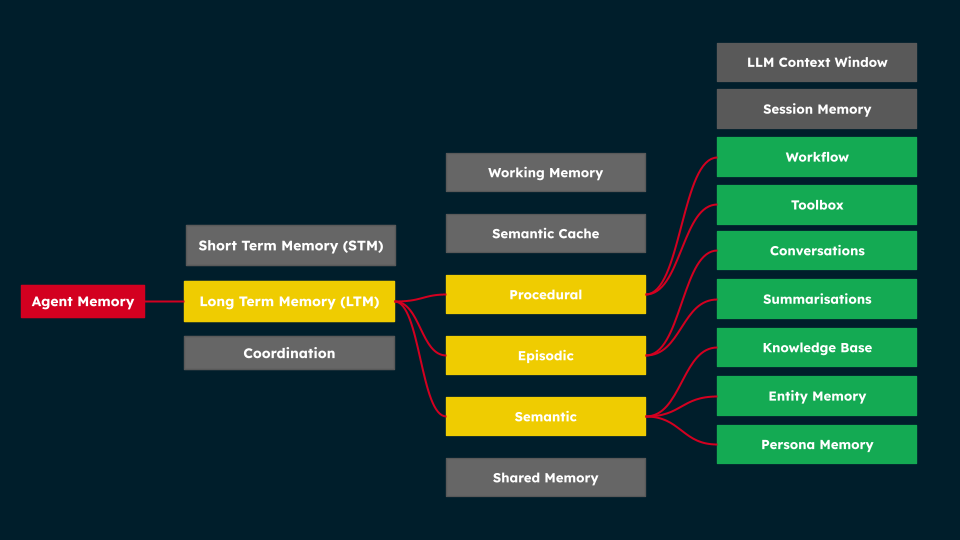
That architecture is why a medical analyst can keep a health history when the patient cannot. Session memory holds today’s episode. Long-term memory should still know the statin, the fall in March, and the fact that your sister noticed word-finding problems first. A knowledge base is for published guidance. Entity memory is for named drugs, clinicians, and diagnoses you have already been given. None of that is a brain scan. It is a refusal to forget the file.
Evidence-based framing, not a diagnosis
The right use of this tool is to arrive prepared. CDC guidance is to talk to a health care provider if you think you or a loved one may have dementia, because some problems are reversible and earlier evaluation can change what happens next. NIA recommends follow-up every six to 12 months when memory problems are already on the table.
Ask the analyst to map what you observed against categories clinicians use — age-related forgetfulness, mild cognitive impairment, dementia warning signs, and common reversible causes — and to list what a doctor may want to know. Then let the doctor decide.
"Over three months I have repeated questions, misplaced keys daily, and gotten turned around on my usual walk. I still pay bills and cook. Here is my medication list. Build a dated timeline and a one-page brief for my internist. Do not diagnose me."
"My father is 78. He paid two bills late, forgot my sister’s name once, and still shops independently. Compare this with how sources distinguish typical aging from changes that warrant evaluation, and list questions a clinician may ask."
"Log this: left the stove on Tuesday; mixed up Thursday’s appointment time. Keep a symptom diary I can take to Friday’s visit. Flag anything that sounds urgent rather than wait-and-see."
Sudden, severe confusion, new weakness, trouble speaking, or a head injury is not a journaling problem. That is emergency care. Use the analyst for patterns over days and weeks, not for stroke-like symptoms in the moment.
Related Agents You'll Also Find Useful
If you are also working on sleep, stress, movement, or the research around a possible diagnosis, these agents extend the same “keep a serious record” habit.
Meditation Guide
NIA notes that depression, anxiety, sleep problems, and major stress can all contribute to memory complaints, and that those problems often improve when the underlying strain eases. If you are also trying to stabilize sleep or rumination while you wait for a workup, Meditation Guide is a practice partner — not a dementia treatment.
- Technique matching across major traditions
- Practice programs and scripts you can actually follow
- Troubleshooting, including when a practice does not feel safe
Fitness & Workout Coach
Staying physically active is among the brain-health strategies public-health agencies review, and CDC materials likewise point to physical activity and blood-pressure control as actions that may reduce risk. That is not a promise that exercise prevents Alzheimer's. It is a reason to keep a realistic program going while you pursue medical evaluation.
- Custom workouts for your current level
- Session coaching and form guidance
- Progress tracking so “I should move more” becomes a plan
Deep Research
If you are also gathering literature on mild cognitive impairment, clinical trials, or caregiver planning, Deep Research searches widely and returns a cited report instead of an unsourced thread. Use it to understand the landscape. Use your clinician to interpret your results.
- Broad source coverage with inline citations
- Synthesis you can take to an appointment
- A check against marketing claims that outrun the evidence
Try the medical analyst free — no credit card required.
How It Works
Step 1: Describe the pattern, not the label you fear Open the AI medical analyst with what changed, when it started, and who noticed. State that you want a record and a visit brief, not a diagnosis.
"I am 64. For about four months I have been losing words mid-sentence and forgetting why I walked into a room several times a day. My partner noticed first. Help me structure this for my primary care visit."
Step 2: Attach the facts a clinician will ask for anyway Add medications, doses, other conditions, recent infections or falls, sleep, alcohol, mood, and family history of dementia. Upload lab PDFs or after-visit summaries if you have them. Persistent memory is only as good as what you put in it.
"Here is my medication list, last TSH, and B12. I started a new sleep aid six weeks ago. Note the timing relative to the forgetfulness."
Step 3: Keep a short diary when episodes happen Log on the day it occurs: what slipped, what was still intact, and whether you were ill, exhausted, or skipped a dose. Short entries beat a heroic recap the night before the appointment.
"Today: could not recall a neighbor’s name I have known for years; still completed a work email. Slept five hours. Add to the diary."
Step 4: Generate a one-page visit brief Before the appointment, ask for a structured summary: timeline, functional impact (bills, driving, cooking, meds), red-flag checklist mapped to the CDC warning signs, reversible-cause reminders, and questions to ask. Correct anything it inferred.
"Draft a one-page brief. Separate what I stated from what you inferred. Include questions about medication review, mood, sleep, and whether I need cognitive testing or a neurology referral."
Step 5: Update the record after the visit Add the assessment, new tests, and the follow-up date. NIA suggests people with memory problems check in every six to 12 months. A history that stops at the first appointment is how families end up retelling year one in year three.
"Visit note: MoCA ordered, TSH and B12 already normal, sleep aid to be tapered. Next visit in eight weeks. Store this as established, not suspected."
Results & Use Cases
📋 Preparing yourself for a first primary-care visit
Scenario: You are 61, still working, and you have been blanking on names in meetings. You are not sure whether this is stress or something to take seriously.
Traditional Approach: You search at midnight, oscillate between “normal aging” and Alzheimer’s, and then underplay it in the exam room because you cannot remember the last six examples.
The medical analyst: You keep a two-week diary, list medications, and walk in with a one-page brief. The clinician still does the exam. You no longer spend the first ten minutes reconstructing the plot.
- Pattern instead of a single embarrassing story
- Reversible-cause checklist (sleep, mood, new drugs) on paper
- Clear request: cognitive screen vs. watchful waiting
👪 An adult child building a parent’s timeline
Scenario: Your mother is 79. She still dresses herself. She has asked what day it is on three Sunday calls and left a kettle dry once.
Traditional Approach: Siblings argue from different incidents. The internist hears whichever relative came to the visit. Dates collapse.
The same persistent record: Each sibling adds dated observations to one history. You bring function (bills, meds, cooking, getting lost) rather than a vibe.
- Shared timeline instead of competing anecdotes
- Warning signs used as a checklist, not a late-night self-diagnosis
- Space to note what is still preserved, which clinicians need
📱 Logging an episode on the commute
Scenario: After a confusing moment in a parking garage, you have ten minutes on your phone before the next meeting.
Traditional Approach: You tell yourself you will write it down tonight. You do not. The story is gone by the quarterly checkup.
Mobile use with full feature parity: You dictate a 30-second log on iOS or Android. Speech-to-text captures it while it is still specific. The next clinic brief includes Tuesday’s garage, not “sometimes I get confused.”
- Same history on phone and laptop
- Capture while details are fresh
- No “real” record that only exists on a home computer
🔎 Family research without turning Google into a diagnosis
Scenario: A clinician mentioned mild cognitive impairment and you want to understand what that usually means, including that not everyone with MCI develops Alzheimer’s.
Traditional Approach: Uncited forums and ads for prevention kits. Federal guidance already warns that no product effectively prevents or treats these diseases.
Deep Research plus your medical analyst: One agent builds a cited briefing. The other keeps your parent’s actual timeline. Movement and sleep, if you pursue them, stay in Fitness & Workout Coach and Meditation Guide as health habits — not as secret cures.
- Literature separated from the personal chart
- Fewer supplement detours
- Questions ready for the specialist, not a substitute for the specialist
FAQ
What causes memory loss?
Memory loss can reflect typical aging, a treatable condition, or the start of dementia. NIA also lists head injury, medication side effects, depression and anxiety, thyroid and other organ problems, vitamin B12 deficiency, sleep problems, alcohol or drug misuse, and major stress. Alzheimer's disease is the most common dementia and accounts for most cases, but it is not the only explanation. Finding the cause requires a clinician, not a chatbot.
When is memory loss a warning sign of dementia?
Memory loss that disrupts daily life is the first CDC warning sign of Alzheimer's. Others include trouble planning, difficulty with familiar tasks, confusion with time or place, language problems, misplacing items and being unable to retrace steps, poorer judgment, withdrawal, and mood or personality change. Forgetting a name and remembering it later is more consistent with typical aging. If function is slipping, make an appointment.
Can Personal Medical Analyst diagnose Alzheimer's or treat memory loss?
No. This AI medical analyst is for organizing history, clarifying questions, and offering evidence-based context. It does not perform a neurologic exam, order imaging, or prescribe. Some FDA-approved medications can slow decline or ease symptoms in selected patients; that decision belongs to a clinician who knows the case. If you have sudden severe confusion, weakness, or trouble speaking, seek emergency care rather than opening an app.
Is Personal Medical Analyst free?
Yes. You can start on the free tier with no credit card. Higher tiers increase usage if you keep a dense daily diary or upload many records. You are paying for usage of a persistent analyst, not for a medical claim that memory loss has been treated.
How is this different from searching memory loss online?
Search results are generic. Your history is not. A web article cannot remember that the sleep aid started in the same month as the word-finding, or that your father still manages medications. The analyst keeps those facts in one place and helps you brief a human clinician. Use published sources such as NIA and CDC for background; use the visit for decisions.
Does this work on mobile if I am a caregiver on the go?
Yes. Web, iOS, and Android share the same history, including speech-to-text. That matters for memory loss because the useful detail is often a 20-second incident in a driveway, not a composed essay at a desk. Log it when it happens, then generate the brief before the appointment.
Conclusion
Memory loss is a symptom, not a single disease. It can be aging, a reversible medical problem, mild cognitive impairment, or dementia — and dementia itself is already a large and growing public-health burden. Software will not repair a brain. A missing timeline, however, is a problem software can actually reduce.
If you are trying to remember what to tell the doctor, start a record with Personal Medical Analyst. Then take that record to a licensed clinician. Explore more at Jenova.
For Developers: Personal Medical Analyst is available programmatically via the Jenova API — integrate persistent symptom and health-history tracking into your application with a single API call. Full documentation →