MCP Integration for AI Agents: One API to Connect Any Tool (July 2026)
2026-07-23
Introduction
Building AI agents that interact with real-world tools through the Model Context Protocol (MCP) demands far more than a well-crafted prompt. In 2026, developers face a sprawling infrastructure challenge: orchestration logic, MCP server hosting, persistent context management, retrieval pipelines, and reliability engineering — all before writing a single line of product logic. The Jenova Agent API eliminates this entire stack, delivering native MCP integration, multi-model orchestration, persistent memory, and fully managed infrastructure through a single integration.
✅ Native MCP support — connect agents to any MCP-compliant server out of the box ✅ Multi-model flexibility — route to OpenAI, Anthropic, Google, xAI, DeepSeek, and more without vendor lock-in ✅ Built-in memory and RAG — persistent context and managed vector storage, no external state management ✅ Production-grade infrastructure — battle-tested orchestration, scaling, and reliability from day one
To understand why a managed approach to MCP integration matters, let's examine the infrastructure challenges developers face when building tool-connected AI agents today.
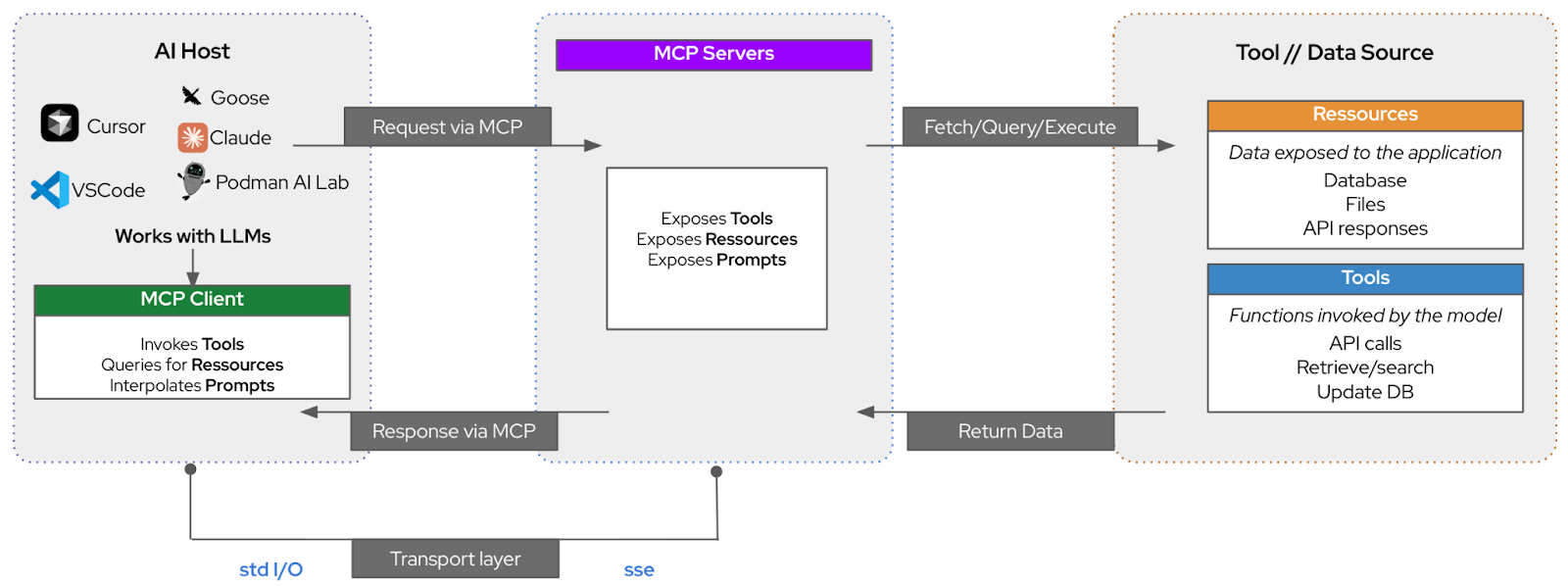
Quick Answer: What Is MCP Integration for AI Agents?
MCP integration for AI agents is the process of connecting AI models to external tools, databases, and APIs through the Model Context Protocol standard, enabling agents to take real actions and access live data. The Jenova Agent API provides this as a managed service — no MCP server setup, orchestration code, or infrastructure provisioning required.
Key capabilities:
- Native support for platform tools and any remote MCP-compliant server
- Unified model routing across OpenAI, Anthropic, Google, xAI, DeepSeek, and more
- Persistent memory and context management built into every agent session
- Fully managed vector storage with built-in RAG for knowledge-grounded responses
The Problem: Why Tool-Connected AI Agents Are Difficult to Build
The AI agents market is projected to grow from $7.84 billion in 2025 to $52.62 billion by 2030, driven by demand for agents that don't just generate text — they take action. MCP has emerged as the standardization layer making this possible, creating what developers describe as "secure, standardized bridges between AI agents and development tools". As the emerging agentic AI infrastructure market rapidly evolves, the tooling required to ship production agents keeps expanding.
But building production MCP-integrated agents remains frustratingly complex:
- Orchestration requires coordinating models, tools, memory, and error handling simultaneously
- MCP server infrastructure must be provisioned, hosted, and maintained for each tool integration
- Context and memory management breaks down at scale — stateless LLM APIs demand external state stores
- Multi-step reliability degrades exponentially — compound failures across tool calls create systemic unreliability
- Development costs are prohibitive — custom agent builds range from $30,000 to $500,000+
Orchestration Complexity
Every tool-connected agent is a distributed system. The model must decide which tool to call, parse the request, handle the response, and incorporate results into its next reasoning step — all while managing errors, timeouts, and partial failures. As one production analysis demonstrates, multi-step AI agents are "distributed systems, whether you like it or not", where every tool call is a network request that can fail, time out, or return garbage. Common pain points include prompt engineering misalignment, integration hurdles, and framework instability — real obstacles that compound when tools are in the loop.
Building this orchestration from scratch means writing and maintaining coordination logic that most teams aren't equipped to ship reliably.
MCP Server and Tool Integration Plumbing
MCP standardizes the protocol, but someone still needs to run the servers. Each MCP server requires its own provisioning, configuration, authentication flow, and monitoring. For an agent that needs filesystem access, database queries, and external API calls, you're managing three or more server processes with distinct failure modes. Integration costs for connecting 3+ systems run $4,000–$8,500+ for the initial connection alone — not counting ongoing maintenance, version updates, and security patching.
Context and Memory Management at Scale
LLM APIs are stateless. Every request starts from zero. For agents executing multi-step tool workflows — where step 5 depends on the output of step 2 — you need external memory infrastructure: session stores, embedding pipelines, retrieval mechanisms, and secure persistence. Implementing retrieval-augmented generation (RAG) systems alone can cost $50,000 to $500,000 depending on scale, and that's a single component of the full memory stack an agent requires.
The Compound Reliability Problem
Here's where intuition fails. Even at 95% per-step accuracy, a 10-step agent workflow succeeds only about 60% of the time. At 20 steps, it drops to 36%. Five distinct failure modes compound in production: wrong tool selection, API timeouts, partial data returns, inconsistent state, and cascading errors where a small mistake early on corrupts every subsequent step.
95% per-step accuracy × 10 steps = 59.9% system success rate — effectively a coin flip for your production agent
Development Cost and Time to Production
Custom AI agent development costs range from $30,000 to $500,000+, with complex agents requiring 12–20 weeks of engineering time. Infrastructure alone — cloud services, GPU resources, monitoring, storage — adds $10,000 to $100,000+ per year. Teams need AI/ML engineers at $80–$180/hour, backend engineers, DevOps specialists, and QA — before a single user interacts with the agent.
This is exactly the problem the Jenova Agent API was built to eliminate.
The Jenova Agent API: Managed MCP Integration for Production Agents
The Jenova Agent API is a fully managed agent infrastructure service — one integration that replaces the entire DIY agent stack. Instead of stitching together LLM APIs, orchestration frameworks, MCP servers, vector databases, and memory stores, developers define their agent's instructions, select a model, configure tools, and let the platform handle everything else.
| DIY Agent Stack | Jenova Agent API |
|---|---|
| Provision and manage individual MCP servers | Native MCP support — platform tools and remote servers ready out of the box |
| Build custom orchestration for model-tool coordination | Battle-tested orchestration handles multi-step workflows automatically |
| Manage multiple LLM provider accounts and APIs | Single integration across OpenAI, Anthropic, Google, xAI, DeepSeek, and more |
| Deploy external state stores and session management | Built-in persistent memory and unlimited conversation context |
| Build and scale RAG pipelines with vector databases | Fully managed vector storage with built-in retrieval |
| Engineer reliability, scaling, and monitoring infrastructure | Production-grade managed infrastructure from day one |
Native MCP: Tools Without the Plumbing
The API provides MCP integration as a platform-level capability. Agents connect to platform-native tools — Gmail, Google Calendar, Drive, Search, Scholar, Maps, Notion, Dropbox, YouTube, Reddit, and more — plus any remote MCP-compliant server, all configured at the agent level. No server provisioning, no authentication plumbing, no tool-selection logic to hand-code. The orchestration layer handles tool discovery, invocation, error handling, and result integration automatically.
Use Any Model: No Vendor Lock-In
Power your agents with models from OpenAI, Anthropic, Google, xAI, DeepSeek, and additional providers — all through the same API endpoint. Switch models per agent or per use case without changing integration code. New model releases from any supported provider become available through your existing integration — no migration, no new SDKs, no additional accounts.
Memory and Context: Built Into Every Session
Every agent session includes unlimited conversation memory and persistent context management. The API maintains state across interactions, tracks tool outputs, and ensures multi-step workflows remain coherent — with no external state stores or session management infrastructure. Cross-session memory persists user preferences, past work, and project context automatically.
Fully Managed Storage and RAG
Managed relational and vector databases with built-in RAG eliminate the need to provision, scale, or maintain storage infrastructure. Agents access private knowledge bases — uploaded documents, domain data, custom datasets — with retrieval handled at the platform level. No chunking strategies to tune, no embedding pipelines to build, no vector database to operate.
Production-Grade Infrastructure
The API is built for production traffic — stable endpoints, managed scaling, and proven reliability backed by a platform tested with over 30,000 users across 70+ countries. This isn't a framework you self-host or a beta experiment. It's fully managed infrastructure where the orchestration layer, memory system, and tool integration pipeline are battle-tested at scale.
What You Can Build
The Jenova Agent API is built for developers who need to ship custom, tool-connected agents on managed infrastructure. Here's what that looks like in practice:
AI-Powered DevOps Assistant
Build a DevOps agent that connects to Git repositories, Kubernetes clusters, and monitoring systems through MCP. Define custom instructions encoding your team's operational runbooks and incident playbooks, connect relevant MCP servers, and deploy an agent that audits environments, flags deployment risks, and provides context-aware operational guidance — all grounded in your actual infrastructure state. The API handles multi-tool orchestration; you define the operational logic.
Embedded Customer Support for Your SaaS
Deploy an AI support agent that connects to your CRM, knowledge base, and ticketing system via MCP. The agent retrieves customer context, searches product documentation, and delivers grounded answers. Persistent memory means returning customers don't repeat themselves. The managed RAG pipeline indexes your docs; the orchestration layer coordinates retrieval and response — your team focuses on content quality, not infrastructure.
Research and Analysis Platform
Build a research agent combining web search, academic databases, and document analysis through MCP tool integration. Users submit queries; the agent searches multiple sources, cross-references findings, and synthesizes coherent reports with citations. Multi-model routing lets you use cost-effective models for retrieval and premium models for synthesis — optimized through a single API integration.
Personalized Financial Advisor for Fintech
Create a portfolio analysis agent for your fintech dashboard. Connect market data APIs and financial databases via MCP, define compliance-aware instructions, and attach proprietary research as a knowledge base. The API manages context across long analytical sessions while built-in memory tracks user portfolios and preferences across interactions — no external database required.
E-Commerce Product Advisor
Ship a product recommendation agent embedded in your storefront. Connect inventory APIs, pricing systems, and customer review databases through MCP. The agent handles product discovery, comparison, and personalized recommendations with persistent memory tracking customer preferences and purchase history across sessions.
Intelligent Content Pipeline
Build an AI content assistant that accesses brand guidelines, style documentation, and content calendars through MCP-connected tools. The agent generates platform-specific content grounded in your brand voice and informed by real-time performance data from connected analytics tools.
How It Works
Getting from zero to a production MCP-integrated agent takes four steps:
Step 1: Get Your API Key
Sign up at the Jenova API platform and generate your API key. This single key authenticates all requests across every model provider, tool, and agent — no separate accounts for OpenAI, Anthropic, or any other provider.
Step 2: Build Your Custom Agent
Define your agent's instructions, select a model, configure MCP tool access, and optionally attach a knowledge base. Your domain expertise goes into the configuration — the agent's behavior, constraints, and capabilities are shaped by what you define.
json{
  "name": "DevOps Assistant",
  "instructions": "You are a senior DevOps engineer specializing in Kubernetes and CI/CD optimization. Always check staging health before recommending production deployments...",
  "model": "claude-sonnet-4-20250514",
  "tools": ["mcp:kubernetes", "mcp:git", "mcp:filesystem"],
  "knowledge_base": ["deployment-runbook.pdf", "incident-playbook.md"]
}
Step 3: Add Credits
Add API credits to your account. Credits are consumed per request based on model usage and tool calls — pay for what you use, scale as traffic grows.
Step 4: Make Your First Call
Send a message to your agent. The API handles model routing, tool orchestration, MCP server communication, context management, and response generation — returning a complete result.
json{
  "message": "Check the status of all pods in the production namespace and flag any that restarted in the last hour"
}
The agent automatically invokes the configured Kubernetes MCP server, retrieves pod status data, analyzes restart patterns, and returns an actionable report — all coordinated by the managed orchestration layer.
Full integration details are available in the API documentation.
Results and Use Cases
🛠️ Startup Deploys AI Support in Days, Not Months
Scenario: A 12-person SaaS startup needs AI customer support that accesses their product docs, CRM, and ticketing system through MCP.
Traditional Approach: 3–4 months of engineering to build orchestration, integrate APIs, set up RAG for documentation, and manage infrastructure. Estimated cost: $40,000–$120,000 for the initial build, plus $2,500–$5,000/month in ongoing infrastructure costs.
Jenova Agent API: The team defines support instructions, connects their doc repository as a knowledge base, configures CRM and ticketing MCP servers, and ships a production agent within a week. Orchestration, memory, and scaling are handled by the managed infrastructure.
- No infrastructure provisioning or DevOps overhead
- Built-in RAG eliminates the $50,000+ cost of custom retrieval pipelines
- Persistent memory reduces repeat-customer friction across sessions
📊 Fintech Launches Portfolio Advisor Across Markets
Scenario: A fintech platform serving clients across three markets needs a multilingual portfolio analysis agent connected to live market data feeds.
Traditional Approach: Building multi-model orchestration, multilingual support, persistent user profiles, and market data API integration from scratch — multiple vendor accounts, custom state management, and 12–20 weeks of development at $100,000–$500,000+.
Jenova Agent API: The team selects the optimal model per market, connects market data MCP servers, and encodes compliance guidelines as agent instructions. Multi-model routing and persistent memory are built in — no additional infrastructure.
- Single integration replaces 5+ vendor relationships
- Model switching for cost optimization requires zero code changes
- Cross-session memory tracks portfolios without external databases
💼 Agency Automates Content Production at Scale
Scenario: A digital marketing agency produces 200+ content pieces monthly across 15 client brands, each with distinct voice, style, and platform requirements.
Traditional Approach: Custom pipelines with brand-specific prompt templates, manual quality assurance, and content management integrations. Each new client requires additional engineering.
Jenova Agent API: One agent per client brand — each configured with brand-specific instructions, connected to the client's content calendar and analytics via MCP, and equipped with brand guidelines as a knowledge base. The managed infrastructure handles concurrent execution across all clients.
- Knowledge bases ground every output in brand-specific voice
- MCP tool access enables real-time data integration from analytics platforms
- Adding a new client requires configuration, not engineering
📱 EdTech Ships Adaptive Tutoring Without an ML Team
Scenario: An edtech startup needs an AI tutor that adapts to individual student progress, accesses curriculum databases, and generates practice materials — with no ML engineering team on staff.
Traditional Approach: Hire AI/ML engineers at $80–$180/hour, build custom learning models, create retrieval systems for curriculum content, and develop progress-tracking infrastructure. Minimum 6-month timeline before launch.
Jenova Agent API: The team uploads curriculum materials as a knowledge base, defines pedagogical instructions, connects student progress databases via MCP, and launches. The API's memory system tracks each student's learning trajectory across sessions; managed RAG retrieves relevant curriculum content for every interaction.
- No ML team required — pedagogical expertise goes into instructions, not model training
- Persistent memory creates personalized learning paths automatically
- Managed vector storage indexes and retrieves curriculum content at scale
FAQ
How does MCP integration work with the Jenova Agent API?
MCP integration is a platform-level capability. When configuring an agent, you specify which tools and servers to connect — both platform-native tools (Gmail, Drive, Search, Calendar, Notion, and more) and any remote MCP-compliant server. The API handles tool discovery, invocation, authentication, and response coordination automatically. No MCP server provisioning or management required on your end.
How much does the Jenova Agent API cost?
The API operates on a credit-based system — add credits to your account and consume them per request based on model usage and tool calls. You pay for what you use rather than committing to fixed infrastructure costs. Visit the API platform for current credit pricing.
Which AI models can I use?
The API provides unified access to models from OpenAI, Anthropic, Google, xAI, DeepSeek, and additional providers through a single integration. Select the model per agent or per use case, and the platform handles routing. New models become available without migration or SDK changes. See the API documentation for the current model list.
How difficult is it to integrate?
Four steps: get your API key, build or select an agent, add credits, make your first call. The entire flow — from signup to a working agent with MCP tools — can be completed in minutes. No orchestration framework to learn, no infrastructure to provision, no MCP servers to manage.
Is the API production-ready?
Yes. The API runs on fully managed infrastructure behind a platform tested with over 30,000 users across 70+ countries. Stable endpoints, managed scaling, and production-grade reliability — this is a managed service, not a beta or self-hosted framework.
Can I build custom agents or only use pre-built ones?
Both. You can select from existing agents in the Jenova gallery or build fully custom agents — define your own instructions, select your preferred model, configure specific MCP tools, and attach private knowledge bases. Custom agents receive the same managed orchestration, memory, and infrastructure as any pre-built agent.
Conclusion
Building tool-connected AI agents through MCP shouldn't require six-figure budgets, months of development, and a dedicated infrastructure team. The compound challenges of orchestration, multi-provider management, context persistence, RAG pipelines, and MCP server infrastructure keep most teams stuck in prototype mode — where demos work but production success rates drop below 60% on multi-step workflows.
The Jenova Agent API collapses this stack into a single managed integration. Define your agent's instructions, connect your tools through MCP, select your model, and ship — with orchestration, memory, storage, and scaling handled by production-grade infrastructure.
Stop building agent infrastructure. Start building agents.
Get your API key at jenova.ai/platform. Full documentation at jenova.ai/platform/docs.