Managed RAG Pipeline: Build AI Agents, Not Infrastructure (July 2026)
2026-07-24
Introduction
Building a production RAG pipeline means operating an entire data infrastructure stack — embedding models, vector databases, chunking strategies, ingestion pipelines, retrieval tuning, and freshness monitoring — before your agent answers a single question. In 2026, the retrieval layer alone can cost more engineering resources than the agent it serves. The Jenova Agent API eliminates this entire layer, delivering fully managed vector storage, built-in retrieval-augmented generation, and production-grade agent orchestration through a single integration.
✅ Fully managed vector storage — no databases to provision, index, or scale ✅ Built-in RAG — from knowledge base upload to grounded retrieval with zero pipeline code ✅ Multi-model flexibility — route to OpenAI, Anthropic, Google, xAI, DeepSeek, and more ✅ Production-grade infrastructure — battle-tested orchestration, memory, and scaling from day one
To understand why managed RAG matters, let's examine what developers actually face when building retrieval pipelines from scratch.
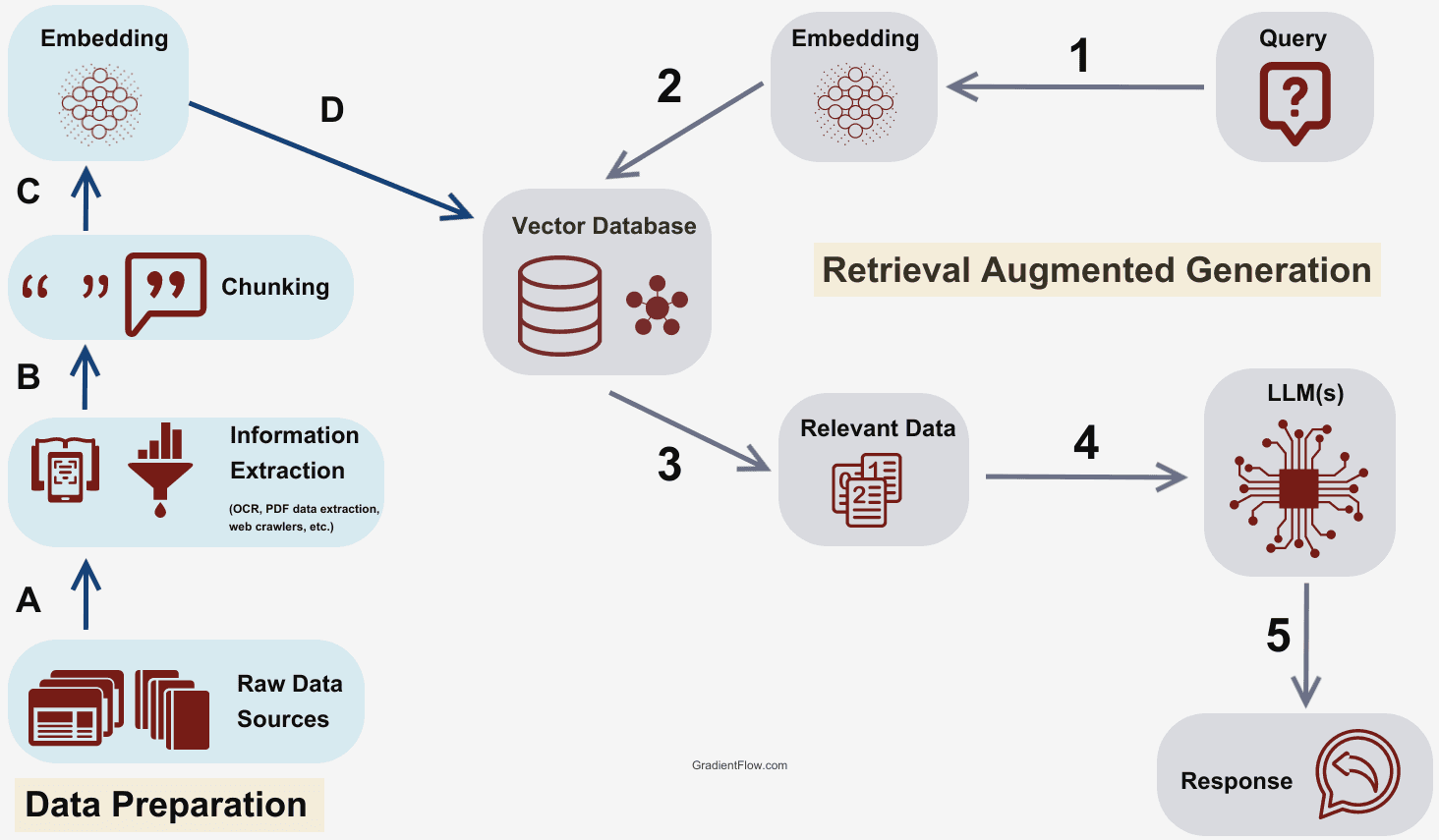
Quick Answer: What Is a Managed RAG Pipeline?
A managed RAG pipeline is a fully hosted retrieval-augmented generation service where vector storage, embedding, retrieval, and knowledge grounding are handled by the platform — not the developer. The Jenova Agent API provides this as infrastructure, not a framework you self-host.
Key capabilities:
- Upload documents and knowledge bases — the retrieval pipeline builds automatically
- Managed relational and vector databases with zero provisioning or scaling
- Built-in retrieval integrated directly into agent orchestration
- Multi-model routing for cost-optimized embedding and generation
The Problem: RAG Pipelines Are Infrastructure Projects Disguised as Features
The retrieval-augmented generation market was valued at $1.2 billion in 2024 and is projected to reach $11.0 billion by 2030, growing at a 49.1% CAGR. The demand is clear — RAG is how agents access private knowledge, reduce hallucinations, and deliver grounded responses.
But getting RAG into production remains frustratingly complex:
- Vector database operations require specialized infrastructure expertise
- Embedding pipelines demand continuous maintenance — not a one-time setup
- Chunking and retrieval quality require iterative tuning across every data source
- Data freshness and ingestion pipelines need ongoing monitoring and automation
- Total implementation costs range from $15,000 to $150,000+ depending on scale
Vector Database Operations
Every RAG system needs a vector database, and every vector database in production presents the same challenges: memory cliffs, embedding drift, and hybrid search gaps that break retrieval quality silently. Vector databases must be able to scale into billions of data objects as data grows, requiring sophisticated indexing strategies, replication, and capacity planning. Production issues include database bugs, storage failures during updates, replication network partitions, and misconfigured shards — failure modes that don't exist in a prototype but dominate in production.
Operating a vector database isn't a feature — it's a full-time infrastructure responsibility.
Embedding Pipeline Maintenance
Embeddings aren't static. Models improve, data changes, and what worked at launch degrades over time. Production RAG demands continuous ingestion pipelines that automatically detect document changes, rechunk content, regenerate embeddings, and update the vector store. Embedding drift — where the semantic space shifts as models update or data distribution changes — is a documented production challenge that silently degrades retrieval quality without obvious errors.
Chunking and Retrieval Quality
RAG quality depends on how documents are split, embedded, and retrieved. There are 12 documented pain points in RAG pipeline development — from missing content and incorrect retrieval specificity to extraction quality degradation and context window limits. Each data source (PDFs, markdown, HTML, structured records) requires different chunking strategies, and optimal configurations vary by use case. This is iterative, experimental work — not a configuration you set once.
Data Freshness and Ingestion
RAG pipelines are not fire-and-forget. Document indices go stale without scheduled ingestion jobs. New documents need processing. Deleted or updated documents need re-indexing. Teams need visibility into the state of their indices and the ability to intervene at the document level. Every source system — file storage, CMS, databases, APIs — requires its own ingestion connector and change-detection logic.
The Cost Reality
RAG implementation costs between $8,000 and $45,000 based on analysis of 89 real deployments. Medium-scale production systems cost $15,700–$27,000 to build, with ongoing expenses of $2,500–$5,800 per month. Enterprise deployments reach $34,400–$58,000+ upfront and $8,100–$19,500+ monthly. On-premises enterprise RAG can run $80,000 to $150,000+.
$8,000–$45,000 — Average RAG implementation cost across 89 production deployments
And that's just the retrieval layer — before agent orchestration, multi-model routing, memory management, tool integration, or any application logic.
This is exactly the problem the Jenova Agent API was built to eliminate.
The Jenova Agent API: RAG as Managed Infrastructure
The Jenova Agent API is a fully managed agent infrastructure service where RAG is a platform capability, not a pipeline you build. Upload documents, attach them as a knowledge base, and the platform handles chunking, embedding, vector storage, indexing, and retrieval — integrated directly into agent orchestration.
| DIY RAG Stack | Jenova Agent API |
|---|---|
| Provision and operate vector databases (Pinecone, Weaviate, Qdrant, etc.) | Fully managed vector storage — no database to provision or scale |
| Build embedding pipelines and manage model versioning | Platform-level embedding with automatic processing |
| Design chunking strategies per document type | Upload documents — chunking and indexing handled automatically |
| Build retrieval logic, ranking, and re-ranking layers | Built-in retrieval integrated into agent orchestration |
| Engineer ingestion pipelines with change detection | Knowledge base updates processed by the platform |
| Manage infrastructure scaling, monitoring, and backups | Production-grade managed infrastructure from day one |
Fully Managed Storage and RAG
The API provides managed relational and vector databases with built-in RAG. No vector database to operate, no embedding pipeline to build, no chunking strategy to tune. Developers upload documents and domain data as agent knowledge bases — the platform processes, indexes, and retrieves relevant content during agent interactions automatically.
This eliminates the $8,000–$45,000 implementation cost and $2,500–$19,500+ monthly operational cost of a custom RAG stack. The retrieval layer is infrastructure — the API treats it accordingly.
Agent Orchestration With Built-In Retrieval
RAG doesn't operate in isolation. In a production agent, retrieval must coordinate with model reasoning, tool execution, memory management, and multi-step workflows. The API's orchestration layer handles this coordination — determining when to retrieve, what to retrieve, and how to integrate retrieved context with the model's reasoning and tool outputs. No custom orchestration logic, no retrieval middleware, no glue code between your vector database and your LLM.
Use Any Model
Power your agents with models from OpenAI, Anthropic, Google, xAI, DeepSeek, and additional providers — all through the same API endpoint. Use cost-effective models for embedding and retrieval-heavy tasks, premium models for complex reasoning and synthesis. Switch models per agent without changing integration code. New model releases become available through your existing integration — no migration, no new SDKs.
Memory and Context: Beyond Single-Query Retrieval
Every agent session includes unlimited conversation memory and persistent context management. RAG retrieval results, tool outputs, and conversational context persist across interactions — enabling agents that build understanding over time, not just answer individual queries. Cross-session memory tracks user preferences and past interactions automatically, with no external state stores required.
Tools and MCP Integration
Agents built on managed RAG can also access external tools through the Model Context Protocol. Connect to Gmail, Google Drive, Search, Notion, Dropbox, and any remote MCP-compliant server — enabling agents that combine private knowledge retrieval with real-world tool execution. The orchestration layer coordinates retrieval and tool calls within the same workflow seamlessly.
Production-Grade Infrastructure
The API runs on fully managed infrastructure behind a platform tested with over 30,000 users across 70+ countries. Stable endpoints, managed scaling, and production reliability — your vector storage, retrieval pipeline, and agent orchestration are all handled by infrastructure built for production traffic. This is a managed service, not a framework you self-host.
What You Can Build
The managed RAG pipeline enables developers to ship knowledge-grounded agents without building retrieval infrastructure. Here's what that looks like across application domains:
Enterprise Knowledge Assistant
Build an internal knowledge agent for your organization. Upload company policies, product documentation, engineering runbooks, and HR guides as the agent's knowledge base. Employees query the agent in natural language and receive grounded, cited answers pulled from your actual documentation — with persistent memory tracking each user's role and prior queries. The API handles document processing, vector storage, retrieval, and response synthesis. Your team maintains the documents; the platform manages everything between upload and answer.
AI-Powered Legal Research Platform
Create a legal research agent that retrieves relevant case law, statutes, and regulatory guidance from uploaded legal databases. Define jurisdiction-aware instructions, attach practice-area knowledge bases, and deploy agents that synthesize complex legal questions with citations to source documents. Multi-model routing lets you use cost-optimized models for retrieval and premium models for analysis — through a single integration.
Customer Support With Product Knowledge
Deploy a support agent grounded in your actual product documentation, release notes, and troubleshooting guides. Unlike generic chatbots, RAG-powered agents retrieve the specific document section relevant to each customer's question — reducing hallucination and increasing resolution accuracy. Persistent memory means returning customers don't repeat their issue history. MCP integration connects the agent to your ticketing system for end-to-end resolution.
Clinical Decision Support Tool
Build a clinical knowledge agent that retrieves from medical literature, drug interaction databases, and clinical guidelines uploaded as knowledge bases. Define evidence-based instructions with appropriate disclaimers, and deploy an agent that synthesizes complex clinical queries with citations to source literature. Managed vector storage handles the volume and specificity of medical knowledge without infrastructure overhead.
Technical Documentation Assistant
Ship an AI documentation assistant that serves your developer community. Upload API docs, SDK guides, code samples, and migration guides as knowledge bases. The agent answers integration questions with code examples grounded in your actual documentation — not hallucinated API endpoints. As your docs evolve, update the knowledge base; the platform re-indexes automatically.
Compliance and Regulatory Advisor
Create a compliance agent for your financial services, healthcare, or legal platform. Upload regulatory frameworks, internal compliance policies, and audit procedures. The agent retrieves relevant regulatory text for each query, cites specific sections, and applies your organization's compliance logic — all grounded in uploaded source material rather than general model training.
Get your API key and ship your first RAG-powered agent in minutes — no vector database required.
How It Works
Getting from zero to a production agent with managed RAG takes four steps:
Step 1: Get Your API Key
Sign up at the Jenova API platform and generate your API key. This single key authenticates all requests — across every model provider, every tool, and every agent you create.
Step 2: Build Your Agent With a Knowledge Base
Define your agent's instructions, select a model, and attach your knowledge base. Upload the documents your agent should retrieve from — product docs, legal texts, medical literature, company policies, or any domain-specific content. The platform processes, chunks, embeds, and indexes everything automatically.
json{
  "name": "Compliance Advisor",
  "instructions": "You are a regulatory compliance specialist for financial services. Always cite the specific regulation section when answering. Flag any query that falls outside your knowledge base scope...",
  "model": "claude-sonnet-4-20250514",
  "knowledge_base": ["sec-regulations.pdf", "internal-compliance-policy.md", "audit-procedures.docx"]
}
Step 3: Add Credits
Add API credits to your account. Credits are consumed per request based on model usage — pay for what you use, scale as traffic grows.
Step 4: Make Your First Call
Send a message to your agent. The API handles retrieval from your knowledge base, model routing, context management, and response generation — returning a grounded, knowledge-backed answer.
json{
  "message": "What are the reporting requirements for transactions over $10,000 under current BSA regulations?"
}
The agent retrieves the relevant sections from your uploaded regulatory documents, synthesizes the requirements, and returns a response with citations to specific document sections — all coordinated by the managed orchestration layer.
Full integration details, endpoints, and SDK references are available in the API documentation.
Results and Use Cases
🏥 HealthTech Deploys Clinical Knowledge Agent in One Week
Scenario: A healthtech startup needs a clinical decision support agent grounded in 50,000+ pages of medical literature and drug interaction databases.
Traditional Approach: Build a custom RAG stack — select and deploy a vector database, design medical-specific chunking strategies, build embedding pipelines, engineer retrieval ranking for clinical precision, and manage infrastructure. Estimated cost: $34,400–$58,000+ upfront, with $8,100–$19,500+ per month in ongoing operations. Timeline: 3–5 months before the first clinician uses it.
Jenova Agent API: Upload medical literature as a knowledge base, define evidence-based clinical instructions, select an appropriate model, and ship. The managed vector storage indexes all 50,000+ pages; built-in retrieval surfaces the relevant clinical evidence for each query.
- Zero vector database operations — no Pinecone, Weaviate, or Qdrant to manage
- Built-in RAG eliminates the $34,000+ upfront cost of custom retrieval pipelines
- Persistent memory tracks patient context across multi-session clinical workflows
📊 Fintech Ships Regulatory Compliance Agent Across Three Jurisdictions
Scenario: A fintech platform serving clients in three regulatory jurisdictions needs a compliance agent that retrieves from jurisdiction-specific regulatory databases.
Traditional Approach: Build separate RAG pipelines per jurisdiction with distinct chunking strategies for regulatory text, cross-reference logic across frameworks, and multi-tenant vector storage. Custom agent development at this complexity runs $80,000–$150,000+ for enterprise-grade deployment, with months of regulatory-specific retrieval tuning.
Jenova Agent API: Create one agent per jurisdiction — each with jurisdiction-specific knowledge bases and regulatory instructions. The managed infrastructure handles multi-tenant vector storage, retrieval, and scaling across all three deployments through a single API integration.
- Single integration replaces three separate RAG infrastructure deployments
- Knowledge base updates processed automatically — no re-indexing scripts
- Model switching for cost optimization requires zero code changes
💼 SaaS Company Cuts Support Costs With Documentation-Grounded AI
Scenario: A B2B SaaS company with 200+ pages of product documentation handles 3,000+ support tickets monthly, with 60% answerable directly from existing docs.
Traditional Approach: Build a retrieval system indexing product docs, engineer chunking for technical documentation, deploy embedding pipelines, build a response layer, and integrate with the support ticketing system. Estimated implementation: $15,700–$27,000 with ongoing costs of $2,500–$5,800/month.
Jenova Agent API: Upload all product documentation as a knowledge base, define support-specific instructions, connect the ticketing system via MCP, and deploy. The agent retrieves the exact documentation section relevant to each customer query — grounded answers, not hallucinated feature descriptions.
- Documentation updates automatically reflected in retrieval results
- MCP integration enables end-to-end ticket resolution
- Persistent memory reduces repeat-customer friction across sessions
📱 EdTech Launches Adaptive Curriculum Agent Without an ML Team
Scenario: An edtech startup needs an AI tutor that retrieves from a 10,000-page curriculum database and adapts to individual student progress — with no ML engineering team on staff.
Traditional Approach: Hire specialists to build educational RAG: curriculum-specific chunking, pedagogical retrieval ranking, student progress tracking, and adaptive response logic. RAG implementation alone costs $8,000–$45,000 based on deployment complexity, plus custom adaptive learning logic on top.
Jenova Agent API: Upload curriculum materials as a knowledge base, define pedagogical instructions encoding learning progression and assessment logic, and launch. Managed RAG retrieves the relevant curriculum content for each student interaction; persistent memory tracks individual learning trajectories across sessions.
- No ML team required — pedagogical expertise goes into agent instructions
- Managed vector storage indexes and retrieves 10,000+ pages at scale
- Cross-session memory creates personalized learning paths automatically
FAQ
What is a managed RAG pipeline for AI agents?
A managed RAG pipeline is a fully hosted retrieval-augmented generation service where the platform handles vector storage, embedding, indexing, and retrieval. Developers upload documents and the agent retrieves relevant content during interactions — no vector databases to operate, no embedding pipelines to build, no retrieval logic to engineer. The Jenova Agent API provides this as built-in infrastructure.
How much does the Jenova Agent API cost?
The API operates on a credit-based system — add credits to your account and consume them per request based on model usage. This replaces the $8,000–$45,000 upfront and $2,500–$19,500+ monthly costs of building and operating a custom RAG stack. Visit the API platform for current credit pricing and details.
Which AI models can I use with managed RAG?
The API provides unified access to models from OpenAI, Anthropic, Google, xAI, DeepSeek, and additional providers. Select the model per agent — use cost-effective models for retrieval-intensive tasks and premium models for complex reasoning. New models become available without migration or SDK changes. See the API documentation for the current model list.
How difficult is it to integrate managed RAG?
Four steps: get your API key, build your agent with a knowledge base, add credits, make your first call. Upload your documents, define instructions, and the platform handles chunking, embedding, vector storage, and retrieval automatically. The entire flow — from signup to a working RAG-powered agent — can be completed in minutes.
Is the managed RAG pipeline production-ready?
Yes. The API runs on fully managed infrastructure behind a platform tested with over 30,000 users across 70+ countries. Vector storage, retrieval pipelines, and agent orchestration are production-grade — stable endpoints, managed scaling, and proven reliability. This is managed infrastructure, not a beta or self-hosted framework.
Can I use my own documents as an agent knowledge base?
Upload any document your agent should retrieve from — PDFs, markdown files, text documents, and more. The platform processes, chunks, embeds, and indexes your content automatically. Your knowledge base is private to your agent and never shared across other agents or users. As documents are updated, the platform reflects changes in retrieval results.
Conclusion
Building a production RAG pipeline in 2026 shouldn't mean operating vector databases, engineering embedding pipelines, tuning chunking strategies, and managing ingestion infrastructure — all before your agent delivers a single grounded answer. With implementation costs reaching $8,000–$45,000 upfront and $2,500–$19,500+ per month in ongoing operations, the retrieval layer alone can consume more engineering resources than the agent it serves.
The Jenova Agent API makes RAG a platform capability — not an infrastructure project. Upload your documents, define your agent's instructions, select your model, and ship. Vector storage, embedding, retrieval, orchestration, memory, and scaling are handled by production-grade managed infrastructure, built on the same platform powering Jenova's agent ecosystem.
Stop building retrieval pipelines. Start building agents.
Get your API key at jenova.ai/platform. Full documentation at jenova.ai/platform/docs.