Long Term Character Card Prompt Engineering for AI Roleplay
2026-09-18
Roleplay Game Master helps you keep a character's voice, motives, and canon intact across long chats by pairing a durable persona with unlimited memory. While most character cards rot as history grows — speech patterns flatten, backstory mutates, and example dialogues sink into the middle of the prompt — this AI keeps the person in working range instead of buried under a mega-prompt.
- ✅ Unlimited chat history and persistent cross-session memory
- ✅ Character consistency treated as the job, not a reminder you paste every turn
- ✅ Multi-model access so you can swap providers without rewriting the card
- ✅ Custom agents with private knowledge bases for bibles, voice notes, and lore
To understand why this matters, let's examine why static cards, stacked prompts, and raw context windows still fail over long campaigns.
Quick Answer: What Is Long Term Character Card Prompt Engineering?
Long term character card prompt engineering is the practice of designing AI character definitions, memory layers, and prompt order so a persona stays consistent across long conversations. It treats the card as a system, not a biography dump.
Key capabilities:
- Invariants (voice, morals, appearance, speech tics) written as standalone facts the model can reuse
- Prompt-layer control so definition, memory, scenario, and examples do not collide
- State updates after turning points, not recaps that replace canon
- A specialist roleplay agent that remembers the person when chat history gets long
Why Character Cards Drift Over Long Chats
Role-playing agents look fluent in the first scene and hollow by the twentieth. Research on role-playing agents documents two failure modes that every card author eventually meets: attention diversion (the model forgets its role) and style drift (reasoning that no longer sounds like the character). The same literature treats long-term memory and dynamic character development as open problems, not solved features of a bigger text box.
A context window is not a character bible. Google describes it as short-term memory: a bounded working set, not an archive. Stuffing a 4,000-token card plus fifty turns of chat into that window feels thorough. It is often the opposite.
But keeping a persona stable is frustratingly difficult:
- Chat history grows every message and crowds out the card
- Mid-prompt facts go missing even when they are still “in context”
- Keyword lorebooks miss, over-fire, and burn the token budget
- Recaps train the model on your summary instead of the original canon
- Unguided extra “thinking” can make the character less consistent, not more
Growing history buries the person
Roleplay front-ends assemble one request from stacked layers: user persona, character definition, chat memory, scenario, custom instructions, example dialogues, then the live thread. The thread is the only layer that never stops growing. After enough turns, applications quietly drop older instructions, and chatbots start contradicting earlier messages. No error fires. The character simply becomes nicer, vaguer, or someone else.
After ~20 turns — long chats begin dropping earlier instructions and contradicting themselves
Practitioners already argue that
. A card that only works at turn three is not engineered for the long term.Bigger windows do not rescue a bad card
Advertised context limits are not the same as usable attention. Context rot is the quality drop as input length grows, especially for facts sitting in the middle of the prompt — exactly where a character definition often lands once history and examples pile up.
More than 30% — accuracy drop when the needed fact sits in middle context positions
Chroma’s tests found every frontier model they checked degrades with longer input. Gemini’s own guidance is blunt: if you do not need tokens in the request, do not send them. A novel-length card is not “more character.” It is competition for the scene you want written.
Lorebooks help lookup, not identity
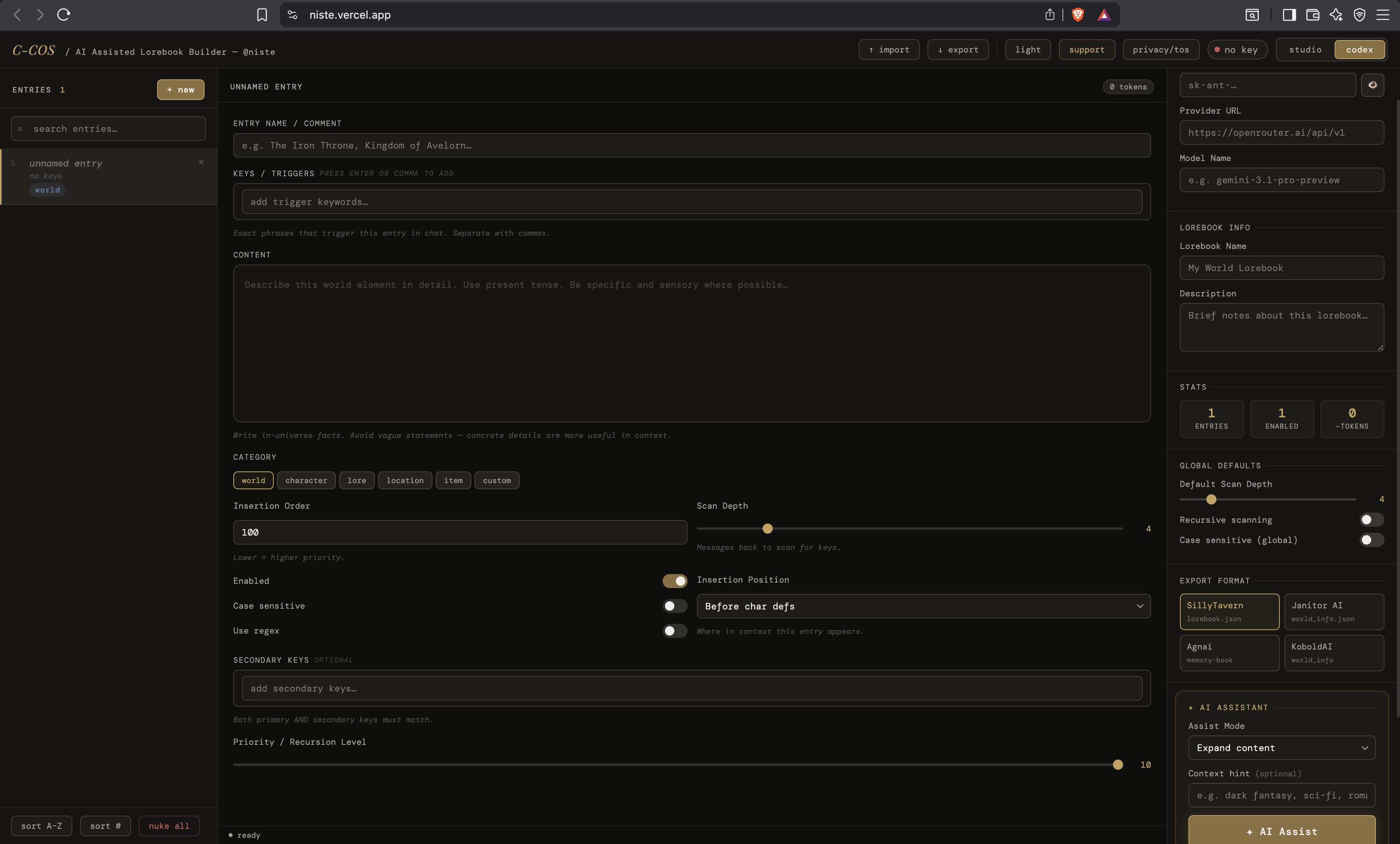
Keyword-triggered world info is useful for places, items, and factions. It is a weak substitute for who this person is when angry. Keys collide (“rose” the NPC vs. the flower). Scan depth misses a vow from two scenes ago. Recursion pulls half the wiki. You still need a layer that stores state — who knows the secret, which oath broke — separately from definition.
TTRPG prompt guides make the same split: the prompts that work share campaign context, a specific task, and a format instruction. At session thirty you cannot paste three sessions of notes into the card. A tool that already holds history is the only setup that scales.
This is exactly what a long-memory roleplay agent is for.
Why Roleplay Game Master
Roleplay Game Master is built as a standalone roleplay product: immersive scenes, unlimited memory, and character consistency as the default, not a plugin. You are not hosting a local front-end, debugging insertion order, and hoping the definition still sits near the top of the stack on message 400.
Role-aware methods in research keep core traits in the reasoning loop so the model does not wander off-role. Unguided extra reasoning, by contrast, can hurt persona consistency and memory. The practical lesson for card authors is the same: a specialist that already thinks in scenes beats a general chatbot plus a longer system prompt.
While Janitor-style apps assemble a character from stacked prompt layers, and local toolkits add keyword world info, this roleplay GM specializes in persistence so the card does not have to carry the entire campaign on its back.
| Traditional character card | Roleplay Game Master |
|---|---|
| Re-paste a 4,000-token bio every session | Persistent memory; the persona is not re-explained from scratch |
| History buries definition (lost-in-the-middle) | Working character state stays available across sessions |
| Keyword lorebooks that miss or flood | Knowledge bases plus an agent that already enforces consistency |
| One general chatbot and constant “stay in character” nagging | A specialist built for immersive roleplay |
| Desktop exports, scan depth, and prompt plumbing | Web, iOS, and Android with the same memory |
Write invariants, not a novel
Long-term cards fail when they mix three jobs in one blob: definition (who they are), state (what happened), and procedure (how the front-end stacks the prompt). Keep definition short and load-bearing: speech, morals, appearance, what they will never do. Present tense. Standalone sentences. If a line only matters when a keyword appears, it belongs in a lore entry, not in the soul of the card.
"Captain Ilya Voss speaks in short clauses and never uses contractions. Salt-stained grey coat, left glove always on. Guest-right is sacred. He will lie about cargo; he will not lie about the dead."
If you need a trait stack before you write those lines, Personality Analyzer can turn Big Five, attachment, or Enneagram patterns into behavior you can actually put on a card — not a type label the model recites.
Separate the person from the wiki
The lorebook screenshot above is the right instinct: categories, triggers, insertion order, scan depth, exports. Use that pattern for world facts. Do not use it as a dumping ground for personality. A faction banner can be retrieved. A speech tic must be present even when nobody typed the keyword.
For serialized stories where the “card” is a protagonist who has to survive draft twenty, Film Screenwriter keeps structure, motive, and unpaid setups attached to the draft so the character sheet is not a sticky note.
Treat memory as state, not recap
After a turning point, write the new fact back: who died, who heard the lie, which vow broke. Retrieval can fetch “Voss never breaks guest-right.” Only persistence can fetch “Voss already watched you break it.” That is the difference between a character card and a character.
"Update state: guest-right was broken at Duskferry. Voss now hunts the party. The left glove is a warning — he takes it off only to kill."
Keep the remote in the world's hands
A card that only answers when spoken to is a puppet. Long-term engineering includes idle behavior: what the character wants off-screen, what they will not wait for. Pair the persona with scene goals, not just adjectives.
"You are Ilya Voss. Want the salt-road tariff paid. Distrust anyone who smiles while bargaining. If I go silent, pursue your goal; do not wait for a cue."
Related Agents You'll Also Find Useful
Try this roleplay GM free — no credit card required. If you are also building the person around the card, these agents fit the same month of work.
College Life — social state as character memory
If you are also running a cast instead of a single NPC, College Life treats friendships, rumors, and fallout as facts as load-bearing as a magic system. Who is angry and who was left on read belong on the state layer of the card.
- Emergent social dynamics instead of scripted routes
- Choice residue later scenes can retrieve
- Tone control for friendship, romance, or fallout without wiping the cast
Learn Russian Through Roleplay — consistency as pedagogy
Learn Russian Through Roleplay is designed around unlimited scenarios, unlimited memory, and character consistency. The “card” is the shopkeeper who still remembers yesterday’s insult. Grammar rides along because the person did not reset.
- Recurring NPCs who remember mistakes and victories
- Scenario freedom without erasing the social map
- Practice that sticks because the world still knows you
Film Screenwriter — the card as a story bible
Film Screenwriter is the right adjacent workflow when the persona has to survive outlines, revisions, and a later scene that pays off act one. Long-term card work and long-form character work are the same discipline with different file names.
- Character bibles that travel with the draft
- Dialogue and motive that do not soften between sittings
- Setup/payoff memory for unpaid plants
Personality Analyzer — traits you can actually prompt
Personality Analyzer synthesizes Big Five, MBTI, Enneagram, and attachment into patterns you have not named yet. Use it to generate invariants (“avoids direct refusal; changes the subject”) instead of a four-letter code the model treats as costume.
- Behavior-level traits, not label recitation
- Relationship and stress patterns for long arcs
- A source file you can drop into a custom agent’s knowledge base
How Long Term Character Card Prompt Engineering Works
You do not need a 2,000-token jailbreak. You need a short definition, a place for state, and an agent that will still be that person next week.
Step 1: Write the card as invariants List only what must be true in every scene: voice, body, morals, hard nos. Present tense. No plot. If deleting a sentence would not change the performance, delete it. Google’s long-context note still applies here: put the actual question after the context, and do not ship tokens you do not need.
"Mira Chen, 28, trauma nurse. Dry humor, never slang in a crisis. Calls people by last name until invited otherwise. Will break protocol to keep a patient alive; will not fake comfort."
Step 2: Map the stack so history cannot eat the person Know what your front-end actually sends. Most roleplay apps concatenate static layers, then append a thread that grows forever. If definition sits above a swelling history, it becomes mid-context — the worst seat in the house.
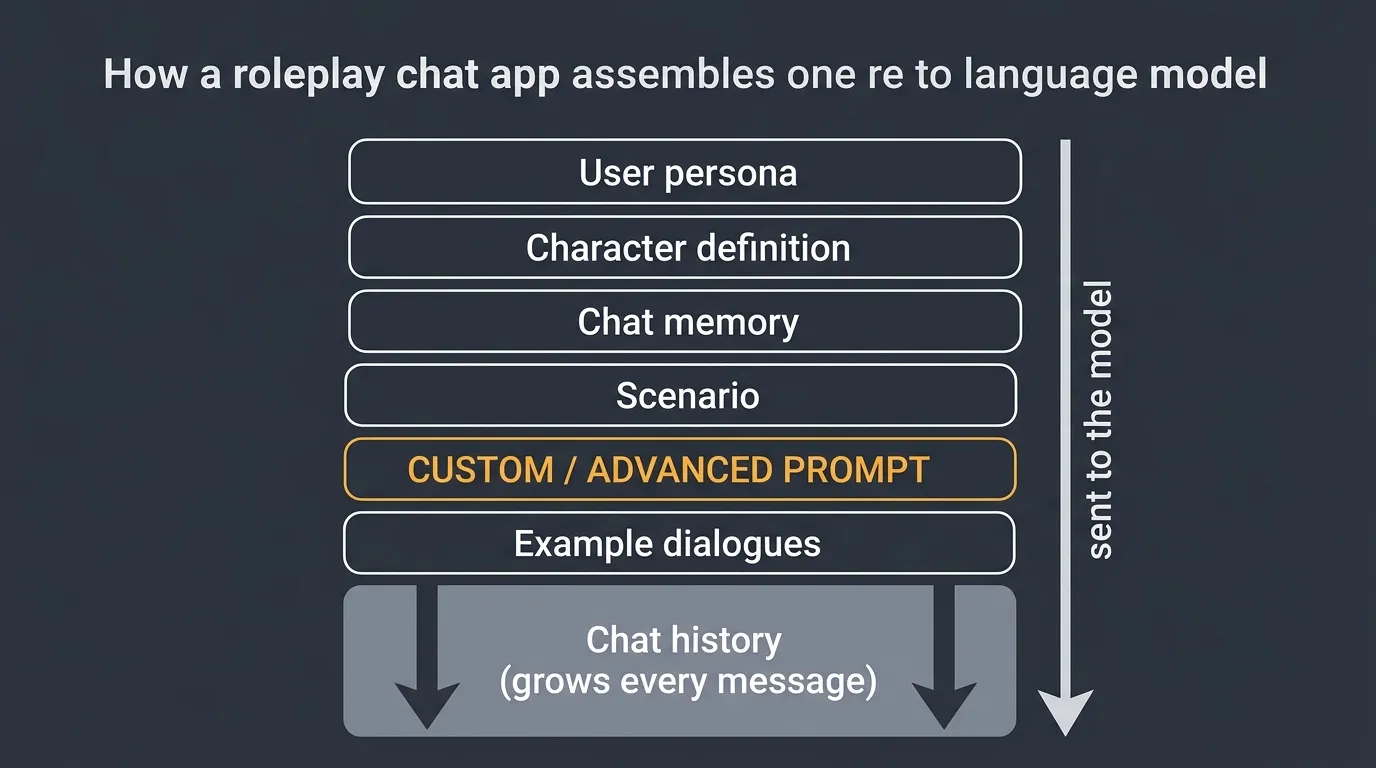
Keep examples short and diagnostic (how they refuse, how they greet, how they lie). Park world facts in a knowledge base or lore entries with triggers. Leave the live thread for play, not for restating the bio.
"Custom instruction: When history is long, prefer the character definition over recent tone. If Mira would not joke, do not joke — even if the last ten user lines were casual."
Step 3: Play inside a specialist, then write state back Open your character engine and run the scene. After a turning point, store the new fact as state, not as a rewritten biography. Definition stays stable; state accumulates.
"State: Mira now knows the intern hid the lab error. She has not reported it. She will be colder with that intern and will not explain why."
Step 4: Continue on the device you actually have The same agent, history, and knowledge base sync across web, iOS, and Android. A commute scene can retrieve last night’s cliffhanger without exporting JSON or rebuilding keys. Speech-to-text is there when you would rather play than type.
Results and Use Cases
📊 Multi-session coastal campaign
- Scenario: Weekly game. Captain Voss, a guest-right rule, a salt-road tariff, three players who remember different details.
- Traditional approach: A 3,000-token card, a shared doc nobody updates, twenty minutes of recap. By session six Voss uses contractions and forgets the glove.
- Roleplay Game Master: Invariants stay on the card; guest-right breaks are written to memory; only the scene’s lore is retrieved.
- Session start is a scene, not a briefing
- Speech tics survive the week off
- Faction facts do not have to live inside the personality block
💼 Screenplay character who must not soften
- Scenario: A 110-page draft. The protagonist’s refusal in scene 8 is the engine of act three. Chatbots keep “helping” her apologize.
- Traditional approach: Re-paste the bible, argue with a general model, lose a weekend to continuity notes.
- Film Screenwriter: Motive and unpaid setups stay attached to the draft. Pressure-test the same invariants in roleplay when you need to hear the voice out loud.
- Plants remain payable
- Dialogue does not drift between sittings
- The card and the script describe the same person
📱 Language roleplay on the train
- Scenario: Twenty minutes of Russian between stops. Yesterday you used the wrong speech level with a shopkeeper.
- Traditional approach: New chat, new shop, a model that congratulates your grammar and erases the social cost.
- Learn Russian Through Roleplay: The shopkeeper still exists. The injected “lore” is your relationship. Mobile parity means the thread is the same world.
- Correction lands in character, not as a lecture
- Vocabulary sticks to a person you will meet again
- The card is social, not encyclopedic
🎯 Campus sim where the cast remembers
- Scenario: You want a living dorm, not a one-shot meet-cute. Last week’s rumor has to still be in the air.
- Traditional approach: A multi-character card that collapses into one voice; NPCs reset when the window fills.
- College Life: Social state is the lorebook. Use Personality Analyzer first if you need stress and attachment patterns before you write greetings.
- Cast members do not merge into one tone
- Fallout persists without a manual recap
- The “card” is a graph of people, not a single bio
FAQ
What is long term character card prompt engineering?
It is the craft of keeping an AI persona stable as conversations get long. You separate definition (who they are) from state (what happened) from procedure (how layers are stacked), then retrieve only what the current scene needs. A dedicated roleplay agent with persistent memory does that without forcing you to re-paste a novel every session.
Is Jenova free?
Yes. The free tier includes core features with limited monthly usage. Plus starts at $20/month for higher usage and custom model selection; Premium, Pro, Max, Ultra, and Enterprise scale from there. Usage resets on the billing date with no daily caps, which matters for campaign nights that spike rather than drip.
How is this different from Janitor AI or SillyTavern character cards?
Those front-ends are strong at assembly: persona, definition, memory, scenario, custom prompt, examples, then growing history — the stack in the diagram above. Keyword world info adds lookup. Jenova is a managed agent platform. You still write invariants, but persistence, multi-model routing, and a specialist built for character consistency sit behind one account on web and mobile. You are not maintaining scan depth as a second hobby.
Does long term character card prompt engineering work on mobile?
Full feature parity across web, iOS, and Android, with synced settings and history. That is the practical test: if the persona only lives in a desktop install and a JSON export, it is not long-term. Speech-to-text is available when you would rather play a scene than type one.
Can I use this for language-learning characters?
Yes. The same architecture applies: a recurring person, speech rules, and memory of what you did last time. Learn Russian Through Roleplay is built for that loop — unlimited scenarios, unlimited memory, character consistency — so the “card” is the relationship, and grammar is what you practice inside it.
Will the AI actually stay in character?
Injection and memory raise the odds; they do not guarantee obedience. Role-play research still flags attention diversion and style drift as live problems. Shorter invariants, state written back after turning points, and a specialist agent all help. If a fact is load-bearing, put it in the definition and in memory, and keep examples diagnostic rather than decorative.
Conclusion
Long chats do not kill character cards because authors lack adjectives. They fail because definition, state, and prompt order get mashed into one growing blob, then lost in the middle of a window that was never memory. Long term character card prompt engineering is the fix: short invariants, separate lore, stacked layers you understand, and state that survives the week off.
Roleplay Game Master puts that discipline in a product that already treats consistency as the point. Use College Life when the card is a cast, Film Screenwriter when it has to survive a draft, and a personality pass when traits are still mush. Write the person once. Update what happened. Play the next scene instead of rewriting the bio.
Explore more at Jenova.
For Developers: Roleplay Game Master is available programmatically via the Jenova API — integrate long-running character consistency into your application with a single API call. Full documentation →