Indonesian Tutor AI: Learn Bahasa Through Immersive Roleplay
2026-08-27
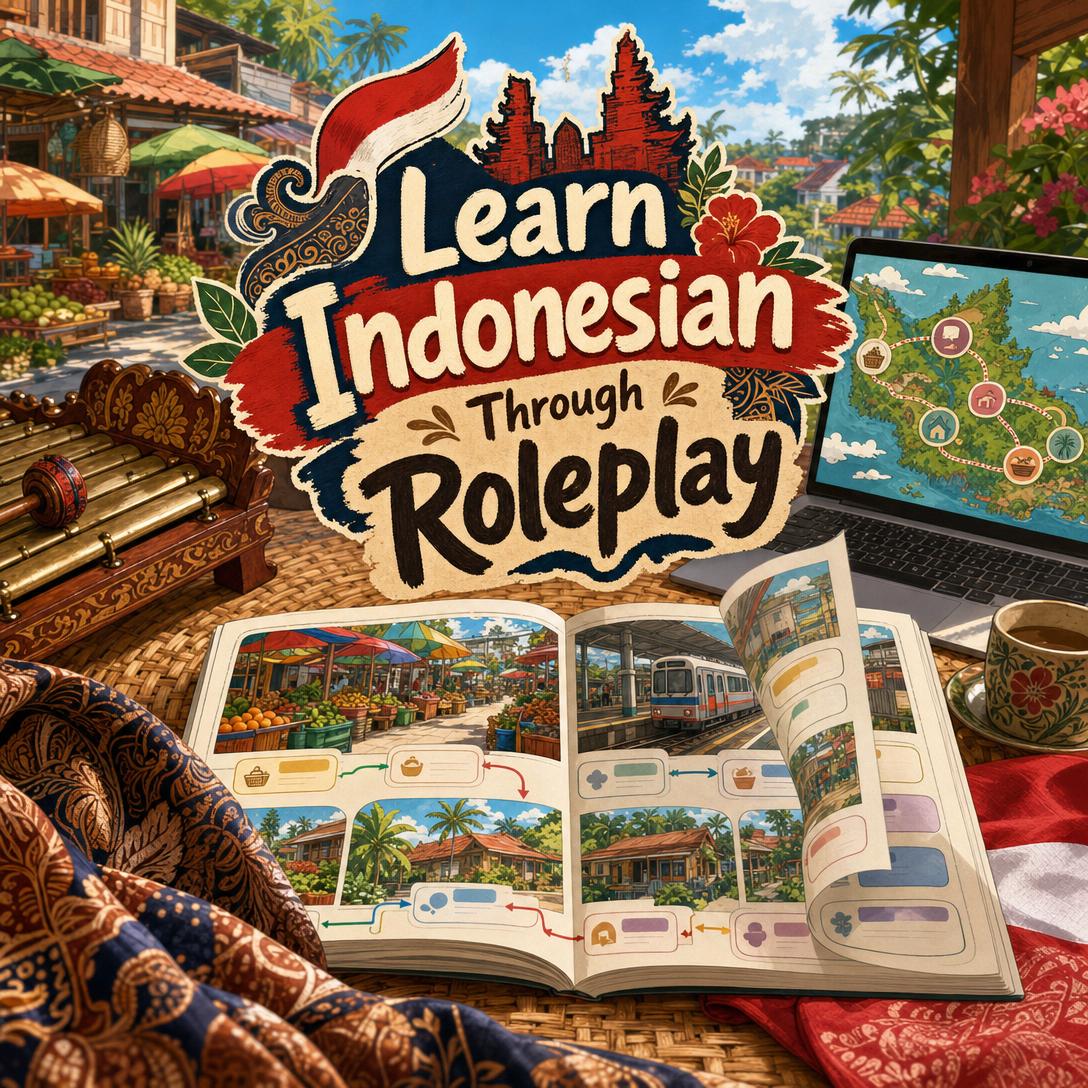
Learn Indonesian Through Roleplay helps you learn Indonesian by placing you inside a story — a Jakarta warung, a Bali homestay, a Menteng office — where vocabulary, grammar, and culture arrive as things people actually say. While flashcards and grammar drills leave Bahasa Indonesia feeling abstract, this AI tutor anchors every word to a scene you care about.
✅ Immersive roleplay that teaches through conversation, not rote lists ✅ Adaptive levels from complete beginner (Pemula) to advanced (Mahir) ✅ Formal Bahasa baku and everyday bahasa gaul, taught in the situations that use them ✅ You reply in your own language — Indonesian is absorbed through the story
To understand why this matters, it helps to look at what usually goes wrong. Indonesian looks “easy” on paper, then collapses the first time a shopkeeper drops the formal textbook and switches to Jakarta speech. The gap is not motivation. It is method.
Quick Answer: What Is Learn Indonesian Through Roleplay?
Learn Indonesian Through Roleplay is an AI language tutor that teaches Bahasa Indonesia through immersive stories, so vocabulary and grammar stick to moments you actually care about. You play a character; the tutor plays the world.
Key capabilities:
- Story-first lessons in any setting you choose — travel, work, daily life, or a custom scenario
- Indonesian dialogue with translations, pronunciation audio, and notes that fade as you improve
- Clear teaching of word-building (affixes) and the formal/casual register split
- Persistent memory of your level, characters, and unfinished storylines across sessions
Why Most Learners Struggle to Learn Indonesian
Indonesian is worth learning. It is the working language of the world’s fourth-most-populous country, and over 97% of Indonesians are fluent in it, making it the largest language by number of speakers in Southeast Asia. Interest outside the archipelago is rising too: Bahasa Indonesia is taught in 52 countries, and it is an official language of the UNESCO General Conference.
52 countries — Bahasa Indonesia was taught in 52 countries as of November 2023, with government BIPA programs sending teachers into universities and embassies worldwide.
Global appetite for languages is not the bottleneck. Duolingo’s 2025 language report found learner interest at an all-time high. The problem is what happens after the first “terima kasih.”
But turning that interest into usable Indonesian is frustratingly difficult:
- Textbook Indonesian and street Indonesian barely overlap. Formal Bahasa baku (saya, tidak, Anda) is what apps teach. Friends, ojek drivers, and coworkers often use bahasa gaul (gue, nggak, lu) plus particles like dong, sih, and deh. Learners who only study the formal register freeze in ordinary conversation.
- Meaning lives in affixes, not in isolated roots. Beli (buy) becomes membeli, membelikan, dibeli, pembeli. If you never see those forms inside real speech, you cannot decode new words on sight — and Indonesian is built this way.
- Drills do not create memory. Isolated vocabulary has nowhere to attach. Research on immersion education finds that the more time spent learning through the language, the higher the proficiency. Ten minutes of flashcards is not that kind of time.
- Emotion is treated as optional. Emotional engagement can switch behavioral and cognitive engagement on or off, which then shapes acquisition. A word you needed to order lunch, defuse an awkward pause, or follow a plot twist is a word you keep.
Native-like listening and reading — Immersion students consistently develop native-like comprehension in the second language, especially when the language is the medium of the activity, not a side quiz.
Classroom BIPA programs help, but they are unevenly available. In 2023, Badan Bahasa supported 1,702 BIPA teachers across 80 institutions in 30 countries — real infrastructure, still not a tutor in your pocket at 11 p.m. when you want another scene. This is exactly what this Indonesian tutor was built for.
How to Learn Indonesian Through AI Roleplay
You do not need to “perform” Indonesian to start. The tutor is designed so you take part in your own language while Indonesian arrives in dialogue, narration, and follow-up notes. You can try producing Indonesian whenever you want; you are not blocked if you do not.
Step 1: Get a Honest Level Check
Open a session and describe your background — zero Indonesian, a few trips to Bali, heritage phrases, or office survival skills. The tutor assesses whether you are Pemula (beginner), Menengah (intermediate), or Mahir (advanced), then sets how much translation and audio you need.
"I've never studied Indonesian. I know 'terima kasih' and that's it. I want to handle food, transport, and greetings before a trip to Jakarta."
Step 2: Choose the World You Will Learn Inside
Pick a setting, tone, and character. A backpacker in Yogyakarta, an expat journalist in Menteng, a guest at a family selamatan, a new hire in a Jakarta office — the scene decides which words appear. Food stalls teach polite-informal speech and classifiers. Offices teach Bahasa baku and fuller affixes. Friend groups teach gaul.
"Set me in a small warung in Menteng. I'm an expat on my first day. Keep it realistic and friendly, beginner level."
Step 3: Play the Scene — Indonesian in the Dialogue, English in Your Replies
The AI tutor narrates in your language, seeded with Indonesian words (warung, sambal, ojek), while every NPC speaks Indonesian. Beginners get full translations and pronunciation audio on key lines. Intermediate learners lose translations on familiar words and start hearing particles and code-switching. Advanced learners get slang, idioms, and thinner scaffolding.
You answer as your character, in English or in Indonesian. If your Indonesian is off but understandable, the NPC simply continues. If it is confusing, they ask in character — “Hah? Maksudnya apa?” — instead of breaking the scene with a red-pen lecture.
"I sit down, smile, and ask what she recommends that isn't too spicy."
Step 4: Read the Language Notes, Then Keep Moving
Every roleplay reply ends with a short teaching footer: how an affix was built (me- + beli + -kan), why someone used Mas instead of Anda, what deh is doing at the end of a suggestion. That is where grammar becomes visible without stopping the story. Interactive, immersive practice is associated with stronger retention and comprehension than passive study — the notes make the immersion legible.
Step 5: Review When You Want Explicit Teaching
Say you want to pause the story and study. The tutor switches into a direct-teaching mode: error patterns, affix charts, register contrasts, a recap of words that are ready to “graduate” (no more translation). Then you drop back into the same warung, the same NPCs, the same unfinished threads. Memory persists, so Bu Ratna still knows you, and soto ayam does not reset to a new word every session.
Try this Indonesian tutor free — no credit card required.
Indonesian Roleplay Use Cases That Build Real Fluency
🧳 First Week in Jakarta Without a Phrasebook Panic
Scenario: You land, you are hungry, and the only English around you is on a Grab receipt. You need to order food, hail an ojek, and not sound rude when you address someone older.
Traditional Approach: A phrasebook, a generic app tree, and a lot of pointing. You memorize “berapa harganya?” then cannot follow the answer when it comes back in fast, friendly Indonesian.
Learn Indonesian Through Roleplay: You play the first afternoon at a warung. The ibu asks what you want; a student at the next table recommends the soto; you learn Mas, mau, -nya, and banget because they showed up in a real exchange.
- Food and transport vocabulary attached to a specific place
- Polite-informal register before you need it on the street
- Pronunciation audio on the lines you will actually reuse
If you are still mapping the trip itself — flights, neighborhoods, a first-night hotel — Travel Planning Advisor can handle logistics while the language tutor handles what you will say when you get there.
💼 Office Indonesian for Expats and Remote Teams
Scenario: You have joined an Indonesian team. Meetings are a mix of English and Bahasa baku. WhatsApp is looser. You keep saying saya in chats where everyone else has switched to gue, and you cannot tell whether Tolong dikirim hari ini is a request or a soft command.
Traditional Approach: A twice-weekly BIPA class that cannot replay yesterday’s meeting, plus guesswork in the group chat.
This AI tutor: You run an office storyline — a briefing with a manager who speaks full baku, then a corridor chat with a peer who does not. Affix notes unpack dikirim, mengirim, and kirimkan so the same root stops looking like three unrelated words.
- Formal verbs and address terms (Pak, Bu, Anda) in the rooms that require them
- A controlled first look at gaul so the register shift does not blindside you
- Repeatable scenes for the phrases you keep missing
When a contract, email, or chat thread needs a clean rendering rather than a lesson, Indonesian-English Translator can convert the document in either direction so you are not mixing study with high-stakes wording.
📱 Ten-Minute Warung Runs on Your Phone
Scenario: You are on a train, in a rideshare, or in bed. You do not have a desk or a 45-minute lesson block. You want one vivid conversation, not a streak of disconnected tiles.
Traditional Approach: Bite-size drills that reset context every screen. Nothing in the lesson knows that yesterday you already ordered nasi goreng.
The roleplay tutor: Full feature parity on web, iOS, and Android means you continue the same story on your phone. One short scene — paying, asking for less sambal, confirming an ojek — is enough to move a word from “new” to “I recognized that without the translation.”
- Sessions that fit a commute
- Speech-to-text if you would rather talk than type
- The same NPCs and vocabulary buffer across devices
Studies link higher engagement with better vocabulary knowledge, speaking ability, and pragmatic competence. A scene you finish because you want to know what happens next is doing that work.
Once you are actually walking past a temple gate, a station sign, or a menu you cannot parse, Tour Guide can read the photo and add local context — then you can drop those details back into the next roleplay.
FAQ: Learning Indonesian With AI Roleplay
Is Learn Indonesian Through Roleplay free?
Yes. The tutor is available on a free plan with core features and limited monthly usage. Paid plans raise that usage ceiling — Plus starts at $20/month for 30× the free allowance — and usage resets in full on your billing date, with no daily cap. You can start a warung scene, an office storyline, or a custom scenario without a credit card.
How is this different from Duolingo or a regular Indonesian course?
Most apps isolate words and grammar into short drills. This Indonesian tutor teaches inside a continuous story: NPCs speak Indonesian, your replies can stay in English, and grammar shows up as affix breakdowns and register notes after the scene. You still get explicit teaching when you ask for it. The difference is that membelikan appears because someone is ordering food for you, not because a unit titled “Suffixes” came due.
Do I need to speak Indonesian before I start?
No. Beginners get full translations, pronunciation audio, and formal register only, with root words emphasized before heavy affix teaching. You participate in your native language. Indonesian is the language of the world around your character. When you do try a phrase, NPCs react in character instead of stopping the scene for a lecture.
Does it work on mobile?
Yes. Web, iOS, and Android share the same conversations, memory, and settings. A scene you start on a laptop continues on your phone. That matters for language work: immersion research from the University of Minnesota’s CARLA program ties proficiency to time spent in the language. Mobile makes it realistic to add that time on a commute.
Can it teach both formal Indonesian and slang?
Yes. That split is a core teaching target, not a side note. Authority figures model Bahasa baku; friends model bahasa gaul; service workers often sit in between. Intermediate and advanced scenes introduce particles, dropped prefixes, and pronoun shifts (saya → gue) with notes on what the shift means socially. Beginners are not dumped into slang on day one.
Is an AI Indonesian tutor accurate enough to trust?
It is strong on high-frequency conversation, affix patterns, and register — the material you need to order, greet, ask, and follow a plot. It is not a substitute for a human examiner if you need certified BIPA scores, and regional varieties beyond common Jakarta-style gaul should be treated as models, not a census of every island. Use it as daily immersion and explanation; verify specialized legal, medical, or ceremonial language with a specialist when the stakes are high.
Start Learning Indonesian Through Stories, Not Drills
Indonesian rewards people who meet it in context. The vocabulary is phonetic, the grammar does not conjugate for tense the way European languages do, and hundreds of millions of speakers will meet you halfway — but only if you can hear the difference between a textbook sentence and what someone says at a warung.
Interactive storytelling is one of the methods shown to raise emotional engagement in online learning. Pair that with immersion’s core finding — comprehension grows when the language is the medium, not the worksheet — and roleplay stops looking like a gimmick. It looks like the way memory actually works.
Try Learn Indonesian Through Roleplay now. Pick a level, pick a scene, and let the first NPC speak. Explore more at Jenova.
For Developers: Learn Indonesian Through Roleplay is available programmatically via the Jenova API — integrate immersive Indonesian language roleplay into your application with a single API call. Full documentation →