AI Korean-English Translator: Natural Results in Seconds
2026-08-28
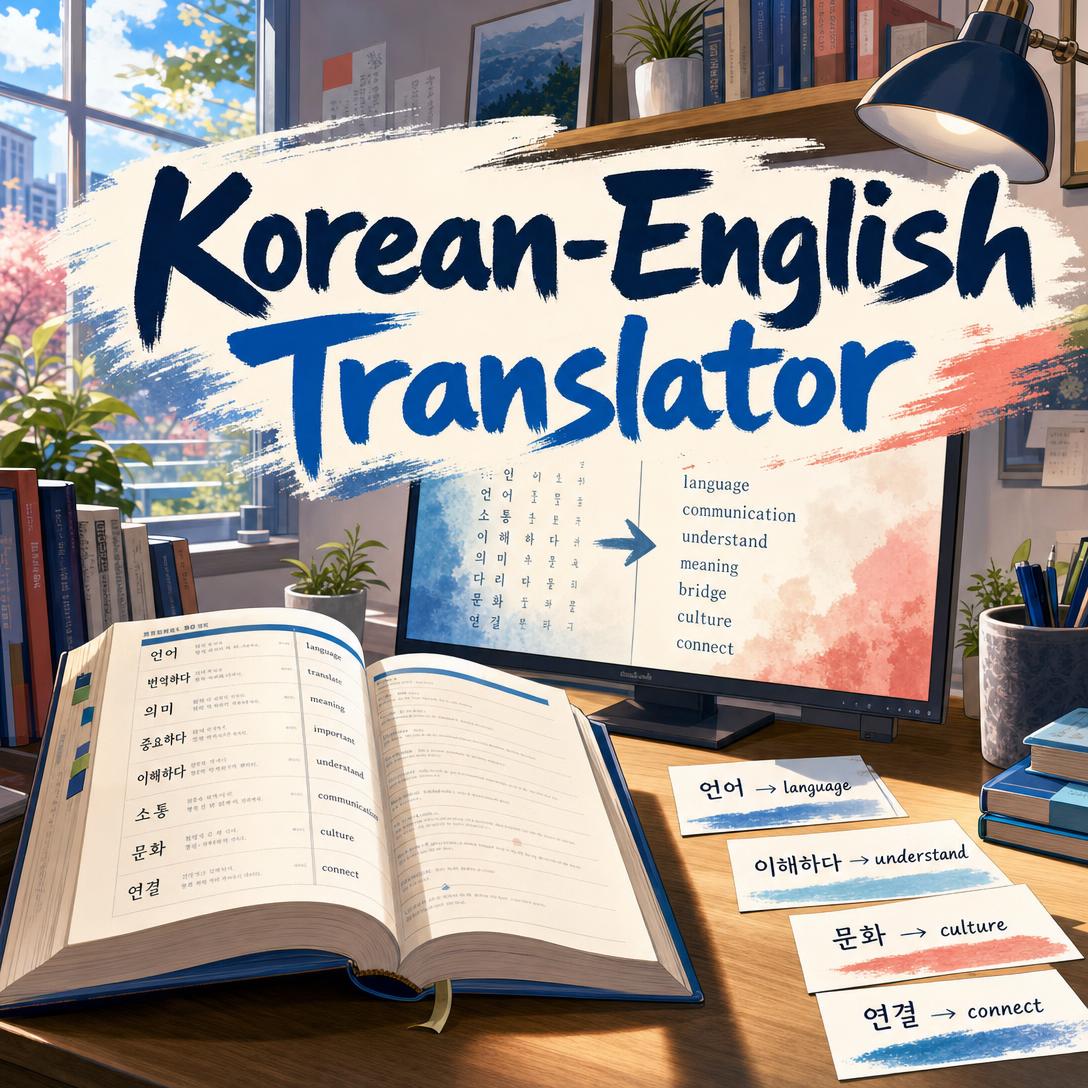
Korean-English Translator helps you move meaning between Korean and English without the stiffness of dictionary output or the guesswork of a generic machine pass. While honorifics, dropped subjects, and opposite word order routinely break word-for-word tools, this AI produces natural phrasing in the right register — then immediately translates that result back so you can confirm what you are about to send.
- ✅ Automatic Korean ↔ English detection, with no language toggle to set
- ✅ Conversational 해요체 by default, shifting to formal 합니다체 for business and official text
- ✅ Idioms rendered by meaning, not by literal word matching
- ✅ Built-in back-translation so you can verify every line before you hit send
K-content, Korean business, and a rebound in inbound travel have turned Korean-English communication into a daily task for people who are not professional translators. To understand why a dedicated pair translator matters, it helps to look at why this language pair is still so easy to get wrong.
Quick Answer: What Is Korean-English Translator?
Korean-English Translator is a bidirectional AI translator that converts Korean and English instantly, then back-translates the result so you can confirm meaning. Paste a message, email, caption, or sign, and receive a natural rendering plus a second-pass check.
Key capabilities:
- Automatic direction: English in, Korean out — or Korean in, English out
- Natural, colloquial default with a formal shift for legal, academic, and professional content
- Meaning-first handling of idioms and fixed expressions
- Numbers, symbols, and emojis left intact; names handled in standard target-language form
- Clean two-part output you can paste into KakaoTalk, email, or documents
Why Korean-English Translation Still Breaks Down
Demand is not the problem. The Korean language learning market exceeded USD 7.2 billion in 2024 and is projected to expand at a 25.1% CAGR from 2025 to 2034. Overseas classrooms are following the same curve: students studying Korean at primary and secondary schools worldwide rose from 170,563 in 2021 to 236,089 in 2025 — a 38% increase. Travel adds another layer of urgency. Korea welcomed about 8.826 million foreign visitors in the first half of 2025, a 4.6% rise from the prior year, after 3.42 million arrivals in the first quarter alone.
The global language-services market is growing with that traffic. Industry analysis puts translation services at roughly $41 billion in 2024, on a path past $55 billion by 2032, with the broader language-services market expected to reach $65.5 billion in 2026**](https://www.kent.edu/mcls/translation-ma/blog/language-trends). South Korea’s own translation-management software segment is forecast to jump from [**$75.3 million in 2024 to $224.5 million by 2029. More volume, though, has not made Korean-English easier.
But getting a usable Korean-English line is still frustratingly difficult:
- Honorifics and speech levels change the entire sentence, not just a pronoun
- Korean drops subjects and objects that English insists on spelling out
- Word order runs the opposite direction of English, so literal tools produce scrambled syntax
- Generic machine translation often lands near “good enough” and leaves you unable to check it
Around 80% — accuracy range commonly cited for Korean machine translation on everyday text
That gap is not a rounding error when you are apologizing to a client, asking a station attendant for directions, or captioning a product page. English and Korean differ in structure, politeness, and what can be left unsaid, so a tool that treats them like interchangeable word lists will sound foreign even when every dictionary gloss is “correct.” Kent State’s 2026 industry overview makes the same point at market scale: machine output still needs a meaning check before it is safe to send.
This is exactly what Korean-English Translator was built for.
Why Korean-English Translator Handles What Dictionaries Miss
Korean-English Translator is a dedicated pair translator, not a 100-language widget with Korean bolted on. It detects the source language, chooses a natural register, and returns a second, independent rendering so you can see whether the meaning survived. That back-translation is the practical answer to the 80% problem: you do not need to be fluent in the other language to notice that “I’ll think about it” came back as a hard no.
| Traditional Approach | Korean-English Translator |
|---|---|
| Word-for-word dictionary lookup | Meaning-first rendering of idioms and set phrases |
| One-shot machine output with no check | Translation plus an independent back-translation |
| The same stiff tone for every context | Conversational 해요체, or 합니다체 when the content is official |
| Extra pronouns that sound unnatural in Korean | Subjects dropped when context already makes them clear |
| App-hopping between dictionary, keyboard, and notes | One paste-and-read flow on web, iPhone, and Android |
Automatic direction, no setup
You do not select a language pair. English input is translated into Korean; Korean input is translated into English. Mixed lines follow the dominant language, which matches how people actually write in KakaoTalk, Slack, and email threads.
Register that matches the situation
Casual messages stay in polite informal Korean (해요체) unless the source itself is blunt 반말. Quarterly reports, contracts, and official notices shift into 합쇼체 (-습니다 / -ㅂ니다). That is the difference between sounding like a colleague and sounding like a tourist who learned one textbook ending.
A built-in meaning check
Every result comes in two blocks: the translation you will use, then a back-translation into the original language. The second block is produced as a fresh translation, not a rearrangement of your source, so mismatches in tone or content show up immediately.
"I need to reschedule the meeting"
"The quarterly report shows a 15% increase in revenue"
"역은 어디에 있어요?"
Try Korean-English Translator free — no credit card required.
How to Translate Korean and English in Seconds
The workflow is built for people who need a line they can send, not a linguistics lesson.
Step 1: Paste the exact text you need to convert Type or paste a message, subject line, caption, menu item, or paragraph. Treat the box as a translator, not a chatbot — including greetings and questions. If you type “Can you help me?”, you will receive a translation of that sentence, not a conversation about it.
"Could you send the revised invoice by Friday afternoon?"
Step 2: Read the Korean or English result first The top block is the line you will copy. Numbers, emojis, and symbols pass through unchanged. Brand names and people names use the standard form in the target language, including Hangul transcription for foreign names in Korean output.
Step 3: Check the back-translation before you send The second block re-expresses that result in your original language. If you wrote a soft request and the back-translation reads like an order, adjust your source and run it again. This is the fastest way to catch honorific mistakes and idiom failures without waiting on a colleague.
Step 4: Match the situation, then paste For a KakaoTalk check-in, keep the source casual. For a supplier email, write the English as you would in a real business note — the translator will follow that formality into 합니다체. Copy the top block into your app and send.
If you are already in Korea with a palace plaque, subway map, or restaurant sign in front of you, pair the text pass with Tour Guide: photograph the landmark or menu and get cultural context, not just a gloss of the words.
Korean-English Translator Use Cases
💼 Client emails and supplier messages
Scenario: You need to tell a Seoul vendor that a shipment will land two days late, without sounding careless or overly blunt.
Traditional Approach: Run the paragraph through a general translator, then ask a bilingual coworker to “make it sound Korean.” That review loop can take hours across time zones.
Korean-English Translator: You paste the English, receive a formal Korean version, and confirm via back-translation that “delay” did not come out as an accusation.
- Formal 합니다체 for professional content
- Idioms recast as natural Korean equivalents
- Ready-to-paste output with no labels or commentary to strip out
Korean buyers and partners prefer to work in their own language and style; localization is often what separates a credible outreach from a ignored one. For high-stakes contracts, still have a human legal translator review the final document — this tool is built for the daily traffic around that work.
📱 Menus, KakaoTalk, and station signs on your phone
Scenario: You are standing in a Hongdae restaurant, phone in hand, staring at a handwritten specials board. Or a host’s KakaoTalk arrives while you are on the subway.
Traditional Approach: Photograph, open a separate app, guess at handwriting, and hope the romanization you get is something you can pronounce — while the line behind you grows.
This AI translator: Paste the Hangul (or type a quick English question) and get a clean English or Korean line you can act on immediately. Full feature parity across web, iOS, and Android means the same two-block format on the device already in your pocket.
- No romanization clutter — output is text you can send or read
- Emojis and prices left untouched
- Fast enough for a queue, a taxi, or a group chat
If you are still planning the itinerary that puts you in that queue, Travel Planning Advisor can build the flights, hotels, and neighborhood logistics around the same trip.
📊 K-content, study notes, and bilingual drafts
Scenario: You are following a drama without reliable subtitles, collecting lyrics, or drafting a short bio in both languages for a portfolio.
Traditional Approach: Browser extensions that flatten every line into textbook Korean, plus a second search to check whether 나는 / 저는 was stuffed into sentences no native speaker would write.
The translator: You get colloquial Korean that omits obvious subjects, or English that reads like a person wrote it. Use the back-translation as a study check: if the return pass drifts, you have found the phrase you still need to learn.
- Natural 해요체 for dialogue and social captions
- Meaning-based idiom handling for slang and set phrases
- A second pass that doubles as a comprehension check
When you want to move from translating lines to producing them yourself, Learn Korean Through Roleplay turns the same vocabulary into conversation practice — speech levels, culture, and all.
Korean-English Translator FAQ
Is Korean-English Translator free?
Yes. Korean-English Translator is available on the free tier, with higher monthly usage on paid plans if you translate at volume. There is no separate per-word fee and no credit card required to try it. Usage resets monthly, so you can batch a week of emails or a trip’s worth of signs without a daily cap.
How is this AI Korean-English translator different from Google Translate?
General-purpose apps cover dozens of languages with a single engine. This product specializes in one pair: Korean and English. It chooses speech level from context, drops pronouns that would sound robotic in Korean, and always returns a back-translation so you can audit meaning. That is closer to a bilingual desk check than to a one-line widget.
Can Korean-English Translator handle formal business Korean?
Yes. Default output is polite informal 해요체, which fits messages, captions, and most conversation. When the source is clearly legal, academic, technical, or professional — a quarterly report, an invoice note, a notice — the Korean shifts into 합니다체. Write the English the way you would send it to a client; the register follows.
Does the translator work on mobile?
It does. The same experience runs on web, iOS, and Android, including speech-to-text if you would rather talk than type on a crowded train. Settings sync across devices, so a phrase you checked at your desk is still in history when you need it at the ticket gate.
Is AI Korean-English translation accurate enough to send?
For everyday messages, menus, captions, and routine business notes, the combination of pair-specific rendering and back-translation is built to catch the mistakes generic engines miss. Independent industry writeups still put raw Korean machine translation near 80% on standard content, which is why the second pass exists. For medical, immigration, or executed legal documents, use this as a draft and have a qualified human translator sign off.
Does it include romanization or pronunciation guides?
No. Output is the translation and the back-translation only — no romanization, no pronunciation keys, no commentary. That keeps the result ready to paste into KakaoTalk, Gmail, or a document. If your goal is speaking practice rather than a sendable line, a dedicated tutor is the better next step.
Translate Korean and English With Confidence
Korean-English is a high-demand pair with structural traps that generic tools were not designed to catch: speech levels, dropped arguments, reversed word order, and idioms that collapse when rendered word by word. Korean-English Translator answers that with automatic direction, natural register, and a back-translation you can actually use as a check.
Paste the line. Read the result. Confirm the meaning. Send it.
Try Korean-English Translator now. Explore more at Jenova.
For Developers: Korean-English Translator is available programmatically via the Jenova API — integrate bidirectional Korean-English translation with back-translation into your application with a single API call. Full documentation →