Jenova — Complete Final Fantasy VII Wiki: Lore, Boss Fights & Legacy
2026-07-15

Overview
Jenova is an extraterrestrial life-form and one of the central antagonists of the Final Fantasy VII universe. Known to the ancient Cetra as the "Calamity from the Skies" (空から来た厄災, sora kara kita yakusai), Jenova arrived on the Planet approximately two thousand years before the events of the game, nearly wiping out the Cetra civilization and fundamentally altering the course of the world's history.
Though Jenova appears as a humanoid feminine figure, the entity is neither human nor Cetra — it is a parasitic alien organism capable of mimicking other life-forms, manipulating minds, and reshaping its own cellular structure at will. Jenova's cells became the foundation of the Shinra Electric Power Company's most ambitious and most catastrophic experiments, producing enhanced super-soldiers, failed clones, and ultimately Sephiroth — the most dangerous being the Planet has ever known.
Across the original Final Fantasy VII (1997), its Compilation titles (Advent Children, Crisis Core, Dirge of Cerberus), and the modern Remake trilogy (Remake, Rebirth), Jenova serves as both a physical threat and a narrative catalyst — the source from which nearly every crisis in the series flows.
Key Facts at a Glance
| Attribute | Detail |
|---|---|
| Full Designation | Jenova (ジェノバ) |
| Also Known As | Calamity from the Skies, Crisis from the Sky, Heaven's Dark Harbinger |
| Species | Extraterrestrial parasitic organism |
| First Appearance | Final Fantasy VII (1997) |
| Origin | Unknown — arrived on the Planet via meteor impact ~2,000 years before FF7 |
| Impact Site | Northern Crater |
| Key Relationships | Sephiroth (biological host/"son"), Professor Hojo (researcher), Professor Gast (discoverer) |
| Boss Encounters (Original) | Jenova∙BIRTH, Jenova∙LIFE, Jenova∙DEATH, Jenova∙SYNTHESIS |
| Boss Encounters (Remake Trilogy) | Jenova Dreamweaver, Jenova Emergent, Jenova Lifeclinger |
| Status | Ambiguous — physical body destroyed, cellular legacy persists |
Profile
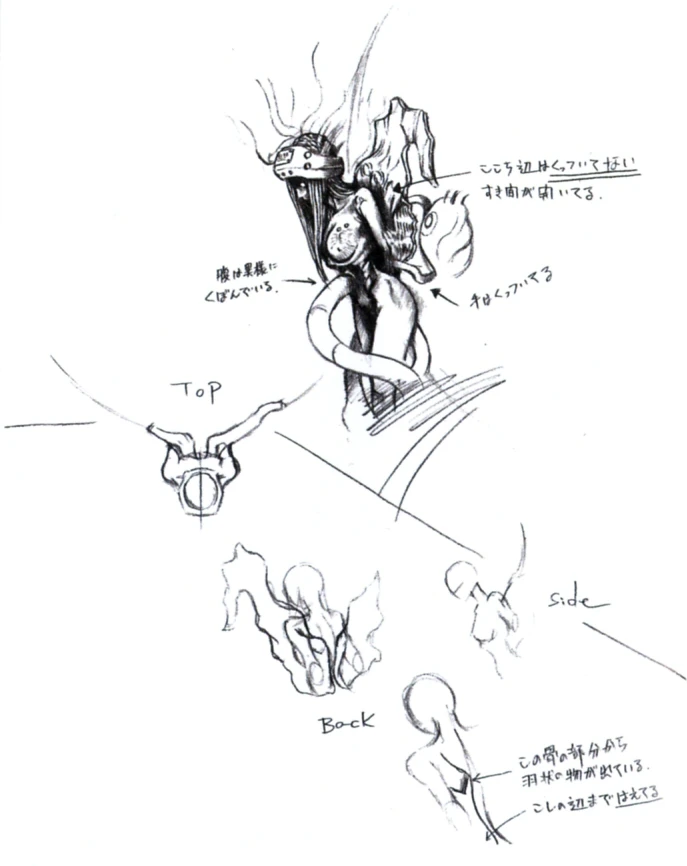
Physical Appearance
In her dormant state within the Shinra mako reactor on Mt. Nibel, Jenova appears as a gray-skinned woman with a scaly texture — rendered with a blue-ish hue in the original 1997 game. Later depictions suggest this coloring may have been an effect of the mako-filled containment tank rather than her natural skin tone.
Jenova's form is consistently feminine and largely bare, covered only by what appears to be an external biological system of veins and tissue rather than clothing. A heart-like organ sits at her feet, connected to various parts of her body by a network of tubes — the largest resembling an umbilical cord that inserts into her abdomen. This organic apparatus reinforces the maternal imagery that pervades her character, particularly in her relationship with Sephiroth.
Her most distinctive physical features include:
- Wings — a full wing protrudes from her left side and a truncated stub from her right, suggesting either damage sustained in her war with the Cetra or an asymmetrical natural form
- Hair — long, silver, parting through the center of her head — a trait directly inherited by Sephiroth
- Eyes — her left eye glows a vivid red, while her right eye is entirely missing, often concealed by her hair
- Headgear — a metallic apparatus inscribed with her name, connecting directly to her containment unit
- Exposed brain — visible within her cranium above the headgear, a detail reinterpreted across different games in the series while remaining consistently unsettling
Nature & Abilities
Jenova is not merely a powerful creature — she is a biological weapon of interstellar scale. Her core abilities form an interconnected system of parasitic dominance:
-
Mimicry & Shapeshifting
- Jenova can assume the appearance of other beings with perfect fidelity
- She used this to devastating effect against the Cetra, appearing as deceased loved ones and trusted allies
- This ability allowed her to lure individual Cetra away from their settlements before infecting or killing them
- Sephiroth later exploits this same capability, projecting his own image through Jenova's body
-
Cellular Infection
- Jenova's cells can be implanted into other organisms, granting enhanced physical abilities
- Implantation creates a permanent biological and psychological link to Jenova — and, later, to Sephiroth
- This property formed the basis of both the SOLDIER program and the Sephiroth-clone experiments
- The cells demonstrate extraordinary resilience, surviving even within the Lifestream
-
The Reunion Instinct
- Beings infused with Jenova's cells feel a compulsive drive to reunite with the main body
- Professor Hojo termed this the Jenova Reunion Theory
- Sephiroth later exploited the instinct to manipulate the numbered Sephiroth-clones
- The Reunion drive can override free will entirely, reducing the host to a puppet
-
Mental Manipulation
- Jenova can influence the thoughts, memories, and perceptions of those carrying her cells
- Cloud Strife's fractured identity and false memories are a direct consequence of this ability
- The manipulation operates through the cellular network, requiring no proximity to the main body
-
Extreme Regeneration & Adaptability
- Even fragmented pieces of Jenova can survive, mutate, and reconstitute into powerful combat forms
- Each boss encounter represents a different fragment reassembled into a new monstrous shape
- Jenova's cells resist dissolution within the Lifestream, contaminating the Planet's spiritual ecology
Names & Titles
The Cetra knew Jenova by several names, each reflecting the terror of her arrival:
| Name | Origin | Context |
|---|---|---|
| Calamity from the Skies | Cetra designation | Most common reference in English translations |
| Crisis from the Sky | Japanese literal translation | 空から来た厄災 (sora kara kita yakusai) |
| Heaven's Dark Harbinger | Cetra poetic epithet | Used in scholarly and reverential Cetra references |
| The Calamity | Shortened common reference | Used by characters familiar with Cetra history |
| Jenova | Shinra-assigned designation | Name inscribed on containment apparatus |
The name "Jenova" is widely interpreted by fans as a compound of "Jehovah" (the Hebrew name of God) and "Nova" (Latin for "new") — suggesting a false deity or a dark new genesis. Square Enix has never officially confirmed this etymology, but the theological overtones are deeply consistent with Final Fantasy VII's broader themes of false gods, corrupted creation, and the Planet's spiritual ecology.
Throughout Final Fantasy VII, Jenova is referred to with inconsistent pronouns. Sephiroth and most characters call Jenova "she" and "mother," while Ifalna refers to the entity as "he" or "it" depending on the version — reinforcing that Jenova's feminine appearance is likely mimicry rather than a genuine indication of biological sex.
Timeline of Key Events
| Approximate Date | Event |
|---|---|
| ~2,000 years before FF7 | Jenova arrives on the Planet, creating the Northern Crater |
| ~2,000 years before FF7 | War with the Cetra; Jenova sealed in geological strata |
| ~30 years before FF7 | Professor Gast discovers Jenova; misidentifies her as Cetra |
| ~27 years before FF7 | Jenova Project begins; Project S produces Sephiroth |
| ~25 years before FF7 | Sephiroth enrolled in SOLDIER |
| 5 years before FF7 | Nibelheim Incident — Sephiroth discovers Jenova, burns the village |
| 5 years before FF7 | Cloud and Zack experimented on by Hojo; Jenova's body moved to Midgar |
| Final Fantasy VII | Sephiroth manipulates Jenova's body across the Planet; Meteor summoned and stopped |
| 2 years after FF7 | Advent Children — Geostigma plague; Sephiroth briefly reborn via Kadaj; healed by Aerith's Great Gospel |
Ancient History
Arrival on the Planet
Approximately two thousand years before the events of Final Fantasy VII, Jenova arrived on the Planet by crashing into its surface — an event so catastrophic it left a massive wound that would later become known as the Northern Crater. The impact site became a focal point of the Planet's healing energy, with the Lifestream concentrating there to repair the damage. This detail would prove critical to Sephiroth's plans millennia later — the Northern Crater was, in essence, a reservoir of the Planet's concentrated spiritual energy.

The Cetra — the Planet's original stewards, a nomadic race capable of communing directly with the Lifestream — were the first to encounter Jenova. Initially, the nature of the alien entity was not understood. Jenova exploited this uncertainty with predatory precision.
The War with the Cetra
What followed was not a conventional war but a slow, insidious campaign of infiltration and infection:
- Infiltration — Jenova used her mimicry abilities to appear as deceased Cetra, drawing living Cetra to her under the pretense of reunion with lost loved ones
- Infection — Individual Cetra who approached were infected with her cells, losing their connection to the Planet and becoming vectors for further spread
- Subversion — Infected Cetra turned against their own communities, spreading paranoia and shattering social bonds
- Decimation — The Cetra population collapsed; those who recognized the threat fought back at enormous cost

The Cetra who survived recognized the alien for what it was — not a lost sister returned, but a predator wearing a beloved face.
The Cetra eventually managed to defeat and seal Jenova, but the conflict decimated their population so severely that they never recovered as a civilization. By the time of Final Fantasy VII, only a handful of Cetra descendants remain, and Aerith Gainsborough is recognized as the last pureblood Cetra.
Jenova's body was sealed within the geological strata of the Northern Continent, where it remained dormant for two millennia — waiting to be found.
Discovery by Shinra
Jenova's entombment was not permanent. The Shinra Electric Power Company, in its relentless extraction of Mako energy (condensed Lifestream), eventually uncovered Jenova's remains. Professor Gast Faremis, Shinra's lead scientist, made a catastrophic error: he misidentified Jenova as a surviving Cetra.
This single misidentification set in motion a chain of events that would reshape the world:
- It launched the Jenova Project — a research program aimed at producing a human-Cetra hybrid
- It justified injecting Jenova's cells into human subjects, including unborn children
- It created Sephiroth, Angeal, and Genesis — three superhumanly powerful individuals carrying alien biology
- It ultimately led to the near-destruction of the Planet itself
The consequences of Gast's mistake would prove more destructive than anything Jenova had accomplished on her own during two thousand years of dormancy.
The Jenova Project
Professor Gast's Research
Professor Gast Faremis, the head of Shinra's Science Department, believed that by combining Jenova's cells with human subjects, he could create a being with the Cetra's legendary ability to commune with the Planet — and, critically, the ability to lead Shinra to the mythical "Promised Land," believed to be a site of limitless Mako energy.
His research operated under the fundamental — and fatally incorrect — assumption that Jenova was a Cetra rather than an alien parasite. Gast oversaw the initial experiments before eventually leaving Shinra after discovering the truth about Jenova's nature through his relationship with Ifalna, one of the last true Cetra.
By then, however, the project had already produced its most consequential subject, and Gast's departure left the experiments entirely in the hands of Professor Hojo — a brilliant but ethically unconstrained scientist who would push them far beyond their original scope.
Project G — Genesis & Angeal
A parallel initiative, Project G (Project Gillian), was led by Dr. Hollander and used a different approach to Jenova cell implantation:
- Gillian Hewley was injected with Jenova's cells and served as a host for genetic material transfer
- Her son, Angeal Hewley, inherited the cells through natural birth
- Genesis Rhapsodos received cells transplanted from Gillian
Unlike the subjects of Project S, both Genesis and Angeal proved genetically unstable. Genesis suffered progressive cellular degradation — his body literally breaking down over time — which drove him to increasingly desperate actions in Crisis Core: Final Fantasy VII. Angeal's internal conflict over his own nature as a "monster" led to a different but equally tragic outcome.
The contrast between the two projects underscores a chilling reality: Hojo's more aggressive approach in Project S produced a more "stable" result — but stability in this context simply meant a more perfectly integrated alien corruption.
Project S — The Birth of Sephiroth
The Jenova Project's most significant outcome was Project S, which produced Sephiroth. Hojo injected Jenova's cells directly into the womb of Lucrecia Crescent, a fellow Shinra scientist and Sephiroth's biological mother, during her pregnancy. The result was a child of extraordinary power:
| Attribute | Enhancement |
|---|---|
| Physical Strength | Superhuman — capable of wielding the 7-foot Masamune one-handed |
| Speed & Reflexes | Far exceeding human limits |
| Resilience | Extreme durability and regenerative capability |
| Jenova Link | Innate connection to Jenova's cellular network |
| Lifestream Resistance | Consciousness persists within the Lifestream rather than dissolving |
Sephiroth was raised without any knowledge of his true origins. Hojo told the young Sephiroth only that his mother's name was "Jenova" and that she had died giving birth to him. At one point, Hojo even provided Sephiroth with a photograph of Lucrecia, falsely identifying her as Jenova — a deliberate deception that concealed both the alien nature of "Jenova" and the identity of Sephiroth's real mother.
Sephiroth grew up believing his mother was a woman named Jenova who had died at his birth. He never questioned the story — until Nibelheim.
Sephiroth was enrolled in SOLDIER, Shinra's elite military unit, where he became the most celebrated warrior in the organization's history. His fame and martial supremacy were, unbeknownst to all, direct products of the alien cells coursing through his body.
The Reunion Theory
Professor Hojo developed the Jenova Reunion Theory: the hypothesis that separated fragments of Jenova's cellular matter would instinctively seek to reunite with the main body. This biological imperative, Hojo theorized, could override the free will of any host carrying the cells.
Hojo's theory proved devastatingly correct. After Sephiroth's apparent death at Nibelheim, the Reunion instinct became the mechanism through which Sephiroth manipulated the Sephiroth-clones — human test subjects injected with Jenova cells and identified by numbered tattoos. Their psyches completely overridden, dressed in black cloaks, these clones were drawn inexorably toward Sephiroth's resting place in the Northern Crater — serving as unwitting carriers of Jenova's biomass and, ultimately, the Black Materia.
The Reunion Theory also explains Cloud's vulnerability: as a recipient of Jenova cells during Hojo's post-Nibelheim experiments, Cloud carries the same biological imperative. His resistance to complete mental override — imperfect though it is — becomes one of the game's key dramatic tensions.
Final Fantasy VII — The Story of Jenova
The Nibelheim Incident
The pivotal moment in Final Fantasy VII's backstory occurs five years before the main game. Sephiroth was dispatched to the village of Nibelheim to investigate a malfunctioning Mako Reactor on Mt. Nibel, accompanied by Zack Fair (1st Class SOLDIER) and two Shinra infantrymen — one of whom was Cloud Strife, a Nibelheim native who had failed to qualify for SOLDIER.
Inside the reactor, Sephiroth discovered:
- Pods containing monstrous creatures — humans mutated beyond recognition by exposure to Jenova's cells and Mako energy
- A sealed chamber — containing Jenova's dormant body, labeled with the name he had been told was his mother's
"Mother... is that... you?"
This discovery shattered Sephiroth's sanity. Retreating to the Shinra Mansion's basement library, he spent days obsessively reading Professor Gast's research notes on the Jenova Project and the Cetra. He emerged with a twisted interpretation of the truth: that Jenova was a Cetra, that the Cetra were the rightful rulers of the Planet, that humans were traitors who had abandoned the Cetra during Jenova's ancient war, and that he — as Jenova's "son" — was heir to this superior race.
The sequence of destruction:
- Sephiroth burns Nibelheim to the ground, slaughtering its inhabitants
- He returns to the reactor to claim Jenova's body
- Tifa Lockhart confronts him (her father already killed) — Sephiroth wounds her severely
- Zack Fair fights Sephiroth and is defeated
- Cloud Strife, impaled on Sephiroth's Masamune, summons impossible strength to hurl Sephiroth into the Mako pit below the reactor
Hojo arrived in the aftermath and took the survivors — Cloud and Zack — for his experiments, injecting them with Jenova's cells to test his Reunion Theory. Sephiroth was declared dead. Shinra covered up the massacre by rebuilding Nibelheim with actors posing as residents. And Jenova's headless remains were transported to Hojo's laboratory in the Shinra Building in Midgar.
The Shinra Building
Five years later, Sephiroth — whose consciousness had persisted within the Lifestream, his Jenova cells preventing full absorption — put his plan into motion. His will had overpowered Jenova's own consciousness, and he gained the ability to exert his influence on those infected with Jenova's biomass, even turning them into vessels imitating his semblance.
What appeared to be Sephiroth's ghost infiltrated the Shinra Building, slaughtering employees and President Shinra. In truth, this was Jenova's body being manipulated by Sephiroth's will — a trail of alien blood marking the path through the corridors.
Cloud and his party — having infiltrated the building to rescue Aerith — discovered the carnage and followed the trail to Jenova's containment chamber, finding it shattered and empty.
The Chase — Jenova's Body Across the Planet
What follows is one of the most celebrated narrative misdirections in RPG history.
Cloud and his allies believe they are pursuing Sephiroth across the world. In reality, they are following Jenova's body — being transported by Sephiroth-clones under his psychic control, with Sephiroth's image projected over the biomass through Jenova's mimicry abilities. At each major confrontation, the "Sephiroth" they encounter sheds a fragment of Jenova's body, which reconstitutes into a monstrous combat form to slow their pursuit:
| Encounter | Location | Fragment |
|---|---|---|
| Jenova∙BIRTH | Cargo Ship (Junon → Costa del Sol) | Jenova's arm |
| Jenova∙LIFE | City of the Ancients / Forgotten City | Mid-body fragment |
| Jenova∙DEATH | Whirlwind Maze | Upper body fragment |
| Jenova∙SYNTHESIS | Northern Cave | Remaining cells |
Each encounter depletes Jenova's remaining biomass while demonstrating the horrifying adaptability of the alien's cellular structure — every form is distinct, with different abilities and increasingly desperate combat tactics. The party does not realize they have been chasing Jenova rather than Sephiroth until after the Whirlwind Maze confrontation — a revelation that recontextualizes every "Sephiroth sighting" in the game.
Aerith's Death & Its Connection to Jenova
The most devastating moment in the story occurs at the City of the Ancients (the Forgotten City). Aerith, the last Cetra, has journeyed there alone to pray for Holy — the only force capable of countering the ultimate destructive magic, Meteor.
As Aerith prays at the altar, Sephiroth — or rather, his will projected through Jenova's biomass and mimicry — descends from above and impales her with his Masamune. The White Materia, containing Holy, falls from Aerith's hair and sinks into the waters below.
Immediately after this scene, the party must fight Jenova∙LIFE — a forced transition from grief to combat that is widely regarded as one of gaming's most emotionally effective sequences. The fragment left behind speaks one of Jenova's only direct lines of dialogue in the entire Compilation:
"Because, you are... a puppet."
These words strike at the core of Cloud's deepest insecurity — the question of whether his memories, identity, and even his will are truly his own, or merely the product of Jenova's cellular manipulation.
The Northern Crater & Meteor
The party's journey culminates at the Northern Crater — the very site where Jenova first crashed into the Planet two thousand years earlier. Here, they discover the real Sephiroth: crystallized in suspended animation within a cocoon of Mako energy, surrounded by the concentrated Lifestream that had gathered to heal the ancient wound.
Cloud, whose Jenova cells made him mentally unstable and susceptible to Sephiroth's manipulation, was tricked into relinquishing the Black Materia — the key to summoning Meteor.
Sephiroth's plan:
- Summon Meteor to inflict a catastrophic wound on the Planet
- Force the entire Lifestream to converge at the impact point to heal the wound
- Absorb the concentrated Lifestream at the point of convergence
- Ascend to godhood — becoming one with the Planet itself
Before the final confrontation, the party faces Jenova∙SYNTHESIS — composed of Jenova's last remaining cells. Once defeated, only Sephiroth himself remains. Cloud and his allies defeat Sephiroth in his evolved forms — the grotesque Bizarro Sephiroth, then the iconic angelic Safer Sephiroth — before a final one-on-one psychic confrontation within Cloud's own mind.
The Planet, aided by the spirits of the Cetra and Aerith's prayer activated from beyond death, summons Holy to counteract Meteor. When Holy alone proves insufficient, the Lifestream itself — the collective spiritual energy of the Planet — surges to the surface to push Meteor back, saving the world.
Boss Fights — Original Final Fantasy VII
Jenova is fought four times throughout the original Final Fantasy VII, each encounter representing a different fragment of her body reconstituted into a unique combat form. These battles function as both gameplay challenges and narrative milestones.
Combat Mechanics Note
Final Fantasy VII uses a deterministic damage model. For players strategizing against Jenova encounters, the core formulas governing physical and magical damage are:
Physical Damage:
Magical Damage:
Where Atk is the attacker's attack power, Lvl is their level, Def is the target's defense, MAtk is magic attack, and MDef is magic defense. These formulas are modified by critical hits (2× multiplier), elemental affinities, and status effects — all of which become relevant in Jenova encounters where elemental weaknesses can be exploited.
Jenova∙BIRTH (Cargo Ship)
| Stat | Value |
|---|---|
| Location | Cargo Ship (Junon → Costa del Sol) |
| HP | 4,000 |
| Weakness | None (neutral to all elements) |
| Notable Attacks | W-Laser, Tail Laser, Stop |
| Reward | White Cape, Ifrit Materia (found nearby) |
The first encounter occurs aboard the Cargo Ship. Created from Jenova's arm by Sephiroth, Jenova∙BIRTH is a tentacled, aquatic-looking monstrosity that introduces the party to the reality that Jenova's body is being fragmented across the world.
Strategy considerations:
- Jenova∙BIRTH can cast Stop on party members — equip accessories or materia to resist if available
- W-Laser hits a single target for moderate damage; keep HP above 500 to avoid being killed outright at typical levels
- The battle is relatively straightforward compared to later Jenova encounters
Upon its defeat, Cloud notes that they have destroyed an "arm" of Jenova — a clue whose full significance only becomes clear much later. This observation is a remnant of an earlier script concept where the Sephiroth-clones were literally named for the body parts of Jenova they carried.
Jenova∙LIFE (Forgotten City)
| Stat | Value |
|---|---|
| Location | City of the Ancients (Forgotten City) |
| HP | 10,000 |
| Weakness | Earth |
| Notable Attacks | Blue Flame, Aqualung (Enemy Skill), Reflect |
| Battle Music | Aerith's Theme — not J-E-N-O-V-A |
The most emotionally devastating Jenova encounter takes place immediately after Sephiroth descends and murders Aerith as she prays at the altar in the City of the Ancients.
In a haunting design choice, the battle music is not Jenova's standard combat theme but "Aerith's Theme" — the gentle, melancholic melody associated with the fallen Cetra. This is widely regarded as one of the most emotionally effective musical decisions in video game history, amplifying the devastation of Aerith's death even as the player is forced into immediate combat.
Strategy considerations:
- Jenova∙LIFE opens with Reflect — casting offensive magic on her will bounce it back at your party
- Use physical attacks or cast spells on your own party members while Jenova has Reflect to bounce them onto her
- Aqualung is an Enemy Skill — if you have the Enemy Skill materia equipped, a party member hit by Aqualung will learn this powerful ability for permanent use
- Earth-elemental attacks deal bonus damage
After the battle, Jenova∙LIFE delivers the line "Because, you are... a puppet" — one of Jenova's only direct lines of dialogue across the entire Compilation. The PlayStation version contains a notable typo: "Beacause, you are......a puppet."
Jenova∙DEATH (Whirlwind Maze)
| Stat | Value |
|---|---|
| Location | Whirlwind Maze (Northern Continent) |
| HP | 25,000 |
| Weakness | None |
| Notable Attacks | Tropic Wind, Red Light (Silence), Tail Attack |
| Significance | Triggers the revelation that the party has been chasing Jenova, not Sephiroth |
The third encounter occurs in the Whirlwind Maze, a treacherous environment near the Northern Crater. Jenova∙DEATH is notable for the narrative revelation that follows: Cloud realizes that what they have been pursuing across the entire Planet was not the real Sephiroth, but Jenova's body under his control.
Strategy considerations:
- Jenova∙DEATH inflicts Silence via Red Light — bring Echo Screens or Esuna materia
- At 25,000 HP, this is a significantly more durable fight than previous Jenova encounters
- Tropic Wind hits the entire party — maintain healing across all members
This encounter is one of the game's most important narrative turns, recontextualizing every previous "Sephiroth sighting" and forcing both Cloud and the player to fundamentally reconsider the nature of the enemy they face.
Jenova∙SYNTHESIS (Northern Cave)
| Stat | Value |
|---|---|
| Location | Northern Cave (final dungeon) |
| HP | 60,000 |
| Weakness | None |
| Notable Attacks | Bio2, Stop, Ultima |
| Position | Third-to-last boss before Sephiroth |
| Battle Music | JENOVA COMPLETE |
The final Jenova battle occurs deep within the Northern Cave. Composed of Jenova's remaining cells, Jenova∙SYNTHESIS represents the alien entity's last stand as an independent organism.
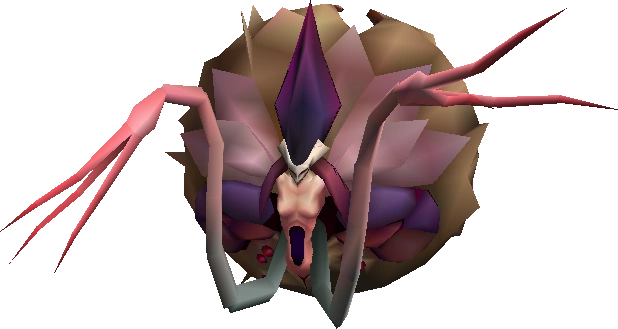
The battle theme shifts to "JENOVA COMPLETE" — a more intense, climactic arrangement of Jenova's musical motif signaling finality.
Strategy considerations:
- Jenova∙SYNTHESIS can cast Ultima, one of the most powerful spells in the game — expect party-wide damage in the range of 1,500–3,000+ depending on your magic defense
- She also uses Bio2 for poison and Stop for time freeze — status immunity accessories are highly valuable
- At 60,000 HP, this is a substantial endurance fight; use your strongest Limit Breaks and summons
- Consider equipping Ribbon accessories to negate multiple status effects simultaneously
Defeating Jenova∙SYNTHESIS effectively ends Jenova's physical existence as a coherent being. However, her cells — already scattered throughout the world via the SOLDIER program, the Sephiroth-clones, and the Lifestream itself — will continue to cause devastation for years to come.
Boss Progression Summary
| Boss | HP | Scaling Factor | Key Status Effects |
|---|---|---|---|
| Jenova∙BIRTH | 4,000 | Baseline (1×) | Stop |
| Jenova∙LIFE | 10,000 | 2.5× | Reflect |
| Jenova∙DEATH | 25,000 | 6.25× | Silence |
| Jenova∙SYNTHESIS | 60,000 | 15× | Bio2, Stop, Ultima |
The 15× HP escalation from BIRTH to SYNTHESIS mirrors Jenova's narrative progression — each encounter depletes her biomass, but the remaining cells become more concentrated and dangerous, as if the organism is consolidating its remaining power into fewer, more lethal forms.
Final Fantasy VII Remake Trilogy
The Remake trilogy reimagines Jenova's boss encounters with modern photorealistic visuals, expanded lore, and significantly more complex combat design. Each encounter retains the narrative weight of its original counterpart while introducing new story elements.
Final Fantasy VII Remake — Jenova Dreamweaver
In Final Fantasy VII Remake (2020), the Shinra Building sequence is substantially expanded. Rather than Jenova's body appearing to break free on its own, the Remake reveals that two Sephiroth-clones retrieved Jenova's body — one carried it away while the other transformed into the boss Jenova Dreamweaver.
| Detail | Information |
|---|---|
| Japanese Name | Jenova Beat (ジェノバBeat) |
| English Name | Jenova Dreamweaver |
| Location | Rooftop, Shinra Building |
| Party | Cloud, Aerith, Tifa, Red XIII |
| Battle Theme | J-E-N-O-V-A - Quickening |

Jenova Dreamweaver is a multi-phase fight featuring reality-warping illusion mechanics:
- The arena shifts and distorts, reflecting Jenova's mimicry abilities
- Party members may experience false visions
- The creature morphs between forms throughout the encounter
- Environmental hazards appear and disappear as Jenova manipulates perception
The Remake's final phase of the battle culminates in a reimagined arrangement that incorporates elements of "One-Winged Angel" — Sephiroth's iconic theme — into the Jenova motif, musically fusing the two antagonists into a unified threat.
Design Challenges
- The body — Though Jenova is explicitly non-human, her headless, unclothed humanoid form created potential ratings issues. The team reluctantly added a mechanical apparatus to her head and covered her body with cloth during scenes where Sephiroth carries her.
- The blood trail — The original game's iconic trail of blood through the Shinra corridors could not use red blood without impacting the target age rating. The team replaced it with a purple, fantasy-like substance that still required multiple review cycles before approval.
- The localization — "Dreamweaver" was chosen for the English version to better convey the entity's illusion-based combat mechanics, replacing the more abstract Japanese name "Beat."
Final Fantasy VII Rebirth — Jenova Emergent & Jenova Lifeclinger
Final Fantasy VII Rebirth (2024) continues with two Jenova encounters corresponding to the original game's Jenova∙BIRTH and Jenova∙LIFE:
Jenova Emergent
- Fought aboard the Shinra-8 cruise ship — Rebirth's equivalent of the original Cargo Ship
- Features expanded combat mechanics with multiple phases
- Battle theme: "J-E-N-O-V-A - Emergence", a new arrangement blending the classic motif with Rebirth's expanded orchestral palette
Jenova Lifeclinger
- Appears in the Forgotten Capital — the Remake trilogy's reimagining of the City of the Ancients
- Battle theme: "J-E-N-O-V-A - Tenacity"
- Carries the same narrative weight as the original Jenova∙LIFE encounter, occurring in proximity to the events surrounding Aerith
- The Remake trilogy's divergent narrative introduces significant complications to the original scene that remain subjects of intense fan discussion
Remake Trilogy Boss Encounter Mapping
| Original (1997) | Remake Trilogy | Game | Musical Theme |
|---|---|---|---|
| (Shinra Building sequence) | Jenova Dreamweaver | FF7 Remake (2020) | J-E-N-O-V-A - Quickening |
| Jenova∙BIRTH | Jenova Emergent | FF7 Rebirth (2024) | J-E-N-O-V-A - Emergence |
| Jenova∙LIFE | Jenova Lifeclinger | FF7 Rebirth (2024) | J-E-N-O-V-A - Tenacity |
| Jenova∙DEATH | TBD — Part 3 | — | — |
| Jenova∙SYNTHESIS | TBD — Part 3 | — | — |
Advent Children & the Remnants
The 2005 CGI film Final Fantasy VII: Advent Children (and its 2009 extended cut, Advent Children Complete) takes place two years after the events of the original game and explores the lingering consequences of Jenova's cellular contamination of the Planet.
Geostigma
Even with Jenova's main body destroyed, her cells persisted within the Lifestream. When the Lifestream surged to the Planet's surface to neutralize Meteor, thousands of people were exposed to Lifestream-borne Jenova cells.
The result was Geostigma — a debilitating plague caused by the body's immune system overcompensating in its attempt to eliminate the alien cells. Symptoms and characteristics include:
- Painful dark sores and scars on the skin, often spreading over time
- Progressive weakness and physical deterioration
- Children disproportionately affected — their developing immune systems proved particularly vulnerable
- No conventional cure — standard medicine is ineffective against Jenova's alien biology
- Psychological effects — some sufferers experience confusion, hopelessness, and behavioral changes

Geostigma represents one of Jenova's most insidious legacies: even in apparent death, her biological material continues to cause suffering on a planetary scale.
The disease creates a public health crisis across the city of Edge (built on the ruins of Midgar) and beyond. Cloud himself is a secret sufferer — the Jenova cells from Hojo's experiments manifesting as Geostigma on his left arm, which he conceals beneath his sleeve.
The Remnants — Kadaj, Loz & Yazoo
Sephiroth's consciousness, not fully diluted within the Lifestream, manifested three physical remnants:
| Remnant | Aspect of Sephiroth | Combat Style | Personality |
|---|---|---|---|
| Kadaj | Cruelty and obsession | Double-bladed katana (Souba) | Unstable, fanatical, desperate for "Mother" |
| Loz | Raw power and emotional volatility | Dual Hound gauntlet (melee) | Childlike aggression, prone to tears |
| Yazoo | Calm detachment and precision | Velvet Nightmare (gunblade) | Quiet, methodical, eerily composed |
The three remnants are driven by an overwhelming compulsion to find Jenova's physical remains, believing that reuniting with "Mother" will allow Sephiroth to be fully reborn. They kidnap children afflicted with Geostigma — recognizing that these children carry Jenova's cells — and manipulate them into joining their search.
Rufus Shinra, thought dead after the Diamond Weapon attack, has in fact survived and has been concealing Jenova's remains, having dispatched the Turks to retrieve them from the Northern Crater.
At least one biological remnant of Jenova had also survived in a crevasse near Icicle Inn, as depicted in the companion novella On the Way to a Smile.
Sephiroth Reborn
The film's climax unfolds in rapid succession:
- Rufus reveals he has Jenova's remains and hurls the container from the edge of the Healin Lodge building
- Kadaj leaps and salvages the remnants mid-fall
- Cloud pursues Kadaj through a high-speed motorcycle chase across Edge
- Kadaj absorbs the Jenova cells, and Sephiroth is reborn within Kadaj's body
During his battle with Cloud, Sephiroth reveals his evolved ambition: no longer content to merely absorb the Planet's Lifestream, he now intends to assimilate the Planet itself and use it as a vessel to journey to another world — continuing Jenova's original cosmic mission of consuming planets across the stars.
"I will... never be a memory." — Sephiroth, Advent Children
Cloud defeats Sephiroth once more, and Kadaj is left dying in the rain. Aerith's Great Gospel manifests as healing rain falling upon Edge and Midgar, curing Geostigma sufferers — including Cloud. The Remnants dissolve, and the immediate threat of Jenova's cellular legacy appears to end.
However, the narrative deliberately maintains ambiguity: due to Jenova's extraordinary adaptability and demonstrated ability to survive in seemingly impossible conditions, whether this truly represents her final end remains unknown.
Other Appearances in the Compilation & Beyond
Crisis Core: Final Fantasy VII
Crisis Core: Final Fantasy VII (2007, remastered as Crisis Core: Final Fantasy VII Reunion in 2022) expands on the Jenova Project's consequences through Zack Fair, Genesis Rhapsodos, and Angeal Hewley. While Jenova does not appear as a direct antagonist, her cells are the root cause of:
- Genesis's degradation — his body breaking down, driving him to search for a cure at any cost
- Angeal's existential crisis — his struggle to reconcile his honor with the knowledge that he is a biological "monster"
- Sephiroth's psychological erosion — the gradual unraveling visible in his shifting demeanor across the game
The game also provides the most detailed depiction of the Nibelheim Incident and the events that transformed both Cloud and Zack from soldiers into experimental subjects.
Ever Crisis
Final Fantasy VII Ever Crisis (2023) — a mobile game retelling the entire Compilation timeline — introduces additional Jenova-related content. Notably, until Ever Crisis, Jenova had only a single line of direct dialogue across the entire Compilation (the "puppet" line after Jenova∙LIFE), making any new dialogue significant.
The game introduces the Masamune and Igara's Illusions storyline:
- Lingering spirits in the Igara Forbidden Zone take control of SOLDIER Alissa Goldie
- Sephiroth perceives Alissa as resembling his mother — based on the false photograph Hojo had provided
- The spirits prey on Angeal's guilt over his father's death and Sephiroth's longing for maternal connection
- These events foreshadow the psychological vulnerabilities that Jenova's legacy would later exploit to catastrophic effect
Appearances in Other Final Fantasy Titles
| Game | Jenova's Presence |
|---|---|
| Final Fantasy Record Keeper | Jenova boss forms appear as event enemies |
| Final Fantasy Brave Exvius | Jenova∙LIFE appears as an event boss; Season 4 introduces Omega, a creature largely inspired by Jenova |
| Final Fantasy XIV | One of the game's servers is named "Jenova" |
Cultural Legacy
In a notable real-world connection, game designer Jenova Chen — creator of critically acclaimed titles Flower, Journey, and Sky: Children of the Light — took his professional name directly from the character, citing Final Fantasy VII as a formative influence on his creative work.
Musical Themes
Jenova's musical identity is among the most recognizable in the Final Fantasy franchise. Composed originally by Nobuo Uematsu, the Jenova motif has been reimagined across three decades of releases.
Original Final Fantasy VII (1997)
| Track | Context | Emotional Function |
|---|---|---|
| "J-E-N-O-V-A" | Battles with Jenova∙BIRTH, Jenova∙DEATH; fight against Hojo; stairway sequence | Aggressive, driving tension — a sense of alien menace |
| "JENOVA COMPLETE" | Battle with Jenova∙SYNTHESIS in the Northern Cave | Climactic finality — the last confrontation with the alien |
| "Aerith's Theme" | Battle with Jenova∙LIFE (Forgotten City) | Grief weaponized — sorrow during combat |
The "Aerith's Theme" substitution during the Jenova∙LIFE battle deserves special emphasis. In defying the player's expectation of an aggressive boss theme, Uematsu forces the emotional devastation of Aerith's murder to persist even during the act of fighting — a decision widely regarded as one of the most effective musical choices in video game history. The player cannot escape grief through the catharsis of action; the music won't let them.
Remake Trilogy (2020–Present)
| Track | Game | Boss Encounter | Notable Elements |
|---|---|---|---|
| "J-E-N-O-V-A - Quickening" | FF7 Remake (2020) | Jenova Dreamweaver | Multi-part; final section fuses Jenova motif with One-Winged Angel |
| "J-E-N-O-V-A - Emergence" | FF7 Rebirth (2024) | Jenova Emergent | New arrangement blending classic motif with expanded orchestration |
| "J-E-N-O-V-A - Tenacity" | FF7 Rebirth (2024) | Jenova Lifeclinger | Narrative weight mirroring the original Jenova∙LIFE |
Each arrangement maintains the core melodic identity of Uematsu's original while adapting instrumentation and intensity to match the specific narrative context — preserving the legacy while pushing it forward into a new generation of players.
Behind the Scenes
Early Script & Concept Changes
According to the Final Fantasy VII Ultimania Omega, early drafts of the game's script contained significantly different approaches to Jenova's presentation:
-
The Cargo Ship confrontation — "Sephiroth" would open his cape to physically shoot out a piece of Jenova (its hand), making the body-fragment nature of the encounters immediately obvious. The final game instead preserves the misdirection until much later.
-
The Black Capes — The Sephiroth-clones wandering the overworld were not conceived as individual infected humans, but as pieces of Jenova itself — fragments of alien biomass floating in the air beneath cloaks shaped like people. Each was named for the body part it contained:
- Hand
- Thumb
- Heart
This is why Cloud still refers to Jenova∙BIRTH as the "arm" of Jenova upon defeat — a remnant of the earlier, more literal concept.
-
The single Jenova — Rather than multiple Black Capes, there was originally just one: Jenova herself, progressively cutting away pieces of her body as she journeyed toward the Northern Crater. By the time the party caught up in the Whirlwind Maze, the cloaked figure would remove its hood to reveal no face, then remove its cloak to reveal nothing but Jenova's heart floating in midair — the final remaining piece.
-
Cut boss encounters — Two additional Jenova boss fights were planned and ultimately removed:
- Between Cosmo Canyon and Nibelheim
- Inside the Temple of the Ancients
The earlier vision was arguably more viscerally horrifying in its imagery but far less effective as a mystery narrative. The final game's approach — allowing the player to genuinely believe they are chasing Sephiroth before slowly revealing the Jenova deception — became one of the most celebrated plot structures in RPG history.
Advent Children Production Notes
In early Advent Children production, the concept of Kadaj eating the Jenova cells to complete Sephiroth's reunion was considered before being replaced with the absorption sequence used in the final film — a change that preserved the visual grandeur of Sephiroth's return while avoiding a potentially off-putting image.
Legacy & Significance
Jenova occupies a singular position in the history of video games. As the hidden architect behind Final Fantasy VII's central conflict, she represents a masterclass in antagonist design — a villain whose influence is felt in every thread of the story while rarely appearing directly.
Thematic Resonance
Jenova's thematic layers extend far beyond a standard video game antagonist:
- Biological contamination — anxiety about invisible, systemic infection that corrupts from within
- Identity dissolution — Cloud's shattered memories, Sephiroth's messianic delusion, and the clones' lost selfhood all stem from Jenova's cells
- Generational trauma — the consequences of Shinra's experiments propagate across decades, affecting people who had no involvement in the original decisions
- False divinity — the theological overtones of Jenova's name and narrative role explore themes of corrupted creation and false gods
- Scientific hubris — Gast's misidentification and Hojo's unchecked experimentation demonstrate the catastrophic potential of arrogant, careless science
Narrative Architecture
What makes Jenova exceptional as a fictional creation is her structural role. She is simultaneously:
- The origin — every crisis in FF7 traces back to her arrival
- The mechanism — her cells are the medium through which Sephiroth exerts control
- The misdirection — the player spends most of the game believing they are chasing someone else entirely
- The aftermath — Geostigma proves that even her death causes planetary suffering
Despite rarely speaking and spending most of the story as a headless body in a containment tank, Jenova has become one of fiction's most compelling monsters — a testament to Square's understanding that the most terrifying villains are not the ones who fight you, but the ones who have already changed you before you knew they existed.
Nearly three decades after Final Fantasy VII's original release, Jenova remains one of the most discussed, theorized about, and analyzed entities in gaming. The Remake trilogy's expanded treatment has introduced her to an entirely new generation while giving long-time fans fresh material to reexamine.
Whether the final installment of the Remake trilogy will recontextualize Jenova's role yet again remains one of the most anticipated questions in the franchise.
Frequently Asked Questions
Is Jenova male or female?
Jenova has no biological sex — she is an extraterrestrial organism that mimics a humanoid feminine appearance. Sephiroth and most characters refer to Jenova as "she" and "mother," but Ifalna, one of the last true Cetra, uses "he" or "it" depending on the game version. The feminine form is widely understood to be an example of Jenova's mimicry rather than an indication of actual gender.
Does Sephiroth control Jenova, or does Jenova control him?
By the time of the main game, Sephiroth's will has completely overpowered Jenova's consciousness. While Jenova's cells grant Sephiroth his abilities and serve as the medium through which he manipulates others, it is Sephiroth who directs her body, creates the combat forms, and orchestrates the Meteor plan. The dynamic has inverted from the ancient era: Jenova was once the apex predator, but Sephiroth has become the dominant intelligence using her biology as an instrument.
How many times do you fight Jenova in Final Fantasy VII?
In the original Final Fantasy VII, Jenova is fought four times: Jenova∙BIRTH (Cargo Ship), Jenova∙LIFE (Forgotten City), Jenova∙DEATH (Whirlwind Maze), and Jenova∙SYNTHESIS (Northern Cave). The Remake trilogy has introduced three encounters so far: Jenova Dreamweaver in Remake, and Jenova Emergent and Jenova Lifeclinger in Rebirth. The final Remake installment is expected to include encounters corresponding to Jenova∙DEATH and Jenova∙SYNTHESIS.
What is Geostigma and how is it cured?
Geostigma is a disease caused by the body's immune response to Jenova cells that contaminated the Lifestream. When the Lifestream surged to the surface to destroy Meteor, exposed individuals became infected. The disease manifests as painful sores and dark scars, predominantly affecting children. It was eventually cured by Aerith's Great Gospel, manifesting as healing rain over Edge and Midgar in Advent Children.
Is Jenova truly dead by the end of Advent Children?
The series deliberately maintains ambiguity. While Jenova's physical remains have been destroyed or dissolved and Aerith's healing rain cured Geostigma, the narrative explicitly notes that Jenova's extraordinary adaptability and history of surviving seemingly fatal conditions mean a definitive end cannot be confirmed. Given that the Remake trilogy appears to be taking the story in new directions, this open question may yet be revisited.
What is the connection between Jenova and the Cetra?
They are enemies — not relatives. Professor Gast's critical error was misidentifying Jenova as a surviving Cetra, which launched the entire Jenova Project. In reality, Jenova nearly drove the Cetra to extinction two thousand years before the game through infiltration and cellular infection. The Cetra sealed Jenova at great cost but never recovered, dwindling to near-total extinction by the events of Final Fantasy VII.
Why does Sephiroth call Jenova "mother"?
Sephiroth was raised believing that a woman named Jenova died giving birth to him. When he discovered Jenova's body in the Nibelheim reactor — labeled with the name he'd been told was his mother's — he mistakenly concluded that this alien entity was his biological parent. Combined with Gast's research misidentifying Jenova as a Cetra, Sephiroth constructed a delusional narrative of superior heritage. His biological mother, Lucrecia Crescent, is actually human — Sephiroth was merely injected with Jenova's cells in utero.
Looking for Jenova AI?
If you arrived here searching for the AI platform rather than the Final Fantasy VII character, Jenova AI is a completely separate entity — an AI technology platform developed by Azeroth Inc. in New York, with no affiliation to Square Enix or the Final Fantasy franchise.
Jenova is an AI agent platform offering a gallery of specialized AI agents for coding, research, education, finance, creative writing, design, and dozens of other professional domains. The platform's architecture is built around:
- Workflow orchestration — multi-step task execution coordinated automatically across agents and tools
- Model routing — unified access to the latest models from OpenAI, Anthropic, Google, DeepSeek, and xAI, with intelligent selection and switching
- Context management — deep session awareness across extended interactions and complex tasks
- Persistent memory & storage — cross-session memory that retains user preferences, past work, and long-running projects
- Retrieval-augmented generation (RAG) — grounded responses from user-uploaded documents and custom knowledge bases
- Model Context Protocol (MCP) — tool integrations connecting to Gmail, Google Calendar, Drive, Notion, Dropbox, and more
Users can create custom agents in minutes with tailored instructions, preferred model configurations, private knowledge bases, and specific tool setups. The platform is available on web, iOS, and Android with full feature parity across all devices.
Explore the platform at jenova.ai.