Jenova AI's Memory Infrastructure Surpasses $1M ARR with 200,000+ Users Across 70+ Countries
2026-06-20
NEW YORK, NY — June 18, 2026 — Azeroth Inc., a New York-based technology company and developer of the AI agent platform Jenova, today announced that its persistent memory architecture has driven the platform to over $1 million in annual recurring revenue and 200,000+ user signups across more than 70 countries, with nearly 100% of that growth organic.
Jenova's core premise is that AI agents should get smarter the longer you use them. Every interaction, every uploaded document, every preference expressed in one context carries forward to the next. Memory is not an add-on. It is the product's foundation, and it is what separates Jenova from general-purpose AI tools that reset with every session.
Pinecone, whose vector database underpins Jenova's retrieval layer, published a detailed case study covering the architecture and its impact.
How Jenova's Memory Works
Jenova delivers hundreds of specialized AI agents, from the Manga Creator orchestrating visual consistency across hundreds of pages, to the Fundamental Stock Analyst running multi-source research pipelines, to the Roleplay Game Master maintaining persistent world state across unlimited sessions. Each agent is an automated expert system engineered for a specific domain with encoded workflows, not a prompt wrapper over a general-purpose model.
What makes these agents compound in value over time is memory. Every conversation, every uploaded file, every piece of context a user provides is retained, indexed, and retrievable. When a user sends a message, Jenova's orchestration pipeline determines what prior knowledge is relevant, retrieves it, and injects it into the agent's context before generating a response. The agent operates with a curated view of the user's full history, not just the immediate conversation window.
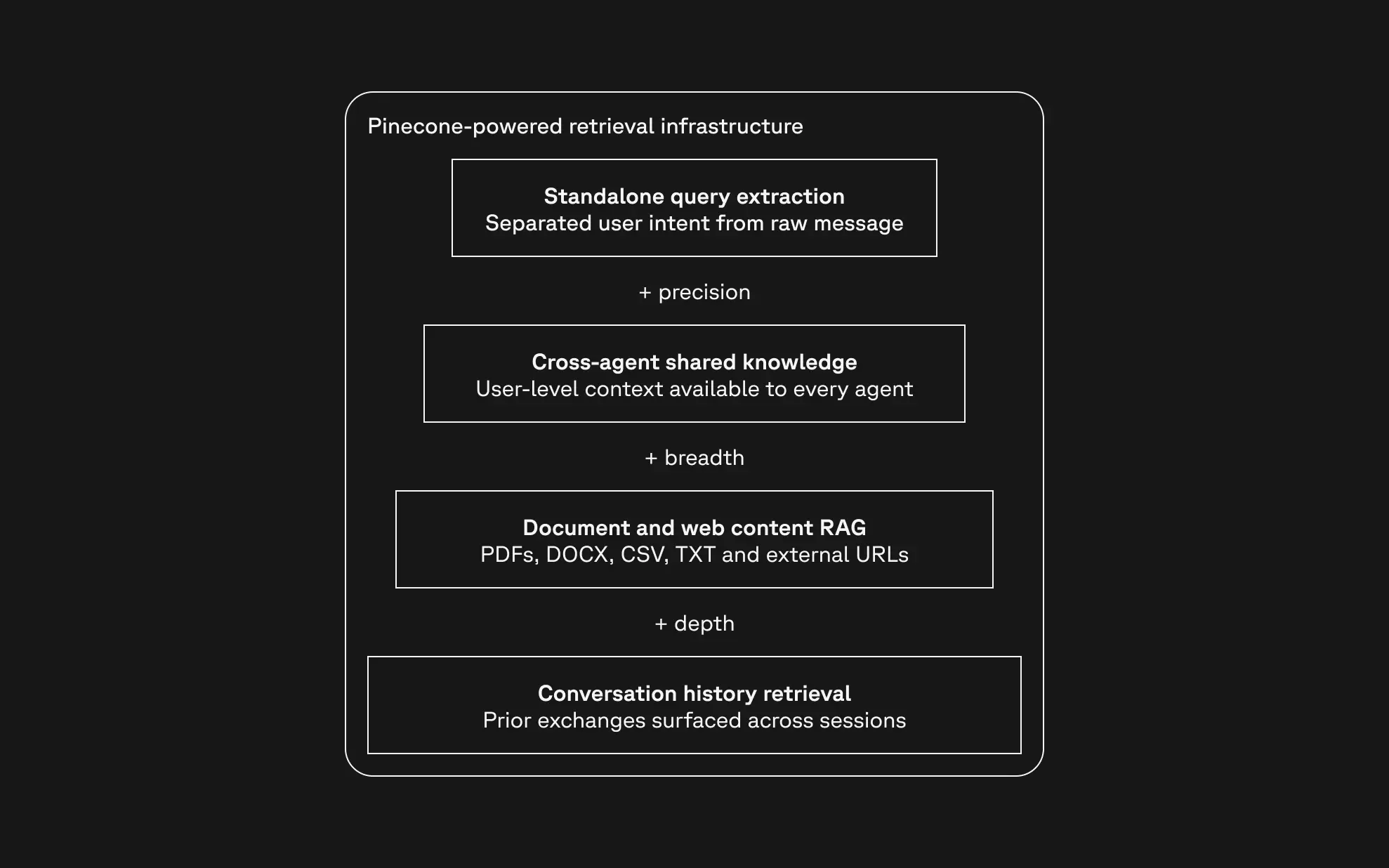
The memory system has evolved through four major milestones:
- Unlimited Conversation History. Every exchange is stored with no compression or expiration. The longest active session on the platform has accumulated over 16 million tokens. Rather than forcing that entire history into context, Jenova's retrieval system selectively surfaces what is relevant to the current interaction. Nothing is lost, but nothing irrelevant crowds the agent's attention.
- Document and Web Content Integration. The memory layer extends beyond conversation to index uploaded files across 40+ formats (PDF, DOCX, XLSX, CSV, TXT, code files, images, and more) as well as external web content. Agents draw from user-provided materials alongside session history when constructing responses.
- Cross-Agent Shared Memory. A structured memory layer gives every agent on the platform access to user-level context that persists across agents, not just across sessions. What one agent learns about a user is available to any other agent the user interacts with. Roughly one in four users on the platform has cross-agent memory active.
- Intent-Based Retrieval. The most recent architecture change separates user intent from raw message text before retrieval. Internal evaluations showed a 20 to 25 percentage point improvement in retrieval precision, meaning agents surface the right prior context significantly more often, especially in long-running sessions where the searchable history is large.
Results
The memory architecture delivers measurable results across every critical metric. As Pinecone's published case study independently documents:
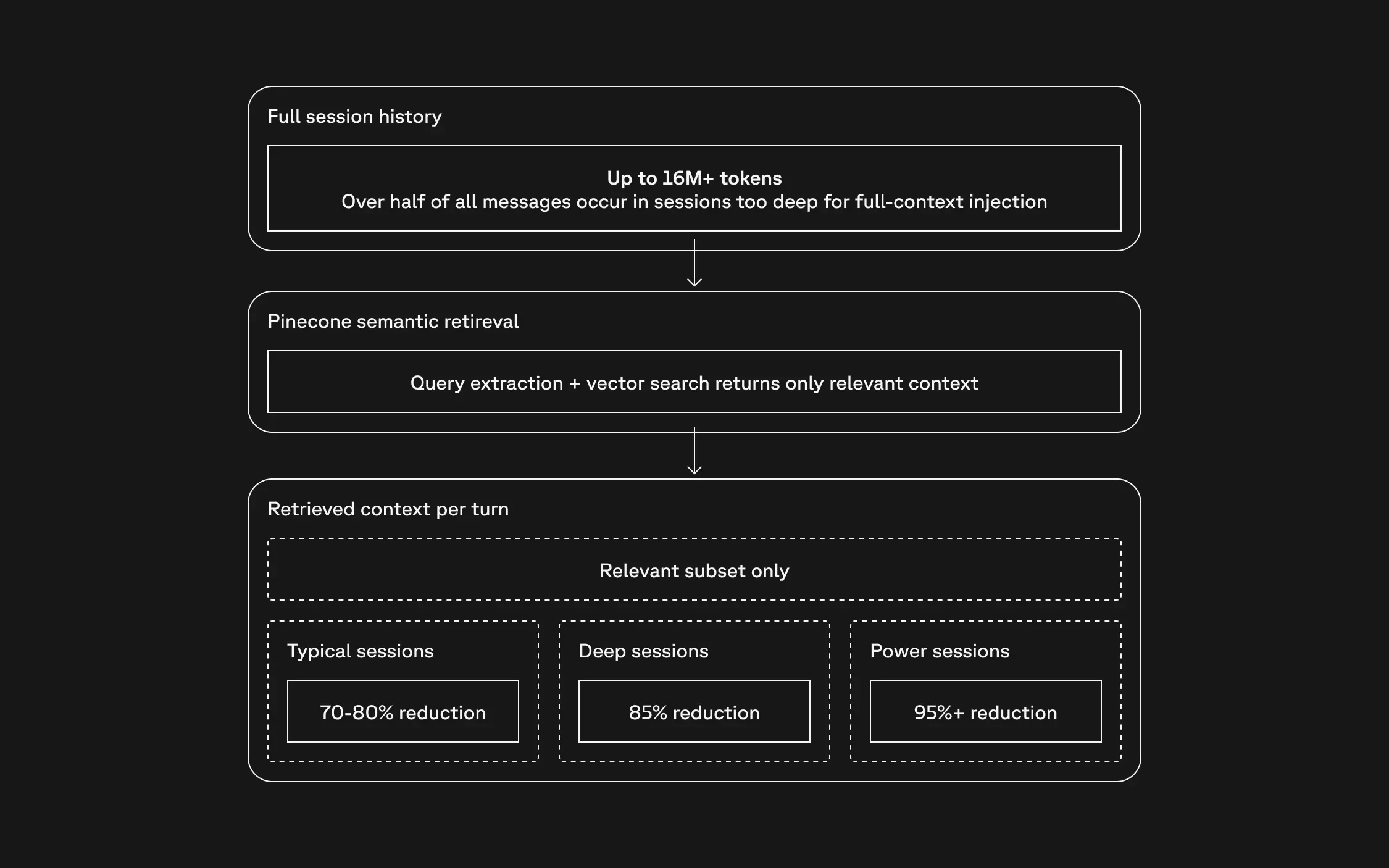
- 70 to 95% reduction in token consumption per agent. Over half of all messages on the platform occur in sessions deep enough that injecting the full history would be prohibitively expensive or would exceed model limits entirely. Selective retrieval replaces brute-force context injection. For typical engaged sessions, this cuts token consumption by 70 to 80%. For deep sessions, 85%. For the longest-running power sessions, the reduction exceeds 95%. Those savings translate directly into gross margin.
- Sub-10ms retrieval latency. Memory retrieval completes in low single-digit milliseconds, fast enough to be invisible in a conversational interaction where users expect immediate responses.
- High-value retention through accumulated knowledge. The platform's top power users, concentrated in memory-intensive workflows like roleplay, creative writing, and long-running specialist research, spend $500 to $2,000 per month. Hundreds of sessions of accumulated context create a body of knowledge that cannot be recreated elsewhere. That history is a switching cost that compounds with every interaction.
- Organic growth driven by memory quality. Jenova's growth has been almost entirely organic. The roleplay segment, which accounts for roughly 30% of all users, illustrates the pattern most clearly: about 60% of new paying users in that category arrive through word of mouth. When users explain why they recommend the platform, memory quality is the feature they mention most. Users who have tried dedicated roleplay AI products consistently point to Jenova's persistent knowledge layer as the reason they switched.
- Zero memory-related production incidents since launch. For a platform where memory reliability is part of the product promise, that operational track record is foundational.
Platform Capabilities
The memory layer operates alongside Jenova's broader infrastructure:
- Leading Agentic Tool Use. 97.3% tool call success rate across all MCP integrations with unlimited tool scaling.
- Multi-Model Support. Frontier models from OpenAI, Anthropic, Google, and other leading providers available through a single interface.
- Full Feature Parity. Web, iOS, and Android with all settings synced across devices.
What's Next
Jenova's roadmap deepens its investment in memory and retrieval across three horizons:
- Multimodal Memory. Extending retrieval to cover image content via multimodal embeddings, giving agents like the Manga Creator the ability to retrieve from a user's visual history semantically rather than structurally.
- Proactive Agents. Async and background agent capabilities will allow agents to retrieve and process context proactively. A stock analyst that surfaces relevant portfolio context before the user asks. A creative agent that prepares continuity context before a session begins.
- Managed Agent API. When Jenova opens its platform to external developers, third-party agents will build on the same memory infrastructure that drives Jenova's first-party agents, with fully managed memory, RAG, and agent workflow orchestration included. Persistent, retrieval-backed knowledge becomes a platform-level capability rather than something each developer has to build from scratch.
About Jenova
Jenova hosts a rapidly expanding ecosystem of specialized AI agents engineered for specific professional and creative use cases, combining deep domain knowledge, multi-step workflow orchestration, and persistent memory to deliver expert systems that compound in value over time. The platform is trusted by users in over 70 countries, from individual students and researchers to teams inside Fortune 500 companies.
Contact
Azeroth Inc. Email: [email protected] Website: www.jenova.ai